


What is the Artificial Kidney Market Size and Growth Rate?
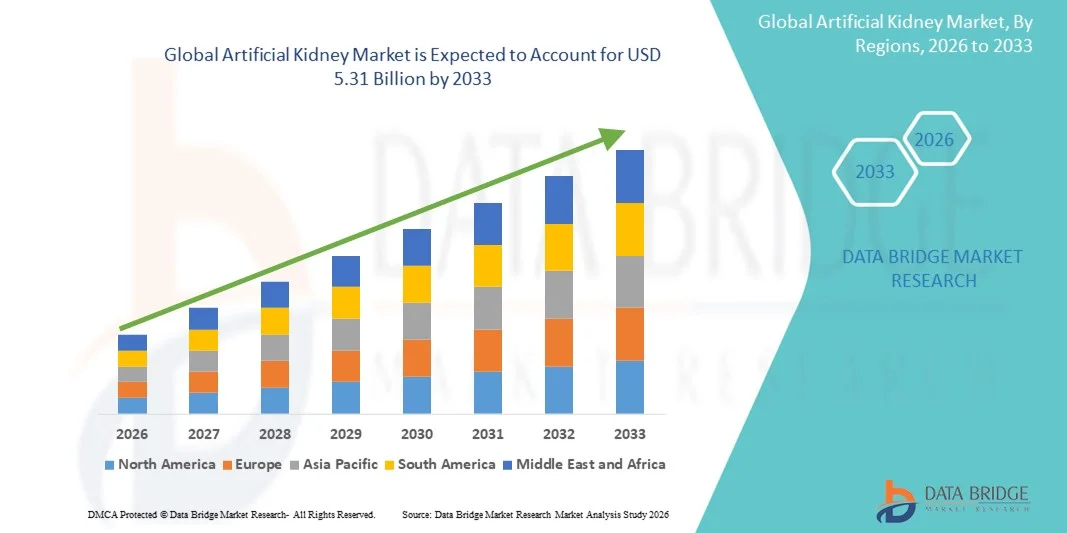
- As per Data Bridge Market Research Analysis the global artificial kidney market size was valued at USD 2.11 billion in 2025 and is expected to reach USD 5.31 billion by 2033, at a CAGR of 12.21% during the forecast period
- The market growth is primarily driven by the rising prevalence of chronic kidney disease (CKD) and end-stage renal disease (ESRD), along with increasing demand for advanced renal replacement therapies and long-term dialysis alternatives
- In addition, ongoing technological advancements in wearable and implantable artificial kidney systems, combined with strong research funding and growing awareness of patient-centric, life-sustaining solutions, are positioning artificial kidneys as a transformative innovation in renal care, thereby significantly accelerating overall market growth
Market Size & Forecast
Global Market Value (2025): USD 2.11 billion
Expected Market Value (2033): USD 5.31 billion
Forecast CAGR (2026–2033): 12.21%
What are the Major Takeaways of Artificial Kidney Market?
- Artificial kidneys, designed to replicate or support natural kidney functions through wearable, implantable, or external renal replacement technologies, are emerging as critical innovations in nephrology care due to their potential to improve patient mobility, treatment efficiency, and quality of life compared to conventional dialysis systems
- The rising demand for artificial kidney solutions is primarily driven by the growing global burden of chronic kidney disease (CKD) and end-stage renal disease (ESRD), limited availability of donor kidneys, and increasing emphasis on long-term, patient-centric renal therapies
- North America dominated the artificial kidney market with the largest revenue share of around 40.9% in 2025, supported by advanced healthcare infrastructure, strong research and development activity, favorable reimbursement frameworks, and a high prevalence of renal disorders, with the U.S. leading innovation through academic–industry collaborations and clinical trials focused on wearable and implantable artificial kidney systems
- Asia-Pacific is expected to be the fastest growing region in the artificial kidney market during the forecast period due to rapidly expanding patient populations, improving healthcare access, increasing government investments in renal care, and rising awareness of advanced kidney replacement technologies
- Hemodialysis segment dominated the market with a share of 58.2% in 2025, driven by their widespread clinical adoption, established treatment protocols, and continuous technological advancements aimed at improving efficiency, portability, and patient comfort
Report Scope and Artificial Kidney Market Segmentation
|
Attributes |
Artificial Kidney Key Market Insights |
|
Segments Covered |
|
|
Countries Covered |
North America
Europe
Asia-Pacific
Middle East and Africa
South America
|
|
Key Market Players |
|
|
Market Opportunities |
|
|
Value Added Data Infosets |
In addition to the insights on market scenarios such as market value, growth rate, segmentation, geographical coverage, and major players, the market reports curated by the Data Bridge Market Research also include in-depth expert analysis, patient epidemiology, pipeline analysis, pricing analysis, and regulatory framework |
What is the Key Trend in the Artificial Kidney Market?
Advancements in Wearable and Implantable Artificial Kidney Technologies
- A significant and accelerating trend in the global artificial kidney market is the increasing focus on wearable and implantable renal replacement systems designed to reduce dependency on conventional in-center dialysis and improve patient mobility and quality of life
- For instance, ongoing programs such as the Kidney Project are advancing implantable bioartificial kidney prototypes that combine hemofiltration membranes with living renal cells to mimic natural kidney function more effectively
- Technological innovation in artificial kidneys is enabling continuous or semi-continuous blood purification, improved toxin clearance, and reduced cardiovascular stress compared to traditional intermittent dialysis. For instance, several wearable artificial kidney (WAK) devices under development are designed to allow patients to ambulate freely while receiving treatment, with integrated sensors for real-time monitoring
- The integration of advanced materials, miniaturized pumps, and biocompatible membranes is facilitating safer long-term use and reducing complications such as clotting or infection, while also enhancing device durability and performance
- This trend toward more compact, patient-centric, and technologically sophisticated artificial kidney systems is reshaping treatment expectations in renal care. Consequently, research institutions and medical device companies are prioritizing next-generation artificial kidneys that emphasize portability, autonomy, and improved patient outcomes
- Growing interest in home-based renal care models is further supporting innovation in portable and wearable artificial kidney systems designed for long-term outpatient use
- The demand for innovative artificial kidney solutions is steadily increasing across healthcare systems, as clinicians and patients alike seek alternatives that can alleviate dialysis burden, reduce hospital visits, and enhance overall treatment adherence
Artificial Kidney Market Dynamics
Driver
Rising Burden of Chronic Kidney Disease and Limited Donor Availability
- The increasing global prevalence of chronic kidney disease (CKD) and end-stage renal disease (ESRD), combined with a persistent shortage of donor kidneys for transplantation, is a major driver accelerating demand for artificial kidney technologies
- For instance, in recent years, healthcare agencies and research organizations have increased funding for artificial kidney development programs to address long transplant waitlists and growing dialysis populations
- As awareness of renal disease rises and life expectancy increases, more patients require long-term renal replacement therapies, positioning artificial kidneys as a promising solution to reduce dependence on conventional dialysis centers
- Furthermore, advancements in healthcare infrastructure and reimbursement support in developed regions are encouraging clinical trials and early adoption of innovative artificial kidney systems within hospital and specialty care settings
- The need for continuous, efficient, and patient-friendly renal therapies is driving strong interest in artificial kidneys from healthcare providers seeking to improve outcomes while managing long-term treatment costs
- Increasing government initiatives aimed at improving access to renal care are indirectly supporting demand for advanced artificial kidney solutions
- The growing economic burden of long-term dialysis is motivating healthcare systems to explore artificial kidneys as a potential cost-effective alternative over a patient’s lifetime
Restraint/Challenge
Technical Complexity and Regulatory Approval Barriers
- The high technical complexity associated with developing safe, reliable, and long-lasting artificial kidney systems poses a significant challenge to market expansion, particularly for implantable and wearable devices
- For instance, ensuring long-term biocompatibility, preventing immune reactions, and maintaining consistent filtration performance remain major engineering and clinical hurdles during development and testing phases
- Regulatory compliance requirements for artificial kidney devices are stringent, as these systems are life-sustaining and must meet rigorous safety, efficacy, and durability standards before receiving approval for clinical use
- In addition, the high cost of research, prolonged clinical trials, and uncertainty around reimbursement pathways can delay commercialization and limit participation by smaller innovators or startups
- Overcoming these challenges through technological standardization, collaborative research, streamlined regulatory pathways, and early engagement with healthcare authorities will be critical for enabling sustained growth in the global artificial kidney market
- Limited availability of large-scale clinical trial data for novel artificial kidney systems can slow physician adoption and payer acceptance
- Ethical and safety concerns related to long-term implantation and device dependency may also influence patient acceptance and regulatory scrutiny
How is the Artificial Kidney Market Segmented?
The market is segmented on the basis of device type, dialysis type, application, and end user.
- By Device Type
On the basis of device type, the global artificial kidney market is segmented into wearable artificial kidney and implantable artificial kidney. The wearable artificial kidney segment dominated the market in 2025, driven by its relatively higher technological readiness and alignment with existing dialysis practices. Wearable systems are designed to deliver continuous or extended dialysis while allowing patient mobility, addressing major limitations of conventional in-center dialysis. These devices face fewer regulatory and surgical barriers compared to implantable systems, supporting earlier adoption. Strong research focus on miniaturization, battery life, and sorbent-based filtration further strengthens this segment. Wearable artificial kidneys also support the growing shift toward home-based renal care models. As a result, this segment currently holds the largest share of development and pilot deployment.
The implantable artificial kidney segment is expected to witness the fastest growth during the forecast period, supported by its potential to act as a permanent alternative to dialysis. Implantable systems aim to continuously replicate natural kidney function, significantly reducing or eliminating dialysis dependence. Increasing public–private investments and government-backed research programs are accelerating innovation in bioartificial membranes and cell-based filtration. Advances in biocompatibility and immune-protection technologies are improving feasibility and safety. Although still largely in experimental stages, successful clinical milestones are expected to rapidly boost adoption. This transformative potential position implantable artificial kidneys as the fastest-growing device type.
- By Dialysis
On the basis of dialysis, the market is segmented into hemodialysis, peritoneal dialysis, and combination. The hemodialysis segment dominated the market in 2025 with a market share of 58.2%, driven by its widespread clinical acceptance and established use in renal replacement therapy. Most artificial kidney development efforts currently focus on replicating or enhancing hemodialysis due to its proven efficacy and familiarity among clinicians. The segment benefits from standardized treatment protocols and strong reimbursement support. Continuous hemodialysis-based artificial kidney designs aim to reduce cardiovascular stress and improve toxin clearance. In addition, the majority of ESRD patients worldwide are treated using hemodialysis. These factors collectively support its dominant market position.
The combination dialysis segment is anticipated to register the fastest growth during the forecast period, driven by the need for more comprehensive toxin removal and improved fluid balance. Combination approaches integrate principles of both hemodialysis and peritoneal dialysis to enhance treatment efficiency. This hybrid method is gaining attention for its potential to reduce complications associated with single-modality therapies. Increasing research interest in multifunctional artificial kidney systems supports segment growth. Combination dialysis also aligns with personalized treatment strategies in nephrology. As innovation advances, this segment is expected to grow rapidly.
- By Application
On the basis of application, the market is segmented into adults and pediatrics. The adult segment dominated the artificial kidney market in 2025, driven by the significantly higher prevalence of chronic kidney disease and end-stage renal disease among adults. Aging populations, along with rising incidence of diabetes and hypertension, contribute to greater demand for renal replacement therapies in adults. Most clinical trials and artificial kidney prototypes are designed primarily for adult patients. Higher healthcare spending and better reimbursement coverage also support adoption in this group. Artificial kidney systems are increasingly viewed as solutions to reduce long-term dialysis dependence in adults. These factors reinforce the dominance of the adult segment.
The pediatric segment is expected to witness the fastest growth during the forecast period, supported by increasing recognition of unmet needs in pediatric renal care. Children with ESRD face limited treatment options and long transplant waiting times. Artificial kidney technologies offer the potential to improve growth outcomes and reduce treatment burden in pediatric patients. Advances in miniaturization and pediatric-specific device design are improving feasibility. Increased funding for rare and pediatric diseases is also supporting innovation. Consequently, the pediatric segment is projected to grow at a faster pace.
- By End User
On the basis of end user, the market is segmented into hospitals, specialty clinics, ambulatory surgical centers, and others. The hospital segment dominated the market in 2025, driven by the availability of advanced nephrology infrastructure and specialist expertise. Hospitals serve as primary centers for dialysis, clinical trials, and early adoption of artificial kidney technologies. These settings are preferred due to the need for close monitoring and multidisciplinary care. Favorable reimbursement frameworks further strengthen hospital adoption. Hospitals also play a key role in regulatory-approved pilot programs. This positions hospitals as the leading end-user segment.
The specialty clinics segment is expected to be the fastest growing during the forecast period, driven by the expansion of outpatient renal care and dialysis services. As artificial kidney technologies become more portable and user-friendly, specialty clinics are increasingly able to adopt these systems. Clinics offer cost-effective and specialized care, aligning with the shift toward decentralized treatment models. Patient preference for focused renal care environments supports this trend. Technological advancements reducing system complexity further enable clinic-based adoption. As a result, specialty clinics are anticipated to experience the highest growth rate.
Which Region Holds the Largest Share of the Artificial Kidney Market?
- North America dominated the artificial kidney market with the largest revenue share of around 40.9% in 2025, supported by advanced healthcare infrastructure, strong research and development activity, favorable reimbursement frameworks, and a high prevalence of renal disorders
- Healthcare providers in the region place strong emphasis on improving long-term patient outcomes through advanced renal replacement therapies, with growing interest in reducing dependence on conventional in-center dialysis
- This strong market position is further supported by favorable reimbursement frameworks, active clinical trials, and significant funding from government agencies and research institutions, positioning North America as a leading hub for artificial kidney development and early adoption
U.S. Artificial Kidney Market Insight
The U.S. artificial kidney market captured the largest revenue share within North America in 2025, driven by the high prevalence of chronic kidney disease and end-stage renal disease, along with strong investment in advanced renal technologies. Healthcare providers are increasingly prioritizing innovative renal replacement solutions to reduce long-term dependence on conventional dialysis. Robust research funding, active clinical trials, and strong academic–industry collaboration further support market growth. Moreover, favorable reimbursement policies and early adoption of novel medical technologies continue to accelerate the development and uptake of artificial kidney systems across the country.
Europe Artificial Kidney Market Insight
The Europe artificial kidney market is projected to expand at a steady CAGR throughout the forecast period, primarily driven by rising CKD prevalence and increasing pressure on healthcare systems to manage dialysis-related costs. Growing emphasis on improving patient quality of life and reducing hospital-based care is supporting interest in artificial kidney solutions. European countries are investing in medical research and innovation, supported by strong regulatory frameworks. Adoption is increasing across hospital and specialty care settings, particularly in countries focusing on advanced renal therapies and long-term disease management strategies.
U.K. Artificial Kidney Market Insight
The U.K. artificial kidney market is anticipated to grow at a notable CAGR during the forecast period, driven by a rising burden of renal diseases and strong public healthcare initiatives. The National Health Service’s focus on cost-effective and patient-centric treatment models is encouraging research into artificial kidney technologies. Increasing awareness of alternatives to traditional dialysis and long transplant waiting lists are further supporting market growth. Continued investment in clinical research and innovation is expected to strengthen adoption over time.
Germany Artificial Kidney Market Insight
The Germany artificial kidney market is expected to expand at a considerable CAGR, fueled by a well-established healthcare infrastructure and strong emphasis on medical technology innovation. Germany’s focus on precision medicine and advanced device development supports the adoption of next-generation renal replacement solutions. Increasing prevalence of kidney disorders and rising healthcare expenditure are driving demand. In addition, the country’s strong regulatory and research ecosystem encourages clinical validation and early adoption of artificial kidney technologies.
Asia-Pacific Artificial Kidney Market Insight
The Asia-Pacific artificial kidney market is poised to grow at the fastest CAGR during the forecast period, driven by rapidly expanding patient populations, increasing healthcare investments, and improving access to renal care. Rising incidence of diabetes and hypertension is significantly increasing CKD prevalence across the region. Government initiatives to strengthen dialysis infrastructure and support advanced medical technologies are accelerating adoption. In addition, growing awareness of innovative renal therapies is contributing to strong regional growth momentum.
Japan Artificial Kidney Market Insight
The Japan artificial kidney market is gaining traction due to the country’s aging population and high prevalence of age-related renal disorders. Japan’s strong focus on advanced medical technology and innovation supports research into artificial kidney systems. The healthcare system emphasizes improving long-term patient outcomes and reducing hospital dependency, driving interest in alternative renal replacement therapies. Integration of advanced monitoring and miniaturized medical devices further supports market growth in the country.
India Artificial Kidney Market Insight
The India artificial kidney market accounted for a significant share within Asia-Pacific in 2025, supported by a rapidly growing CKD patient population and expanding healthcare infrastructure. Rising awareness of renal diseases, coupled with increasing access to dialysis and specialty care centers, is driving demand for advanced treatment solutions. Government initiatives aimed at strengthening nephrology services and reducing the economic burden of long-term dialysis are supporting market growth. In addition, increasing research activity and collaborations are expected to enhance future adoption of artificial kidney technologies in India.
Which are the Top Companies in Artificial Kidney Market?
The Artificial Kidney industry is primarily led by well-established companies, including:
- Fresenius Medical Care AG (Germany)
- Baxter (U.S.)
- Medtronic (Ireland)
- B. Braun SE (Germany)
- NIPRO CORPORATION (Japan)
- DaVita Inc. (U.S.)
- Outset Medical, Inc. (U.S.)
- Quanta Dialysis Technologies Ltd. (U.K.)
- AWAK Technologies Pte Ltd (Singapore)
- Diality Inc. (U.S.)
- Toray Medical Co., Ltd. (Japan)
- JMS Co., Ltd. (Japan)
- Kawasumi Laboratories, Inc. (Japan)
- Medica S.p.A. (Italy)
- Kimal Plc (U.K.)
- Rockwell Medical, Inc. (U.S.)
- CytoSorbents Corporation (U.S.)
- Blood Purification Technologies Inc. (U.S.)
- Allmed Medical GmbH (Germany)
- Nephrodite, Inc. (U.S.)
What are Latest Developments in Artificial Kidney Market?
- In December 2025, Nephrodite announced its “Holly” implantable artificial kidney system received Breakthrough Device Designation from the U.S. Food and Drug Administration (FDA), recognizing it as a novel continuous renal replacement therapy that functions inside the body to filter waste and balance fluids without frequent clinic visits, marking a significant step toward implantable solutions that could transform end-stage kidney disease care
- In April 2023, Medtronic plc and DaVita Inc. jointly launched Mozarc Medical, a dedicated kidney-health technology company aimed at advancing patient-centered solutions for kidney failure, including technologies that could support artificial or enhanced renal therapies
- In August 2022, Kidney Innovation Accelerator (KidneyX) announced a new prize competition backed by USD 10.5 million in funding to accelerate prototype development of fully functional bioartificial kidneys and related enabling technologies, stimulating global innovation in artificial kidney research
- In September 2021, The Kidney Project achieved a major milestone by demonstrating a functional preclinical prototype of an implantable bioartificial kidney that integrated a hemofilter and bioreactor, representing a breakthrough toward a fully implantable solution
- In May 2021, Baxter International received FDA 510(k) clearance for its next-generation AK 98 dialysis machine, a more portable artificial kidney-type system designed to simplify hemodialysis workflow and integrate connectivity with electronic medical records, underscoring continued innovation in renal replacement devices

- Interactive Data Analysis Dashboard
- Company Analysis Dashboard for high growth potential opportunities
- Research Analyst Access for customization & queries
- Competitor Analysis with Interactive dashboard
- Latest News, Updates & Trend analysis
- Harness the Power of Benchmark Analysis for Comprehensive Competitor Tracking
Data collection and base year analysis are done using data collection modules with large sample sizes. The stage includes obtaining market information or related data through various sources and strategies. It includes examining and planning all the data acquired from the past in advance. It likewise envelops the examination of information inconsistencies seen across different information sources. The market data is analysed and estimated using market statistical and coherent models. Also, market share analysis and key trend analysis are the major success factors in the market report. To know more, please request an analyst call or drop down your inquiry.
The key research methodology used by DBMR research team is data triangulation which involves data mining, analysis of the impact of data variables on the market and primary (industry expert) validation. Data models include Vendor Positioning Grid, Market Time Line Analysis, Market Overview and Guide, Company Positioning Grid, Patent Analysis, Pricing Analysis, Company Market Share Analysis, Standards of Measurement, Global versus Regional and Vendor Share Analysis. To know more about the research methodology, drop in an inquiry to speak to our industry experts.
Data Bridge Market Research is a leader in advanced formative research. We take pride in servicing our existing and new customers with data and analysis that match and suits their goal. The report can be customized to include price trend analysis of target brands understanding the market for additional countries (ask for the list of countries), clinical trial results data, literature review, refurbished market and product base analysis. Market analysis of target competitors can be analyzed from technology-based analysis to market portfolio strategies. We can add as many competitors that you require data about in the format and data style you are looking for. Our team of analysts can also provide you data in crude raw excel files pivot tables (Fact book) or can assist you in creating presentations from the data sets available in the report.













