


What is the Audio AI Market Size and Growth Rate?
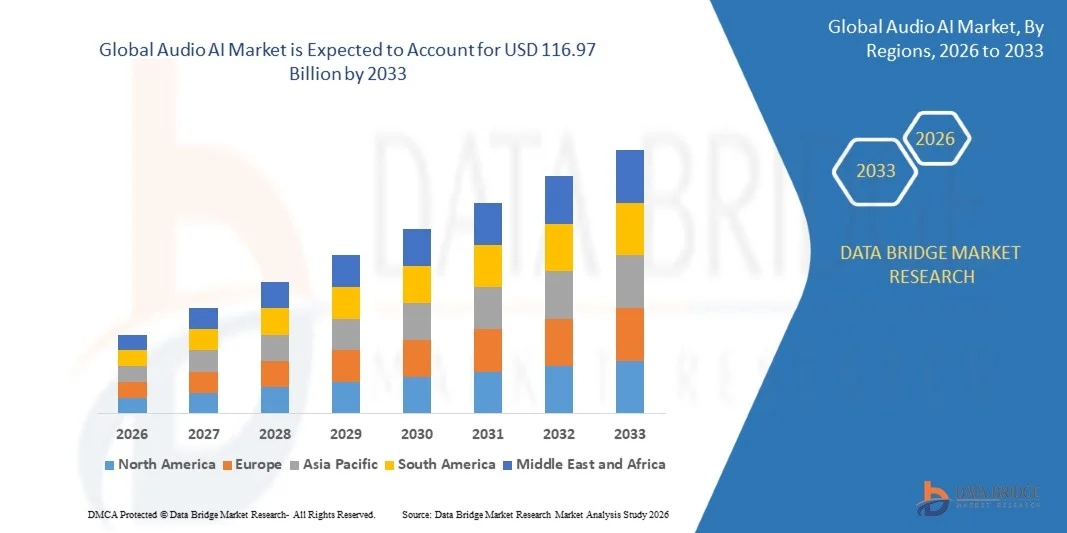
- As per Data Bridge Market Research analysis, the audio AI market was valued at USD 28.70 Billion in 2025 and is projected to reach USD 116.97 Billion by 2033, growing at a CAGR of 19.20% from 2026 to 2033.
- The market is experiencing rapid growth driven by breakthrough advances in generative AI and large language models that have dramatically improved the naturalness, context-awareness, and commercial viability of AI-generated and AI-processed audio, alongside surging enterprise demand for voice-enabled automation in customer service, content creation, and media production.
- The emergence of speech-native architectures capable of processing audio input and generating audio output directly, bypassing traditional cascaded speech-recognition-to-synthesis pipelines, is enabling ultra-low-latency, natural conversational experiences that are accelerating adoption across virtual assistants, call centers, and interactive media applications.
Market Size & Forecast
- Global Market Value (2025): USD 28.70 Billion
- Expected Market Value (2033): USD 116.97 Billion
- Forecast CAGR (2026–2033): 19.20%
- Leading Region in 2025: North America
- Fastest Growing Region: Asia-Pacific
What are the Major Takeaways of the Audio AI Market?
- North America dominated the global audio AI market with the largest revenue share of 39.80% in 2025, supported by heavy investment from major hyperscalers and AI research labs and the concentration of leading foundation model developers in the region.
- Asia-Pacific is expected to be the fastest-growing region at a CAGR of 22.60% from 2026 to 2033, fueled by rapid enterprise AI adoption, expanding multilingual voice technology demand, and growing investment in domestic AI infrastructure across China, India, and Japan.
- The text-to-speech/voice synthesis segment led the market in 2025, driven by widespread enterprise adoption for content creation, audiobook narration, dubbing, and programmatic audio advertising.
- The speech-native/end-to-end model architecture segment is the fastest-growing category, reflecting the technology shift toward models that process audio directly rather than relying on cascaded recognition-to-synthesis pipelines.
- The customer service & call centers application segment dominated the market in 2025, reflecting sustained enterprise investment in automating high-volume, repetitive voice interactions.
- The cloud-based deployment segment continued to hold the largest share in 2025, while edge deployment is the fastest-growing sub-segment, driven by demand for ultra-low-latency, on-device audio AI processing.
- The media & entertainment end-user industry accounted for a leading share of the market in 2025, driven by rapid adoption of AI voice generation and music creation tools in content production workflows.
Report Scope and Audio AI Market Segmentation
|
Attributes |
Audio AI Key Market Insights |
|
Segments Covered |
|
|
Countries Covered |
North America
Europe
Asia-Pacific
Middle East and Africa
South America
|
|
Key Market Players |
|
|
Market Opportunities |
|
|
Value Added Data Infosets |
In addition to the market insights such as market value, growth rate, market segments, geographical coverage, market players, and market scenario, the market report curated by the Data Bridge Market Research team includes in-depth expert analysis, import/export analysis, pricing analysis, production consumption analysis, and pestle analysis. |
What is the Key Trend in the Audio AI Market?
- Leading AI developers are increasingly shifting from cascaded speech pipelines toward speech-native architectures that process audio input and generate audio output directly, reducing latency and improving conversational naturalness.
- For instance, in February 2025, ElevenLabs launched Scribe, its first standalone speech-to-text model supporting more than 99 languages, which the company reported outperformed rival models from Google and OpenAI in benchmark accuracy testing, reflecting the rapid pace of capability advancement across the sector.
- AI voice companies are attracting record levels of investor funding as commercial adoption accelerates across enterprise and consumer applications.
- For instance, in February 2026, ElevenLabs raised USD 500 million at an USD 11 billion valuation in a round led by Sequoia Capital with participation from Nvidia, more than tripling the USD 3.3 billion valuation it achieved following a USD 180 million Series C round in January 2025.
- As speech-native architectures mature and investor capital continues to flow into the sector, developers are expected to continue prioritizing latency reduction and multilingual capability expansion, reinforcing conversational naturalness as a core market trend.
What are the Key Drivers of the Audio AI Market?
- Breakthrough advances in generative AI and large language models have dramatically improved the naturalness and commercial viability of AI-generated and AI-processed audio, driving surging enterprise adoption across customer service, content creation, and media production.
- For instance, in August 2025, industry analysis reported that approximately 8.4 billion voice assistants were active globally, with 60% of smartphone users regularly interacting with voice AI, underscoring the massive scale of the underlying consumer and enterprise demand base.
- Enterprises are increasingly deploying voice AI agents to automate high-volume customer service interactions, reducing operational costs while maintaining or improving customer experience quality.
- For instance, in August 2025, industry analysis reported that the intelligent virtual assistant segment of the broader voice AI market was projected to reach approximately USD 27.9 billion in 2025, up from USD 20.7 billion in 2024, reflecting the rapid pace of enterprise adoption for automated conversational applications.
- With enterprises across virtually every industry continuing to identify new use cases for voice-enabled automation and AI-generated audio content, sustained investment in audio AI technology is expected to remain a key growth driver for the market.
Which Factors are Challenging the Growth of the Audio AI Market?
- AI-generated voice and music technology has raised significant intellectual property and copyright concerns, particularly regarding the use of copyrighted recordings and performers' voices in model training without explicit consent.
- For instance, beginning in June 2024 and continuing through 2025, major record labels including Universal Music Group, Sony Music, and Warner Music Group pursued litigation against AI music generation platforms Suno and Udio over allegations of unauthorized use of copyrighted recordings in model training, creating ongoing legal uncertainty for the broader generative audio sector.
- The computing infrastructure required to train and run large-scale audio and speech models remains costly, creating a competitive barrier for smaller developers seeking to compete with well-funded incumbents.
- For instance, in February 2026, ElevenLabs' ability to raise USD 500 million in a single funding round at an USD 11 billion valuation illustrated the scale of capital increasingly required to remain competitive at the frontier of audio AI model development.
- The combination of unresolved copyright and intellectual property disputes and infrastructure costs that increasingly favor well-capitalized incumbents continues to create uncertainty that could shape the competitive and legal landscape for audio AI providers going forward.
How is the Audio AI Market Segmented?
The audio AI market is segmented on the basis of technology type, component, deployment mode, application, end-user industry, voice type, organization size, model architecture, latency type, and sales channel.
- By Technology Type
On the basis of technology type, the global audio AI market is segmented into speech recognition (ASR), text-to-speech/voice synthesis, natural language processing, audio analytics & sound classification, and AI music generation. The text-to-speech/voice synthesis segment dominated the market with a 34.20% share in 2025, fueled by widespread enterprise adoption for content creation, audiobook narration, video dubbing, and programmatic audio advertising.
The AI music generation segment is projected to register the fastest growth at a CAGR of 24.10% from 2026 to 2033, driven by rapid consumer and creator adoption of generative music platforms capable of producing studio-quality compositions from simple text prompts.
- By Component
On the basis of component, the global audio AI market is segmented into software/platform, hardware, and services. The software/platform segment dominated the market with a 64.50% share in 2025, reflecting the software-centric nature of most audio AI capabilities, delivered primarily through APIs, SDKs, and cloud-based platforms.
The services segment is expected to witness the fastest CAGR of 21.30% from 2026 to 2033, driven by rising enterprise demand for custom voice model development, integration support, and consulting as organizations move from pilot projects to production deployments.
- By Deployment Mode
On the basis of deployment mode, the global audio AI market is segmented into cloud-based and on-premise/edge. The cloud-based segment dominated the market with a 62.40% share in 2025, supported by the substantial computing resources required to train and run large audio and speech models, which are most cost-effectively provisioned through major cloud platforms.
The on-premise/edge segment is anticipated to witness the fastest CAGR of approximately 25.00% from 2026 to 2033, driven by rising demand for ultra-low-latency, privacy-preserving, on-device audio AI processing in automotive, healthcare, and industrial applications.
- By Application
On the basis of application, the global audio AI market is segmented into virtual assistants & voice agents, customer service & call centers, content creation & media production, audio/video transcription, and security & surveillance. The customer service & call centers segment dominated the market with a 31.70% share in 2025, reflecting sustained enterprise investment in automating high-volume, repetitive voice interactions to reduce operating costs.
The content creation & media production segment is projected to witness the fastest CAGR of 22.90% from 2026 to 2033, driven by rapid adoption of AI voice generation, dubbing, and music creation tools among independent creators, studios, and marketing teams.
- By End-User Industry
On the basis of end-user industry, the global audio AI market is segmented into media & entertainment, BFSI, healthcare, retail & e-commerce, and automotive. The media & entertainment segment dominated the market with a 26.80% share in 2025, driven by rapid adoption of AI voice generation, dubbing, and music creation tools across film, gaming, podcasting, and advertising production workflows.
The automotive segment is expected to witness the fastest CAGR of 21.80% from 2026 to 2033, driven by rising integration of natural-language voice assistants and in-cabin audio AI into next-generation connected and autonomous vehicle platforms.
- By Voice Type
On the basis of voice type, the global audio AI market is segmented into synthetic/AI-generated voice, cloned/custom voice, and multilingual voice models. The synthetic/AI-generated voice segment dominated the market with a 48.60% share in 2025, reflecting its broad use across standard virtual assistant, IVR, and content narration applications.
The multilingual voice models segment is anticipated to witness the fastest CAGR of 23.40% from 2026 to 2033, driven by growing enterprise demand for real-time translation and localization capabilities that support global customer engagement.
- By Organization Size
On the basis of organization size, the global audio AI market is segmented into large enterprises and small & medium enterprises (SMEs). The large enterprises segment dominated the market with a 70.20% share in 2025, supported by greater capital availability for enterprise-wide voice AI deployment and dedicated AI implementation teams.
The SMEs segment is expected to witness the fastest CAGR of 22.20% from 2026 to 2033, driven by falling API pricing and growing availability of low-code, pre-built audio AI integration tools tailored to smaller organizations.
- By Model Architecture
On the basis of model architecture, the global audio AI market is segmented into cascaded (ASR+LLM+TTS) systems and speech-native/end-to-end models. The cascaded systems segment dominated the market with a 66.00% share in 2025, reflecting the continued widespread use of established, modular pipelines combining separate speech recognition, language processing, and speech synthesis components.
The speech-native/end-to-end models segment is projected to witness the fastest CAGR of approximately 27.00% from 2026 to 2033, driven by their ability to process audio directly and achieve ultra-low latency, under 300 milliseconds in leading implementations, for more natural conversational interaction.
- By Latency Type
On the basis of latency type, the global audio AI market is segmented into real-time/low-latency and batch/offline processing. The real-time/low-latency segment dominated the market with a 58.30% share in 2025, driven by the critical importance of immediate response times in voice agent, customer service, and interactive media applications.
The real-time/low-latency segment is also the fastest-growing category, projected to register a CAGR of approximately 23.60% from 2026 to 2033, as speech-native model architectures continue to push latency thresholds down toward natural human conversational speed.
- By Sales Channel
On the basis of sales channel, the global audio AI market is segmented into direct enterprise sales, API/developer platforms, and cloud marketplace. The API/developer platforms segment dominated the market with a 45.90% share in 2025, reflecting the developer-first go-to-market approach adopted by most leading audio AI providers.
The cloud marketplace segment is expected to witness the fastest CAGR of 22.80% from 2026 to 2033, driven by growing enterprise procurement of audio AI capabilities directly through major cloud provider marketplaces alongside other AI infrastructure purchases.
Which Region Holds the Largest Share of the Audio AI Market?
- North America dominated the audio AI market and accounted for the largest revenue share of 39.80% in 2025, supported by heavy investment from major hyperscalers and AI research labs and the concentration of leading foundation model developers in the region.
- The region also benefits from a mature enterprise AI adoption base, deep venture capital funding for audio AI startups, and early regulatory frameworks addressing AI-generated content, which continues to reinforce North America's leadership position in the global market.
U.S. Audio AI Market Insight
The U.S. audio AI market is experiencing rapid growth, supported by the concentration of leading foundation model developers and substantial hyperscaler investment in speech and audio AI research. Leading companies continue to advance speech-native model architectures aimed at reducing latency and improving conversational naturalness. Growing enterprise adoption of voice AI agents in customer service is further contributing to market growth in the U.S.
U.K. Audio AI Market Insight
The U.K. audio AI market is expanding steadily, anchored by leading voice AI and synthetic media companies including Speechmatics and Synthesia. Growing enterprise interest in multilingual voice technology and AI-generated video localization continues to support innovation and investment across the country's audio AI sector.
Asia-Pacific Audio AI Market Insight
The Asia-Pacific audio AI market is expected to witness the fastest growth globally, driven by rapid enterprise AI adoption, expanding multilingual voice technology demand, and growing investment in domestic AI infrastructure across China, India, and Japan.
China Audio AI Market Insight
The China audio AI market is growing rapidly, supported by strong domestic AI research investment and leading companies including iFLYTEK and Baidu advancing speech recognition and voice synthesis technology tailored to the Chinese language and regional dialects. Rising enterprise adoption of voice AI in customer service and smart device applications continues to support strong market growth in China.
Japan Audio AI Market Insight
The Japan audio AI market is witnessing consistent growth, supported by the country's strong consumer electronics base and rising enterprise interest in voice-enabled automation. Domestic and international vendors continue to introduce audio AI solutions tailored to Japan's language-specific customer service and content localization requirements.
Which are the Top Companies in Audio AI Market?
The audio AI industry is primarily led by well-established companies, including:
- Alphabet Inc. (Google) (U.S.)
- Microsoft Corporation (U.S.)
- Amazon.com, Inc. (U.S.)
- International Business Machines Corporation (IBM) (U.S.)
- Apple Inc. (U.S.)
- ElevenLabs, Inc. (U.S.)
- SoundHound AI, Inc. (U.S.)
- Nuance Communications, Inc. (U.S.)
- iFLYTEK Co., Ltd. (China)
- Baidu, Inc. (China)
- Descript, Inc. (U.S.)
- Speechmatics (U.K.)
- Synthesia Limited (U.K.)
- Adobe Inc. (U.S.)
- Dolby Laboratories, Inc. (U.S.)
What are Latest Developments in Audio AI Market?
- In February 2026, ElevenLabs raised USD 500 million at an USD 11 billion valuation in a round led by Sequoia Capital with participation from Nvidia, more than tripling its prior valuation and positioning the company for a potential IPO.
- In January 2025, ElevenLabs raised USD 180 million in a Series C funding round led by Andreessen Horowitz and Iconiq Growth, valuing the company at USD 3.3 billion.
- In February 2025, ElevenLabs launched Scribe, its first standalone speech-to-text model, supporting more than 99 languages and reporting benchmark accuracy that outperformed rival models from Google and OpenAI.
- In January 2025, AI avatar startup Synthesia raised USD 200 million as part of a broader wave of European AI funding that saw the region's AI startups raise a record USD 21.6 billion over the course of 2025.
- Beginning in June 2024 and continuing through 2025, major record labels including Universal Music Group, Sony Music, and Warner Music Group pursued litigation against AI music generation platforms Suno and Udio over allegations of unauthorized use of copyrighted recordings in model training.

- Interactive Data Analysis Dashboard
- Company Analysis Dashboard for high growth potential opportunities
- Research Analyst Access for customization & queries
- Competitor Analysis with Interactive dashboard
- Latest News, Updates & Trend analysis
- Harness the Power of Benchmark Analysis for Comprehensive Competitor Tracking
Data collection and base year analysis are done using data collection modules with large sample sizes. The stage includes obtaining market information or related data through various sources and strategies. It includes examining and planning all the data acquired from the past in advance. It likewise envelops the examination of information inconsistencies seen across different information sources. The market data is analysed and estimated using market statistical and coherent models. Also, market share analysis and key trend analysis are the major success factors in the market report. To know more, please request an analyst call or drop down your inquiry.
The key research methodology used by DBMR research team is data triangulation which involves data mining, analysis of the impact of data variables on the market and primary (industry expert) validation. Data models include Vendor Positioning Grid, Market Time Line Analysis, Market Overview and Guide, Company Positioning Grid, Patent Analysis, Pricing Analysis, Company Market Share Analysis, Standards of Measurement, Global versus Regional and Vendor Share Analysis. To know more about the research methodology, drop in an inquiry to speak to our industry experts.
Data Bridge Market Research is a leader in advanced formative research. We take pride in servicing our existing and new customers with data and analysis that match and suits their goal. The report can be customized to include price trend analysis of target brands understanding the market for additional countries (ask for the list of countries), clinical trial results data, literature review, refurbished market and product base analysis. Market analysis of target competitors can be analyzed from technology-based analysis to market portfolio strategies. We can add as many competitors that you require data about in the format and data style you are looking for. Our team of analysts can also provide you data in crude raw excel files pivot tables (Fact book) or can assist you in creating presentations from the data sets available in the report.













