


Automatic Emergency Braking Market Size
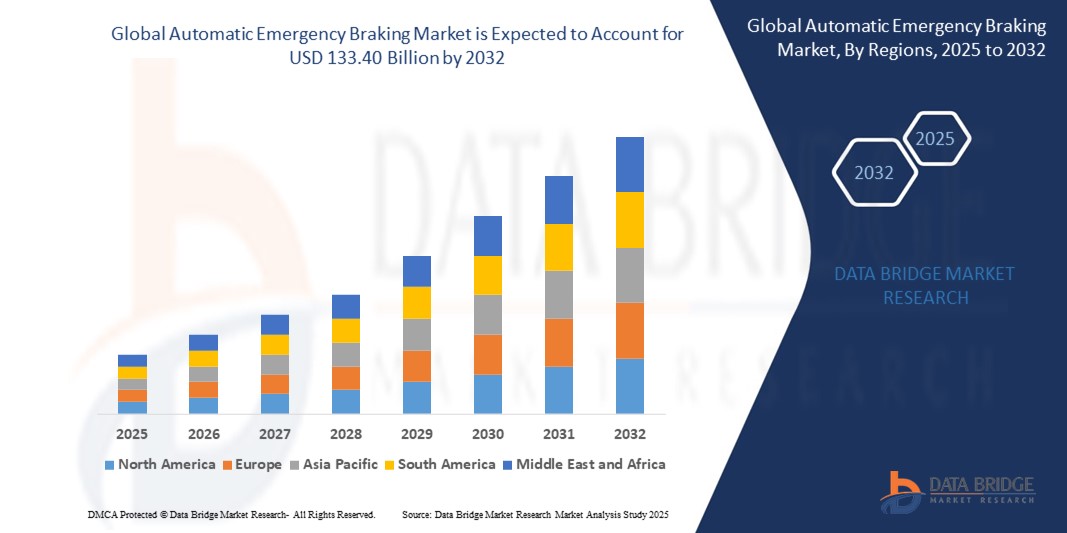
- The Global Automatic Emergency Braking Market size was valued at USD 55.76 billion in 2024 and is expected to reach USD 133.40 billion by 2032, at a CAGR of 11.52% during the forecast period
- The market’s expansion is driven by the increasing integration of advanced driver assistance systems (ADAS) in both passenger and commercial vehicles, coupled with stringent government safety regulations mandating the inclusion of AEB in new vehicles.
- Moreover, consumer demand for enhanced vehicular safety, reduced collision risks, and autonomous driving features is positioning AEB as a core component of next-generation automotive safety systems. Advancements in technologies such as radar, LiDAR, camera systems, and sensor fusion algorithms are significantly improving AEB system accuracy and functionality, further accelerating market growth.
Automatic Emergency Braking Market Analysis
- The Global Automatic Emergency Braking (AEB) Market is driven by rising demand for vehicle safety, growing road accident concerns, and increasing adoption of advanced driver assistance systems (ADAS).
- AEB systems automatically apply brakes to avoid or reduce collision severity, making them a key feature in modern vehicles. Regulatory mandates, integration with sensors and radar, and growing consumer preference for autonomous features are accelerating market growth.
- North America leads the Global Automatic Emergency Braking (AEB) Market with the largest revenue share of 32.21% in 2024, primarily due to strict vehicle safety regulations, high awareness about road safety, and early adoption of advanced driver assistance systems (ADAS).
- The Asia-Pacific AEB market is projected to grow at the fastest CAGR of 13.44% from 2025 to 2032, driven by rapid urbanization, booming automotive production, and increasing safety awareness in developing economies.
- The disc brake segment accounted for the largest market revenue share in 2024, driven by its superior heat dissipation, faster response, and better stopping power, making it ideal for high-performance and passenger vehicles.
Report Scope and Automatic Emergency Braking Market Segmentation
|
Attributes |
Automatic Emergency Braking Key Market Insights |
|
Segments Covered |
|
|
Countries Covered |
North America
Europe
Asia-Pacific
Middle East and Africa
South America
|
|
Key Market Players |
|
|
Market Opportunities |
|
|
Value Added Data Infosets |
In addition to the insights on market scenarios such as market value, growth rate, segmentation, geographical coverage, and major players, the market reports curated by the Data Bridge Market Research also include in-depth expert analysis, pricing analysis, brand share analysis, consumer survey, demography analysis, supply chain analysis, value chain analysis, raw material/consumables overview, vendor selection criteria, PESTLE Analysis, Porter Analysis, and regulatory framework. |
Automatic Emergency Braking Market Trends
“Rising Road Safety Regulations and Government Mandates”
- Increasing concerns over road fatalities and traffic collisions are prompting governments worldwide to implement stringent regulations requiring the integration of Automatic Emergency Braking (AEB) systems in both passenger and commercial vehicles.
- For instance, in 2023, the European Union mandated the inclusion of AEB systems in all new vehicles sold from 2024 onwards under its General Safety Regulation. This move is expected to significantly boost market adoption across Europe.
- These regulations are driven by global efforts to reduce road traffic injuries, which remain a leading cause of death worldwide, especially in low- and middle-income countries.
- AEB systems play a vital role in enhancing vehicle safety by detecting potential collisions and automatically applying brakes to avoid or mitigate impact.
- Mandates from agencies such as the U.S. National Highway Traffic Safety Administration (NHTSA) and support from safety advocacy groups like IIHS (Insurance Institute for Highway Safety) are accelerating AEB integration, driving consistent market growth.
Automatic Emergency Braking Market Dynamics
Driver
“Technological Advancements in Sensor Fusion and AI Integration”
- Advances in radar, LiDAR, camera systems, and AI-based data processing are significantly enhancing the accuracy and responsiveness of AEB systems.
- In April 2024, Mobileye (an Intel company) introduced a new AEB platform combining surround-view cameras and deep neural networks to improve pedestrian and cyclist detection in complex environments.
- These innovations enable more precise object recognition, faster decision-making, and better adaptation to dynamic road conditions.
- The growing application of sensor fusion technologies improves the reliability of AEB, especially in poor visibility or crowded urban settings.
- Such progress in ADAS technologies is helping automakers offer more sophisticated safety features, increasing consumer trust and boosting AEB system installations.
Restraint/Challenge
“High System Costs and Complexity in Integration”
- Despite safety benefits, AEB systems remain expensive due to their reliance on complex sensors, ECUs, and software integration, making them less viable for budget vehicles in price-sensitive markets.
- Smaller automakers may face challenges in redesigning vehicle platforms to accommodate AEB modules, especially in markets with limited regulatory pressure.
- Maintenance and repair of AEB systems can also be cost-prohibitive, especially in regions lacking advanced service infrastructure.
- These factors could hinder mass-market adoption and slow down the penetration of AEB systems in emerging economies.
Automatic Emergency Braking Market Scope
The market is segmented on the basis of brake type, vehicle propulsion, technology, AEB type, and vehicle type.
- By Brake Type
On the basis of brake type, the Automatic Emergency Braking Market is segmented into disc brakes and drum brakes. The disc brake segment accounted for the largest market revenue share in 2024, driven by its superior heat dissipation, faster response, and better stopping power, making it ideal for high-performance and passenger vehicles. Disc brakes are widely adopted in modern vehicles due to their reliability and integration ease with advanced driver assistance systems (ADAS), including AEB.
The drum brake segment is expected to witness moderate growth through 2032, especially in light commercial vehicles and budget-friendly models, due to their cost-effectiveness and ease of maintenance, particularly in rear brake configurations.
- By Vehicle Propulsion
Based on vehicle, the Automatic Emergency Braking Market is segmented into Internal Combustion Engine (ICE) and Electric & Hybrid Vehicles. The ICE vehicle segment held the largest share in 2024, owing to the high global volume of gasoline- and diesel-powered vehicles still being sold and operated, particularly in emerging markets.
However, the electric & hybrid vehicle segment is projected to grow at the fastest CAGR from 2025 to 2032. This growth is driven by the surge in EV adoption, favorable government incentives, and the fact that most new electric models come pre-equipped with AEB systems to meet regulatory requirements for zero-emission and high-safety vehicles.
- By Technology
On the basis of technology, the market is segmented into Crash Imminent Braking (CIB), Dynamic Brake Support (DBS), and Forward Collision Warning (FCW). The Crash Imminent Braking segment leads the market in 2024 due to its advanced functionality in automatically applying brakes when a collision is unavoidable. Increasing demand for fully autonomous emergency responses supports this segment’s dominance.
The Forward Collision Warning segment is anticipated to grow significantly due to its role as a foundational ADAS feature, offering real-time alerts and acting as a prerequisite for full AEB systems in lower-tier vehicle trims.
- By AEB Type
On the basis of type, the market is segmented into Low-Speed AEB System, High-Speed AEB System, and Pedestrian AEB System. The Low-Speed AEB System segment dominates in 2024, owing to its extensive use in urban vehicles for avoiding fender-benders and ensuring safety in stop-and-go traffic. It is also cost-effective and often bundled with entry-level ADAS packages.
The Pedestrian AEB System segment is expected to witness the fastest growth during the forecast period, driven by growing regulations around vulnerable road user protection and rising incidents of pedestrian-related traffic accidents in urban zones.
- By Vehicle Type
Based on vehicle type, the Automatic Emergency Braking Market is segmented into Passenger Cars, Light Commercial Vehicles (LCVs), and Heavy Commercial Vehicles (HCVs). The Passenger Cars segment captured the largest share in 2024, largely due to high production volumes and the increasing standardization of AEB in mid-range and premium vehicles globally.
The Heavy Commercial Vehicles segment is anticipated to grow steadily, propelled by fleet safety mandates and the rising importance of collision avoidance systems in reducing commercial accident liabilities and insurance costs.
Automatic Emergency Braking Market Regional Analysis
- North America leads the Global Automatic Emergency Braking (AEB) Market with the largest revenue share of 32.21% in 2024, primarily due to strict vehicle safety regulations, high awareness about road safety, and early adoption of advanced driver assistance systems (ADAS).
- The region's strong automotive industry and presence of leading automakers and technology providers support the widespread integration of AEB systems across vehicle segments.
- Rising demand for semi-autonomous and autonomous vehicles, backed by government safety mandates and growing consumer awareness, drives the market further.
U.S. Automatic Emergency Braking Market Insight
The U.S. accounted for 76.77% of North America's AEB market revenue in 2024, owing to the National Highway Traffic Safety Administration (NHTSA) and Insurance Institute for Highway Safety (IIHS) initiatives promoting AEB systems in all new vehicles. Automakers in the U.S. are voluntarily equipping vehicles with AEB, and consumers show increasing preference for vehicles with pre-installed safety technologies. The development of autonomous vehicle technologies and increasing investments in R&D by major OEMs also contribute significantly to market expansion.
Europe Automatic Emergency Braking Market Insight
The Europe AEB market is set to grow at a steady CAGR, supported by strict Euro NCAP safety standards and growing adoption of driver-assistance features in passenger and commercial vehicles. European governments are increasingly making AEB mandatory in new vehicles, particularly in countries like Germany, France, and the U.K. The emphasis on sustainable mobility and safer urban transport systems also boosts the demand for AEB systems in electric and hybrid vehicles.
U.K. Automatic Emergency Braking Market Insight
The U.K. AEB market is witnessing rapid growth, fueled by the Department for Transport's safety targets and a national push toward reducing road accidents and fatalities. The penetration of smart and connected vehicles, along with consumer awareness about safety technologies, is fostering adoption. Fleet owners are also showing rising interest in AEB to minimize accident-related costs and ensure regulatory compliance.
Germany Automatic Emergency Braking Market Insight
Germany, home to top automotive manufacturers, is rapidly integrating AEB systems in luxury and mass-market vehicles. Government incentives and regulations promoting ADAS features, along with a tech-savvy consumer base, are accelerating the demand for AEB. German automakers are also at the forefront of testing and deploying L3 and L4 autonomous features, further encouraging the use of advanced emergency braking systems.
Asia-Pacific Automatic Emergency Braking Market Insight
The Asia-Pacific AEB market is projected to grow at the fastest CAGR of 13.44% from 2025 to 2032, driven by rapid urbanization, booming automotive production, and increasing safety awareness in developing economies. Countries like China, Japan, South Korea, and India are investing heavily in smart mobility solutions and ADAS integration. The region benefits from growing income levels, government support for road safety initiatives, and consumer demand for technologically advanced vehicles.
Japan Automatic Emergency Braking Market Insight
Japan’s AEB market is advancing due to its aging population and the government's emphasis on enhancing vehicle safety. The adoption of AEB is high in compact and mid-sized vehicles, and major OEMs like Toyota and Honda are making AEB a standard feature. The growing market for automated and semi-automated vehicles also supports further integration of AEB technology in new models
China Automatic Emergency Braking Market Insight
China dominates the AEB market in Asia-Pacific with the largest revenue share in 2024, driven by rapid vehicle electrification, smart city initiatives, and stringent safety regulations. Major Chinese OEMs are investing in ADAS technologies, and the rising demand for premium vehicles boosts the AEB segment. The Ministry of Industry and Information Technology (MIIT) supports the integration of AEB as part of the broader vehicle safety and automation framework.
Automatic Emergency Braking Market Share
The Automatic Emergency Braking industry is primarily led by well-established companies, including:
- Autoliv Inc.(Sweden)
- Robert Bosch GmbH(Germany)
- Continental AG (Germany)
- Delphi Technologies(United Kingdom)
- Magna International Inc.(Canada)
- Mobileye(Israel)
- ZF Friedrichshafen AG (Germany)
- Valeo (France)
- AISIN SEIKI Co., Ltd.(Japan)
- DENSO CORPORATION (Japan)
- Daimler AG (Germany)
- Bayerische Motoren Werke AG (Germany)
- Mercedes-Benz (Germany)
- AB Volvo(Sweden)
- Siemens(Germany)
- Ford Motor Company (United States)
- General Motors (United States)
- Hyundai Motor Company(South Korea)
- Groupe PSA (France)
- Bosch Mobility Solutions
Latest Developments in Global Automatic Emergency Braking Market
- In May 2024, Bosch Mobility Solutions announced the launch of its next-generation Automatic Emergency Braking (AEB) system featuring AI-powered pedestrian detection and adaptive braking capabilities. This innovation aims to enhance vehicle safety by significantly reducing collision risks in urban environments. Bosch’s new system is designed to integrate seamlessly with existing driver-assistance technologies, reinforcing its leadership in automotive safety solutions globally.
- In April 2024, Continental AG expanded its Automatic Emergency Braking portfolio by introducing a modular sensor fusion platform that combines radar, camera, and LiDAR technologies. This development enables more precise obstacle detection and faster response times, particularly under challenging weather and lighting conditions. Continental’s enhanced AEB systems are targeted at commercial vehicles, reflecting the growing demand for advanced safety features in logistics and freight transportation.
- In March 2024, ZF Friedrichshafen AG partnered with NVIDIA to develop a scalable, AI-based Automatic Emergency Braking platform designed for next-gen autonomous vehicles. The collaboration focuses on leveraging high-performance computing to improve real-time decision-making during emergency braking scenarios. This strategic partnership underscores the industry's shift towards fully integrated, intelligent safety systems to support higher levels of vehicle automation.
- In February 2024, Denso Corporation announced the rollout of an upgraded Automatic Emergency Braking system tailored for electric vehicles (EVs), featuring enhanced battery safety protocols during emergency stops. The system is designed to minimize risks associated with sudden braking in EVs, including battery pack damage and fire hazards. Denso’s innovation aligns with the accelerating adoption of EVs worldwide and the increasing emphasis on tailored safety technologies.
- In January 2024, Autoliv Inc. released a new cloud-connected Automatic Emergency Braking system that enables over-the-air updates and remote diagnostics. This smart connectivity feature allows for continuous performance optimization and rapid deployment of safety enhancements without requiring vehicle recalls. Autoliv’s development marks a significant step toward more adaptive and connected vehicle safety ecosystems.

- Interactive Data Analysis Dashboard
- Company Analysis Dashboard for high growth potential opportunities
- Research Analyst Access for customization & queries
- Competitor Analysis with Interactive dashboard
- Latest News, Updates & Trend analysis
- Harness the Power of Benchmark Analysis for Comprehensive Competitor Tracking
Data collection and base year analysis are done using data collection modules with large sample sizes. The stage includes obtaining market information or related data through various sources and strategies. It includes examining and planning all the data acquired from the past in advance. It likewise envelops the examination of information inconsistencies seen across different information sources. The market data is analysed and estimated using market statistical and coherent models. Also, market share analysis and key trend analysis are the major success factors in the market report. To know more, please request an analyst call or drop down your inquiry.
The key research methodology used by DBMR research team is data triangulation which involves data mining, analysis of the impact of data variables on the market and primary (industry expert) validation. Data models include Vendor Positioning Grid, Market Time Line Analysis, Market Overview and Guide, Company Positioning Grid, Patent Analysis, Pricing Analysis, Company Market Share Analysis, Standards of Measurement, Global versus Regional and Vendor Share Analysis. To know more about the research methodology, drop in an inquiry to speak to our industry experts.
Data Bridge Market Research is a leader in advanced formative research. We take pride in servicing our existing and new customers with data and analysis that match and suits their goal. The report can be customized to include price trend analysis of target brands understanding the market for additional countries (ask for the list of countries), clinical trial results data, literature review, refurbished market and product base analysis. Market analysis of target competitors can be analyzed from technology-based analysis to market portfolio strategies. We can add as many competitors that you require data about in the format and data style you are looking for. Our team of analysts can also provide you data in crude raw excel files pivot tables (Fact book) or can assist you in creating presentations from the data sets available in the report.













