


What is the Automotive Aftermarket Glass Market Size and Growth Rate?
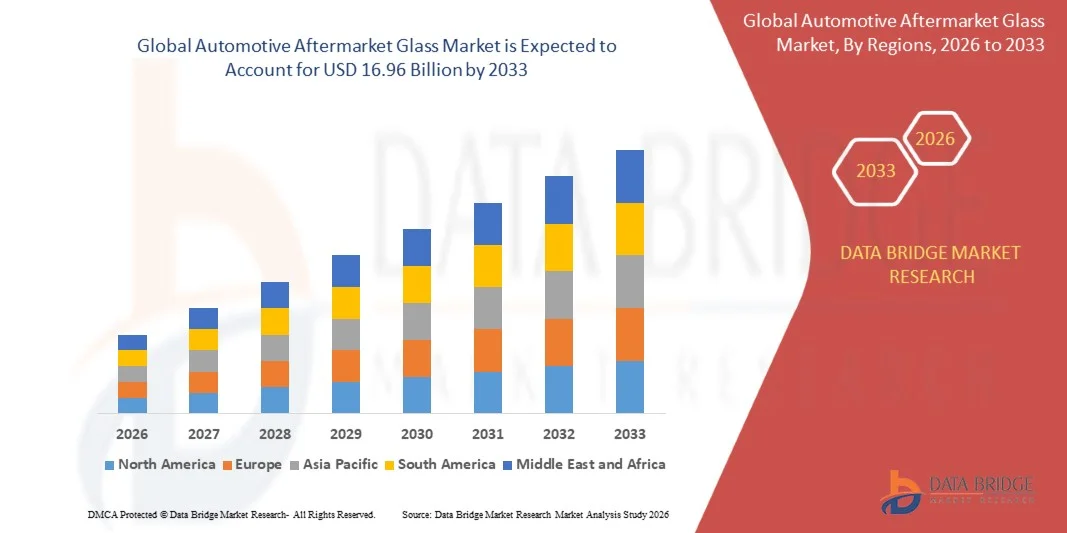
- As per Data Bridge Market Research analysis, the automotive aftermarket glass market was valued at USD 10.13 billion in 2025 and is projected to reach USD 16.96 billion by 2033, growing at a CAGR of 6.66% from 2026 to 2033.
- The market is experiencing consistent growth driven by rising vehicle ownership, increasing demand for replacement glass, growing road traffic accidents, and the expanding vehicle parc, which is creating sustained demand for automotive glass replacement and repair services.
- The increasing incidence of road accidents and windshield damage, combined with the growing adoption of advanced driver assistance systems (ADAS), is compelling vehicle owners and aftermarket service providers to adopt advanced replacement glass solutions. Laminated glass, ADAS-compatible windshields, and specialized replacement glass are gaining traction as safety requirements, vehicle complexity, and demand for reliable aftermarket services continue to increase.
Market Size & Forecast
- Global Market Value (2025): USD 10.13 Billion
- Expected Market Value (2033): USD 16.96 Billion
- Forecast CAGR (2026–2033): 6.66%
- Leading Region in 2025: North America
- Fastest Growing Region: Asia Pacific
What are the Major Takeaways of the Automotive Aftermarket Glass Market?
- North America dominated the automotive aftermarket glass market with the largest revenue share of 34.92% in 2025, supported by a mature automotive aftermarket, high vehicle ownership, established replacement networks, and increasing demand for advanced glass solutions.
- Asia-Pacific is expected to be the fastest-growing region at a CAGR of 8.84% from 2026 to 2033, fueled by expanding automotive production, increasing road traffic, and growing demand for vehicle repair and replacement services.
- The tempered glass segment led the market with a 50.0% share in 2025, driven by its strength, durability, lower cost, and extensive use in sidelites and backlites.
- Laminated glass are the fastest-growing type, projected to register a CAGR of 6.0%, reflecting the surge in consumer awareness of vehicle safety and growing demand for laminated windshields in the replacement market.
- The sidelite segment dominated the application category with a 30.0% revenue share in 2025, led by frequent damage and replacement requirements and the widespread use of tempered glass in side windows.
- Passenger cars accounted for 65.0% of the market share in 2025, preferred by the large passenger-vehicle parc and recurring replacement requirements.
- The metal-coated segment is the fastest-growing software category, with a CAGR of 6.0%, driven by increasing demand for solar-control and heat-rejection properties in automotive glazing.
Report Scope and Automotive Aftermarket Glass Market Segmentation
|
Attributes |
Automotive Aftermarket Glass Key Market Insights |
|
Segments Covered |
|
|
Countries Covered |
North America
Europe
Asia-Pacific
Middle East and Africa
South America
|
|
Key Market Players |
|
|
Market Opportunities |
|
|
Value Added Data Infosets |
In addition to the insights on market scenarios such as market value, growth rate, segmentation, geographical coverage, and major players, the market reports curated by the Data Bridge Market Research also include import export analysis, production capacity overview, production consumption analysis, price trend analysis, climate change scenario, supply chain analysis, value chain analysis, raw material/consumables overview, vendor selection criteria, PESTLE Analysis, Porter Analysis, and regulatory framework. |
What is the Key Trend in the Automotive Aftermarket Glass Market?
- Automotive aftermarket glass is increasingly shifting from conventional replacement products toward technology-enabled windshields that integrate ADAS cameras, acoustic features, solar-control coatings, and head-up display functionality.
- For instance, in May 2025, AGC Automotive Replacement Glass reported that complex glass accounted for 60% of the automotive replacement glass market, up from 15% in 2015, driven by ADAS, acoustic, solar-control, and HUD-compatible technologies.
- The increasing integration of cameras and sensors into windshields is also making ADAS recalibration an important part of aftermarket glass replacement, requiring specialized equipment, trained technicians, and manufacturer-specific procedures.
- Automotive glass replacement providers are consequently expanding beyond conventional installation toward integrated replacement and calibration services, while premium laminated, acoustic, and solar-control glass is creating higher-value aftermarket applications.
- For instance, in August 2025, Glass.NET reported that auto-glass companies were increasingly adding mobile ADAS calibration capabilities, allowing windshield replacement and calibration to be completed together at the customer’s location.
- As vehicles increasingly incorporate ADAS, HUDs, sensors, and specialized glazing, the aftermarket glass industry is expected to place greater emphasis on precision fitting, calibration capability, advanced materials, and technician specialization, reinforcing the transition toward technology-intensive replacement services.
What are the Key Drivers of the Automotive Aftermarket Glass Market?
- The rapid expansion of ADAS-equipped vehicles is increasing demand for technologically compatible replacement windshields capable of maintaining camera positioning, optical clarity, and sensor functionality after installation.
- For instance, in May 2025, MEMA Aftermarket Suppliers and SEMA brought together aftermarket service, parts, tools, and equipment providers to address the growing challenges of ADAS calibration, highlighting how increasing ADAS integration is creating new requirements for automotive aftermarket services
- The growing vehicle parc, increasing road traffic, and rising frequency of windshield damage are creating recurring replacement requirements, while insurers and repair networks are increasingly supporting professional glass replacement and calibration procedures.
- For instance, in February 2025, the Auto Glass Safety Council (AGSC) updated its automotive glass replacement standards to address windshield-mounted ADAS cameras, noting that camera recalibration had become a common part of auto glass replacement and that new guidelines were needed to address the technology.
- With automotive manufacturers increasingly incorporating multifunctional glazing into passenger vehicles, the aftermarket is benefiting from the expanding need for ADAS-compatible windshields, laminated glass, acoustic glazing, and specialized replacement services, supporting continued demand for advanced automotive glass solutions.
Which Factors are Challenging the Growth of the Automotive Aftermarket Glass Market?
- Advanced automotive glass replacement requires significant investment in ADAS calibration equipment, specialized tools, technician training, diagnostic software, and OEM-specific procedures, increasing operating costs for aftermarket service providers.
- For instance, in November 2024, MEMA reported that most repair facilities lacked the technology or training required to calibrate ADAS, while different OEM calibration approaches were adding complexity to aftermarket servicing.
- These higher costs can limit adoption among smaller independent repair shops and regional installers, particularly where customers remain price-sensitive and replacement providers lack access to specialized calibration infrastructure.
- The increasing complexity of windshields, combined with the need for precise optical alignment and post-installation calibration, can extend service times and increase replacement costs, creating affordability and workforce challenges across price-sensitive aftermarket markets.
- For instance, in February 2025, glassBYTEs reported that windshield-mounted camera recalibration had become a common part of auto glass replacement, while insurance approval and reimbursement for recalibration remained a challenge for auto glass companies, adding time and administrative costs to replacement services.
- The rising technical requirements and investment needed to handle next-generation automotive glazing continue to challenge smaller aftermarket participants, potentially creating a gap between technologically equipped service networks and conventional glass replacement providers.
How is the Automotive Aftermarket Glass Market Segmented?
The automotive aftermarket glass market is segmented on the basis of type, application, vehicle type, and material.
- By Type
On the basis of type, the automotive aftermarket glass market is segmented into tempered, laminated, and others. The tempered glass segment dominated the market with a share of 50.0% in 2025, owing to its strength, durability, lower cost, and extensive use in sidelites and backlites. Tempered glass is widely used in automotive side and rear windows because of its ability to withstand impact and thermal stress. Its manufacturing process provides greater strength than conventional glass, supporting its extensive aftermarket application. The segment also benefits from the large installed base of vehicles equipped with tempered sidelites and backlites. Replacement demand is supported by damage caused by road debris, accidents, vandalism, and other external impacts. The comparatively lower cost of tempered glass also makes it attractive for price-sensitive replacement customers.
The laminated glass segment is projected to register the fastest growth at a CAGR of 6.0% during forecast period, driven by increasing consumer awareness of vehicle safety and growing demand for laminated windshields in the replacement market. Laminated glass uses an interlayer between glass sheets that helps hold the glass together after impact. This characteristic makes it particularly suitable for windshields where occupant protection and visibility are critical. The increasing penetration of ADAS cameras and sensors is also creating demand for precisely manufactured laminated replacement windshields. Premium acoustic and solar-control features are further increasing the functionality of laminated glass products. Growing consumer preference for enhanced safety and comfort is supporting its adoption in modern vehicles.
- By Application
On the basis of application, the automotive aftermarket glass market is segmented into windscreen, sidelite, backlite, and others. The sidelite segment dominated the market with a share of 30.0% in 2025, driven by frequent damage and replacement requirements and the widespread use of tempered glass in side windows. Sidelites are exposed to road debris, accidental impacts, vandalism, and break-ins, which can result in replacement rather than repair. Their extensive installation across passenger vehicles provides a substantial installed base for aftermarket demand. Tempered glass remains widely used for sidelites because of its strength and characteristic breakage pattern. Increasing vehicle ownership is also expanding the number of side windows requiring periodic replacement. The relatively simple availability of replacement sidelites across numerous vehicle models supports efficient aftermarket servicing.
The backlite segment is expected to register the fastest growth at a CAGR of 6.0%, during forecast period, supported by technological developments, increasing road accidents, component theft, and demand for higher-quality replacement glass. Modern backlites increasingly incorporate heating elements, antennas, defogging systems, and other integrated features. These technologies increase the complexity and value of replacement rear-window glass. Rising vehicle ownership and an expanding vehicle parc are creating a larger installed base requiring aftermarket maintenance. Accidental damage and component theft can also generate replacement demand for backlites. Increasing adoption of larger rear glazing areas and technologically advanced vehicle designs is creating additional requirements for specialized replacement products.
- By Vehicle Type
On the basis of vehicle type, the automotive aftermarket glass market is segmented into passenger cars, light commercial vehicles, and heavy commercial vehicles. The passenger cars segment dominated the market with a share of 65.0% in 2025, supported by the large passenger-vehicle parc and recurring replacement requirements. Passenger cars represent the largest installed vehicle base for automotive glass replacement applications. Windshields, sidelites, and backlites are exposed to road debris, accidents, weather conditions, and other sources of damage. The increasing age of vehicles in operation is also generating recurring maintenance and replacement requirements. Modern passenger cars increasingly incorporate ADAS cameras and sensors, making replacement windshields more technologically sophisticated. Rising vehicle ownership in developing economies is further expanding the potential customer base
The light commercial vehicle segment is expected to register the fastest growth at a CAGR of 6.5% during forecast period, supported by increasing demand for delivery vehicles, expanding commercial fleets, and higher vehicle utilization. The growth of e-commerce and last-mile delivery is increasing the deployment of vans and other light commercial vehicles. These vehicles typically operate for longer periods and cover greater distances than privately used passenger cars. Higher utilization increases exposure to road debris, accidents, and other conditions that can damage automotive glass. Fleet operators also require rapid replacement services because extended vehicle downtime can disrupt commercial operations. Increasing incorporation of advanced glazing and ADAS technologies in newer LCVs is creating additional demand for compatible replacement glass.
- By Material
On the basis of material, the automotive aftermarket glass market is segmented into IR-PVB, metal coated, and tinted. The IR-PVB segment dominated the market with a share of 42.0% in 2025, supported by its heat-rejection, UV-blocking, and cabin-comfort characteristics. The material is particularly relevant to laminated automotive glazing, including windshield applications. IR-PVB interlayers can reduce infrared transmission and help limit solar heat entering the vehicle cabin. This functionality supports improved thermal comfort and can reduce the burden on vehicle air-conditioning systems. Growing consumer demand for enhanced comfort and solar protection is supporting the use of higher-performance interlayer materials. The increasing technological sophistication of replacement windshields is also creating opportunities for advanced PVB solutions.
The metal-coated segment is expected to register the fastest growth at CAGR of 6.0% during forecast period, supported by increasing demand for solar-control and heat-rejection properties in automotive glazing. Metal coatings can help control infrared and solar transmission through automotive glass while supporting improved cabin thermal comfort. These characteristics are becoming increasingly relevant as vehicle manufacturers and consumers seek glazing solutions with enhanced functional performance. Growing demand for premium replacement glass is creating additional opportunities for coated products with specialized performance characteristics. The increasing penetration of electric vehicles is also strengthening interest in technologies that can help manage cabin thermal loads. Metal-coated glass can therefore provide additional functionality beyond conventional glazing products.
Which Region Holds the Largest Share of the Automotive Aftermarket Glass Market?
- North America dominated the automotive aftermarket glass market with the largest revenue share of 34.92% in 2025, supported by a mature automotive aftermarket, high vehicle ownership, established replacement networks, and increasing demand for advanced glass solutions.
- The region also benefits from widespread ADAS adoption, established insurance and repair networks, increasing demand for windshield replacement and recalibration services, and strong availability of specialized aftermarket providers. Rising demand for premium laminated, acoustic, and sensor-compatible glass, together with harsh weather and road conditions that can increase glass damage, continues to strengthen North America's position in the global market.
U.S. Automotive Aftermarket Glass Market Insight
The U.S. automotive aftermarket glass market is witnessing strong growth due to high vehicle ownership, an extensive vehicle parc, and well-established windshield repair and replacement networks. The country's mature automotive aftermarket ecosystem, together with widespread ADAS adoption, is increasing demand for technologically compatible replacement windshields and recalibration services. In addition, the large population of SUVs, pickups, and passenger vehicles is supporting recurring demand for replacement glass. The growing integration of cameras, sensors, acoustic features, and head-up displays into windshields is further increasing the technical requirements for aftermarket glass services.
Asia-Pacific Automotive Aftermarket Glass Market Insight
The Asia-Pacific automotive aftermarket glass market is expected to witness rapid growth, driven by expanding vehicle production, a large and growing vehicle parc, and increasing demand for replacement glass across countries such as China, India, and Japan. Rising disposable income, urbanization, and increasing road traffic are supporting vehicle ownership and aftermarket servicing activity across the region. In addition, the availability of raw materials and established automotive-glass manufacturing capabilities is supporting replacement-product supply. Growing adoption of ADAS-equipped vehicles is also increasing demand for sensor-compatible windshields and calibration services. The expansion of premium vehicles and technologically advanced glazing is further supporting regional market development.
Japan Automotive Aftermarket Glass Market Insight
The Japan automotive aftermarket glass market is witnessing consistent growth due to a mature vehicle fleet, established automotive service infrastructure, and increasing demand for technologically advanced replacement glass. Automotive-glass suppliers and repair providers are increasingly addressing windshields incorporating cameras, sensors, antennas, and other electronic functions. Moreover, Japan's strong focus on vehicle safety and advanced mobility technologies is encouraging demand for precision-engineered glazing and sensor-compatible replacement products. Growing awareness of authentic and properly specified replacement glass is also supporting professional aftermarket services.
China Automotive Aftermarket Glass Market Insight
The China automotive aftermarket glass market is growing rapidly, driven by the country's large vehicle parc, substantial automotive production, and expanding demand for vehicle repair and replacement services. The availability of extensive automotive-glass manufacturing capacity is supporting domestic supply of tempered and laminated replacement products. Growing adoption of ADAS, connected vehicles, and advanced glazing is increasing demand for windshields capable of accommodating cameras and other sensing technologies. In addition, rising consumer demand for vehicle safety, comfort, and premium features is supporting higher-value replacement glass. Continued expansion of China's automotive aftermarket is further strengthening demand for specialized glass replacement services.
U.K. Automotive Aftermarket Glass Market Insight
The U.K. automotive aftermarket glass market is experiencing steady growth, supported by established windshield replacement networks, strong repair infrastructure, and increasing adoption of ADAS-equipped vehicles. Growing requirements for proper calibration following windshield replacement are increasing demand for specialized technicians, diagnostic tools, and calibration equipment. Furthermore, the country's focus on repair quality and vehicle safety is strengthening adherence to standardized windscreen replacement procedures. Integration of cameras and sensors into modern windshields is increasing the technical complexity of replacement services. These developments are supporting continued demand for professional aftermarket glass replacement and calibration services in the U.K.
Germany Automotive Aftermarket Glass Market Insight
The Germany automotive aftermarket glass market is expanding steadily due to its strong automotive industry, established repair networks, and large installed base of passenger and commercial vehicles. The increasing presence of ADAS-equipped vehicles is creating greater demand for accurately fitted replacement windshields and post-replacement calibration. Automotive-glass technologies incorporating cameras, sensors, antennas, and advanced optical functions are also increasing the technical sophistication of replacement products. In addition, Germany's established automotive component and repair ecosystem supports the availability of specialized aftermarket services. Growing emphasis on vehicle safety, precise repair procedures, and advanced glazing technologies is further supporting market development.
Which are the Top Companies in Automotive Aftermarket Glass Market?
The automotive aftermarket glass industry is primarily led by well-established companies, including:
- AGC Automotive (Japan)
- Nippon Sheet Glass Co., Ltd. (Japan)
- Fuyao Group (China)
- Saint-Gobain (France)
- Carlex Glass America, LLC (U.S.)
- Vitro (Mexico)
- Xinyi Glass Holdings Limited (Hong Kong)
- Asahi India Glass Limited (India)
- Central Glass Co., Ltd. (Japan)
- CSG HOLDING CO..LTD. (China)
- Türkiye Şişe ve Cam Fabrikaları A.Ş. (Turkey)
- Taiwan Glass Ind. Corp. (Taiwan)
- Mygrant Glass Co., Inc. (U.S.)
- NuVision Auto Glass (U.S.)
- Guardian Glass LLC (U.S.)
- LKQ Corporation (U.S.)
- Boyd Group Services Inc. (Canada)
- Driven Brands Holdings Inc. (U.S.)
- Sika AG (Switzerland)
- 3M (U.S.)
What are Latest Developments in Automotive Aftermarket Glass Market?
- In February 2025, the Auto Glass Safety Council (AGSC) continued updating the Automotive Glass Replacement Safety Standard (AGRSS) to incorporate specific guidelines for windshield-mounted ADAS cameras, reflecting the increasing need for safe recalibration procedures during aftermarket glass replacement. The development highlights the industry's shift toward more technology-focused windshield replacement standards as ADAS becomes increasingly common in vehicles.
- In May 2024, AGC Automotive Replacement Glass introduced its ADAS Compliant programme, developed to provide replacement windscreens that meet stringent compatibility requirements for cameras, sensors, and detection systems. The programme combines AGC's OEM glazing expertise with ADAS-equipment partnerships and intensive testing to support safer and more precise aftermarket windshield replacement.
- In March 2023, Autel and Repairify announced a new partnership to expand access to OEM-level diagnostic and repair solutions through Autel’s Remote Expert platform, including support for ADAS calibration systems. The development is relevant to the automotive aftermarket glass sector because windshield replacement on ADAS-equipped vehicles increasingly requires diagnostic access and post-replacement calibration, linking glass replacement services with advanced repair technologies.
- In January 2022, the Auto Glass Safety Council's ADAS committee reported substantial progress in incorporating ADAS-related provisions into the Automotive Glass Replacement Safety Standard 005-2022. The initiative focused on updating aftermarket replacement practices to address the growing presence of advanced driver-assistance technology in windshields and ensure that safety procedures evolve alongside vehicle technology.
- In April 2021, Safelite Group announced the acquisition of Troy Auto Glass, expanding its automotive glass replacement and windshield calibration capabilities. Troy Auto Glass provided replacement, calibration, fleet-service, and related automotive glass services, while the acquisition enabled the business to leverage Safelite's distribution network, operational systems, and advanced safety-system expertise

- Interactive Data Analysis Dashboard
- Company Analysis Dashboard for high growth potential opportunities
- Research Analyst Access for customization & queries
- Competitor Analysis with Interactive dashboard
- Latest News, Updates & Trend analysis
- Harness the Power of Benchmark Analysis for Comprehensive Competitor Tracking
Global Automotive Aftermarket Glass Market, Supply Chain Analysis and Ecosystem Framework
To support market growth and help clients navigate the impact of geopolitical shifts, DBMR has integrated in-depth supply chain analysis into its Global Automotive Aftermarket Glass Market research reports. This addition empowers clients to respond effectively to global changes affecting their industries. The supply chain analysis section includes detailed insights such as Global Automotive Aftermarket Glass Market consumption and production by country, price trend analysis, the impact of tariffs and geopolitical developments, and import and export trends by country and HSN code. It also highlights major suppliers with data on production capacity and company profiles, as well as key importers and exporters. In addition to research, DBMR offers specialized supply chain consulting services backed by over a decade of experience, providing solutions like supplier discovery, supplier risk assessment, price trend analysis, impact evaluation of inflation and trade route changes, and comprehensive market trend analysis.
Data collection and base year analysis are done using data collection modules with large sample sizes. The stage includes obtaining market information or related data through various sources and strategies. It includes examining and planning all the data acquired from the past in advance. It likewise envelops the examination of information inconsistencies seen across different information sources. The market data is analysed and estimated using market statistical and coherent models. Also, market share analysis and key trend analysis are the major success factors in the market report. To know more, please request an analyst call or drop down your inquiry.
The key research methodology used by DBMR research team is data triangulation which involves data mining, analysis of the impact of data variables on the market and primary (industry expert) validation. Data models include Vendor Positioning Grid, Market Time Line Analysis, Market Overview and Guide, Company Positioning Grid, Patent Analysis, Pricing Analysis, Company Market Share Analysis, Standards of Measurement, Global versus Regional and Vendor Share Analysis. To know more about the research methodology, drop in an inquiry to speak to our industry experts.
Data Bridge Market Research is a leader in advanced formative research. We take pride in servicing our existing and new customers with data and analysis that match and suits their goal. The report can be customized to include price trend analysis of target brands understanding the market for additional countries (ask for the list of countries), clinical trial results data, literature review, refurbished market and product base analysis. Market analysis of target competitors can be analyzed from technology-based analysis to market portfolio strategies. We can add as many competitors that you require data about in the format and data style you are looking for. Our team of analysts can also provide you data in crude raw excel files pivot tables (Fact book) or can assist you in creating presentations from the data sets available in the report.













