


What is the Automotive Carbon Canister Market Size and Growth Rate?
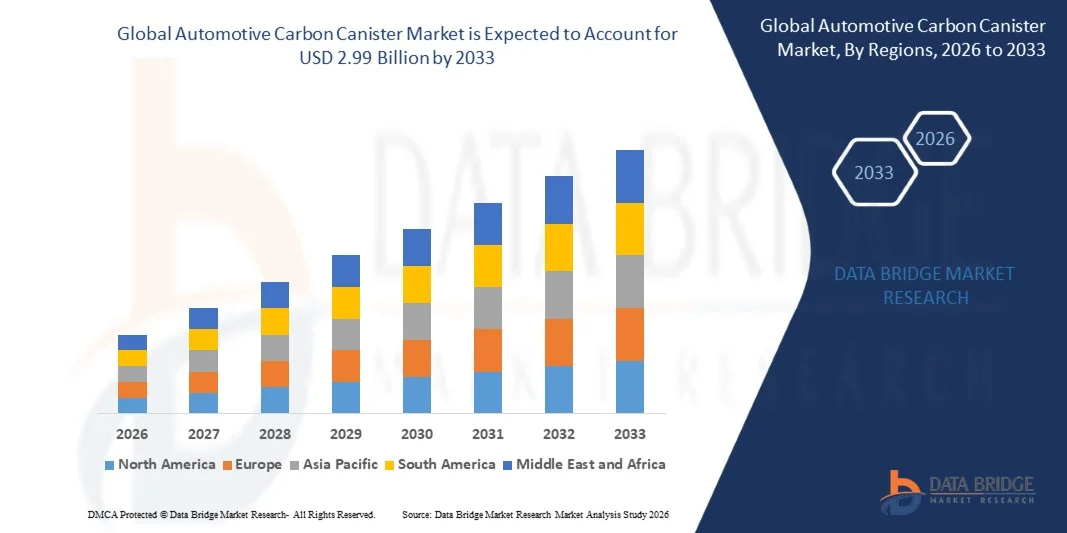
- As per Data Bridge Market Research analysis, the automotive carbon canister market was valued at USD 2.10 billion in 2025 and is projected to reach USD 2.99 billion by 2033, growing at a CAGR of 4.50% from 2026 to 2033.
- The market is experiencing steady growth driven by increasingly stringent global evaporative emission regulations, continued high production volumes of internal combustion engine and hybrid vehicles, and rising adoption of advanced multi-canister systems designed to meet near-zero evaporative emission standards.
- The growing regulatory push toward stricter onboard refueling vapor recovery and evaporative emission thresholds across North America, Europe, and Asia-Pacific is compelling automakers and Tier-1 suppliers to integrate higher-capacity, higher-efficiency activated carbon canisters into new vehicle platforms. Rising adoption of plug-in hybrid electric vehicles, which require specialized canister designs to manage infrequent engine operation and extended fuel-vapor retention periods, is further reshaping canister engineering requirements.
Market Size & Forecast
- Global Market Value (2025): USD 2.10 Billion
- Expected Market Value (2033): USD 2.99 Billion
- Forecast CAGR (2026–2033): 4.50%
- Leading Region in 2025: Asia-Pacific
- Fastest Growing Region: North America
What are the Major Takeaways of the Automotive Carbon Canister Market?
- Asia-Pacific dominated the global automotive carbon canister market with the largest revenue share of 44.73% in 2025, supported by high vehicle production volumes across China, Japan, and India.
- North America is expected to be the fastest-growing region at a CAGR of 5.6% from 2026 to 2033, fueled by stringent evaporative emission regulations and rising adoption of advanced multi-canister systems among domestic automakers.
- The activated carbon material type segment led the market with a 68.42% share in 2025, driven by its established vapor-adsorption performance and widespread compatibility with existing canister manufacturing processes.
- The honeycomb carbon material type segment is the fastest-growing material category, projected to register a CAGR of 6.8%, reflecting rising adoption of compact, high-efficiency vapor-adsorption media in space-constrained vehicle platforms.
- The passenger cars vehicle type segment dominated the vehicle type category with a 71.36% revenue share in 2025, led by high global production volumes and widespread evaporative emission system integration across compact, mid-size, and luxury trims.
- The OEM sales channel accounted for 83.27% of the market share in 2025, preferred for its factory-integrated reliability and compliance with vehicle-specific emission-certification requirements.
- The hybrid electric vehicles propulsion type segment is the fastest-growing propulsion category, with a CAGR of 7.2%, driven by rising global hybrid vehicle production requiring specialized canister designs to manage extended fuel-vapor retention.
Report Scope and Automotive Carbon Canister Market Segmentation
|
Attributes |
Automotive Carbon Canister Key Market Insights |
|
Segments Covered |
|
|
Countries Covered |
North America
Europe
Asia-Pacific
Middle East and Africa
South America
|
|
Key Market Players |
|
|
Market Opportunities |
|
|
Value Added Data Infosets |
In addition to the market insights such as market value, growth rate, market segments, geographical coverage, market players, and market scenario, the market report curated by the Data Bridge Market Research team includes in-depth expert analysis, import/export analysis, pricing analysis, production consumption analysis, and pestle analysis. |
What is the Key Trend in the Automotive Carbon Canister Market?
- Automotive suppliers are increasingly developing advanced carbon canisters with higher vapor-adsorption capacity and improved purge efficiency to meet increasingly stringent evaporative-emission requirements while maintaining compact packaging.
- The growing adoption of hybrid and plug-in hybrid vehicles is driving specialized fuel-vapor management technologies, as longer engine-off periods require improved vapor retention and tighter fuel-system sealing.
- For instance, in June 2025, Aisan Industry introduced its latest technical developments for HEVs and PHEVs, including a stepping-motor fuel-tank closed valve designed to prevent gasoline vapor leakage during extended engine-off periods. The technology reduces volume by approximately 30% and mass by approximately 50% compared with conventional products.
- Advanced activated-carbon materials, including shaped and honeycomb carbon structures, are gaining adoption because they can provide high gasoline working capacity, lower density, improved purge efficiency, and reduced evaporative emissions.
- For instance, in February 2022, Ingevity expanded activated-carbon production capacity at its Zhuhai, China, facility by approximately 15–20%, following equipment upgrades to meet demand for high-capacity activated-carbon products used primarily in gasoline vapor-emission control systems.
- Overall, tightening evaporative-emission requirements, hybridization, and advances in activated-carbon materials are encouraging manufacturers to develop more compact, efficient, and vehicle-specific carbon canister solutions, supporting continued technological development across gasoline, hybrid, and plug-in hybrid platforms.
What are the Key Drivers of the Automotive Carbon Canister Market?
- Increasingly stringent global evaporative emission regulations, combined with continued high production volumes of internal combustion engine and hybrid vehicles, have significantly increased demand for advanced carbon canister systems capable of meeting tightening vapor-emission thresholds.
- For instance, in March 2025, Continental expanded its evaporative emission control component production capacity in Europe to meet rising demand from automakers complying with updated regional emission standards.
- Automotive OEMs and Tier-1 suppliers are increasingly incorporating higher-capacity, higher-efficiency carbon canisters into standard vehicle platforms to ensure regulatory compliance while minimizing packaging and cost impact.
- For instance, in October 2024, DENSO announced an investment in additional carbon canister manufacturing capacity to support rising orders from automotive customers expanding hybrid vehicle production.
- For instance, in June 2024, Plastic Omnium expanded its fuel-system component portfolio to include additional advanced canister designs, supporting growing OEM demand for compliant evaporative emission solutions.
- With global vehicle production continuing to rely predominantly on gasoline and hybrid powertrains subject to evaporative emission regulations, automotive carbon canisters will remain an indispensable emission-control component across passenger and commercial vehicle segments worldwide.
Which Factors are Challenging the Growth of the Automotive Carbon Canister Market?
- The accelerating global transition toward battery electric vehicles (BEVs), which do not require conventional evaporative-emission control systems, represents a structural long-term challenge for the automotive carbon canister market. As EV penetration increases, the addressable market for fuel-vapor management components is expected to gradually contract.
- This shift toward electrification is also influencing supplier investment and product-development strategies, as automakers and component manufacturers increasingly redirect capital toward batteries, electric powertrains, thermal-management systems, and other EV-specific technologies. Hybrid and internal-combustion vehicles, however, continue to support near- and medium-term demand for carbon canisters.
- For instance, in September 2024, the European Automobile Manufacturers’ Association (ACEA) reported that European automakers had invested billions in electrification while the industry was experiencing changing demand for battery-electric vehicles. This highlights the continuing structural transition from conventional powertrains toward electrified vehicle platforms and the resulting pressure on suppliers of ICE-related components.
- Overall, the gradual shift toward BEV platforms is expected to constrain the long-term growth potential of conventional carbon canisters, particularly in markets pursuing aggressive vehicle-electrification targets. Suppliers with significant exposure to conventional fuel-system components may increasingly need to diversify into products serving hybrid, electric, and other emerging vehicle technologies.
How is the Automotive Carbon Canister Market Segmented?
The automotive carbon canister market is segmented on the basis of material type, canister type, vehicle type, propulsion type, fuel type, sales channel, capacity, component, vehicle class and application.
- By Material Type
On the basis of material type, the global automotive carbon canister market is segmented into activated carbon, honeycomb carbon, and others. The activated carbon segment dominated the market with a 68.42% share in 2025, owing to its established vapor-adsorption performance, cost-effective production, and widespread compatibility with existing canister manufacturing processes. This material delivers proven, reliable fuel-vapor capture performance, making it the foundational media category across current-generation canister production.
The honeycomb carbon segment is projected to register the fastest growth at a CAGR of 6.8% from 2026 to 2033, driven by rising demand for compact, high-efficiency vapor-adsorption media in space-constrained vehicle platforms. Advances in honeycomb structural design, combined with growing OEM adoption to meet tightening emission standards, are accelerating segment expansion. This structural format also reduces pressure-drop losses during the purge cycle, an efficiency gain that OEM powertrain engineers increasingly value when calibrating fuel-system performance.
- By Canister Type
On the basis of canister type, the global automotive carbon canister market is segmented into single canister and multi-canister/stacked canister. The single canister segment led the market with a 61.73% share in 2025, supported by its widespread use across mainstream passenger vehicle platforms meeting standard evaporative emission requirements.
The multi-canister/stacked canister segment is expected to experience the fastest growth at a CAGR of 6.4% from 2026 to 2033, driven by increasing adoption among automakers seeking to meet the most stringent near-zero evaporative emission regulatory thresholds. These configurations distribute vapor-adsorption load across multiple stages, improving overall system capacity without requiring a single oversized canister body.
- By Vehicle Type
On the basis of vehicle type, the global automotive carbon canister market is segmented into passenger cars, light commercial vehicles, heavy commercial vehicles, and two-wheelers. The passenger cars segment dominated the market with a share of 71.36% in 2025 due to its critical role in representing the largest share of global vehicle production requiring standardized evaporative emission control systems, high production volumes across compact, mid-size, and luxury trims, and widespread regulatory-compliance requirements. Additionally, rising focus on emission-standard harmonization across passenger vehicle platforms further supports the strong adoption of carbon canisters in this vehicle-type category.
The two-wheelers segment is anticipated to witness the fastest CAGR of 6.9% from 2026 to 2033, driven by the increasing extension of evaporative emission regulations to motorcycle and scooter platforms in key Asian markets. Manufacturers are adopting compact carbon canister designs to conduct cost-effective, scalable evaporative emission compliance for two-wheeler production. Additionally, the integration of canister systems into expanding two-wheeler regulatory-compliance programs is enhancing market accessibility, further driving segment growth.
- By Propulsion Type
On the basis of propulsion type, the global automotive carbon canister market is segmented into ICE vehicles and hybrid electric vehicles (PHEV/HEV). The ICE vehicles segment dominated the market with a share of 79.64% in 2025 due to its critical role in representing the largest global vehicle production base requiring standard evaporative emission control systems. The widespread integration of carbon canisters across mainstream ICE vehicle platforms is driving strong demand for this propulsion-type category.
The hybrid electric vehicles (PHEV/HEV) segment is expected to witness the fastest CAGR of 7.2% from 2026 to 2033, driven by the rising global production of hybrid vehicles requiring specialized canister designs to manage extended fuel-vapor retention during electric-only operation periods. Manufacturers are increasingly developing hybrid-specific canister architectures. Additionally, the growing global shift toward hybrid powertrains as a transitional technology is further accelerating adoption of this propulsion-type category.
- By Fuel Type
On the basis of fuel type, the global automotive carbon canister market is segmented into gasoline/petrol, flex-fuel, and CNG/LPG. The gasoline/petrol segment dominated the market with a share of 76.28% in 2025 due to its critical role as the predominant fuel type across global vehicle production requiring standard evaporative emission control. High adoption is driven by the increasing need for compliant vapor-control systems across mainstream gasoline vehicle platforms, integration with standardized emission-certification processes, and enhanced production-line compatibility. Additionally, growing investment by automotive OEMs and Tier-1 suppliers to improve gasoline-vehicle emission compliance is reinforcing the leading position of this segment in the market.
The flex-fuel segment is expected to witness the fastest CAGR of 6.1% from 2026 to 2033, driven by increasing adoption of flex-fuel vehicles in South American and other biofuel-supportive markets requiring specialized canister designs to manage the distinct vapor characteristics of ethanol-blended fuels. Growing regulatory support for biofuel adoption is further accelerating market expansion in this segment.
- By Sales Channel
On the basis of sales channel, the global automotive carbon canister market is segmented into OEM and aftermarket. The OEM segment dominated the market with a share of 83.27% in 2025 due to its widespread adoption in factory-integrated vehicle production, which requires seamless compatibility with vehicle-specific emission-certification requirements. High adoption is supported by automakers and Tier-1 suppliers that rely on integrated OEM production lines to ensure consistency, regulatory compliance, and measurable quality outcomes. Additionally, increasing integration with vehicle-wide emission-control system design enhances component reliability and reinforces the dominance of the OEM sales channel segment.
The aftermarket segment is expected to witness the fastest CAGR of 5.9% from 2026 to 2033, driven by the increasing demand for replacement carbon canisters among the large global fleet of aging in-service vehicles requiring emission-system component replacement. By offering accessible, cost-effective replacement parts, this channel enhances vehicle emission-compliance longevity and supports independent repair-shop operations, making aftermarket canister supply highly relevant for vehicle-maintenance markets.
- By Capacity
On the basis of capacity, the global automotive carbon canister market is segmented into small capacity (<1L), medium capacity (1-2L), and large capacity (>2L). The medium capacity (1-2L) segment dominated the market with a share of 52.84% in 2025 due to its critical role in providing balanced vapor-adsorption capacity for standard passenger vehicle fuel-tank configurations. Additionally, established manufacturing infrastructure, broad OEM specification compatibility, and extensive production history are facilitating continued adoption of medium-capacity canisters across mainstream vehicle platforms.
The large capacity (>2L) segment is expected to witness the fastest CAGR of 6.3% from 2026 to 2033, driven by the increasing adoption of multi-canister and high-capacity systems required to meet the most stringent near-zero evaporative emission regulatory thresholds. Manufacturers are leveraging larger-format canister designs to enhance vapor-retention capacity, enable compliance with advanced emission standards, and support hybrid-vehicle-specific requirements.
- By Component
On the basis of component, the global automotive carbon canister market is segmented into canister body, purge valve, vent valve, and filter element. The canister body segment dominated the market with a share of 44.62% in 2025 due to its critical role as the primary structural and vapor-adsorption component within the evaporative emission control system. Additionally, established manufacturing infrastructure, broad OEM supplier familiarity, and extensive production-cost optimization are facilitating continued adoption of canister-body components across global vehicle platforms, while strong supplier support networks are improving accessibility, reliability, and trust, further reinforcing this segment's leading market position.
The purge valve segment is expected to witness the fastest CAGR of 6.5% from 2026 to 2033, driven by the increasing precision requirements for controlling fuel-vapor purge timing to meet tightening emission-control calibration standards. Manufacturers are leveraging advanced electronic purge-valve technology to enhance emission-control precision, enable improved engine-management integration, and support compliance with increasingly sophisticated onboard diagnostic requirements.
- By Vehicle Class
On the basis of vehicle class, the global automotive carbon canister market is segmented into economy, mid-size, and luxury. The mid-size segment dominated the market with a share of 41.73% in 2025 due to its preference among the largest base of vehicle production across global markets requiring standard evaporative emission compliance. Additionally, established manufacturing infrastructure, broad platform-sharing compatibility, and extensive production-scale requirements are facilitating continued adoption of canister systems across mid-size vehicle platforms, while strong OEM support networks are improving accessibility, reliability, and trust, further reinforcing this segment's leading market position.
The luxury segment is expected to witness the fastest CAGR of 6.2% from 2026 to 2033, driven by the increasing integration of advanced multi-canister and honeycomb-carbon systems as premium automakers adopt the most sophisticated emission-control technologies ahead of regulatory mandates. Manufacturers are leveraging premium engineering resources to enhance emission-control performance, enable early compliance with upcoming standards, and support brand positioning around environmental technology leadership.
Which Region Holds the Largest Share of the Automotive Carbon Canister Market?
- Asia-Pacific dominated the automotive carbon canister market and accounted for the largest revenue share of 44.73% in 2025, supported by high vehicle production volumes, strong presence of component manufacturers, and cost-competitive production capabilities across China, Japan, and India.
- The region also benefits from extensive automotive component manufacturing infrastructure, high adoption of standardized emission-control systems, and growing use of carbon canisters across passenger and two-wheeler vehicle production applications. Increasing focus on export-oriented vehicle manufacturing and rising domestic emission-regulation enforcement continues to strengthen Asia-Pacific's leadership position in the global market.
China Automotive Carbon Canister Market Insight
The China automotive carbon canister market is growing steadily, driven by high domestic vehicle production volumes, tightening national emission standards, and rising investment in domestic component manufacturing capacity. Growing adoption of advanced carbon canister systems across passenger vehicle and hybrid vehicle production is significantly boosting market demand. In addition, rising investments in domestic activated-carbon and canister manufacturing infrastructure, increasing export-oriented component production, and rapid regulatory-compliance advancement are positioning China as a leading market for automotive carbon canisters globally.
Japan Automotive Carbon Canister Market Insight
The Japan automotive carbon canister market is witnessing consistent growth due to rising investments in advanced emission-control technologies, precision manufacturing innovation, and strong domestic hybrid-vehicle production leadership. Automotive manufacturers, component suppliers, and research institutes are increasingly developing high-precision honeycomb carbon and multi-canister systems for passenger and hybrid vehicle applications. Moreover, the country's focus on emission-technology leadership and manufacturing excellence are further contributing to market growth.
North America Automotive Carbon Canister Market Insight
The North American automotive carbon canister market is driven heavily by stringent EPA regulations and multi-pollutant standards targeting evaporative emissions and volatile organic compounds (VOCs). While the rapid adoption of pure electric vehicles poses a long-term restraint, steady manufacturing of internal combustion and hybrid-electric vehicles (HEVs) sustains consistent demand. Industry focus has shifted toward advanced smart modules, high-capacity activated carbon honeycombs, and integrated active purge pumps to meet increasingly tight emission limits.
U.S. Automotive Carbon Canister Market Insight
The U.S. automotive carbon canister market is experiencing steady growth, largely propelled by stringent Environmental Protection Agency (EPA) regulations and California Air Resources Board (CARB) standards targeting evaporative emissions and volatile organic compounds (VOCs). While the rapid rise of battery electric vehicles poses a long-term restraint, the continued manufacturing of internal combustion engines and hybrid-electric vehicles (HEVs) sustains healthy demand. Manufacturers are increasingly innovating compact, high-efficiency canister designs integrated with active purge pumps to meet modern powertrain requirements.
Canada Automotive Carbon Canister Market Insight
The Canadian automotive carbon canister market remains closely tied to North American regulatory frameworks and integrated cross-border supply chains. While long-term shifts toward vehicle electrification pose structural adjustments, adjustments in federal adoption timelines and a sustained reliance on internal combustion engines and hybrid vehicles protect mid-term demand for evaporative emission controls. Suppliers are focusing on compact, high-efficiency canister modules integrated with advanced purge systems to meet rigorous emission standards while preserving space for modern vehicle architectures.
Which are the Top Companies in Automotive Carbon Canister Market?
The automotive carbon canister industry is primarily led by well-established companies, including:
- MAHLE GmbH (Germany)
- Continental AG (Germany)
- BorgWarner Inc. (U.S.)
- DENSO Corporation (Japan)
- Eaton Corporation plc (Ireland)
- Aisan Industry Co., Ltd. (Japan)
- Kayaba Industry Co., Ltd. (KYB) (Japan)
- Plastic Omnium SE (France)
- Kautex Textron GmbH & Co. KG (Germany)
- MANN+HUMMEL GmbH (Germany)
- Marelli Holdings Co., Ltd. (Japan)
- Nifco Inc. (Japan)
- Meiwa Industry Co., Ltd. (Japan)
- Toyoda Gosei Co., Ltd. (Japan)
- Futaba Industrial Co., Ltd. (Japan)
- UNO Minda Group (Minda Industries Limited) (India)
- Sogefi S.p.A. (Italy)
- Ningbo Huaxiang Electronic Co., Ltd. (China)
- Ecoscience Automotive Ltd. (India)
- Shanghai Baolong Automotive Corporation (China)
- Zhejiang VIE Science & Technology Co., Ltd. (China)
- Mikuni Corporation (Japan)
- Hitachi Astemo, Ltd. (Japan)
- WOCO Industrietechnik GmbH (Germany)
- Cooper Standard Holdings Inc. (U.S.)
What are Latest Developments in Automotive Carbon Canister Market?
- In September 2025, MAHLE launched an expanded honeycomb carbon canister product line for global OEM customers, offering improved vapor-adsorption efficiency and strengthening its position in the advanced emission-control component market.
- In February 2025, DENSO expanded its carbon canister manufacturing capacity in Asia to support growing demand from hybrid vehicle manufacturers requiring specialized canister designs.
- In November 2025, Aisan Industry introduced an upgraded multi-canister system optimized for plug-in hybrid electric vehicle applications, improving vapor-retention capacity for extended electric-only driving periods. This development strengthens Aisan's position in the hybrid-vehicle emission-control market by offering automakers a purpose-built solution for evolving powertrain requirements.
- In October 2024, Continental expanded its evaporative emission control component portfolio in Europe to include additional multi-canister systems tailored for near-zero emission regulatory compliance.
- In June 2023, Plastic Omnium partnered with an automotive Tier-1 supplier to co-develop next-generation carbon canister architecture for hybrid vehicle fuel-system integration, combining its component manufacturing expertise with the partner's systems integration capabilities to support evolving emission-compliance requirements.
- In March 2023, MANN+HUMMEL received manufacturing certification for an expanded activated-carbon media production facility dedicated to automotive canister applications, enabling the company to serve growing demand from OEM customers requiring consistent, high-performance vapor-adsorption material supply.

- Interactive Data Analysis Dashboard
- Company Analysis Dashboard for high growth potential opportunities
- Research Analyst Access for customization & queries
- Competitor Analysis with Interactive dashboard
- Latest News, Updates & Trend analysis
- Harness the Power of Benchmark Analysis for Comprehensive Competitor Tracking
Data collection and base year analysis are done using data collection modules with large sample sizes. The stage includes obtaining market information or related data through various sources and strategies. It includes examining and planning all the data acquired from the past in advance. It likewise envelops the examination of information inconsistencies seen across different information sources. The market data is analysed and estimated using market statistical and coherent models. Also, market share analysis and key trend analysis are the major success factors in the market report. To know more, please request an analyst call or drop down your inquiry.
The key research methodology used by DBMR research team is data triangulation which involves data mining, analysis of the impact of data variables on the market and primary (industry expert) validation. Data models include Vendor Positioning Grid, Market Time Line Analysis, Market Overview and Guide, Company Positioning Grid, Patent Analysis, Pricing Analysis, Company Market Share Analysis, Standards of Measurement, Global versus Regional and Vendor Share Analysis. To know more about the research methodology, drop in an inquiry to speak to our industry experts.
Data Bridge Market Research is a leader in advanced formative research. We take pride in servicing our existing and new customers with data and analysis that match and suits their goal. The report can be customized to include price trend analysis of target brands understanding the market for additional countries (ask for the list of countries), clinical trial results data, literature review, refurbished market and product base analysis. Market analysis of target competitors can be analyzed from technology-based analysis to market portfolio strategies. We can add as many competitors that you require data about in the format and data style you are looking for. Our team of analysts can also provide you data in crude raw excel files pivot tables (Fact book) or can assist you in creating presentations from the data sets available in the report.













