


Automotive Headliner Market Analysis
The automotive headliner market is experiencing steady growth, driven by rising vehicle production, increasing consumer demand for premium interiors, and advancements in lightweight materials. Headliners, which enhance both aesthetic appeal and acoustic insulation, have become a crucial component in modern vehicles. The shift towards fuel efficiency and sustainability has prompted manufacturers to adopt lightweight composite materials, such as polyurethane, fiberglass, and recycled thermoplastics, reducing vehicle weight and improving fuel economy. In addition, OEMs and aftermarket suppliers are incorporating smart headliners with integrated lighting, ambient sensors, and noise reduction technology, elevating comfort and driving experience.
Advancements in manufacturing technologies such as 3D molding and automated lamination have enabled the production of customized, durable headliners that cater to various vehicle segments, from economy cars to luxury SUVs. Companies such as Toyota Boshoku, Lear Corporation, and Magna International are investing in eco-friendly solutions, including biodegradable headliner materials to align with sustainability goals. The electric vehicle (EV) boom has also influenced the market, with automakers designing headliners that enhance cabin aerodynamics and improve energy efficiency. With technological innovations and rising consumer expectations, the automotive headliner market is set for continuous expansion, offering lucrative opportunities for industry players.
Automotive Headliner Market Size
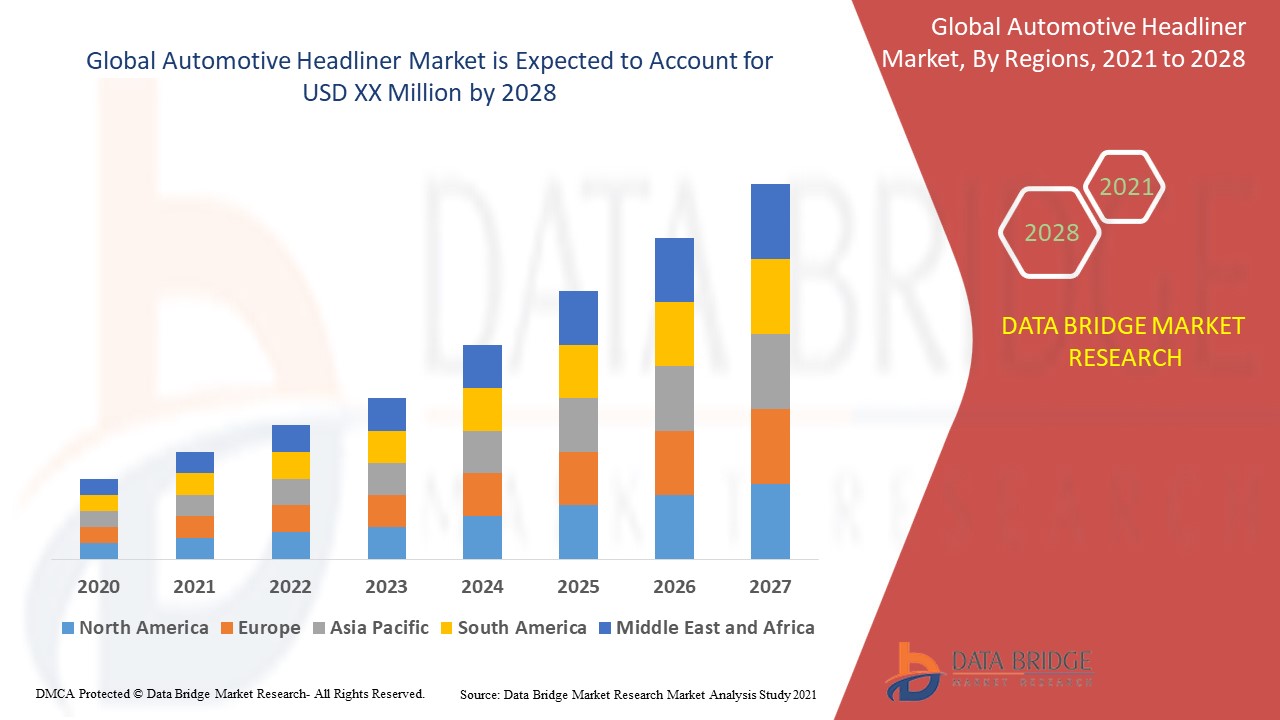
The global automotive headliner market size was valued at USD 19.98 billion in 2024 and is projected to reach USD 28.97 billion by 2032, with a CAGR of 4.75% during the forecast period of 2025 to 2032. In addition to the insights on market scenarios such as market value, growth rate, segmentation, geographical coverage, and major players, the market reports curated by the Data Bridge Market Research also include import export analysis, production capacity overview, production consumption analysis, price trend analysis, climate change scenario, supply chain analysis, value chain analysis, raw material/consumables overview, vendor selection criteria, PESTLE Analysis, Porter Analysis, and regulatory framework.
Automotive Headliner Market Trends
“Increasing Adoption of Integration of Smart Headliners”
One of the key trends in the automotive headliner market is the integration of smart headliners with advanced functional features such as ambient lighting, noise-canceling technology, and embedded sensors. Automakers are focusing on enhancing in-cabin experiences by incorporating interactive headliner systems that adjust lighting and acoustics based on driving conditions. For instance, Mercedes-Benz and BMW have introduced ambient LED-illuminated headliners that create a personalized atmosphere inside the vehicle, improving both aesthetics and passenger comfort. In addition, active noise cancellation (ANC) technology in headliners, as seen in Tesla’s premium models, helps reduce road noise, ensuring a quieter ride experience. With the rise of electric vehicles (EVs) and autonomous cars, manufacturers are developing lightweight, sound-absorbing, and sustainable headliner materials to enhance energy efficiency and luxury appeal. This shift towards high-tech, eco-friendly automotive interiors is driving innovation and competition in the global headliner market, making smart headliners a critical component of future vehicle designs.
Report Scope and Automotive Headliner Market Segmentation
|
Attributes |
Automotive Headliner Key Market Insights |
|
Segments Covered |
|
|
Countries Covered |
U.S., Canada and Mexico in North America, Germany, France, U.K., Netherlands, Switzerland, Belgium, Russia, Italy, Spain, Turkey, Rest of Europe in Europe, China, Japan, India, South Korea, Singapore, Malaysia, Australia, Thailand, Indonesia, Philippines, Rest of Asia-Pacific (APAC) in the Asia-Pacific (APAC), Saudi Arabia, U.A.E., South Africa, Egypt, Israel, Rest of Middle East and Africa (MEA) as a part of Middle East and Africa (MEA), Brazil, Argentina and Rest of South America as part of South America |
|
Key Market Players |
Adient plc. (Ireland), Antolin (Spain), Harodite Industries (U.S.), Atlas Roofing Corporation (U.S.), IAC Group (Luxembourg), Yanfeng (China), Magna International Inc. (Canada), Marelli Holdings Co., Ltd. (Japan), TACHI-S CO., LTD (Japan), Tata Sons Private Limited (India), Lear (U.S.), SMS Auto Fabrics (U.S.), Sage Automotive Interiors (U.S.), TOYOTA BOSHOKU CORPORATION (Japan), and Freudenberg Performance Materials (Germany) |
|
Market Opportunities |
|
|
Value Added Data Infosets |
In addition to the insights on market scenarios such as market value, growth rate, segmentation, geographical coverage, and major players, the market reports curated by the Data Bridge Market Research also include import export analysis, production capacity overview, production consumption analysis, price trend analysis, climate change scenario, supply chain analysis, value chain analysis, raw material/consumables overview, vendor selection criteria, PESTLE Analysis, Porter Analysis, and regulatory framework. |
Automotive Headliner Market Definition
An automotive headliner is the material-covered panel attached to the interior roof of a vehicle, designed to enhance aesthetics, insulation, and comfort. It consists of a fabric or synthetic material bonded to a foam or composite backing, providing soundproofing, thermal insulation, and structural support.
Automotive Headliner Market Dynamics
Drivers
- Rising Demand for Premium and Aesthetic Interiors
Consumers today are prioritizing luxury, comfort, and personalization in their vehicles, leading to a significant increase in demand for high-quality headliners. Modern headliners are no longer just functional components; they now incorporate premium materials, integrated LED lighting, and advanced noise-reduction technology to enhance the overall in-cabin experience. Luxury automakers such as Mercedes-Benz and Audi have set industry standards by introducing ambient LED-illuminated headliners that improve aesthetics and create a sophisticated and relaxing environment for passengers. For instance, Audi’s Virtual Cockpit system integrates ambient lighting into the headliner, providing a seamless blend of style and functionality. This increasing consumer inclination toward customized and visually appealing interiors is a major driver in the automotive headliner market, prompting manufacturers to develop innovative and stylish solutions that cater to evolving customer preferences.
- Growth of Electric and Autonomous Vehicles
The rapid expansion of electric vehicles (EVs) and autonomous vehicles (AVs) is reshaping the automotive headliner market, with a growing focus on lightweight and energy-efficient materials. Since EVs do not have traditional internal combustion engines, they require enhanced soundproofing solutions to minimize road noise and ensure a quiet and comfortable cabin experience. Manufacturers such as Tesla and Lucid Motors are leveraging aerodynamic and sound-absorbing headliner materials to enhance vehicle efficiency while maintaining a sleek design. For instance, Tesla's Model S Plaid features an advanced acoustically optimized headliner, which helps reduce external noise, improving passenger comfort. In addition, autonomous vehicle developers are incorporating smart headliners equipped with integrated sensors, touch-sensitive lighting, and adaptive soundproofing technologies to create an immersive experience for riders. These innovations present new market opportunities, as automakers continue to prioritize comfort, efficiency, and cutting-edge technology in next-generation vehicles.
Opportunities
- Advancements in Sustainable and Lightweight Materials
As global emission regulations tighten and the push for fuel efficiency intensifies, automotive manufacturers are increasingly turning to sustainable and lightweight materials for headliners. Traditional materials are being replaced by eco-friendly alternatives such as recycled thermoplastics, polyurethane foam, and bio-based composites, which help reduce vehicle weight while maintaining structural integrity, durability, and insulation properties. Companies such as Toyota Boshoku and Lear Corporation are at the forefront of this innovation, investing in sustainable headliner solutions that align with global sustainability goals. For instance, Toyota Boshoku's ECOPLAST material, developed from plant-based sources, provides a lightweight and environmentally responsible alternative to conventional headliner materials. This trend presents a significant market opportunity as automakers strive to reduce their carbon footprint while meeting consumer demand for eco-conscious vehicles, further fueling the adoption of green materials in automotive interiors.
- Increasing Vehicle Production and Aftermarket Demand
The growing global vehicle production, particularly in emerging markets such as China and India, is driving demand for high-quality headliners that enhance both aesthetics and functionality. As automakers ramp up production to meet the increasing demand for passenger and commercial vehicles, the need for durable and lightweight headliners continues to grow. In addition, the automotive aftermarket segment is expanding as vehicle owners seek premium and customized headliners that offer improved noise reduction, comfort, and visual appeal. Companies catering to the aftermarket industry are offering a variety of replacement options, including luxury fabric headliners, suede finishes, and LED-integrated designs to enhance the cabin experience. For instance, Lear Corporation has introduced advanced acoustic headliners for the aftermarket, improving cabin quietness and thermal insulation. This trend highlights a key market opportunity, as both OEMs and aftermarket suppliers benefit from the increasing demand for upgraded and customized vehicle interiors.
Restraints/Challenges
- High Production Costs
The manufacturing of automotive headliners involves advanced materials such as polyester, fabric composites, and specialized plastics that enhance durability, noise insulation, and aesthetics. These materials, while improving overall vehicle quality, come at a higher cost, impacting production expenses. In addition, modern headliners integrate features such as ambient lighting, sunroof cutouts, and soundproofing layers, requiring precision engineering and advanced manufacturing techniques. For instance, luxury automakers such as Mercedes-Benz and BMW use Alcantara and suede-like materials in their headliners to enhance cabin aesthetics and comfort, but these premium materials significantly raise production costs. As a market challenge, these increased costs can reduce profit margins for OEMs and limit affordability for consumers in budget-friendly vehicle segments.
- Stringent Safety and Environmental Regulations
Automotive headliners must comply with strict safety and environmental regulations related to crash protection, fire resistance, and sustainability. Governments worldwide impose stringent guidelines on interior materials to ensure passenger safety and minimize environmental impact. For instance, the U.S. Federal Motor Vehicle Safety Standards (FMVSS 302) and the European ECE R118 regulations mandate that headliner materials meet fire resistance and toxicity requirements. Furthermore, automakers are increasingly required to use recyclable and non-toxic materials to align with global sustainability goals. Tesla, for instance, has incorporated eco-friendly, non-leather, and vegan interior materials, influencing headliner material choices. As a market challenge, these regulations increase research and development (R&D) costs, material sourcing complexity, and production constraints, making compliance an expensive and resource-intensive process for manufacturers.
This market report provides details of new recent developments, trade regulations, import-export analysis, production analysis, value chain optimization, market share, impact of domestic and localized market players, analyses opportunities in terms of emerging revenue pockets, changes in market regulations, strategic market growth analysis, market size, category market growths, application niches and dominance, product approvals, product launches, geographic expansions, technological innovations in the market. To gain more info on the market contact Data Bridge Market Research for an Analyst Brief, our team will help you take an informed market decision to achieve market growth.
Impact and Current Market Scenario of Raw Material Shortage and Shipping Delays
Data Bridge Market Research offers a high-level analysis of the market and delivers information by keeping in account the impact and current market environment of raw material shortage and shipping delays. This translates into assessing strategic possibilities, creating effective action plans, and assisting businesses in making important decisions. Apart from the standard report, we also offer in-depth analysis of the procurement level from forecasted shipping delays, distributor mapping by region, commodity analysis, production analysis, price mapping trends, sourcing, category performance analysis, supply chain risk management solutions, advanced benchmarking, and other services for procurement and strategic support.
Expected Impact of Economic Slowdown on the Pricing and Availability of Products
When economic activity slows, industries begin to suffer. The forecasted effects of the economic downturn on the pricing and accessibility of the products are taken into account in the market insight reports and intelligence services provided by DBMR. With this, our clients can typically keep one step ahead of their competitors, project their sales and revenue, and estimate their profit and loss expenditures.
Automotive Headliner Market Scope
The market is segmented on the basis of headliner type, vehicle type, material type, and sales channel. The growth amongst these segments will help you analyse meagre growth segments in the industries and provide the users with a valuable market overview and market insights to help them make strategic decisions for identifying core market applications.
Headliner Type
- Built-In
- Tilt and Slide
- Top Mount
- Solar Glass
- Pop-up
- Tilt
- Panoramic
Vehicle Type
- Passenger Vehicles
- Light Commercial Vehicles
- Heavy Commercial Vehicles
Material Type
- Fabric
- Polyester
- Plastic
Sales Channel
- Original Equipment Manufacturer (OEM)
- Aftermarket
Automotive Headliner Market Regional Analysis
The market is analysed and market size insights and trends are provided by country, headliner type, vehicle type, material type, and sales channel as referenced above.
The countries covered in the market report are U.S., Canada and Mexico in North America, Germany, France, U.K., Netherlands, Switzerland, Belgium, Russia, Italy, Spain, Turkey, Rest of Europe in Europe, China, Japan, India, South Korea, Singapore, Malaysia, Australia, Thailand, Indonesia, Philippines, Rest of Asia-Pacific (APAC) in the Asia-Pacific (APAC), Saudi Arabia, U.A.E., South Africa, Egypt, Israel, Rest of Middle East and Africa (MEA) as a part of Middle East and Africa (MEA), Brazil, Argentina and Rest of South America as part of South America.
Asia-Pacific dominates the automotive headliner market due to stringent government regulations promoting lightweight vehicle components to improve fuel efficiency and reduce emissions. In addition, the region's rising income levels and increasing disposable income have boosted consumer spending on automobiles, driving market expansion. The availability of low-interest vehicle loans has further fueled car ownership, making advanced automotive interior components more accessible. Moreover, intense market competition among automakers and a rapidly growing population continue to support the demand for high-quality, durable, and aesthetically appealing headliners in the region.
The country section of the report also provides individual market impacting factors and changes in regulation in the market domestically that impacts the current and future trends of the market. Data points such as down-stream and upstream value chain analysis, technical trends and porter's five forces analysis, case studies are some of the pointers used to forecast the market scenario for individual countries. Also, the presence and availability of global brands and their challenges faced due to large or scarce competition from local and domestic brands, impact of domestic tariffs and trade routes are considered while providing forecast analysis of the country data.
Automotive Headliner Market Share
The market competitive landscape provides details by competitor. Details included are company overview, company financials, revenue generated, market potential, investment in research and development, new market initiatives, global presence, production sites and facilities, production capacities, company strengths and weaknesses, product launch, product width and breadth, application dominance. The above data points provided are only related to the companies' focus related to market.
Automotive Headliner Market Leaders Operating in the Market Are:
- Adient plc. (Ireland)
- Antolin (Spain)
- Harodite Industries (U.S.)
- Atlas Roofing Corporation (U.S.)
- IAC Group (Luxembourg)
- Yanfeng (China)
- Magna International Inc. (Canada)
- Marelli Holdings Co., Ltd. (Japan)
- TACHI-S CO., LTD (Japan)
- Tata Sons Private Limited (India)
- Lear (U.S.)
- SMS Auto Fabrics (U.S.)
- Sage Automotive Interiors (U.S.)
- TOYOTA BOSHOKU CORPORATION (Japan)
- Freudenberg Performance Materials (Germany)
Latest Developments in Automotive Headliner Market
- In October 2024, Volkswagen introduced an updated GT range of the Virtus in the market, unveiling new trims named GT Line and GT Plus Sport. These trims were first showcased during the company's annual press conference in March. Alongside the GT range, the German automaker also introduced a new Highline Plus trim for both the Virtus and its platform sibling, the Taigun
- In October 2024, Nissan India provided a teaser of the interior of the upcoming Magnite facelift. The updated Magnite will feature a dual-tone interior with a brown and black color scheme, contrasting with its predecessor’s all-black interior with an off-white headliner. Nissan has previously teased the Magnite’s exterior, offering glimpses of its refreshed design
- In July 2024, LyondellBasell, a leading global chemical company, announced the launch of its new Schulamid ET100 product line, a groundbreaking polyamide-based compound. This innovation is designed for automotive interior structural applications, such as door window frames, showcasing LyondellBasell’s expertise in engineered polymers
- In February 2023, Tier 1 supplier Lumax Auto Technologies signed an agreement to acquire a majority stake in IAC International Automotive India (IAC India) from the International Automotive Components Group (IAC Group) for INR 440 crore
- In October 2020, Oracle Lighting introduced the StarLINER ColorSHIFT Fiber Optic hardtop headliner, expanding its product portfolio with innovative automotive lighting solutions

- Interactive Data Analysis Dashboard
- Company Analysis Dashboard for high growth potential opportunities
- Research Analyst Access for customization & queries
- Competitor Analysis with Interactive dashboard
- Latest News, Updates & Trend analysis
- Harness the Power of Benchmark Analysis for Comprehensive Competitor Tracking
Global Automotive Headliner Market, Supply Chain Analysis and Ecosystem Framework
To support market growth and help clients navigate the impact of geopolitical shifts, DBMR has integrated in-depth supply chain analysis into its Global Automotive Headliner Market research reports. This addition empowers clients to respond effectively to global changes affecting their industries. The supply chain analysis section includes detailed insights such as Global Automotive Headliner Market consumption and production by country, price trend analysis, the impact of tariffs and geopolitical developments, and import and export trends by country and HSN code. It also highlights major suppliers with data on production capacity and company profiles, as well as key importers and exporters. In addition to research, DBMR offers specialized supply chain consulting services backed by over a decade of experience, providing solutions like supplier discovery, supplier risk assessment, price trend analysis, impact evaluation of inflation and trade route changes, and comprehensive market trend analysis.
Data collection and base year analysis are done using data collection modules with large sample sizes. The stage includes obtaining market information or related data through various sources and strategies. It includes examining and planning all the data acquired from the past in advance. It likewise envelops the examination of information inconsistencies seen across different information sources. The market data is analysed and estimated using market statistical and coherent models. Also, market share analysis and key trend analysis are the major success factors in the market report. To know more, please request an analyst call or drop down your inquiry.
The key research methodology used by DBMR research team is data triangulation which involves data mining, analysis of the impact of data variables on the market and primary (industry expert) validation. Data models include Vendor Positioning Grid, Market Time Line Analysis, Market Overview and Guide, Company Positioning Grid, Patent Analysis, Pricing Analysis, Company Market Share Analysis, Standards of Measurement, Global versus Regional and Vendor Share Analysis. To know more about the research methodology, drop in an inquiry to speak to our industry experts.
Data Bridge Market Research is a leader in advanced formative research. We take pride in servicing our existing and new customers with data and analysis that match and suits their goal. The report can be customized to include price trend analysis of target brands understanding the market for additional countries (ask for the list of countries), clinical trial results data, literature review, refurbished market and product base analysis. Market analysis of target competitors can be analyzed from technology-based analysis to market portfolio strategies. We can add as many competitors that you require data about in the format and data style you are looking for. Our team of analysts can also provide you data in crude raw excel files pivot tables (Fact book) or can assist you in creating presentations from the data sets available in the report.













