


What is the Automotive Immobilizer Market Size and Overview?
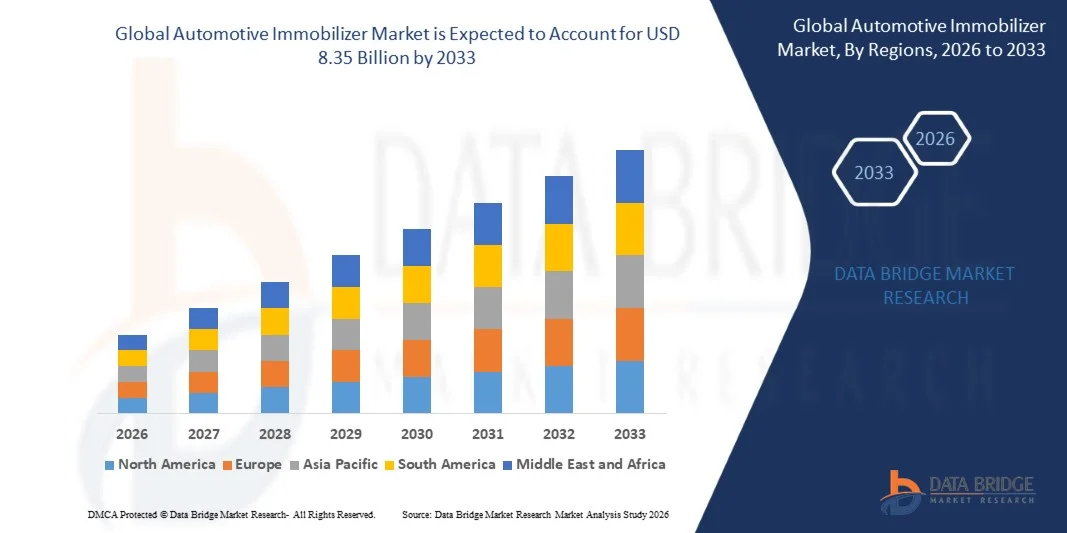
As per Data Bridge Market Research Analysis the automotive immobilizer market was valued at USD 5.20 billion in 2025 and is projected to reach USD 8.35 billion by 2033, growing at a CAGR of 6.10% from 2026 to 2033. Market growth is supported by persistent vehicle-theft concerns, mandatory anti-theft requirements, rising vehicle production, expansion of electric and connected vehicle fleets, and increasing demand for retrofit security solutions across countries where older vehicles were not originally equipped with advanced immobilizers.
An automotive immobilizer prevents unauthorized engine or electric-powertrain activation by verifying a coded key, transponder, digital credential, biometric input, or connected authorization signal. Conventional transponder and rolling-code systems remain widely used because they are established, economical, and compatible with mass-market vehicle platforms. However, the market is gradually moving toward smartphone-based digital keys, Ultra-Wideband localization, biometric authentication, telematics-linked shutdown, and software-defined security that can be updated throughout the vehicle lifecycle.
Market Size & Forecast
- Market Value (2025): USD 5.20 Billion
- Expected Market Value (2033): USD 8.35 Billion
- Forecast CAGR (2026-2035): 6.10%
- Leading Region: Asia-Pacific
- Fastest-Growing Region: North America
Key Market Trends & Insights
- Asia-Pacific dominated the automotive immobilizer market with the largest revenue share of approximately 38.6% in 2025, supported by expanding vehicle production, increasing disposable incomes, and rising awareness regarding vehicle security. Rapid urbanization, growth in passenger vehicle ownership, and expanding automotive manufacturing activities across China, India, Japan, and South Korea are accelerating market demand.
- North America automotive immobilizer market is expected to witness the fastest growth rate from 2026 to 2033, supported by high vehicle ownership rates, strong automotive security regulations, and increasing concerns regarding vehicle theft.
- The transponder/RFID-Based Immobilizer segment held the largest market revenue share of 49.2% in 2025 driven by its widespread use across mass-market passenger vehicles, mature OEM integration, reliable coded-key authentication, and cost-effective compatibility with established vehicle electrical systems. Transponder systems are preferred due to their proven performance, broad supplier base, and ability to prevent engine activation unless the correct coded key is detected.
- The biometric immobilizer segment is projected to register the fastest growth from 2026 to 2033, driven by increasing demand for fingerprint, facial, and voice authentication in premium, connected, and electric vehicles. Rising adoption of multi-factor security, personalized vehicle settings, keyless convenience, and software-integrated access is accelerating segment expansion.
- The OEM segment held the largest market revenue share in 2025 driven by factory integration of immobilizers with engine control units, body control modules, key systems, digital-access functions, and the overall vehicle electrical architecture. OEM systems are preferred due to their high compatibility, regulatory alignment, warranty coverage, and ability to provide integrated security from the time of vehicle manufacture.
- The Aftermarket segment is projected to register the fastest growth from 2026 to 2033, driven by increasing demand for security upgrades across older vehicles, theft-prone models, commercial fleets, and markets with uneven factory-fit penetration. Rising insurance requirements, retrofit programs, GPS-linked immobilization, mobile alerts, and professional installation networks are accelerating segment expansion.
Report Scope and Automotive Immobilizer Market Segmentation
|
Attributes |
Automotive Immobilizer Key Market Insights |
|
Segments Covered |
|
|
Countries Covered |
North America
Europe
Asia-Pacific
Middle East and Africa
South America
|
|
Key Market Players |
|
|
Market Opportunities |
|
|
Value Added Data Infosets |
|
What is the Key Trend in the Automotive Immobilizer Market?
Trend: Growing Adoption of Digital Keys, Biometrics, and Connected Vehicle Security Solutions
Growing demand for enhanced vehicle security, seamless user access, and connected mobility solutions is accelerating the integration of digital keys, biometric authentication, and software-defined immobilizer systems across the automotive industry. Modern immobilizers are increasingly being combined with Bluetooth Low Energy (BLE), Near Field Communication (NFC), Ultra-Wideband (UWB), cloud-based credential management, and smartphone-based access technologies to improve vehicle protection while enhancing user convenience. The rapid expansion of connected vehicles, electric vehicles, shared mobility services, and keyless entry systems is further strengthening demand for advanced immobilization technologies.
For instance, in May 2026, AUMOVIO announced a major contract for its CoSmA digital vehicle-access platform, which combines cloud-based key management, secure digital credentials, and centralized access control for large-scale vehicle deployment beginning in 2028. The development highlights the industry's transition from traditional anti-theft hardware toward fully connected and software-driven vehicle security ecosystems.
The growing adoption of digital keys, biometric authentication, UWB localization technology, and remotely managed vehicle credentials is expected to strengthen long-term demand for advanced automotive immobilizer systems. Manufacturers that combine cybersecurity capabilities, cloud connectivity, mobile interoperability, and secure authentication technologies are expected to gain a competitive advantage as software-defined vehicles become increasingly prevalent.
Automotive Immobilizer Market Dynamics
Key Market Driver: Rising Vehicle Theft Incidents and Increasing Automotive Security Requirements
The market is primarily driven by growing concerns regarding vehicle theft and the increasing need for advanced anti-theft protection across passenger and commercial vehicles. Immobilizers prevent unauthorized engine start by requiring electronically authenticated credentials, significantly reducing the effectiveness of traditional theft methods such as hotwiring and key duplication. Rising vehicle ownership, increasing insurance requirements, and stricter automotive security regulations are further supporting market growth.
For instance, widespread vehicle theft incidents across major automotive markets have encouraged automakers to strengthen factory-installed security systems and expand retrofit security programs. High-profile anti-theft initiatives implemented by several vehicle manufacturers have demonstrated the importance of advanced immobilizer technologies in reducing theft-related risks and protecting vehicle owners.
As vehicle production continues to increase and security standards become more stringent, demand for factory-installed immobilizers, aftermarket security upgrades, and multi-layer vehicle protection systems is expected to remain strong throughout the forecast period.
Key Restraint/Challenge: Cybersecurity Risks and System Reliability Concerns
A major challenge facing the market is the increasing complexity of connected vehicle security systems and the growing exposure to cybersecurity threats. Modern immobilizers rely on wireless communication, mobile applications, cloud connectivity, and electronic control units, creating additional attack surfaces that may be targeted through relay attacks, credential theft, unauthorized software access, or communication vulnerabilities.
In addition, immobilizer malfunctions can prevent legitimate users from starting vehicles, resulting in operational disruptions, repair costs, warranty claims, and customer dissatisfaction. Increasing integration of digital access technologies also requires extensive validation, software maintenance, encryption management, and long-term cybersecurity support throughout the vehicle lifecycle.
Cybersecurity vulnerabilities, system integration complexities, software maintenance requirements, and potential operational failures are expected to remain significant challenges for automotive immobilizer manufacturers throughout the forecast period.
Key Market Opportunity: Expanding Demand from Electric Vehicles, Connected Fleets, and Aftermarket Security Upgrades
Significant growth opportunities are emerging from the rapid adoption of electric vehicles, connected fleet management systems, shared mobility platforms, and aftermarket vehicle security solutions. Electric and software-defined vehicles increasingly integrate immobilization functions with centralized vehicle computers, battery-management systems, cloud-based access controls, and mobile applications, creating new opportunities for advanced authentication technologies.
For instance, AUMOVIO has expanded its digital vehicle-access solutions to support commercial and heavy-duty vehicle applications, enabling fleet operators to remotely manage vehicle access, issue temporary credentials, and improve fleet security through connected authentication systems. Growing demand for telematics-enabled immobilizers, GPS-integrated security solutions, and smartphone-based vehicle access is creating substantial opportunities across both OEM and aftermarket channels.
The continued expansion of electric mobility, connected fleet operations, vehicle-sharing services, and digital-access technologies is expected to create attractive long-term growth opportunities for automotive immobilizer manufacturers during the forecast period.
Automotive Immobilizer Market Scope
The automotive immobilizer market is segmented on the basis of technology, sales channel, and vehicle type,
- By Technology
On the basis of technology, the automotive immobilizer market is divided into transponder/RFID-based immobilizer, rolling code immobilizer, GPS/telematics-integrated immobilizer, OBD-port-based immobilizer, biometric immobilizer, and others. The transponder/RFID-Based Immobilizer segment held the largest market revenue share of 49.2% in 2025 driven by its widespread use across mass-market passenger vehicles, mature OEM integration, reliable coded-key authentication, and cost-effective compatibility with established vehicle electrical systems. Transponder systems are preferred due to their proven performance, broad supplier base, and ability to prevent engine activation unless the correct coded key is detected.
The biometric immobilizer segment is projected to register the fastest growth from 2026 to 2033, driven by increasing demand for fingerprint, facial, and voice authentication in premium, connected, and electric vehicles. Rising adoption of multi-factor security, personalized vehicle settings, keyless convenience, and software-integrated access is accelerating segment expansion.
- By Sales Channel
On the basis of sales channel, the automotive immobilizer market is divided into OEM and aftermarket. The OEM segment held the largest market revenue share in 2025 driven by factory integration of immobilizers with engine control units, body control modules, key systems, digital-access functions, and the overall vehicle electrical architecture. OEM systems are preferred due to their high compatibility, regulatory alignment, warranty coverage, and ability to provide integrated security from the time of vehicle manufacture.
The Aftermarket segment is projected to register the fastest growth from 2026 to 2033, driven by increasing demand for security upgrades across older vehicles, theft-prone models, commercial fleets, and markets with uneven factory-fit penetration. Rising insurance requirements, retrofit programs, GPS-linked immobilization, mobile alerts, and professional installation networks are accelerating segment expansion.
- By Vehicle Type
On the basis of vehicle type, the automotive immobilizer market is divided into passenger vehicles and commercial vehicles. The Passenger Vehicles segment held the largest market revenue share in 2025 driven by high global production volumes, broad factory fitment across hatchbacks, sedans, SUVs, premium cars, and electric vehicles, and strong consumer demand for theft protection and keyless convenience. Passenger-vehicle systems are preferred due to regulatory coverage, high ownership volumes, and continuous integration of smart keys, digital access, and biometric features.
The Commercial Vehicles segment is projected to register the fastest growth from 2026 to 2033, driven by increasing demand for driver identity verification, remote immobilization, temporary access, and telematics-linked fleet security across logistics, delivery, rental, construction, and service operations. Rising fleet digitalization and the need to reduce unauthorized use and asset loss are accelerating segment expansion.
Automotive Immobilizer Market Regional Analysis
Asia-Pacific Automotive Immobilizer Market Insight
The Asia-Pacific dominated the automotive immobilizer market with the largest revenue share of approximately 38.6% in 2025, supported by expanding vehicle production, increasing disposable incomes, and rising awareness regarding vehicle security. Rapid urbanization, growth in passenger vehicle ownership, and expanding automotive manufacturing activities across China, India, Japan, and South Korea are accelerating market demand. Furthermore, increasing government initiatives aimed at improving vehicle safety standards and reducing vehicle theft are supporting wider adoption of immobilizer systems throughout the region.
Japan Automotive Immobilizer Market Insight
The Japan automotive immobilizer market is expected to witness the fastest growth rate from 2026 to 2033 due to the country's advanced automotive industry, high adoption of connected vehicle technologies, and strong focus on vehicle safety. Japanese automakers are increasingly integrating immobilizers with digital access systems, biometric technologies, and advanced cybersecurity features. The growing production of hybrid and electric vehicles, combined with increasing demand for sophisticated anti-theft solutions, is expected to further stimulate market growth across the country.
China Automotive Immobilizer Market Insight
The China automotive immobilizer market accounted for the largest market revenue share in Asia-Pacific in 2025, attributed to the country's position as the world's largest automotive manufacturing and sales market. Rising vehicle ownership, increasing adoption of smart and connected vehicles, and growing consumer awareness regarding vehicle security are major factors supporting market expansion. In addition, government regulations promoting vehicle safety, rapid electric vehicle adoption, and the presence of major domestic and international automotive manufacturers continue to strengthen demand for advanced automotive immobilizer systems in China.
North America Automotive Immobilizer Market Insight
North America automotive immobilizer market is expected to witness the fastest growth rate from 2026 to 2033, supported by high vehicle ownership rates, strong automotive security regulations, and increasing concerns regarding vehicle theft. Consumers and fleet operators across the region are increasingly prioritizing advanced anti-theft technologies that provide enhanced vehicle protection and insurance benefits. The widespread adoption of connected vehicles, keyless entry systems, and advanced driver-assistance technologies further supports demand for sophisticated immobilizer solutions across passenger and commercial vehicles.
U.S. Automotive Immobilizer Market Insight
The U.S. automotive immobilizer market captured the largest revenue share in 2025 within North America, driven by rising vehicle theft incidents and strong demand for factory-installed anti-theft systems. Automakers are increasingly integrating advanced immobilizers with keyless entry, remote vehicle access, and connected-car platforms to improve vehicle security. Growing adoption of electric vehicles, increasing fleet sizes, and rising consumer awareness regarding vehicle protection continue to support market expansion. Furthermore, regulatory requirements and insurance incentives encouraging anti-theft technologies are contributing significantly to market growth.
Europe Automotive Immobilizer Market Insight
The Europe automotive immobilizer market is expected to witness the fastest growth rate from 2026 to 2033, primarily driven by stringent vehicle security regulations, increasing vehicle electrification, and widespread adoption of advanced automotive technologies. The region's strong automotive manufacturing base and growing focus on connected mobility solutions are accelerating demand for next-generation immobilizer systems. Increasing integration of digital keys, encrypted communication systems, and vehicle cybersecurity solutions is further supporting market expansion across both passenger and commercial vehicle segments.
U.K. Automotive Immobilizer Market Insight
The U.K. automotive immobilizer market is expected to witness the fastest growth rate from 2026 to 2033, driven by rising concerns regarding vehicle theft, growing adoption of connected vehicles, and increasing demand for enhanced automotive security systems. The growing penetration of electric vehicles and advanced keyless entry technologies is encouraging manufacturers to deploy more sophisticated immobilization solutions. In addition, the country's mature automotive aftermarket and strong consumer awareness regarding vehicle security continue to support market growth.
Germany Automotive Immobilizer Market Insight
The Germany automotive immobilizer market is expected to witness the fastest growth rate from 2026 to 2033, fueled by the country's strong automotive manufacturing sector and increasing investments in connected and software-defined vehicles. Germany's emphasis on vehicle safety, engineering excellence, and technological innovation is driving adoption of advanced immobilizer systems integrated with digital keys, biometric authentication, and cybersecurity features. The rapid transition toward electric mobility is also creating new opportunities for advanced vehicle access and immobilization technologies.
Which are the Top Companies in Automotive Immobilizer Market?
The automotive immobilizer market is led by well established companies:
- Robert Bosch GmbH (Germany)
- AUMOVIO SE (Germany)
- DENSO Corporation (Japan)
- Valeo SE (France)
- FORVIA HELLA (Germany)
- Lear Corporation (U.S.)
- ZF Friedrichshafen AG (Germany)
- Alps Alpine Co., Ltd. (Japan)
- Tokai Rika Co., Ltd. (Japan)
- AISIN Corporation (Japan)
- Mitsubishi Electric Corporation (Japan)
- Marquardt Group (Germany)
- Huf Hülsbeck & Fürst GmbH & Co. KG (Germany)
Latest Developments in Automotive Immobilizer Market
- In May 2026, AUMOVIO announced a major contract to supply its CoSmA digital vehicle-access system as a complete end-to-end solution, including the cloud backend and centralized key management. A European automaker plans to introduce smartphone-based access across most of its vehicle platforms from 2028, showing how immobilization is moving from an isolated module toward standardized digital credentials and cloud-managed security.
- In June 2025, Continental announced that its CoSmA digital-access system was being supplied for the Audi Q6 e-tron. The solution combines a traditional key with smartphone-based locking and engine-start authorization, while precise UWB location detection is designed to reduce relay-attack risk and strengthen theft protection.
- In December 2024, Thales expanded its vehicle-access portfolio with a CCC-standard digital car key and a contactless NFC CARd Key. The solutions allow drivers to lock, unlock, and start vehicles through a smartphone or secure card, reflecting growing demand for interoperable digital access with a reliable physical backup credential.

- Interactive Data Analysis Dashboard
- Company Analysis Dashboard for high growth potential opportunities
- Research Analyst Access for customization & queries
- Competitor Analysis with Interactive dashboard
- Latest News, Updates & Trend analysis
- Harness the Power of Benchmark Analysis for Comprehensive Competitor Tracking
Data collection and base year analysis are done using data collection modules with large sample sizes. The stage includes obtaining market information or related data through various sources and strategies. It includes examining and planning all the data acquired from the past in advance. It likewise envelops the examination of information inconsistencies seen across different information sources. The market data is analysed and estimated using market statistical and coherent models. Also, market share analysis and key trend analysis are the major success factors in the market report. To know more, please request an analyst call or drop down your inquiry.
The key research methodology used by DBMR research team is data triangulation which involves data mining, analysis of the impact of data variables on the market and primary (industry expert) validation. Data models include Vendor Positioning Grid, Market Time Line Analysis, Market Overview and Guide, Company Positioning Grid, Patent Analysis, Pricing Analysis, Company Market Share Analysis, Standards of Measurement, Global versus Regional and Vendor Share Analysis. To know more about the research methodology, drop in an inquiry to speak to our industry experts.
Data Bridge Market Research is a leader in advanced formative research. We take pride in servicing our existing and new customers with data and analysis that match and suits their goal. The report can be customized to include price trend analysis of target brands understanding the market for additional countries (ask for the list of countries), clinical trial results data, literature review, refurbished market and product base analysis. Market analysis of target competitors can be analyzed from technology-based analysis to market portfolio strategies. We can add as many competitors that you require data about in the format and data style you are looking for. Our team of analysts can also provide you data in crude raw excel files pivot tables (Fact book) or can assist you in creating presentations from the data sets available in the report.













