


What is the Automotive Keyless Entry Systems Market Size and Growth Rate?
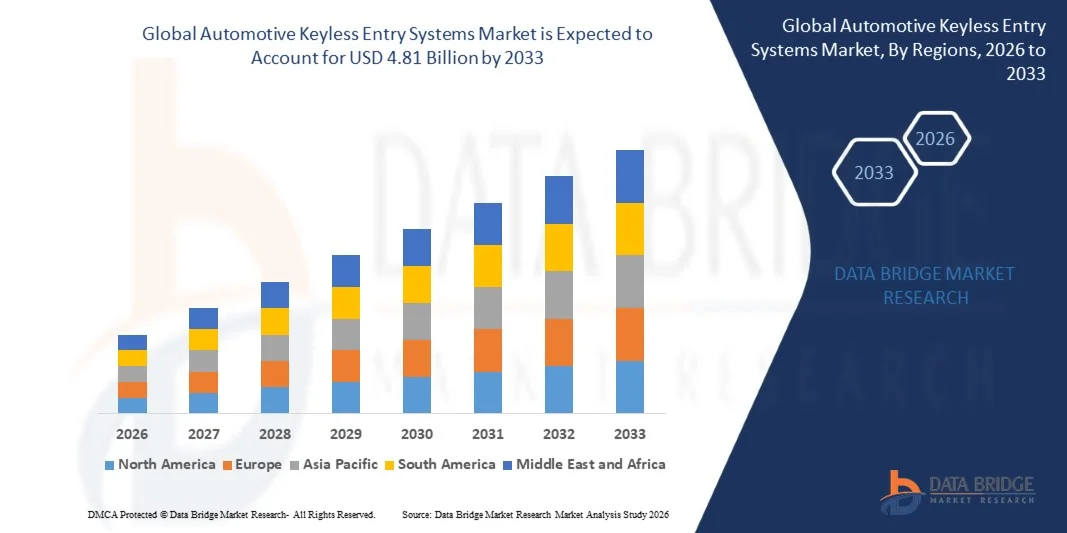
- As per Data Bridge Market Research analysis, the automotive keyless entry systems market was valued at USD 1.85 billion in 2025 and is projected to reach USD 4.81 billion by 2033, growing at a CAGR of 12.7% from 2026 to 2033.
- The market is experiencing rapid growth driven by rising consumer demand for convenience-oriented vehicle access technologies, increasing integration of passive keyless entry and push-button start systems across mid-size and economy vehicle segments, and expanding adoption of smartphone-based digital key solutions.
- The growing shift toward connected and software-defined vehicles, combined with increasing OEM focus on differentiating vehicle access experiences, is compelling automakers to integrate ultra-wideband and Bluetooth-based keyless entry systems that offer enhanced security and seamless hands-free operation.
- Increasing concerns over relay-attack vulnerabilities associated with traditional radio-frequency keyless systems are pushing component suppliers and OEMs to accelerate the transition toward ultra-wideband-based secure ranging technology, which offers significantly improved resistance to signal-relay theft while maintaining the convenience benefits consumers expect.
- The proliferation of software-defined vehicle architectures is further enabling over-the-air updates to keyless entry authentication protocols, allowing automakers to continuously strengthen security measures and add new convenience features without requiring hardware replacement throughout the vehicle's lifecycle.
Market Size & Forecast
- Global Market Value (2025): USD 1.85 Billion
- Expected Market Value (2033): USD 4.81 Billion
- Forecast CAGR (2026–2033): 12.7%
- Leading Region in 2025: Asia-Pacific
- Fastest Growing Region: North America
What are the Major Takeaways of the Automotive Keyless Entry Systems Market?
- Asia-Pacific dominated the global automotive keyless entry systems market with the largest revenue share of 41.36% in 2025, supported by high vehicle production volumes and rapid adoption of convenience electronics across China, Japan, and South Korea.
- North America is expected to be the fastest-growing region at a CAGR of 14.2% from 2026 to 2033, fueled by rising consumer preference for premium convenience features and increasing integration of digital key technology among domestic and international automakers.
- The passive keyless entry segment led the market with a 58.74% share in 2025, driven by growing OEM adoption of hands-free door access and push-button start systems across mid-size and premium vehicle segments.
- The ultra-wideband-based technology segment is the fastest-growing technology category, projected to register a CAGR of 15.6%, reflecting rising demand for relay-attack-resistant secure ranging solutions among premium and connected vehicle platforms.
- The passenger cars vehicle type segment dominated the vehicle type category with a 76.28% revenue share in 2025, led by widespread integration of keyless entry systems across compact, mid-size, and luxury passenger vehicle trims.
- The OEM sales channel accounted for 81.53% of the market share in 2025, preferred for its factory-integrated reliability and seamless compatibility with vehicle immobilizer and security systems.
- The smartphone-based digital key connectivity segment is the fastest-growing connectivity category, with a CAGR of 16.3%, driven by rising automaker partnerships with technology companies to enable phone-as-a-key functionality.
Report Scope and Automotive Keyless Entry Systems Market Segmentation
|
Attributes |
Automotive Keyless Entry Systems Key Market Insights |
|
Segments Covered |
|
|
Countries Covered |
North America
Europe
Asia-Pacific
Middle East and Africa
South America
|
|
Key Market Players |
|
|
Market Opportunities |
|
|
Value Added Data Infosets |
In addition to the insights on market scenarios such as market value, growth rate, segmentation, geographical coverage, and major players, the market reports curated by the Data Bridge Market Research also include in-depth expert analysis, geographically represented company-wise production and capacity, network layouts of distributors and partners, detailed and updated price trend analysis, and deficit analysis of supply chain and demand. |
What is the Key Trend in the Automotive Keyless Entry Systems Market?
- Automotive OEMs are increasingly integrating ultra-wideband-based keyless entry technology to enable precise, secure vehicle-to-key distance ranging, replacing conventional radio-frequency systems that remain vulnerable to relay-attack theft.
- For instance, in April 2025, Continental AG expanded its ultra-wideband access control platform to additional OEM customers in Europe and Asia, offering enhanced anti-theft protection alongside seamless hands-free entry and start functionality.
- Rising adoption of smartphone-based digital key systems is enabling automakers to offer keyless entry and remote vehicle control through mobile applications, eliminating the need for a traditional physical key fob in select vehicle models.
- Automakers and technology companies are increasingly collaborating to standardize digital key protocols, enabling interoperability between vehicles and smartphones across different manufacturer ecosystems.
- For instance, in January 2025, DENSO Corporation partnered with a leading semiconductor supplier to co-develop next-generation ultra-wideband keyless entry modules optimized for compact and mid-size vehicle platforms.
- As automakers continue to prioritize convenience, security, and connected-vehicle differentiation, the adoption of advanced keyless entry systems is expected to accelerate, reinforcing their role as a standard feature across next-generation vehicle platforms.
What are the Key Drivers of the Automotive Keyless Entry Systems Market?
- Rising consumer demand for convenience-oriented vehicle access features, combined with increasing vehicle electrification and growth in connected-car ecosystems, has significantly increased demand for advanced passive keyless entry and remote keyless entry systems.
- For instance, in March 2025, Valeo SA expanded its keyless entry system production capacity in Europe to meet rising demand from automakers integrating hands-free access features across mid-size and premium vehicle segments.
- Automotive OEMs are increasingly incorporating keyless entry systems into standard and mid-tier vehicle trims to differentiate their offerings, reduce perceived ownership friction, and align with evolving consumer expectations around vehicle convenience.
- For instance, in October 2024, Huf Hülsbeck & Fürst announced an investment in additional manufacturing capacity for Bluetooth-based access control modules to support rising orders from automotive customers in North America and Asia.
- With the automotive industry increasingly prioritizing connected, convenience-driven ownership experiences, automotive keyless entry systems will remain indispensable for delivering secure, seamless vehicle access across passenger and commercial vehicle segments.
- For instance, in June 2024, Aptiv PLC expanded its partnership with a global automaker to co-develop integrated digital key and passive entry architecture for next-generation electric vehicle platforms.
- Therefore, as software-defined architectures and smartphone integration redefine modern mobility, the transition from legacy fobs to advanced protocols like Ultra-Wideband (UWB) and Bluetooth Low Energy (BLE) will solidify keyless entry systems as foundational components of vehicle security, connectivity, and user experience.
Which Factors are Challenging the Growth of the Automotive Keyless Entry Systems Market?
- Automotive keyless entry systems remain vulnerable to relay-attack and signal-amplification theft techniques, raising security concerns among consumers and prompting increased scrutiny from insurers and regulatory bodies regarding vehicle theft prevention.
- These security vulnerabilities and the additional cost of implementing advanced countermeasures such as ultra-wideband ranging limit adoption among cost-sensitive vehicle segments and constrain the pace of technology upgrades among smaller component suppliers.
- For instance, in September 2024, the German Insurance Association (GDV) highlighted surging vehicle theft claims driven by electronic relay attacks, prompting European automakers to fast-track security upgrades across their keyless entry portfolios.
- The additional hardware and integration costs associated with advanced keyless entry technologies, including ultra-wideband modules and digital key infrastructure, continue to restrict adoption in entry-level and price-sensitive vehicle segments. This cost barrier slows market penetration in emerging regions, limiting the widespread deployment of advanced keyless access technologies despite growing consumer demand.
- Additionally, the complexity of ensuring cross-platform interoperability between smartphone-based digital key systems and diverse vehicle architectures continues to create integration challenges for automakers pursuing broad ecosystem compatibility.
- Regulatory fragmentation across regions regarding wireless spectrum allocation for ultra-wideband and Bluetooth-based automotive access systems further complicates global platform standardization, requiring component suppliers to develop region-specific hardware variants that increase overall development and certification costs.
How is the Automotive Keyless Entry Systems Market Segmented?
The automotive keyless entry systems market is segmented on the basis of type, component, technology, vehicle type, propulsion type, application, sales channel, vehicle class, connectivity and end user.
- By Type
On the basis of type, the global automotive keyless entry systems market is segmented into passive keyless entry and remote keyless entry. The passive keyless entry segment dominated the market with a 58.74% share in 2025, owing to growing OEM adoption of hands-free door access and push-button start systems across mid-size and premium vehicle segments. These systems deliver seamless, effortless vehicle access, making them the preferred choice for automakers seeking to enhance the overall ownership experience.
The remote keyless entry segment, while more mature, continues to hold significant share in entry-level and price-sensitive vehicle segments, supported by its lower cost structure and proven reliability across decades of automotive deployment. Continued innovation in remote keyless entry encryption protocols is helping extend its relevance even as passive systems gain broader adoption across higher vehicle trims.
- By Component
On the basis of component, the global automotive keyless entry systems market is segmented into electronic control unit, antenna, receiver, transmitter/key fob, and sensors. The electronic control unit segment led the market with a 31.62% share in 2025, supported by its central role in processing authentication signals and coordinating vehicle access and ignition functions.
The sensors segment is expected to experience the fastest growth at a CAGR of 14.8% from 2026 to 2033, driven by increasing integration of proximity and capacitive sensors that enable touch-free door handle activation and enhanced passive entry responsiveness.
- By Technology
On the basis of technology, the global automotive keyless entry systems market is segmented into RFID-based, Bluetooth-based, NFC-based, and ultra-wideband-based. The RFID-based segment dominated the market with a share of 44.85% in 2025 due to its widespread legacy adoption across existing passive and remote keyless entry systems, proven reliability, and cost-effective integration. Additionally, established supplier ecosystems and mature manufacturing processes further support the continued adoption of RFID-based keyless entry technology.
The ultra-wideband-based segment is anticipated to witness the fastest CAGR of 15.6% from 2026 to 2033, driven by the increasing need for relay-attack-resistant secure ranging technology among premium and connected vehicle platforms. Automakers are adopting ultra-wideband modules to conduct precise, tamper-resistant distance measurement between the key and vehicle. Additionally, the integration of ultra-wideband technology with smartphone-based digital key ecosystems is enhancing the security and convenience of next-generation vehicle access systems, further driving segment growth.
- By Vehicle Type
On the basis of vehicle type, the global automotive keyless entry systems market is segmented into passenger cars, light commercial vehicles, and heavy commercial vehicles. The passenger cars segment dominated the market with a share of 76.28% in 2025 due to its critical role in delivering convenience-focused ownership experiences, high production volumes, and broad OEM adoption across compact, mid-size, and luxury trims. The widespread integration of passive keyless entry and digital key technologies across passenger vehicle platforms is driving strong demand for keyless entry solutions.
The light commercial vehicles segment is expected to witness the fastest CAGR of 13.9% from 2026 to 2033, driven by the rising need for secure, convenient fleet-vehicle access solutions among logistics and delivery fleet operators. Fleet management companies are increasingly integrating keyless entry and digital key systems to streamline vehicle-sharing and multi-driver access scenarios. Additionally, the growing emphasis on operational efficiency in commercial fleet operations is further accelerating adoption of keyless entry technology in this vehicle segment.
- By Propulsion Type
On the basis of propulsion type, the global automotive keyless entry systems market is segmented into ICE vehicles, electric vehicles, and hybrid vehicles. The ICE vehicles segment dominated the market with a share of 61.47% in 2025 due to its critical role in representing the largest share of global vehicle production and existing installed base. High adoption is driven by the increasing need for convenience-focused access solutions across mainstream internal-combustion vehicle platforms, integration with existing immobilizer systems, and enhanced production accuracy. Additionally, growing investment by automotive OEMs and Tier-1 suppliers to improve keyless entry adoption across mass-market ICE vehicle segments is reinforcing the leading position of this segment in the market.
The electric vehicles segment is expected to witness the fastest CAGR of 17.4% from 2026 to 2033. This growth is driven by increasing electric vehicle production volumes and strong OEM emphasis on integrating premium, technology-forward convenience features, including ultra-wideband keyless entry and digital key systems, as standard offerings. Growing consumer expectations for connected, software-defined ownership experiences in electric vehicles is further accelerating market expansion in this segment.
- By Application
On the basis of application, the global automotive keyless entry systems market is segmented into doors, trunk, ignition/engine start, and others. The doors segment dominated the market with a share of 48.93% in 2025 due to its widespread use as the primary and most frequently used keyless entry application, providing hands-free access convenience for daily vehicle use. Rising adoption of capacitive touch sensors, proximity detection, and automated door-handle deployment is enabling automakers to enhance user experience, improve perceived vehicle quality, and optimize convenience-feature differentiation. Additionally, increasing investment by automotive OEMs and component suppliers is accelerating adoption and reinforcing this segment's leading position in the market.
The ignition/engine start segment is expected to witness the fastest CAGR of 14.1% from 2026 to 2033, driven by the increasing integration of push-button start systems as a standard convenience feature across mid-size and economy vehicle trims. These systems enhance user convenience, reduce mechanical key-related wear, and allow seamless integration with passive entry authentication, making keyless ignition systems more accessible, desirable, and valuable for mainstream vehicle buyers.
- By Sales Channel
On the basis of sales channel, the global automotive keyless entry systems market is segmented into OEM and aftermarket. The OEM segment dominated the market with a share of 81.53% in 2025 due to its widespread adoption in factory-integrated vehicle production, which requires seamless compatibility with vehicle immobilizer, security, and infotainment systems. High adoption is supported by automakers and Tier-1 suppliers that rely on integrated OEM production lines to ensure consistency, reliability, and measurable quality outcomes. Additionally, increasing integration with vehicle-wide electronic architecture and cybersecurity protocols enhances system reliability and reinforces the dominance of the OEM sales channel segment.
The aftermarket segment is expected to witness the fastest CAGR of 13.2% from 2026 to 2033. This growth is primarily driven by the increasing demand for keyless entry retrofit and upgrade solutions among owners of older vehicle models seeking enhanced convenience and security features. By offering accessible, cost-effective retrofit kits, this channel enhances vehicle functionality, owner satisfaction, and resale value, making it highly attractive for aftermarket accessory retailers and independent installers.
- By Vehicle Class
On the basis of vehicle class, the global automotive keyless entry systems market is segmented into economy, mid-size, and luxury. The luxury segment dominated the market with a share of 39.76% in 2025 due to its critical role in offering premium, technology-forward convenience features as a standard differentiator across high-end vehicle trims. Additionally, established partnerships between luxury automakers, component suppliers, and semiconductor providers are expanding reach, improving system sophistication, and reinforcing the adoption of advanced keyless entry solutions across global luxury vehicle markets.
The economy segment is expected to witness the fastest CAGR of 16.8% from 2026 to 2033. This growth is primarily driven by the increasing consumer expectation for convenience features previously limited to premium vehicles, now becoming standard across entry-level and budget vehicle trims. Automakers and component suppliers are leveraging cost-optimized RFID and Bluetooth-based keyless entry modules to enhance affordability, enable broader feature accessibility, and support mass-market adoption across price-sensitive vehicle segments.
- By Connectivity
On the basis of connectivity, the global automotive keyless entry systems market is segmented into smartphone-based digital key and traditional key fob. The traditional key fob segment dominated the market with a share of 68.24% in 2025 due to its preference among the largest base of vehicle owners accustomed to established, reliable, and widely compatible keyless entry hardware. Additionally, established manufacturing infrastructure, broad OEM supplier familiarity, and extensive field-reliability history are facilitating continued adoption of traditional key fobs, while strong dealership support networks are improving accessibility, reliability, and trust, further reinforcing this segment's leading market position.
The smartphone-based digital key segment is expected to witness the fastest CAGR of 16.3% from 2026 to 2033. This growth is primarily driven by the increasing automaker partnerships with smartphone manufacturers and technology platforms to enable phone-as-a-key functionality. Developers and automotive OEMs are leveraging near-field communication and ultra-wideband protocols to enhance convenience, enable keyless sharing among multiple users, and support next-generation connected-vehicle ownership experiences, thereby accelerating adoption across premium and technology-forward vehicle segments.
- By End User
On the basis of end user, the global automotive keyless entry systems market is segmented into individual/retail and fleet operators. The individual/retail segment dominated the market with a share of 84.19% in 2025 due to its preference among the largest base of private vehicle owners seeking enhanced convenience, security, and ownership experience across personal passenger vehicles. Additionally, established dealership networks, OEM marketing of convenience features, and consumer demand for technology-forward vehicles are facilitating continued adoption of keyless entry systems among individual buyers, while strong OEM support networks are improving accessibility, reliability, and trust, further reinforcing this segment's leading market position.
The fleet operators segment is expected to witness the fastest CAGR of 14.6% from 2026 to 2033. This growth is primarily driven by the increasing adoption of digital key and multi-user access solutions among logistics, ride-sharing, and corporate fleet operators seeking to streamline vehicle-sharing and reduce physical key management overhead. These solutions enhance operational efficiency, reduce administrative burden, and allow centralized access management, making keyless entry systems more accessible, scalable, and valuable for fleet management applications.
Which Region Holds the Largest Share of the Automotive Keyless Entry Systems Market?
- Asia-Pacific dominated the automotive keyless entry systems market and accounted for the largest revenue share of 41.36% in 2025, supported by high vehicle production volumes, strong presence of component manufacturers, and rapid adoption of convenience electronics across China, Japan, and South Korea.
- The region also benefits from cost-competitive component manufacturing, high adoption of automated production and quality-inspection platforms, and growing use of keyless entry systems across passenger vehicle and electric vehicle production applications. Increasing focus on export-oriented vehicle manufacturing and rising domestic vehicle ownership continues to strengthen Asia-Pacific's leadership position in the global market.
China Automotive Keyless Entry Systems Market Insight
China automotive keyless entry systems market is growing rapidly, driven by increasing vehicle production, expanding electric vehicle manufacturing infrastructure, and rising consumer demand for technology-forward convenience features. Growing adoption of ultra-wideband and Bluetooth-based keyless entry modules across passenger vehicle and electric vehicle sectors is significantly boosting market demand. In addition, rising investments in domestic semiconductor and component manufacturing capacity, increasing export-oriented production, and rapid technological advancements are positioning China as one of the fastest-growing markets for automotive keyless entry systems globally.
Japan Automotive Keyless Entry Systems Market Insight
The Japan automotive keyless entry systems market is witnessing consistent growth due to rising investments in advanced vehicle access technologies, precision manufacturing innovation, and strong domestic automaker adoption of premium convenience features. Automotive manufacturers, component suppliers, and research institutes are increasingly adopting high-precision ultra-wideband and passive entry systems for passenger and hybrid vehicle applications. Moreover, increasing integration of digital key ecosystems and the country's focus on quality and reliability are further contributing to market growth.
Europe Automotive Keyless Entry Systems Market Insight
Europe’s automotive keyless entry systems market is supported by strong automotive manufacturing, increasing vehicle connectivity, electrification, and rising demand for advanced safety and convenience features. Germany, the U.K., and France are important markets, while automakers increasingly integrate passive keyless entry, smartphone digital keys, UWB, Bluetooth, and NFC technologies. Stringent vehicle safety and cybersecurity requirements, premium-vehicle adoption, and growing consumer awareness of advanced access technologies are also supporting regional market growth.
Germany Automotive Keyless Entry Systems Market Insight
The Germany automotive keyless entry systems market is expanding steadily due to the country's strong automotive manufacturing base, advanced component engineering capabilities, and increasing adoption of next-generation ultra-wideband and digital key technologies. Automotive companies, component suppliers, and research institutes are increasingly utilizing keyless entry technologies for premium and luxury vehicle segments. Continuous advancements in secure ranging technology, process automation, and cybersecurity protocols, along with strong government focus on vehicle theft prevention, are further driving market growth in Germany.
U.K. Automotive Keyless Entry Systems Market Insight
The U.K. automotive keyless entry systems market is driven by rising vehicle-security concerns, growing consumer preference for convenience, increasing adoption of connected and electric vehicles, and the integration of smartphone-based digital keys. Advances in Bluetooth, NFC, and UWB technologies are supporting more secure and seamless vehicle access. Strong aftermarket demand, automotive technology development, and growing awareness of advanced anti-theft solutions are further contributing to market expansion.
Which are the Top Companies in Automotive Keyless Entry Systems Market?
The automotive keyless entry systems industry is primarily led by well-established companies, including:
- Continental AG (Germany)
- Robert Bosch GmbH (Germany)
- DENSO Corporation (Japan)
- Valeo SA (France)
- Forvia HELLA GmbH & Co. KGaA (Germany)
- Alps Alpine Co., Ltd. (Japan)
- Tokai Rika Co., Ltd. (Japan)
- Mitsubishi Electric Corporation (Japan)
- Kiekert AG (Germany)
- U-Shin Ltd. (Alpha Corporation) (Japan)
- Marquardt GmbH (Germany)
- Huf Hülsbeck & Fürst GmbH & Co. KG (Germany)
- Lear Corporation (U.S.)
- Aptiv PLC (Ireland)
- Magna International Inc. (Canada)
- ZF Friedrichshafen AG (Germany)
- Gentex Corporation (U.S.)
- STRATTEC Security Corporation (U.S.)
- WITTE Automotive GmbH (Germany)
- NXP Semiconductors N.V. (Netherlands)
- Infineon Technologies AG (Germany)
- STMicroelectronics N.V. (Switzerland)
- Texas Instruments Incorporated (U.S.)
- Panasonic Corporation (Japan)
- Voxx International Corporation (U.S.)
- Directed, LLC (U.S.)
- Compustar (U.S.)
- Omega Research and Development, Inc. (U.S.)
- Shenzhen Xhorse Electronics Co., Ltd. (China)
- Neusoft Corporation (China)
What are Latest Developments in Automotive Keyless Entry Systems Market?
- In September 2025, Continental AG launched a next-generation ultra-wideband access control module for global OEM customers, adding relay-attack-resistant secure ranging capability and strengthening its position in premium and electric vehicle platforms.
- In February 2025, DENSO Corporation expanded its keyless entry component manufacturing capacity in Asia to support growing demand for passive entry and digital key systems from regional automakers.
- In November 2025, Huf Hülsbeck & Fürst introduced an upgraded Bluetooth and ultra-wideband hybrid keyless entry platform optimized for mid-size and economy vehicle segments, improving affordability and dimensional accuracy for compact vehicle integration. This development strengthens Huf's position in the keyless entry market by enabling automakers to offer premium convenience features across broader vehicle price points.
- In October 2024, Aptiv PLC introduced a new digital key software platform enabling cross-manufacturer smartphone-based vehicle access, offering improved interoperability for automakers pursuing connected-vehicle ecosystems.
- In June 2023, NXP Semiconductors partnered with an automotive Tier-1 supplier to co-develop ultra-wideband secure ranging chipsets for next-generation keyless entry systems, combining its semiconductor expertise with the partner's automotive systems integration capabilities to support high-precision, high-security vehicle access development.

- Interactive Data Analysis Dashboard
- Company Analysis Dashboard for high growth potential opportunities
- Research Analyst Access for customization & queries
- Competitor Analysis with Interactive dashboard
- Latest News, Updates & Trend analysis
- Harness the Power of Benchmark Analysis for Comprehensive Competitor Tracking
Data collection and base year analysis are done using data collection modules with large sample sizes. The stage includes obtaining market information or related data through various sources and strategies. It includes examining and planning all the data acquired from the past in advance. It likewise envelops the examination of information inconsistencies seen across different information sources. The market data is analysed and estimated using market statistical and coherent models. Also, market share analysis and key trend analysis are the major success factors in the market report. To know more, please request an analyst call or drop down your inquiry.
The key research methodology used by DBMR research team is data triangulation which involves data mining, analysis of the impact of data variables on the market and primary (industry expert) validation. Data models include Vendor Positioning Grid, Market Time Line Analysis, Market Overview and Guide, Company Positioning Grid, Patent Analysis, Pricing Analysis, Company Market Share Analysis, Standards of Measurement, Global versus Regional and Vendor Share Analysis. To know more about the research methodology, drop in an inquiry to speak to our industry experts.
Data Bridge Market Research is a leader in advanced formative research. We take pride in servicing our existing and new customers with data and analysis that match and suits their goal. The report can be customized to include price trend analysis of target brands understanding the market for additional countries (ask for the list of countries), clinical trial results data, literature review, refurbished market and product base analysis. Market analysis of target competitors can be analyzed from technology-based analysis to market portfolio strategies. We can add as many competitors that you require data about in the format and data style you are looking for. Our team of analysts can also provide you data in crude raw excel files pivot tables (Fact book) or can assist you in creating presentations from the data sets available in the report.













