


Automotive Motor Oil Market Size
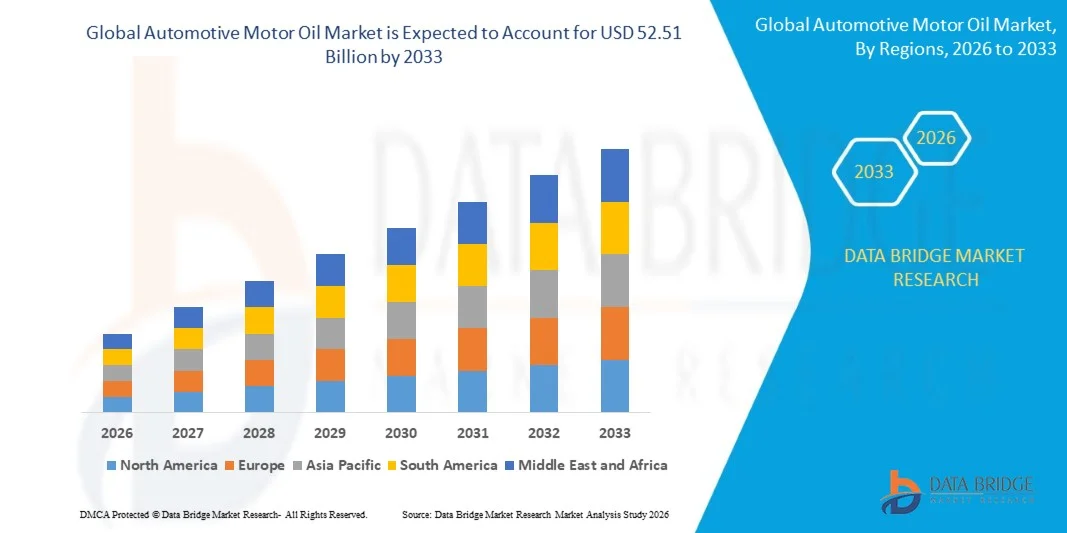
- The global automotive motor oil market size was valued at USD 40.81 billion in 2025 and is expected to reach USD 52.51 billion by 2033, at a CAGR of 3.20% during the forecast period
- The market growth is largely fuelled by the increasing global vehicle parc and rising demand for high-performance lubricants that enhance engine efficiency and durability
- Growing adoption of synthetic and semi-synthetic motor oils is supporting market expansion, as these products provide improved viscosity stability, better temperature resistance, and longer oil change intervals
Automotive Motor Oil Market Analysis
- The market is experiencing steady growth driven by continuous advancements in lubricant technology and the increasing focus on improving fuel efficiency and reducing engine wear in modern vehicles
- Expanding automotive fleets, growth in transportation activities, and increasing awareness regarding timely vehicle maintenance are further supporting the demand for automotive motor oil in both aftermarket and OEM segments
- North America dominated the automotive motor oil market with the largest revenue share of 39.85% in 2025, driven by the presence of a large vehicle fleet, high vehicle ownership rates, and strong demand for regular automotive maintenance services
- Asia-Pacific region is expected to witness the highest growth rate in the global automotive motor oil market, driven by expanding automotive production, growing transportation activities, and rising disposable incomes across emerging economies such as China, India, and Southeast Asian countries
- The Full-synthetic Oil segment held the largest market revenue share in 2025 driven by its superior lubrication properties, better engine protection, and ability to perform efficiently under extreme temperatures. Full-synthetic motor oils are widely preferred for modern engines due to their longer oil change intervals, improved fuel efficiency, and enhanced durability, making them a popular choice among vehicle owners and automotive service providers
Report Scope and Automotive Motor Oil Market Segmentation
|
Attributes |
Automotive Motor Oil Key Market Insights |
|
Segments Covered |
|
|
Countries Covered |
North America
Europe
Asia-Pacific
Middle East and Africa
South America
|
|
Key Market Players |
• Royal Dutch Shell plc (U.K.) |
|
Market Opportunities |
• Growing Adoption Of Synthetic And High-Performance Lubricants |
|
Value Added Data Infosets |
In addition to the insights on market scenarios such as market value, growth rate, segmentation, geographical coverage, and major players, the market reports curated by the Data Bridge Market Research also include in-depth expert analysis, geographically represented company-wise production and capacity, network layouts of distributors and partners, detailed and updated price trend analysis and deficit analysis of supply chain and demand. |
Automotive Motor Oil Market Trends
“Increasing Demand for High-Performance and Synthetic Motor Oils”
• The growing focus on improving engine efficiency and vehicle performance is significantly shaping the automotive motor oil market, as vehicle owners increasingly prefer lubricants that provide enhanced protection, reduced engine wear, and improved fuel efficiency. High-performance and synthetic motor oils are gaining traction due to their ability to withstand extreme temperatures, maintain viscosity stability, and extend engine life. This trend is encouraging lubricant manufacturers to develop advanced formulations that meet evolving vehicle engine requirements and regulatory standards
• Rising global vehicle ownership and expanding automotive fleets have accelerated the demand for automotive motor oils across passenger cars, commercial vehicles, and two-wheelers. Vehicle owners are increasingly recognizing the importance of routine engine maintenance and timely oil replacement to ensure optimal performance and durability. This trend is strengthening the demand for premium lubricants and supporting growth in the automotive aftermarket sector
• Technological advancements in engine design and lubricant formulation are influencing purchasing decisions, with manufacturers emphasizing improved fuel economy, reduced emissions, and extended oil drain intervals. These innovations are helping automotive motor oil brands differentiate their products in a competitive market while supporting compliance with increasingly stringent environmental regulations. Companies are also investing in marketing campaigns that highlight engine protection, performance reliability, and long-term cost efficiency
• For instance, in 2024, Shell in the Netherlands and ExxonMobil in the U.S. expanded their automotive motor oil product portfolios by introducing advanced synthetic lubricants designed for modern engines and hybrid vehicles. These products were launched across retail, service centers, and automotive workshops to address rising demand for high-performance engine oils. The lubricants were also promoted for their ability to enhance fuel efficiency and reduce engine wear, strengthening brand loyalty among vehicle owners
• While demand for advanced motor oils is increasing, sustained market expansion depends on continuous product innovation, regulatory compliance, and cost-effective manufacturing. Companies are also focusing on improving distribution networks, strengthening supply chain efficiency, and developing environmentally friendly lubricant solutions that balance performance, cost, and sustainability
Automotive Motor Oil Market Dynamics
Driver
“Rising Global Vehicle Parc and Demand for Engine Protection”
• Increasing global vehicle ownership is a major driver for the automotive motor oil market. Passenger vehicles, commercial trucks, and two-wheelers require regular lubrication to ensure engine performance and prevent mechanical wear. As the number of vehicles on the road continues to grow, the demand for reliable motor oils that enhance engine life and performance is also expanding significantly
• Expanding automotive maintenance activities across service stations, repair workshops, and authorized dealerships are influencing market growth. Automotive motor oils help maintain optimal engine temperature, reduce friction between moving parts, and improve fuel efficiency. The growing awareness among vehicle owners about preventive maintenance further reinforces the importance of regular oil replacement
• Automotive lubricant manufacturers are actively promoting advanced motor oil formulations through product innovation, brand marketing, and collaborations with automotive manufacturers. These efforts are supported by the increasing consumer focus on vehicle performance, reliability, and long-term cost savings. Partnerships between lubricant producers and automobile companies are also strengthening product credibility and market reach
• For instance, in 2023, BP in the U.K. and TotalEnergies in France reported expanded production and distribution of advanced automotive motor oils to meet rising global demand from passenger and commercial vehicle segments. These initiatives were introduced to support growing vehicle fleets and increasing maintenance requirements. Both companies emphasized improved engine protection and extended oil drain intervals to attract a wider consumer base
• Although increasing vehicle ownership supports market growth, long-term expansion depends on technological advancements in lubricant formulations, efficient supply chain management, and adaptation to evolving automotive engine technologies
Restraint/Challenge
“Growing Adoption of Electric Vehicles Reducing Lubricant Demand”
• The increasing adoption of electric vehicles (EVs) presents a key challenge for the automotive motor oil market, as electric powertrains do not require traditional engine lubrication. As governments and consumers shift toward electric mobility to reduce carbon emissions, the long-term demand for conventional automotive motor oils may experience gradual pressure in certain markets
• Environmental regulations and emission standards are also influencing the automotive industry, encouraging automakers to develop energy-efficient and alternative powertrain technologies. These developments are gradually transforming the vehicle landscape, which may affect the consumption patterns of engine lubricants over time
• Market participants also face challenges related to fluctuating crude oil prices and raw material availability, which can impact the production costs of base oils and lubricant additives. Supply chain disruptions and increasing regulatory scrutiny regarding environmental impact can further create operational complexities for lubricant manufacturers
• For instance, in 2024, automotive industry associations in Germany and Norway reported rising electric vehicle adoption across passenger vehicle segments, leading to a gradual shift in lubricant demand patterns. Service centers and lubricant distributors observed slower growth in engine oil replacement cycles in regions with higher EV penetration. These changes are prompting lubricant manufacturers to diversify product portfolios and explore new fluid technologies
• Addressing these challenges will require continuous innovation in lubricant technologies, expansion into specialized fluids for hybrid and electric vehicles, and strategic investments in sustainable product development. Strengthening distribution networks and adapting to evolving mobility trends will also be essential for maintaining growth in the global automotive motor oil market
Automotive Motor Oil Market Scope
The market is segmented on the basis of product and application.
• By Product
On the basis of product, the automotive motor oil market is segmented into Conventional Oil, Full-synthetic Oil, and Synthetic-blend Oil. The Full-synthetic Oil segment held the largest market revenue share in 2025 driven by its superior lubrication properties, better engine protection, and ability to perform efficiently under extreme temperatures. Full-synthetic motor oils are widely preferred for modern engines due to their longer oil change intervals, improved fuel efficiency, and enhanced durability, making them a popular choice among vehicle owners and automotive service providers.
The Synthetic-blend Oil segment is expected to witness the fastest growth rate from 2026 to 2033, driven by its balanced combination of performance and affordability. Synthetic-blend oils provide improved protection compared to conventional oils while remaining more cost-effective than fully synthetic options. These oils are increasingly adopted across passenger vehicles and light commercial vehicles where moderate performance enhancement and cost efficiency are key considerations.
• By Application
On the basis of application, the automotive motor oil market is segmented into Passenger Vehicle and Commercial Vehicle. The Passenger Vehicle segment held the largest market revenue share in 2025 driven by the high global ownership of passenger cars and the increasing need for regular vehicle maintenance and engine lubrication. Rising urbanization, growing middle-class populations, and expanding automotive sales are contributing to the increasing consumption of motor oil in passenger vehicles worldwide.
The Commercial Vehicle segment is expected to witness the fastest growth rate from 2026 to 2033, driven by the expansion of logistics, transportation, and e-commerce industries. Commercial vehicles such as trucks and buses require frequent engine maintenance and lubrication due to heavy usage and long-distance operations, which significantly increases the demand for high-performance motor oils in this segment.
Automotive Motor Oil Market Regional Analysis
• North America dominated the automotive motor oil market with the largest revenue share of 39.85% in 2025, driven by the presence of a large vehicle fleet, high vehicle ownership rates, and strong demand for regular automotive maintenance services
• Consumers and fleet operators in the region highly prioritize engine performance, reliability, and vehicle longevity, increasing the demand for high-quality motor oils and advanced lubricant formulations
• This widespread adoption is further supported by well-established automotive service networks, high disposable incomes, and growing awareness regarding preventive vehicle maintenance, positioning automotive motor oils as essential products for both passenger and commercial vehicle segments
U.S. Automotive Motor Oil Market Insight
The U.S. automotive motor oil market captured the largest revenue share in 2025 within North America, fueled by the presence of a large automotive fleet and strong demand for vehicle maintenance products. Consumers and fleet operators are increasingly focusing on engine protection and improved fuel efficiency through the use of advanced synthetic and high-performance motor oils. The growing number of service centers, repair workshops, and quick-lube outlets further supports the demand for motor oils across passenger and commercial vehicle segments. Moreover, continuous technological advancements in lubricant formulations are strengthening market expansion in the country.
Europe Automotive Motor Oil Market Insight
The Europe automotive motor oil market is expected to witness the fastest growth rate from 2026 to 2033, primarily driven by increasing automotive ownership, strong environmental regulations, and rising demand for high-performance lubricants. The growing focus on improving vehicle efficiency and reducing engine emissions is encouraging the adoption of advanced motor oils across the region. European consumers are also increasingly opting for premium synthetic oils to ensure better engine protection and extended service intervals.
U.K. Automotive Motor Oil Market Insight
The U.K. automotive motor oil market is expected to witness the fastest growth rate from 2026 to 2033, driven by increasing vehicle usage, expanding transportation activities, and growing awareness regarding routine vehicle maintenance. The country’s well-developed automotive service infrastructure, combined with the rising adoption of synthetic motor oils, is supporting market growth. In addition, the increasing focus on fuel efficiency and engine durability among vehicle owners is contributing to the demand for high-quality automotive lubricants.
Germany Automotive Motor Oil Market Insight
The Germany automotive motor oil market is expected to witness the fastest growth rate from 2026 to 2033, fueled by the country’s strong automotive industry and high demand for advanced vehicle maintenance solutions. Germany’s emphasis on engineering excellence and automotive innovation supports the adoption of premium lubricants designed to enhance engine performance and reduce mechanical wear. The presence of leading automobile manufacturers and well-established automotive service networks further strengthens the demand for motor oils in the country.
Asia-Pacific Automotive Motor Oil Market Insight
The Asia-Pacific automotive motor oil market is expected to witness the fastest growth rate from 2026 to 2033, driven by increasing vehicle ownership, rapid urbanization, and expanding transportation activities in countries such as China, Japan, and India. The growing middle-class population and rising disposable incomes are encouraging higher automotive sales and vehicle usage across the region. In addition, the expansion of automotive service networks and aftermarket distribution channels is contributing to the increasing consumption of motor oils.
Japan Automotive Motor Oil Market Insight
The Japan automotive motor oil market is expected to witness the fastest growth rate from 2026 to 2033 due to the country’s advanced automotive technology and strong focus on vehicle efficiency and reliability. Japanese consumers emphasize regular vehicle maintenance and high-quality lubricants to ensure optimal engine performance. The presence of major automobile manufacturers and the widespread adoption of advanced engine technologies are also supporting demand for high-performance motor oils.
China Automotive Motor Oil Market Insight
The China automotive motor oil market accounted for the largest market revenue share in Asia-Pacific in 2025, attributed to the country’s large automotive fleet, rapid urbanization, and expanding transportation and logistics industries. China is one of the largest automobile markets globally, with increasing demand for both passenger and commercial vehicles. The expansion of automotive service centers, rising vehicle maintenance awareness, and strong domestic lubricant production are key factors driving the automotive motor oil market in China.
Automotive Motor Oil Market Share
The Automotive Motor Oil industry is primarily led by well-established companies, including:
• Royal Dutch Shell plc (U.K.)
• Exxon Mobil Corporation (U.S.)
• bp p.l.c. (U.K.)
• TotalEnergies SE (France)
• Chevron Corporation (U.S.)
• FUCHS SE (Germany)
• Idemitsu Kosan Co., Ltd. (Japan)
• JX Nippon Oil & Gas Exploration Corporation (Japan)
• SK Lubricants Co., Ltd. (South Korea)
• Hyundai Oilbank (South Korea)
• Sinopec (China)
• China National Petroleum Corporation (China)
• Donghao Lansheng (Group) Co., Ltd. (China)
• LUKOIL (Russia)
• Amsoil, Inc. (U.S.)
• Castrol Limited (U.K.)
• Petroliam Nasional Berhad (PETRONAS) (Malaysia)
• Pennzoil (U.S.)
Latest Developments in Global Automotive Motor Oil Market
- In June 2022, In June 2022, ExxonMobil announced an investment of approximately USD 900 million to establish a new lubricant manufacturing plant in India. The facility is expected to produce a wide range of synthetic and conventional lubricants tailored for the growing automotive market in the region. The plant is scheduled to become operational by 2025 and will strengthen the company’s regional production capacity. This investment will enhance supply chain efficiency and reduce reliance on imports. The development supports the increasing demand for high-performance automotive lubricants in emerging markets. It is also expected to improve market competitiveness and support long-term growth in the automotive motor oil industry
- In May 2023, In May 2023, Valvoline announced the acquisition of CST Brands in a deal valued at approximately USD 2.5 billion. Through this acquisition, Valvoline aims to expand its retail distribution network by gaining access to more than 1,100 convenience stores and fuel retail locations. This strategic move will allow the company to directly offer its lubricant and automotive maintenance products to a broader consumer base. The acquisition strengthens Valvoline’s presence in the automotive aftermarket and enhances brand visibility. It is expected to drive higher lubricant sales and improve market penetration across retail channels

- Interactive Data Analysis Dashboard
- Company Analysis Dashboard for high growth potential opportunities
- Research Analyst Access for customization & queries
- Competitor Analysis with Interactive dashboard
- Latest News, Updates & Trend analysis
- Harness the Power of Benchmark Analysis for Comprehensive Competitor Tracking
Global Automotive Motor Oil Market, Supply Chain Analysis and Ecosystem Framework
To support market growth and help clients navigate the impact of geopolitical shifts, DBMR has integrated in-depth supply chain analysis into its Global Automotive Motor Oil Market research reports. This addition empowers clients to respond effectively to global changes affecting their industries. The supply chain analysis section includes detailed insights such as Global Automotive Motor Oil Market consumption and production by country, price trend analysis, the impact of tariffs and geopolitical developments, and import and export trends by country and HSN code. It also highlights major suppliers with data on production capacity and company profiles, as well as key importers and exporters. In addition to research, DBMR offers specialized supply chain consulting services backed by over a decade of experience, providing solutions like supplier discovery, supplier risk assessment, price trend analysis, impact evaluation of inflation and trade route changes, and comprehensive market trend analysis.
Data collection and base year analysis are done using data collection modules with large sample sizes. The stage includes obtaining market information or related data through various sources and strategies. It includes examining and planning all the data acquired from the past in advance. It likewise envelops the examination of information inconsistencies seen across different information sources. The market data is analysed and estimated using market statistical and coherent models. Also, market share analysis and key trend analysis are the major success factors in the market report. To know more, please request an analyst call or drop down your inquiry.
The key research methodology used by DBMR research team is data triangulation which involves data mining, analysis of the impact of data variables on the market and primary (industry expert) validation. Data models include Vendor Positioning Grid, Market Time Line Analysis, Market Overview and Guide, Company Positioning Grid, Patent Analysis, Pricing Analysis, Company Market Share Analysis, Standards of Measurement, Global versus Regional and Vendor Share Analysis. To know more about the research methodology, drop in an inquiry to speak to our industry experts.
Data Bridge Market Research is a leader in advanced formative research. We take pride in servicing our existing and new customers with data and analysis that match and suits their goal. The report can be customized to include price trend analysis of target brands understanding the market for additional countries (ask for the list of countries), clinical trial results data, literature review, refurbished market and product base analysis. Market analysis of target competitors can be analyzed from technology-based analysis to market portfolio strategies. We can add as many competitors that you require data about in the format and data style you are looking for. Our team of analysts can also provide you data in crude raw excel files pivot tables (Fact book) or can assist you in creating presentations from the data sets available in the report.













