


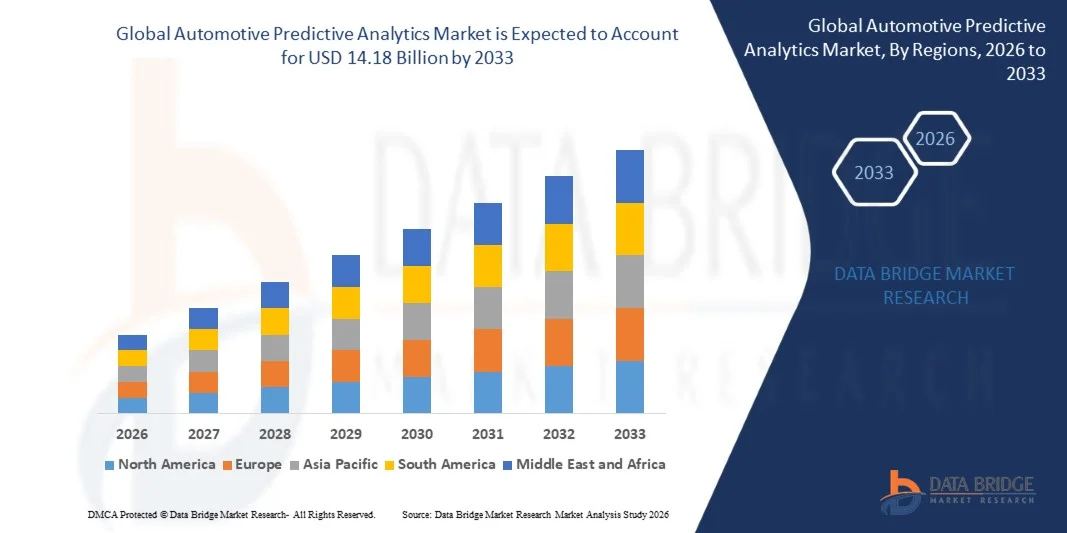
What is the Global Automotive Predictive Analytics Market Size and Growth Rate?
- The global automotive predictive analytics market size was valued at USD 2.21 billion in 2025 and is expected to reach USD 14.18 billion by 2033, at a CAGR of26.10% during the forecast period
- Market growth is driven by rising adoption of data-driven decision-making in the automotive sector, increasing integration of AI and machine learning in vehicles, growing demand for predictive maintenance and fleet optimization, expansion of connected and electric vehicles, and the need to reduce downtime, improve safety, and enhance operational efficiency across OEMs and fleet operators.
What are the Major Takeaways of Automotive Predictive Analytics Market?
- Growing penetration of connected cars, telematics systems, and advanced driver assistance systems (ADAS), along with increasing investments in automotive R&D and digital transformation, is creating significant growth opportunities for the market
- However, challenges such as high implementation costs, data security and privacy concerns, lack of skilled analytics professionals, and complexity in integrating predictive analytics platforms with existing automotive systems may restrain market growth to some extent
- North America dominated the automotive predictive analytics market with a 39.36% revenue share in 2025, driven by strong adoption of connected vehicles, advanced telematics systems, and AI-driven data analytics across the automotive ecosystem in the U.S. and Canada
- Asia-Pacific is projected to register the fastest CAGR of 8.32% from 2026 to 2033, driven by rapid growth in automotive production, expanding connected vehicle adoption, and rising digital transformation across China, Japan, India, South Korea, and Southeast Asia
- The Software segment dominated the market with an estimated 52.6% share in 2025, driven by widespread adoption of AI-driven analytics platforms, cloud-based data processing tools, and advanced machine learning algorithms
Report Scope and Automotive Predictive Analytics Market Segmentation
|
Attributes |
Automotive Predictive Analytics Key Market Insights |
|
Segments Covered |
|
|
Countries Covered |
North America
Europe
Asia-Pacific
Middle East and Africa
South America
|
|
Key Market Players |
|
|
Market Opportunities |
|
|
Value Added Data Infosets |
In addition to the insights on market scenarios such as market value, growth rate, segmentation, geographical coverage, and major players, the market reports curated by the Data Bridge Market Research also include in-depth expert analysis, pricing analysis, brand share analysis, consumer survey, demography analysis, supply chain analysis, value chain analysis, raw material/consumables overview, vendor selection criteria, PESTLE Analysis, Porter Analysis, and regulatory framework. |
What is the Key Trend in the Automotive Predictive Analytics Market?
“Growing Adoption of AI-Driven, Cloud-Based, and Real-Time Predictive Analytics Across Connected Vehicles”
- The automotive predictive analytics market is witnessing increasing adoption of AI-driven, cloud-integrated, and real-time analytics platforms to enable predictive maintenance, vehicle health monitoring, and performance optimization
- Automakers and fleet operators are deploying machine learning, big data analytics, and digital twin technologies to analyze large volumes of vehicle sensor, telematics, and operational data
- Rising integration of connected vehicles, IoT sensors, and V2X communication systems is enabling continuous data collection and predictive decision-making
- For instance, companies such as IBM, SAP, Microsoft, Oracle, and SAS are enhancing automotive analytics platforms with AI-based forecasting, anomaly detection, and cloud scalability
- Growing demand for reduced vehicle downtime, improved safety, and optimized lifecycle management is accelerating adoption across OEMs and fleet operators
- As vehicles become increasingly software-defined and data-centric, automotive predictive analytics will remain critical for intelligent mobility ecosystems
What are the Key Drivers of Automotive Predictive Analytics Market?
- Rising demand for predictive maintenance and real-time vehicle diagnostics to reduce repair costs and unplanned downtime
- For instance, during 2024–2025, leading vendors such as SAP, Microsoft, and Oracle expanded automotive analytics solutions with advanced AI, cloud processing, and edge analytics capabilities
- Growing adoption of connected vehicles, electric vehicles (EVs), and autonomous driving technologies is generating massive volumes of actionable data
- Advancements in AI algorithms, data visualization, cloud computing, and edge analytics are enhancing prediction accuracy and operational efficiency
- Increasing focus on fleet optimization, driver behavior analysis, warranty analytics, and regulatory compliance is strengthening market demand
- Supported by digital transformation initiatives and smart mobility investments, the Automotive Predictive Analytics market is expected to witness robust long-term growth
Which Factor is Challenging the Growth of the Automotive Predictive Analytics Market?
- High implementation costs associated with advanced analytics platforms, AI infrastructure, and cloud integration can limit adoption among smaller fleets
- During 2024–2025, concerns related to data privacy, cybersecurity risks, and regulatory compliance increased complexity for analytics deployment
- Integration challenges with legacy vehicle systems and fragmented data sources restrict seamless analytics adoption
- Limited availability of skilled data scientists and automotive analytics experts slows implementation and optimization
- Competition from in-house analytics platforms and low-cost telematics solutions creates pricing pressure for solution providers
- To overcome these challenges, companies are focusing on scalable cloud platforms, modular deployment models, enhanced cybersecurity, and user-friendly analytics dashboards
How is the Automotive Predictive Analytics Market Segmented?
The market is segmented on the basis of component and application.
• By Component
On the basis of component, the automotive predictive analytics market is segmented into Software, Services, and Hardware. The Software segment dominated the market with an estimated 52.6% share in 2025, driven by widespread adoption of AI-driven analytics platforms, cloud-based data processing tools, and advanced machine learning algorithms. Automotive OEMs, fleet operators, and mobility service providers increasingly rely on software solutions for predictive maintenance, real-time vehicle diagnostics, performance optimization, and data visualization. Continuous updates, scalability, and integration with telematics systems further support software dominance.
The Services segment is expected to grow at the fastest CAGR from 2026 to 2033, supported by rising demand for data integration, analytics consulting, system deployment, and managed services. As predictive analytics implementations become more complex, enterprises increasingly outsource analytics configuration, customization, and maintenance, accelerating long-term service adoption.
• By Application
Based on application, the market is segmented into Predictive Maintenance, Vehicle Telematics, Driver & Behavior Analytics, Fleet Management, Warranty Analytics, and Others. The Predictive Maintenance segment dominated the market with a 34.8% share in 2025, owing to its ability to reduce unplanned vehicle downtime, lower maintenance costs, and extend vehicle lifespan. Automotive manufacturers and fleet operators increasingly deploy predictive maintenance analytics to monitor component health using real-time sensor and telematics data.
The Fleet Management segment is projected to register the fastest CAGR from 2026 to 2033, driven by rising demand for route optimization, fuel efficiency monitoring, asset tracking, and operational cost reduction. Rapid growth of commercial fleets, logistics operations, and mobility-as-a-service platforms is further accelerating adoption of fleet-focused predictive analytics solutions.
• By Vehicle Type
On the basis of vehicle type, the automotive predictive analytics market is segmented into Passenger Cars, Commercial Vehicles, and Electric Vehicles (EVs). The Passenger Cars segment dominated the market with a 41.3% share in 2025, supported by high production volumes, increasing integration of connected vehicle technologies, and rising adoption of advanced driver assistance systems. Predictive analytics is widely used in passenger vehicles for diagnostics, driver behavior monitoring, and preventive maintenance.
The Electric Vehicles (EVs) segment is expected to grow at the fastest CAGR from 2026 to 2033, driven by increasing EV adoption, battery performance monitoring needs, and predictive analytics for charging optimization. Growing government incentives and investments in EV infrastructure further strengthen analytics demand across electric mobility platforms.
• By End User
Based on end user, the market is segmented into OEMs (Original Equipment Manufacturers), Fleet Operators, Insurance Providers, and Others. The OEMs segment dominated the market with a 38.9% share in 2025, as automotive manufacturers increasingly embed predictive analytics into vehicle platforms to improve reliability, reduce warranty costs, and enhance customer experience. OEM-led integration of analytics during vehicle design and production drives strong adoption.
The Fleet Operators segment is anticipated to grow at the fastest CAGR from 2026 to 2033, supported by increasing demand for real-time vehicle monitoring, cost optimization, and operational efficiency. Expansion of logistics, ride-hailing, and commercial transportation services continues to accelerate predictive analytics adoption among fleet operators globally.
Which Region Holds the Largest Share of the Automotive Predictive Analytics Market?
- North America dominated the automotive predictive analytics market with a 39.36% revenue share in 2025, driven by strong adoption of connected vehicles, advanced telematics systems, and AI-driven data analytics across the automotive ecosystem in the U.S. and Canada. High penetration of predictive maintenance solutions, vehicle diagnostics platforms, and real-time analytics tools among OEMs, fleet operators, and mobility service providers continues to support regional leadership
- Leading companies in North America are investing heavily in cloud-based analytics platforms, machine learning models, and real-time vehicle data processing technologies, strengthening the region’s competitive advantage. Continuous investment in AI, IoT-enabled mobility, and digital automotive platforms supports long-term market expansion
- Strong technology infrastructure, high availability of skilled data scientists, and early adoption of advanced automotive analytics solutions further reinforce North America’s market dominance
U.S. Automotive Predictive Analytics Market Insight
The U.S. is the largest contributor in North America, supported by extensive deployment of predictive analytics across OEMs, fleet operators, and insurance providers. Rising adoption of connected cars, EV platforms, and autonomous vehicle technologies is increasing demand for analytics solutions focused on predictive maintenance, driver behavior analysis, and warranty optimization. Presence of major technology firms, strong startup ecosystems, and high investments in smart mobility accelerate market growth.
Canada Automotive Predictive Analytics Market Insight
Canada contributes steadily to regional growth, driven by increasing adoption of telematics, fleet analytics, and usage-based insurance models. Growing investments in smart transportation, EV infrastructure, and data-driven mobility solutions encourage adoption of predictive analytics across commercial fleets and automotive manufacturers. Supportive government initiatives and expanding digital ecosystems further strengthen market development.
Asia-Pacific Automotive Predictive Analytics Market
Asia-Pacific is projected to register the fastest CAGR of 8.32% from 2026 to 2033, driven by rapid growth in automotive production, expanding connected vehicle adoption, and rising digital transformation across China, Japan, India, South Korea, and Southeast Asia. Increasing deployment of telematics, AI-driven fleet analytics, and predictive maintenance solutions across passenger and commercial vehicles fuels regional expansion. Growth in EV adoption, smart mobility platforms, and data-driven transportation systems continues to accelerate analytics demand.
China Automotive Predictive Analytics Market Insight
China leads the Asia-Pacific market due to large-scale vehicle production, strong EV penetration, and rapid adoption of AI-powered mobility solutions. Rising use of predictive analytics for battery monitoring, fleet optimization, and vehicle diagnostics drives sustained growth.
Japan Automotive Predictive Analytics Market Insight
Japan shows stable growth supported by advanced automotive manufacturing, high-quality data analytics adoption, and continuous innovation in connected and autonomous vehicle technologies.
Which are the Top Companies in Automotive Predictive Analytics Market?
The automotive predictive analytics industry is primarily led by well-established companies, including:
- IBM Corporation (U.S.)
- Microsoft Corporation (U.S.)
- SAP SE (Germany)
- Oracle Corporation (U.S.)
- Robert Bosch GmbH (Germany)
- Cloud Software Group, Inc. (U.S.)
- Continental AG (Germany)
- NXP Semiconductors (Netherlands)
- PTC, Inc. (U.S.)
- SAS Institute Inc. (U.S.)
- ZF Friedrichshafen AG (Germany)
- Aptiv PLC (Ireland)
What are the Recent Developments in Global Automotive Predictive Analytics Market?
- In September 2025, Volkswagen Group announced a five-year expansion of its strategic collaboration with Amazon Web Services, strengthening its Digital Production Platform, also known as the factory cloud, as the core of its manufacturing transformation. The platform now supports over 1,200 AI-based applications, including real-time image-based quality inspection, energy optimization, and machine learning via Amazon SageMaker, reinforcing data-driven manufacturing excellence across global operations
- In August 2025, Force Motors launched iPulse, an AI-powered connected vehicle platform offered as standard across its commercial vehicle portfolio. Developed with Intangles, the platform delivers real-time vehicle intelligence, remote monitoring, and 24/7 command center support, improving fleet efficiency, maintenance planning, and operational decision-making
- In May 2025, during the Think 2025 conference, IBM showcased Watsonx-powered real-time analytics by converting streaming sensor data from a Formula 1 race car into personalized insights. The demonstration highlighted edge-to-cloud intelligence capable of handling high-frequency automotive data for predictive diagnostics, performance optimization, and enhanced safety analytics
- In April 2025, PTC and Schaeffler expanded their strategic partnership by migrating to Windchill+, PTC’s cloud-based PLM platform integrated with AI-driven capabilities. This transition enables faster predictive maintenance cycles, streamlined product development, and advanced cloud analytics across automotive components and subsystems
- In October 2024, automotiveMastermind upgraded its Behavior Prediction Score system using advanced machine learning techniques to strengthen predictive accuracy. The company also introduced an enhanced Customer Deal Sheet interface, simplifying access to critical customer insights and improving data-driven sales engagement for automotive dealers

- Interactive Data Analysis Dashboard
- Company Analysis Dashboard for high growth potential opportunities
- Research Analyst Access for customization & queries
- Competitor Analysis with Interactive dashboard
- Latest News, Updates & Trend analysis
- Harness the Power of Benchmark Analysis for Comprehensive Competitor Tracking
Data collection and base year analysis are done using data collection modules with large sample sizes. The stage includes obtaining market information or related data through various sources and strategies. It includes examining and planning all the data acquired from the past in advance. It likewise envelops the examination of information inconsistencies seen across different information sources. The market data is analysed and estimated using market statistical and coherent models. Also, market share analysis and key trend analysis are the major success factors in the market report. To know more, please request an analyst call or drop down your inquiry.
The key research methodology used by DBMR research team is data triangulation which involves data mining, analysis of the impact of data variables on the market and primary (industry expert) validation. Data models include Vendor Positioning Grid, Market Time Line Analysis, Market Overview and Guide, Company Positioning Grid, Patent Analysis, Pricing Analysis, Company Market Share Analysis, Standards of Measurement, Global versus Regional and Vendor Share Analysis. To know more about the research methodology, drop in an inquiry to speak to our industry experts.
Data Bridge Market Research is a leader in advanced formative research. We take pride in servicing our existing and new customers with data and analysis that match and suits their goal. The report can be customized to include price trend analysis of target brands understanding the market for additional countries (ask for the list of countries), clinical trial results data, literature review, refurbished market and product base analysis. Market analysis of target competitors can be analyzed from technology-based analysis to market portfolio strategies. We can add as many competitors that you require data about in the format and data style you are looking for. Our team of analysts can also provide you data in crude raw excel files pivot tables (Fact book) or can assist you in creating presentations from the data sets available in the report.













