


What is the Automotive Printed Circuit Board Market Size and Growth Rate?
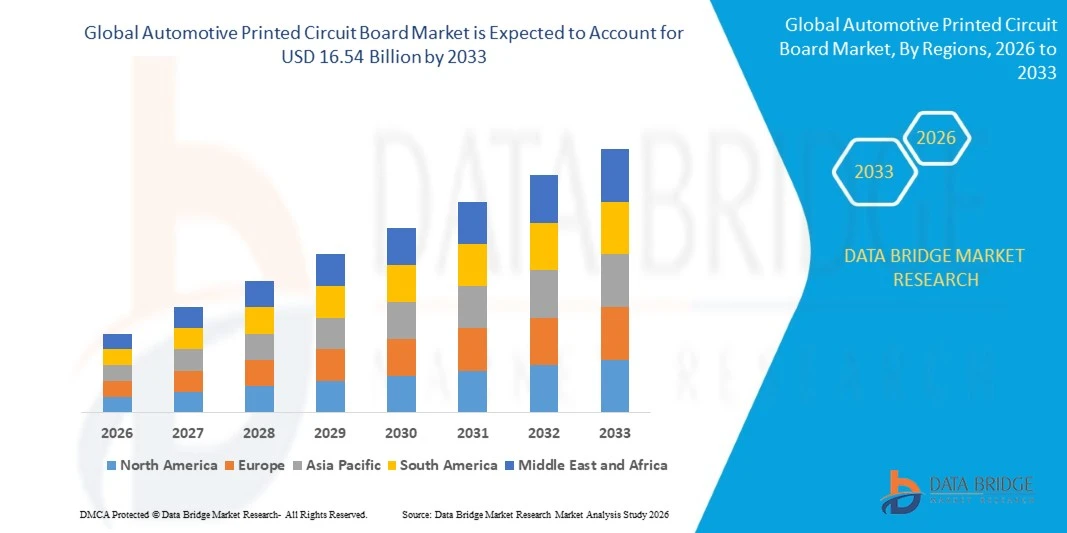
- As per Data Bridge Market Research analysis, the automotive printed circuit board market was valued at USD 10.70 billion in 2025 and is projected to reach USD 16.54 billion by 2033, growing at a CAGR of 5.60% from 2026 to 2033.
- The market is experiencing consistent growth driven by rising demand for advanced vehicle electronics, electric vehicle systems, ADAS technologies, infotainment and connectivity solutions, and high-density PCB architectures, while increasing vehicle electrification and the growing complexity of electronic control systems are further supporting demand for reliable automotive PCBs.
- The increasing integration of ADAS, battery management systems, autonomous driving technologies, digital cockpits, and connected-car functions, combined with the need for compact, lightweight, thermally reliable, and high-performance electronic components, is compelling automotive manufacturers and PCB suppliers to adopt advanced multilayer, HDI, flexible, and rigid-flex PCB technologies
Market Size & Forecast
- Global Market Value (2025): USD 10.70 Billion
- Expected Market Value (2033): USD 16.54 Billion
- Forecast CAGR (2026–2033): 5.60%
- Leading Region in 2025: North America
- Fastest Growing Region: Asia Pacific
What are the Major Takeaways of the Automotive Printed Circuit Board Market?
- North America dominated the automotive printed circuit board market with the largest revenue share of 34.2%, supported by the region’s advanced automotive manufacturing base, strong presence of automotive electronics suppliers, and early adoption of electric vehicle and connected-car technologies.
- Asia-Pacific is expected to be the fastest-growing region at a CAGR of 8.18% from 2026 to 2033, fueled by expanding electric vehicle production, increasing electronics content per vehicle, and continued investments in advanced PCB manufacturing across China, Japan, India, and South Korea.
- The double-layer PCB segment led the market with a 39.80% share in 2025, driven by its established manufacturing infrastructure, cost efficiency, and broad use across automotive electronic systems
- Multi-layer PCB are the fastest-growing PCB type, projected to register a CAGR of 8,2%, reflecting the surge in electronic complexity in modern vehicles.
- The passenger cars segment dominated the vehicle type category with a 61.50% revenue share in 2025, led by the large global production volume of passenger vehicles and their increasing electronic content.
- Internal combustion engine (ICE) vehicles accounted for 54.96% of the market share in 2025, preferred by the continued large-scale production and installed base of conventional vehicles.
- The autonomous driving compute segment is the fastest-growing application category, with a CAGR of 13.86%, driven by increasing development of advanced automated-driving architectures.
Report Scope and Automotive Printed Circuit Board Market Segmentation
|
Attributes |
Automotive Printed Circuit Board Key Market Insights |
|
Segments Covered |
|
|
Countries Covered |
North America
Europe
Asia-Pacific
Middle East and Africa
South America
|
|
Key Market Players |
|
|
Market Opportunities |
|
|
Value Added Data Infosets |
In addition to the insights on market scenarios such as market value, growth rate, segmentation, geographical coverage, and major players, the market reports curated by the Data Bridge Market Research also include in-depth expert analysis, geographically represented company-wise production and capacity, network layouts of distributors and partners, detailed and updated price trend analysis and deficit analysis of supply chain and demand. |
What is the Key Trend in the Automotive Printed Circuit Board Market?
- Automotive PCB manufacturers are increasingly shifting toward high-density interconnect (HDI), flexible, and rigid-flex technologies to support vehicle miniaturization, higher electronic content, and increasingly complex electrical architectures across modern vehicle platforms.
- For instance, in September 2025, Panasonic showcased PCB laminate materials for high-frequency automotive applications at Electronica India 2025, alongside solutions supporting ADAS and electric-vehicle ecosystems for future vehicle electronics systems.
- Growing electrification is accelerating demand for lightweight flexible circuits and advanced multilayer boards used in battery management systems, power electronics, charging systems, and electric powertrain control applications across vehicle platforms.
- Centralized vehicle computing and advanced driver assistance systems are increasing requirements for high-speed, compact, thermally efficient PCBs capable of supporting greater data transmission, signal integrity, and processing loads in applications.
- For instance, in March 2025, Wevolver highlighted that advanced HDI PCBs using fine-line traces, microvias, and multiple layers are increasingly relevant to automotive applications such as ADAS and electric-vehicle battery management systems.
- Connected cockpits, digital displays, telematics, and vehicle networking are expanding PCB requirements as automakers integrate more electronic functions into increasingly software-defined vehicle architectures for connected mobility experiences across automotive platforms.
What are the Key Drivers of the Automotive Printed Circuit Board Market?
- The rapid expansion of electric vehicles is increasing PCB content per vehicle because battery management, inverters, onboard chargers, thermal management, and power conversion systems require specialized high-reliability circuit boards globally.
- For instance, in June 2025, Continental established an Advanced Electronics and Semiconductor Solutions organization to strengthen automotive electronics capabilities and reduce supply-chain risks through greater internal development and technological resilience.
- Growing adoption of ADAS is increasing demand for advanced PCBs supporting cameras, radar, lidar, sensor fusion, electronic control units, and high-speed processing required for real-time vehicle safety functions today globally.
- Automakers are increasingly adopting centralized and zonal electrical architectures, which consolidate electronic control functions and increase requirements for high-density, high-speed, and thermally reliable automotive PCB solutions across connected vehicle platforms.
- For instance, in December 2025, Valuates Reports reported that vehicle electrification and increasing EV production were major factors supporting automotive PCB demand, as electric powertrains depend on complex PCB systems.
- Rising vehicle connectivity and digital cockpit adoption are expanding PCB applications across infotainment, telematics, displays, navigation, wireless communication, and vehicle-to-everything systems requiring reliable high-speed signal transmission and advanced connectivity capabilities.
Which Factors are Challenging the Growth of the Automotive Printed Circuit Board Market?
- Automotive PCB manufacturers face substantial raw-material cost volatility because copper, fiberglass, resins, laminates, and specialty chemicals represent important production inputs whose prices can fluctuate significantly across global supply markets globally.
- For instance, in July 2025, Reuters reported that proposed U.S. copper tariffs were adding cost pressure to the automotive industry amid higher copper and supplier costs directly for automakers.
- Complex automotive PCB designs require extensive testing, qualification, thermal management, and reliability validation, increasing production costs and lengthening development cycles compared with conventional commercial electronics manufacturing programs for vehicles today.
- Supply-chain disruptions and geopolitical trade restrictions can affect the availability of automotive-grade materials and components, forcing manufacturers to diversify suppliers and maintain additional inventories across critical production locations worldwide globally.
- For instance, in April 2026, Reuters reported that global PCB prices surged by as much as 40% compared with March amid shortages of epoxy resin, glass fiber, and copper foil, while copper foil prices had increased by as much as 30% during the year, highlighting the material-cost and supply-chain pressures that can increase automotive PCB manufacturing costs.
- Automotive PCB production also faces stringent quality requirements because failures in safety-critical systems can trigger warranty costs, recalls, qualification delays, and reputational risks for manufacturers and suppliers.
How is the Automotive Printed Circuit Board Market Segmented?
The automotive printed circuit board market is segmented on the basis of PCB type, vehicle type, propulsion type, and application
- By PCB Type
On the basis of PCB type, the automotive printed circuit board market is segmented into single-layer PCB, double-layer PCB, multi-layer PCB, high-density interconnect (HDI) PCB, flexible PCB, and rigid-flex PCB. The double-layer PCB segment dominated the market with 39.80% share in 2025, owing to its established manufacturing infrastructure, cost efficiency, and broad use across automotive electronic systems. Double-layer PCBs provide sufficient circuit density for many body electronics, lighting, infotainment interfaces, and control modules. Their relatively straightforward manufacturing process supports high-volume automotive production. They also provide a practical balance between circuit functionality, reliability, and production cost. Their widespread compatibility with existing automotive electronic architectures continues to support demand.
The multi-layer PCB segment is projected to register the fastest growth at 8.2% CAGR during forecast period, driven by increasing electronic complexity in modern vehicles. Multi-layer boards allow numerous power, ground, and signal layers to be integrated into compact structures. They are increasingly used in ADAS controllers, battery-management systems, V2X modules, infotainment systems, and advanced power electronics. Growing electrification is increasing the need for boards capable of handling higher circuit density and complex signal routing. The expansion of autonomous and connected vehicle technologies is further strengthening demand for multi-layer architectures.
- By Vehicle Type
On the basis of vehicle type, the automotive printed circuit board market is segmented into passenger cars and commercial vehicles. The passenger cars segment dominated the market with 61.50% share in 2025, supported by the large global production volume of passenger vehicles and their increasing electronic content. Passenger cars increasingly incorporate ADAS, infotainment, connectivity, digital displays, lighting controls, and electronic powertrain systems. The transition toward electric and software-defined passenger vehicles is further increasing PCB requirements. Premium and mid-range passenger vehicles are also integrating more sophisticated electronic control systems. The high volume of passenger-car production creates substantial recurring demand for automotive PCBs.
The commercial vehicles segment is projected to register the fastest growth at 8.6% CAGR during forecast period, driven by increasing electrification and the integration of advanced electronic systems into trucks, buses, and delivery vehicles. Commercial fleets are increasingly adopting telematics and fleet-management systems for vehicle monitoring and operational optimization. ADAS technologies are also expanding across commercial vehicles to improve safety and reduce collision risks. Electrification of buses and delivery fleets is increasing the need for battery-management, power-conversion, and vehicle-control electronics. Commercial vehicles also require rugged electronic systems capable of operating under demanding vibration and temperature conditions. Increasing regulatory emphasis on commercial-vehicle safety is supporting greater deployment of electronic controls.
- By Propulsion Type
On the basis of propulsion type, the automotive printed circuit board market is segmented into internal combustion engine (ICE) vehicles, battery electric vehicles (BEVs), hybrid electric vehicles (HEVs), and plug-in hybrid electric vehicles (PHEVs). The internal combustion engine (ICE) vehicles segment dominated the market with a 54.96% share in 2025, supported by the continued large-scale production and installed base of conventional vehicles. ICE vehicles use PCBs across engine-control units, transmission systems, body electronics, lighting, safety systems, and infotainment. Increasing electronic integration is raising PCB content even in conventional powertrains. The large installed vehicle population continues to generate significant demand for automotive electronic components. In addition, many ICE platforms are incorporating mild-hybrid and 48-volt technologies, increasing electronic complexity.
The battery electric vehicles (BEVs) segment is projected to register the fastest growth at an 18.29% CAGR during forecast period, driven by the increasing electrification of automotive powertrains. BEVs require PCBs for battery-management systems, traction inverters, onboard chargers, DC-DC converters, thermal-management systems, and electronic control units. These systems increase the amount of power-management and monitoring electronics required per vehicle. The expansion of high-voltage EV architectures is also increasing requirements for specialized PCB designs capable of supporting demanding electrical and thermal conditions. Growing EV production is consequently increasing demand for high-density and high-reliability PCB technologies.
- By Application
On the basis of application, the automotive printed circuit board market is segmented into ADAS and basic safety, body, comfort, and vehicle lighting, infotainment and connectivity, powertrain and electrification, autonomous driving compute, and navigation systems. The ADAS and basic safety segment dominated the market with a 33.71% share in 2025, driven by increasing integration of electronic safety technologies in modern vehicles. ADAS applications require PCBs for radar, cameras, sensors, electronic control units, and related processing systems. Features such as automatic emergency braking, adaptive cruise control, lane-assistance systems, and blind-spot monitoring are increasing electronic content. Regulatory requirements and consumer demand for improved vehicle safety are encouraging broader deployment of these systems. Increasing sensor density is also creating greater requirements for reliable and high-density PCB architectures.
The autonomous driving compute segment is projected to register the fastest growth at a 13.86% CAGR during forecast period, supported by increasing development of advanced automated-driving architectures. Autonomous driving systems require high-performance computing platforms to process large volumes of data generated by cameras, radar, LiDAR, and other sensors. These computing platforms require sophisticated PCB architectures with high circuit density and reliable high-speed signal transmission. The transition toward centralized and domain-based vehicle architectures is further increasing PCB complexity. Growing investment in autonomous-driving technologies is also creating demand for advanced multi-layer and HDI boards. Increasing computational requirements are pushing automotive electronics toward more sophisticated thermal and electrical designs.
Which Region Holds the Largest Share of the Automotive Printed Circuit Board Market?
- North America dominated the automotive printed circuit board market with the largest revenue share of 34.2%, supported by the region’s advanced automotive manufacturing base, strong presence of automotive electronics suppliers, and early adoption of electric vehicle and connected-car technologies.
- The region also benefits from growing deployment of ADAS, connected vehicles, electric powertrains, and sophisticated infotainment systems, along with the presence of established automotive OEMs and technology suppliers. Increasing investments in vehicle electronics, semiconductor technologies, and advanced PCB manufacturing capabilities continue to strengthen North America’s position in the global market
U.S. Automotive Printed Circuit Board Market Insight
The U.S. automotive printed circuit board market is witnessing strong growth due to rising vehicle electrification, increasing adoption of advanced driver-assistance systems, and growing demand for connected vehicle technologies. The country’s mature automotive ecosystem, along with increasing integration of sophisticated electronic systems, is driving PCB demand across passenger cars and commercial vehicles. In addition, growing investments in electric vehicle manufacturing, autonomous driving technologies, and advanced automotive electronics are accelerating PCB adoption across the automotive industry.
Asia-Pacific Automotive Printed Circuit Board Market Insight
The Asia-Pacific automotive printed circuit board market is expected to witness rapid growth, driven by expanding automotive production, increasing electric vehicle adoption, and rising investments in advanced automotive electronics across countries such as China, Japan, and South Korea. Growing demand for ADAS, infotainment, connectivity, and electrified powertrain systems is supporting regional market expansion. In addition, the strong presence of PCB manufacturers, automotive component suppliers, and electronics production facilities is accelerating adoption across the regional automotive industry.
Japan Automotive Printed Circuit Board Market Insight
The Japan automotive printed circuit board market is witnessing consistent growth due to rising investments in vehicle electrification, automotive electronics, and advanced safety technologies. Automotive manufacturers and component suppliers are increasingly adopting sophisticated PCBs for ADAS, infotainment, powertrain control, and connected vehicle applications. Moreover, increasing integration of high-density, flexible, and multi-layer PCB technologies and the country’s focus on advanced mobility solutions are further contributing to market growth.
China Automotive Printed Circuit Board Market Insight
The China automotive printed circuit board market is growing rapidly, driven by expanding automotive production, increasing electric vehicle adoption, and rising demand for advanced vehicle electronics. Growing deployment of ADAS, infotainment, connectivity, battery-management systems, and electric powertrain technologies is significantly boosting market demand. In addition, rising investments in domestic automotive and electronics manufacturing, increasing PCB production capabilities, and rapid technological advancements are positioning China as one of the fastest-growing markets for automotive printed circuit boards globally.
U.K. Automotive Printed Circuit Board Market Insight
The U.K. automotive printed circuit board market is experiencing steady growth, supported by rising adoption of electric vehicles, advanced safety systems, and connected automotive technologies. Increasing investments in automotive electronics and growing demand for compact, reliable, and high-density PCB solutions are contributing to market growth. Furthermore, integration of advanced driver-assistance systems, electrified powertrains, and sophisticated infotainment technologies is strengthening PCB demand across the U.K. automotive industry.
Germany Automotive Printed Circuit Board Market Insight
The Germany automotive printed circuit board market is expanding steadily due to the country’s strong automotive manufacturing base, advanced engineering capabilities, and increasing adoption of next-generation vehicle electronics. Automotive companies and component manufacturers are increasingly utilizing sophisticated PCBs for ADAS, electrification, infotainment, connectivity, and powertrain applications. Continuous advancements in multi-layer, HDI, and flexible PCB technologies, along with strong industry focus on vehicle electrification and digitalization, are further driving market growth in Germany.
Which are the Top Companies in Automotive Printed Circuit Board Market?
The automotive printed circuit board industry is primarily led by well-established companies, including:
- TTM Technologies, Inc. (U.S.)
- Meiko Co., Ltd. (Japan)
- CMK Corporation (Japan)
- IBIDEN CO.,LTD. (Japan)
- DAEDUCK ELECTRONICS Co.,Ltd. (South Korea)
- Unimicron Technology Corp. (Taiwan)
- Tripod Technology Corporation (Taiwan)
- Compeq Co., Ltd. (Taiwan)
- KINSUS INTERCONNECT TECHNOLOGY CORP. (Taiwan)
- Zhen Ding Technology Holding Limited (Taiwan)
- Gold Circuit Electronics Ltd. (Taiwan)
- Dynamic Electronics Co., Ltd. (Taiwan)
- Chin-Poon Industrial Co., Ltd. (Taiwan)
- WUS Printed Circuit Co., Ltd. (Taiwan)
- KCE Electronics Public Company Limited (Thailand)
- HannStar Board Corporation (Taiwan)
- Nippon Mektron, Ltd. (Japan)
- Fujikura Ltd. (Japan)
- Sumitomo Electric Industries, Ltd. (Japan)
What are Latest Developments in Automotive Printed Circuit Board Market?
- In May 2025, AT&S announced that its new production facility in Kulim Hi-Tech Park, Malaysia, was ready to begin high-volume manufacturing. The facility strengthens AT&S’s high-end PCB and semiconductor-related manufacturing capabilities in Southeast Asia and supports the company’s expansion of advanced electronics production. The development is significant for the regional PCB supply chain as automotive electronics increasingly require sophisticated, high-density circuit technologies.
- In May 2024, AT&S reported continued development of its new manufacturing facilities in Kulim and Leoben, while highlighting the medium-term growth of automotive PCB demand. The company noted that increasing electronic content per vehicle was supporting the automotive PCB market despite near-term pressure from elevated inventories in the supply chain. The development reflects ongoing investment in advanced PCB production capabilities to support increasingly electronic vehicle architectures.
- In June 2023, CMK Corporation highlighted its strategy to expand production capacity for automotive PCBs in response to expected medium- to long-term growth in automotive PCB demand. The company identified increasing electronic content and the shift toward more advanced automotive systems as important factors supporting demand for automotive circuit boards. CMK also outlined its focus on strengthening its automotive product portfolio and increasing production capabilities.
- In May 2022, Meiko Corporation showcased its latest automotive PCB technologies at the 2022 Printed Wiring Board Technology Exhibition in Japan. The company presented high-density automotive circuit-board technologies developed for CASE applications, together with flexible PCB technologies and heat-dissipation PCB solutions for advanced electronic systems. The exhibition demonstrated Meiko’s development focus on increasingly compact, high-performance, and reliable automotive circuit boards.
- In June 2021, AT&S announced plans to establish its first production facility in Southeast Asia in Kulim, Malaysia, focused on high-end PCBs and IC substrates. The company planned a major investment in the new campus, with construction scheduled to begin in the second half of 2021 and commercial operations targeted for 2024. The development expanded AT&S’s advanced PCB manufacturing footprint in Asia and strengthened the regional electronics supply chain.

- Interactive Data Analysis Dashboard
- Company Analysis Dashboard for high growth potential opportunities
- Research Analyst Access for customization & queries
- Competitor Analysis with Interactive dashboard
- Latest News, Updates & Trend analysis
- Harness the Power of Benchmark Analysis for Comprehensive Competitor Tracking
Global Automotive Printed Circuit Board Market, Supply Chain Analysis and Ecosystem Framework
To support market growth and help clients navigate the impact of geopolitical shifts, DBMR has integrated in-depth supply chain analysis into its Global Automotive Printed Circuit Board Market research reports. This addition empowers clients to respond effectively to global changes affecting their industries. The supply chain analysis section includes detailed insights such as Global Automotive Printed Circuit Board Market consumption and production by country, price trend analysis, the impact of tariffs and geopolitical developments, and import and export trends by country and HSN code. It also highlights major suppliers with data on production capacity and company profiles, as well as key importers and exporters. In addition to research, DBMR offers specialized supply chain consulting services backed by over a decade of experience, providing solutions like supplier discovery, supplier risk assessment, price trend analysis, impact evaluation of inflation and trade route changes, and comprehensive market trend analysis.
Data collection and base year analysis are done using data collection modules with large sample sizes. The stage includes obtaining market information or related data through various sources and strategies. It includes examining and planning all the data acquired from the past in advance. It likewise envelops the examination of information inconsistencies seen across different information sources. The market data is analysed and estimated using market statistical and coherent models. Also, market share analysis and key trend analysis are the major success factors in the market report. To know more, please request an analyst call or drop down your inquiry.
The key research methodology used by DBMR research team is data triangulation which involves data mining, analysis of the impact of data variables on the market and primary (industry expert) validation. Data models include Vendor Positioning Grid, Market Time Line Analysis, Market Overview and Guide, Company Positioning Grid, Patent Analysis, Pricing Analysis, Company Market Share Analysis, Standards of Measurement, Global versus Regional and Vendor Share Analysis. To know more about the research methodology, drop in an inquiry to speak to our industry experts.
Data Bridge Market Research is a leader in advanced formative research. We take pride in servicing our existing and new customers with data and analysis that match and suits their goal. The report can be customized to include price trend analysis of target brands understanding the market for additional countries (ask for the list of countries), clinical trial results data, literature review, refurbished market and product base analysis. Market analysis of target competitors can be analyzed from technology-based analysis to market portfolio strategies. We can add as many competitors that you require data about in the format and data style you are looking for. Our team of analysts can also provide you data in crude raw excel files pivot tables (Fact book) or can assist you in creating presentations from the data sets available in the report.













