


What is the Automotive Robotics Market Size and Growth Rate?
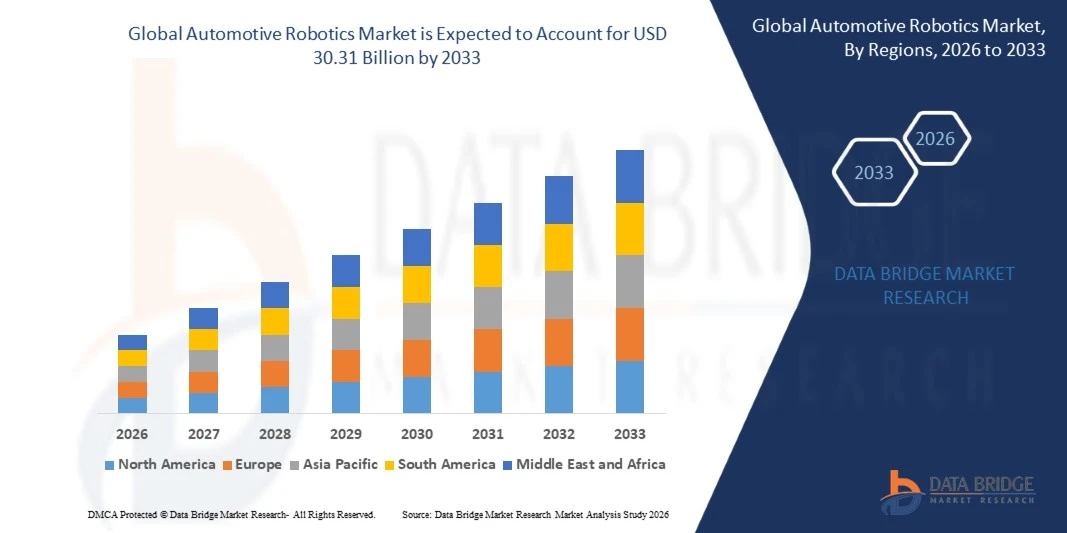
- As per Data Bridge Market Research analysis, the automotive robotics market was valued at USD 15.10 billion in 2025 and is projected to reach USD 30.31 billion by 2033, growing at a CAGR of 9.10% from 2026 to 2033.
- The market is experiencing consistent growth driven by rising demand for flexible factory automation, increasing production of electric vehicles and batteries, and expanding applications across welding, material handling, assembly, painting, and inspection at vehicle and component manufacturers.
- The increasing shift toward AI-enabled automation, simulation-based commissioning, and labor-saving production, combined with growing adoption of industrial robots in body shops and powertrain lines, is supporting market adoption. Collaborative robots are being applied across component assembly, machine tending, and inspection, while humanoid robots are being piloted for lineside logistics, offering manufacturers greater flexibility in how automation is deployed on the factory floor.
Market Size & Forecast
- Global Market Value (2025): USD 15.10 Billion
- Expected Market Value (2033): USD 30.31 Billion
- Forecast CAGR (2026–2033): 9.10%
- Leading Region in 2025: Asia Pacific
- Fastest Growing Region: North America
What are the Major Takeaways of the Automotive Robotics Market?
- Asia-Pacific dominated the automotive robotics market with the largest revenue share of 47.62% in 2025, supported by the concentration of vehicle assembly, battery manufacturing, and robot production across China, Japan, and South Korea.
- North America is expected to be the fastest-growing region at a CAGR of 10.84% from 2026 to 2033, fueled by new vehicle and battery plant investments, reshoring of component production, and pilot deployments of humanoid robots.
- The articulated robots segment led the market with a 58.36% share in 2025, driven by their flexibility across welding, material handling, painting, and assembly operations.
- Collaborative robots are the fastest-growing robot type, projected to register a CAGR of 13.45%, reflecting demand for flexible automation that can work alongside operators without extensive safeguarding.
- The robotic arm segment dominated the component category with a 41.78% revenue share in 2025, led by extensive use of multi-axis arms across body shops and powertrain lines.
- Welding accounted for 33.24% of the market share in 2025, preferred for its repeatability and the high volume of spot and arc welds required in body-in-white production.
- The assembly segment is the fastest-growing application category, with a CAGR of 11.18%, driven by increasing use of vision-guided and AI-enabled robots for interior, wiring, and final assembly tasks.
Report Scope and Automotive Robotics Market Segmentation
|
Attributes |
Automotive Robotics Key Market Insights |
|
Segments Covered |
|
|
Countries Covered |
North America
Europe
Asia-Pacific
Middle East and Africa
South America
|
|
Key Market Players |
|
|
Market Opportunities |
|
|
Value Added Data Infosets |
In addition to the market insights such as market value, growth rate, market segments, geographical coverage, market players, and market scenario, the market report curated by the Data Bridge Market Research team includes in-depth expert analysis, import/export analysis, pricing analysis, production consumption analysis, and pestle analysis. |
What is the Key Trend in the Automotive Robotics Market?
- Automotive robots are moving from fixed, pre-programmed machines toward AI-enabled systems that combine machine vision, simulation-based training, and edge computing to adapt to variation in vehicles, parts, and line layouts, which is changing how plants are designed and reconfigured.
- For instance, in February 2026, according to Assembly Magazine, Mercedes-Benz and John Deere were among the investors committing more than USD 500 million to humanoid robot developer Apptronik to scale production of its Apollo robot, which Mercedes-Benz has been testing for intralogistics tasks at its Berlin Digital Factory Campus, highlighting the move of humanoid platforms from laboratory demonstrations toward factory pilots.
- Rapid electrification of vehicle platforms is changing robot requirements, as battery pack assembly, cell handling, and large-scale casting lines need high-payload, precise, and contamination-controlled automation that conventional body-shop layouts did not demand.
- Suppliers and vehicle manufacturers are also adopting digital twins and virtual commissioning to validate robot cells before installation, which shortens ramp-up times and reduces the cost of model changeovers.
- For instance, in September 2025, according to the International Federation of Robotics (IFR), 542,000 industrial robots were installed worldwide in 2024, more than double the number a decade earlier, with global installations projected to grow 6% to 575,000 units in 2025, underlining the scale of the automation base on which AI-enabled automotive robotics is being built.
- As AI-based perception, humanoid platforms, collaborative automation, and simulation tools mature, automotive robotics is expected to expand beyond welding and painting cells into flexible assembly, logistics, inspection, and battery manufacturing.
What are the Key Drivers of the Automotive Robotics Market?
- Rising pressure to improve productivity, quality consistency, and worker safety, together with skilled-labor shortages in vehicle assembly, is increasing investment in robotic automation across vehicle manufacturers and their supplier networks.
- For instance, in September 2025, according to the International Federation of Robotics (IFR), automotive robot installations in India surged 15% to 4,070 units in 2024, with parts suppliers installing 2,100 units, a 40% increase, showing how component makers are scaling automation alongside vehicle manufacturers.
- The shift toward electric vehicles, new battery plants, and regionalized production is creating fresh demand for robots in cell handling, module assembly, and high-precision joining, while also prompting manufacturers to modernize aging lines.
- For instance, in June 2026, according to the International Federation of Robotics (IFR), industrial robot installations in the U.S. rose 11% to 38,000 units in 2025, with the automotive industry remaining the largest adopter at 13,500 units, only 1% below the previous year, indicating sustained automotive automation demand despite cyclical investment patterns.
- With vehicle makers pursuing lower cost per vehicle and faster model changeovers, robots that can be programmed by operators, integrate with simulation software, and support multiple processes are expected to see broader adoption.
What Factors Are Challenging the Growth of the Automotive Robotics Market?
- Automotive robotics requires substantial upfront capital for robots, tooling, safety systems, and integration, and investment decisions are closely tied to vehicle launch cycles, which makes demand sensitive to industry slowdowns.
- For instance, in September 2025, according to the International Federation of Robotics (IFR), the EU's automotive industry installed 30,650 industrial robots in 2024 but was not expected to drive robot demand growth in 2025, as uncertainty had caused companies to postpone investment projects.
- Integration complexity, shortages of robotics engineers and programmers, and the need to retrain workers can lengthen deployment timelines, particularly for smaller component suppliers with limited in-house automation expertise.
- Trade policy, tariffs, and shifting electric vehicle demand are also making manufacturers cautious about committing to new plants and line upgrades, which can delay or scale back robot orders in affected regions.
- For instance, in September 2025, according to the International Federation of Robotics (IFR), robot installations in the U.K. fell 35% to 2,500 units in 2024, while installations in Canada declined 12% to 3,800 units and were described as largely dependent on automotive investment cycles, illustrating how demand can contract quickly when vehicle investment slows.
- Concerns related to cybersecurity, functional safety, and the interoperability of robots from different vendors add further complexity, and these factors can restrain adoption among cost-sensitive manufacturers and suppliers.
How is the Automotive Robotics Market Segmented?
The automotive robotics market is segmented on the basis of robot type, component, application, and end user.
- By Robot Type
On the basis of robot type, the automotive robotics market is segmented into articulated robots, Cartesian robots, SCARA robots, collaborative robots, and others. The articulated robots segment dominated the market with 58.36% share in 2025, supported by their wide reach, high payload range, and flexibility across welding, painting, material handling, and assembly tasks. Multi-axis articulated arms can be programmed for many vehicle variants on the same line, which suits mixed-model production. Their long service life, mature supplier ecosystems, and compatibility with standard controllers and offline programming tools further support demand. Continued investment in body shops, powertrain lines, and battery plants keeps articulated robots central to automotive automation.
The collaborative robots segment is projected to register the fastest growth at a CAGR of 13.45% from 2026 to 2033, driven by demand for flexible automation that can operate near human workers without extensive fencing. Collaborative robots can be redeployed between tasks such as screw driving, part inspection, machine tending, and light assembly. Lower integration costs make them attractive to tier-2 and tier-3 suppliers that previously found automation uneconomical. Force-limited designs and improved safety standards are broadening their use in final assembly. Integration with machine vision and AI-based programming tools is further reducing setup time and widening the range of feasible applications.
- By Component
On the basis of component, the automotive robotics market is segmented into robotic arm, controller, end effector, sensors, drive, and others. The robotic arm segment dominated the market with 41.78% share in 2025, supported by the large number of arms installed across stamping, body-in-white, paint, and final assembly operations. The arm accounts for the largest share of robot hardware value because of its precision gearing, motors, and structural design. Replacement and upgrade cycles at established plants provide steady demand. Vehicle manufacturers also prefer standardized arm families that simplify maintenance and spare-parts management across global facilities.
The sensors segment is projected to register the fastest growth at a CAGR of 11.92% from 2026 to 2033, supported by increasing use of machine vision, force-torque sensing, and proximity detection to make robots adaptive. Vision-guided robots can handle part variation, locate components without precise fixturing, and perform in-line inspection. Sensor data also feeds predictive maintenance and digital-twin platforms that help plants reduce unplanned downtime. Falling costs of cameras and edge processors, together with improved AI models, are expanding adoption. Safety-rated sensors are further enabling closer human-robot collaboration on assembly lines.
- By Application
On the basis of application, the automotive robotics market is segmented into welding, material handling, assembly, painting & dispensing, and others. The welding segment dominated the application category with 33.24% share in 2025, supported by the high volume of spot, arc, and laser welds required in body-in-white production. Robots provide consistent weld quality, repeatability, and speed that manual processes struggle to match. Welding cells are also well established, with proven integration practices and strong supplier support. The shift to mixed-material bodies and battery enclosures is creating additional demand for advanced joining processes that rely on precise robotic motion.
The assembly segment is projected to register the fastest growth at a CAGR of 11.18% from 2026 to 2033, driven by increasing automation of interior, wiring, cockpit, and final assembly tasks that were historically manual. Vision-guided arms, collaborative robots, and emerging humanoid platforms are being tested for parts sequencing and lineside logistics. Greater vehicle complexity, rising part counts, and labor availability pressures are encouraging manufacturers to automate more assembly steps. Battery module and pack assembly is creating further demand for precise handling. Software-defined production lines make it easier to reconfigure assembly robots as models change.
- By End User
On the basis of end user, the automotive robotics market is segmented into vehicle manufacturers, automotive component manufacturers, EV & battery manufacturers, and others. The vehicle manufacturers segment dominated the end-user category with 61.47% share in 2025, supported by extensive robot use across stamping, body assembly, painting, and final inspection. Large manufacturers have the scale and capital to deploy fully automated lines and standardize robot platforms across plants. Investments in new electric vehicle platforms and flexible factories are renewing automation spending. Long-term supplier relationships with robot makers also support repeat orders and service contracts.
The EV & battery manufacturers segment is projected to register the fastest growth at a CAGR of 12.36% from 2026 to 2033, driven by construction of cell, module, and pack plants that rely on high-precision, high-throughput automation. Robots are used for electrode handling, cell stacking, module assembly, welding, and end-of-line testing in clean or controlled environments. Rapid scaling of battery capacity and the need for consistent quality are encouraging greater automation intensity. Regional incentives for localized battery production add further momentum. Safety, traceability, and process-control requirements make robotic systems with integrated sensing particularly attractive.
Which Region Holds the Largest Share of the Automotive Robotics Market?
- Asia-Pacific dominated the automotive robotics market with the largest revenue share of 47.62% in 2025, supported by the concentration of vehicle assembly, battery manufacturing, and robot production across China, Japan, and South Korea.
- The region also benefits from large vehicle output, extensive supplier networks, government support for factory automation, and the presence of leading robot manufacturers. Rising electric vehicle production and growing automation in India and Southeast Asia continue to strengthen Asia-Pacific's position in the global market.
China Automotive Robotics Market Insight
The China automotive robotics market is expanding rapidly, driven by the country's position as the world's largest vehicle producer, large-scale electric vehicle and battery manufacturing, and strong government support for intelligent manufacturing. Domestic robot makers are gaining share alongside global suppliers by offering competitive pricing and faster customization. Automakers are upgrading body shops, battery plants, and logistics with vision-guided and collaborative robots. In addition, growing interest in humanoid robots and a dense component supply base are positioning China as a key growth center for automotive automation across Asia-Pacific.
North America Automotive Robotics Market Insight
The North America automotive robotics market is expected to witness rapid growth, supported by new vehicle and battery plant investments, reshoring of component production, and increasing interest in AI-enabled and humanoid robots for assembly and logistics. Manufacturers are seeking automation to offset labor shortages and to improve productivity in newly built, flexible factories. Growing availability of simulation tools, edge computing, and integration services is also lowering barriers for suppliers. Investments across the U.S., Mexico, and Canada, along with expanding integrator networks, are accelerating regional demand.
U.S. Automotive Robotics Market Insight
The U.S. automotive robotics market is witnessing steady growth due to continued investment in vehicle assembly, electric vehicle and battery plants, and supplier modernization. The automotive industry remains the largest adopter of industrial robots in the country, supported by labor constraints and the need for consistent quality. Manufacturers are increasingly deploying collaborative, vision-guided, and AI-enabled robots, and several are piloting humanoid platforms for intralogistics. In addition, strong integrator networks, access to robotics and AI talent, and incentives for domestic manufacturing are supporting wider adoption.
Mexico Automotive Robotics Market Insight
The Mexico automotive robotics market is growing consistently, supported by the country's large vehicle and auto-parts export base and nearshoring of production for the North American market. The automotive industry is the key customer for industrial robots in the country, with tier-1 and tier-2 suppliers expanding automation to meet quality and delivery requirements. Foreign automakers and global robot suppliers maintain regional service and integration capabilities. Moreover, growing electric vehicle component production and efforts to offset wage and labor-availability pressures are encouraging further investment in robotic cells.
Germany Automotive Robotics Market Insight
The Germany automotive robotics market is expanding steadily due to the country's strong automotive manufacturing base, advanced engineering ecosystem, and early adoption of Industry 4.0 practices. Premium vehicle manufacturers and their suppliers use robots extensively across body shops, paint shops, and assembly, and are investing in flexible, software-defined production and digital twins. Domestic robot and automation suppliers contribute to a deep local ecosystem. However, cost pressures and the transition to electric vehicles are shaping investment timing, with a focus on efficiency, energy savings, and reconfigurable lines.
U.K. Automotive Robotics Market Insight
The U.K. automotive robotics market is witnessing consistent growth, supported by its position as one of Europe's major vehicle-producing countries and strong demand for automation from the automotive industry. Vehicle manufacturers and component suppliers are investing in robotic welding, handling, and assembly to maintain competitiveness and support electric vehicle production. Government programs encouraging industrial digitalization and battery manufacturing projects are creating additional opportunities. In addition, a well-established network of system integrators and the presence of global automotive plants are supporting wider deployment of robots.
Which are the Top Companies in Automotive Robotics Market?
The automotive robotics industry is primarily led by well-established companies, including:
- FANUC Corporation (Japan)
- ABB Ltd. (Switzerland)
- KUKA AG (Germany)
- Yaskawa Electric Corporation (Japan)
- Kawasaki Heavy Industries, Ltd. (Japan)
- Dürr AG (Germany)
- Comau S.p.A. (Italy)
- Nachi-Fujikoshi Corp. (Japan)
- DENSO Wave Incorporated (Japan)
- OMRON Corporation (Japan)
- Seiko Epson Corporation (Japan)
- Mitsubishi Electric Corporation (Japan)
- Stäubli International AG (Switzerland)
- Universal Robots A/S (Denmark)
- Hyundai Robotics (South Korea)
- Boston Dynamics, Inc. (U.S.)
- Rockwell Automation, Inc. (U.S.)
- Harmonic Drive Systems Inc. (Japan)
- Estun Automation Co., Ltd. (China)
- Yamaha Motor Co., Ltd. (Japan)
What are Latest Developments in Automotive Robotics Market?
- In June 2026, Kawasaki Robotics unveiled its RL030N 8-axis robot platform for physical AI applications, along with other automation systems including the MXP360L with a 360 kg payload, at Automate 2026 in Chicago, broadening the range of dexterous and heavy-payload tasks that robots can handle in factories.
- In March 2026, FANUC announced a collaboration with NVIDIA to advance physical AI in industrial robotics, integrating NVIDIA Jetson edge modules, Isaac Sim, and Omniverse libraries into its robot portfolio and ROBOGUIDE simulation software, with robots able to interpret voice commands and automatically generate Python code for applications in automotive, logistics, and food processing.
- In January 2026, Hyundai Motor Group and its Boston Dynamics unit unveiled the product version of the Atlas humanoid robot at CES, announcing plans to build a production system for 30,000 robots a year by 2028 and to begin deploying Atlas at its Georgia Metaplant in 2028, with training at a planned Robot Metaplant Application Center.
- In November 2025, two Figure AI humanoid robots completed an 11-month project at the BMW Group Plant in Spartanburg, South Carolina, according to Figure AI, providing operating experience on how humanoid robots perform in a live automotive production environment.
- In October 2025, SoftBank Group agreed to acquire ABB's robotics business at an enterprise value of about USD 5.4 billion to advance its physical AI strategy, with closing targeted for mid-to-late 2026 subject to regulatory approvals; the unit employs about 7,000 people and generated about USD 2.3 billion in revenue in 2024.

- Interactive Data Analysis Dashboard
- Company Analysis Dashboard for high growth potential opportunities
- Research Analyst Access for customization & queries
- Competitor Analysis with Interactive dashboard
- Latest News, Updates & Trend analysis
- Harness the Power of Benchmark Analysis for Comprehensive Competitor Tracking
Data collection and base year analysis are done using data collection modules with large sample sizes. The stage includes obtaining market information or related data through various sources and strategies. It includes examining and planning all the data acquired from the past in advance. It likewise envelops the examination of information inconsistencies seen across different information sources. The market data is analysed and estimated using market statistical and coherent models. Also, market share analysis and key trend analysis are the major success factors in the market report. To know more, please request an analyst call or drop down your inquiry.
The key research methodology used by DBMR research team is data triangulation which involves data mining, analysis of the impact of data variables on the market and primary (industry expert) validation. Data models include Vendor Positioning Grid, Market Time Line Analysis, Market Overview and Guide, Company Positioning Grid, Patent Analysis, Pricing Analysis, Company Market Share Analysis, Standards of Measurement, Global versus Regional and Vendor Share Analysis. To know more about the research methodology, drop in an inquiry to speak to our industry experts.
Data Bridge Market Research is a leader in advanced formative research. We take pride in servicing our existing and new customers with data and analysis that match and suits their goal. The report can be customized to include price trend analysis of target brands understanding the market for additional countries (ask for the list of countries), clinical trial results data, literature review, refurbished market and product base analysis. Market analysis of target competitors can be analyzed from technology-based analysis to market portfolio strategies. We can add as many competitors that you require data about in the format and data style you are looking for. Our team of analysts can also provide you data in crude raw excel files pivot tables (Fact book) or can assist you in creating presentations from the data sets available in the report.













