


Autophagy-Modulating Drug Therapies Market Size
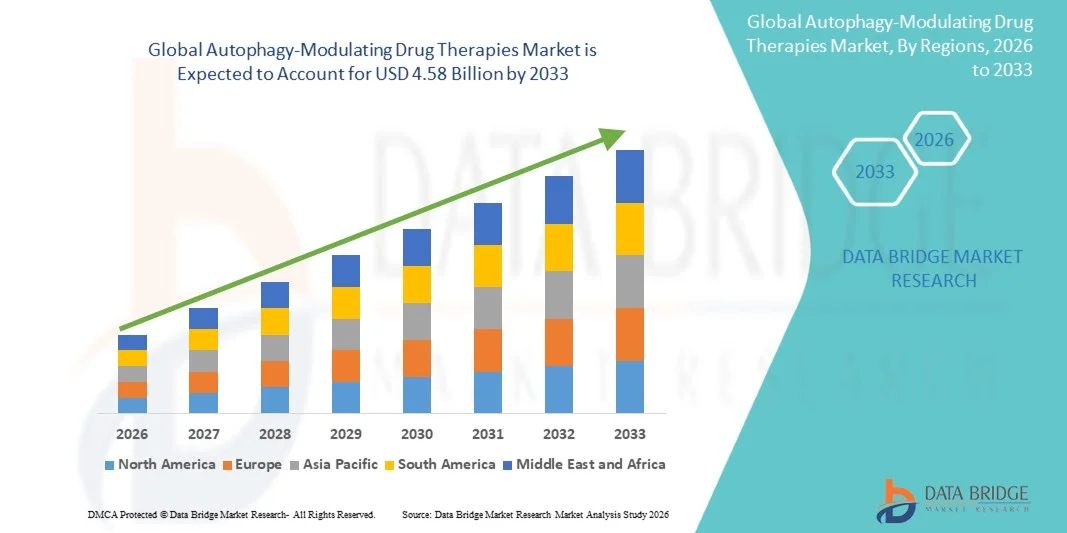
- The global autophagy-modulating drug therapies market size was valued at USD 1.28 billion in 2025 and is expected to reach USD 4.58 billion by 2033, at a CAGR of 17.30% during the forecast period
- The market growth is largely driven by increasing research and clinical advancements in autophagy‑related therapeutic agents, rising prevalence of chronic and age‑associated diseases such as cancer and neurodegenerative disorders, and expanding investment in precision medicine and targeted cellular therapies
- Furthermore, the growing focus of pharmaceutical and biotechnology companies on novel autophagy modulators that can improve therapeutic outcomes, along with supportive regulatory environments and rising demand for disease‑modifying treatments, is establishing autophagy‑modulating therapies as promising options across diverse clinical applications. These converging factors are accelerating adoption and significantly boosting the industry’s growth trajectory
Autophagy-Modulating Drug Therapies Market Analysis
- Autophagy‑modulating drug therapies, targeting the cellular autophagy pathways to regulate disease progression, are increasingly vital components of modern therapeutic strategies in oncology, neurodegenerative, and metabolic disorders due to their potential to improve treatment outcomes, enhance combination therapy efficacy, and modulate disease-specific cellular mechanisms
- The escalating demand for autophagy‑modulating therapies is primarily fueled by growing prevalence of chronic and age-associated diseases, rapid advancements in molecular biology and precision medicine, and rising investment by pharmaceutical and biotechnology companies in novel targeted therapeutics
- North America dominated the autophagy‑modulating drug therapies market with the largest revenue share of 42.3% in 2025, driven by strong R&D infrastructure, early adoption of advanced therapeutics, high healthcare expenditure, and a robust presence of key market players, with the U.S. witnessing substantial clinical trial activity and early regulatory approvals for novel autophagy modulators
- Asia-Pacific is expected to be the fastest-growing region in the market during the forecast period due to increasing healthcare investment, rising incidence of chronic diseases, and expanding pharmaceutical manufacturing capabilities in countries such as China, Japan, and India
- Small molecule modulators dominated the market with a market share of 38.7% in 2025, driven by their established efficacy, easier development pathways, and broad applicability across multiple therapeutic indications
Report Scope and Autophagy-Modulating Drug Therapies Market Segmentation
|
Attributes |
Autophagy-Modulating Drug Therapies Key Market Insights |
|
Segments Covered |
|
|
Countries Covered |
North America
Europe
Asia-Pacific
Middle East and Africa
South America
|
|
Key Market Players |
|
|
Market Opportunities |
|
|
Value Added Data Infosets |
In addition to the insights on market scenarios such as market value, growth rate, segmentation, geographical coverage, and major players, the market reports curated by the Data Bridge Market Research also include in-depth expert analysis, patient epidemiology, pipeline analysis, pricing analysis, and regulatory framework |
Autophagy-Modulating Drug Therapies Market Trends
“Advancements in Targeted and Combination Therapies”
- A significant and accelerating trend in the global autophagy-modulating drug therapies market is the increasing development of targeted therapies and combination treatments, enhancing efficacy in complex diseases such as cancer and neurodegenerative disorders
- For instance, novel combinations of small molecule autophagy modulators with immuno-oncology agents are being trialed to overcome drug resistance and improve patient outcomes
- Integration of biomarkers and precision medicine approaches enables therapies to be tailored to specific patient profiles, improving response rates and minimizing side effects
- The convergence of autophagy modulators with gene therapy and biologics is creating multifunctional treatment options that target multiple cellular pathways simultaneously, expanding therapeutic potential
- Growing adoption of AI and machine learning in drug discovery allows identification of novel autophagy targets and prediction of treatment response, accelerating pipeline development
- This trend towards more personalized, effective, and multi-mechanistic therapies is reshaping expectations for treatment outcomes, prompting pharmaceutical companies such as Evotec to develop autophagy-targeted combination solutions
- The demand for therapies that integrate precision targeting and combinational strategies is growing rapidly across oncology and neurodegenerative disease segments, as clinicians seek disease-modifying treatment options
Autophagy-Modulating Drug Therapies Market Dynamics
Driver
“Rising Prevalence of Chronic and Age-Associated Diseases”
- The increasing incidence of cancer, Alzheimer’s, Parkinson’s, and other age-related diseases is a major driver for the heightened adoption of autophagy-modulating therapies
- For instance, clinical studies indicate that targeting autophagy pathways can reduce tumor growth and improve chemotherapy response, creating strong demand for novel therapeutics
- Rising investment in biotechnology and pharmaceutical R&D is accelerating the development and approval of autophagy-based treatments for multiple indications
- Furthermore, the growing focus on precision medicine and targeted therapies is making autophagy modulators an integral component of advanced treatment regimens
- Increasing awareness among healthcare providers and patients regarding the therapeutic potential of autophagy modulation is boosting clinical adoption in both oncology and neurodegenerative care
- Expansion of partnerships between pharmaceutical companies and research institutes is fostering faster development and commercialization of autophagy modulators
- Increasing prevalence of multi-drug resistant cancers and limited efficacy of conventional therapies is pushing demand for autophagy-based interventions
- The availability of patient-tailored therapies and combination treatment protocols enhances clinical outcomes and is propelling market growth across major regions
Restraint/Challenge
“Regulatory Hurdles and Complex Clinical Development”
- Regulatory complexities and stringent approval processes for novel autophagy-modulating therapies pose significant challenges to market growth
- For instance, long clinical trial timelines, difficulty in demonstrating disease-modifying effects, and high costs of biologics can delay market entry for new therapies
- Variability in patient response and lack of universally accepted biomarkers complicate clinical development and commercialization strategies
- Moreover, the high cost of advanced therapies may limit patient access, particularly in developing countries or for rare disease indications
- Safety concerns related to overactivation or inhibition of autophagy pathways necessitate extensive preclinical and clinical validation, increasing development risk
- Limited awareness among clinicians and patients about autophagy-targeted therapies can slow adoption despite proven efficacy
- Complex manufacturing processes for biologics and combination therapies can create supply chain challenges and affect scalability
- Addressing regulatory compliance, optimizing clinical trial design, and developing cost-effective therapies will be vital for sustained growth in the autophagy-modulating drug therapies market
Autophagy-Modulating Drug Therapies Market Scope
The market is segmented on the basis of drug, route of administration, application, and end user.
- By Drug
On the basis of drug, the global autophagy-modulating drug therapies market is segmented into small molecule modulators, biologics, natural compounds, and others. The small molecule modulators segment dominated the market with the largest revenue share of 38.7% in 2025, driven by their well-established pharmacological profiles and relatively easier development pathways compared with biologics. These drugs are widely used in oncology and neurodegenerative research because they can effectively regulate autophagy pathways at the cellular level. Pharmaceutical companies also favor small molecules due to their cost-effective manufacturing and broader scalability in commercial production. In addition, the availability of multiple clinical candidates targeting autophagy inhibition or activation further strengthens the segment’s dominance. Their compatibility with combination therapies, particularly in cancer treatment, is also accelerating their clinical adoption. As a result, small molecule modulators continue to represent a significant portion of the therapeutic pipeline and market revenue.
The biologics segment is anticipated to witness the fastest growth rate during the forecast period, fueled by increasing advancements in biotechnology and targeted therapeutic development. Biologics offer highly specific mechanisms of action, enabling precise regulation of autophagy pathways involved in complex diseases. Growing investment in monoclonal antibodies, recombinant proteins, and gene-based therapies is supporting the expansion of this segment. Biologic therapies also demonstrate strong potential for treating conditions such as neurodegenerative disorders and rare genetic diseases where targeted cellular mechanisms are critical. Furthermore, advancements in protein engineering and cell-based therapies are accelerating research into novel autophagy modulators. Increasing collaboration between biotechnology companies and research institutes is expected to drive innovation and commercialization in this category. Consequently, biologics are projected to experience the fastest expansion within the drug segment.
- By Route of Administration
On the basis of route of administration, the global autophagy-modulating drug therapies market is segmented into oral, injectable, and others. The oral segment dominated the market with the largest revenue share in 2025, primarily due to its convenience and high patient compliance compared with other administration methods. Oral therapies are widely preferred for long-term disease management in conditions such as cancer and metabolic disorders. Many small molecule autophagy modulators are designed for oral delivery, further supporting the segment’s leadership. In addition, oral drugs reduce the need for hospital visits and enable easier treatment monitoring in outpatient settings. Pharmaceutical companies also prioritize oral formulations because they simplify large-scale distribution and reduce healthcare costs. These advantages collectively contribute to the strong demand and widespread adoption of orally administered therapies.
The injectable segment is expected to witness the fastest CAGR during the forecast period, driven by the increasing development of biologic drugs and advanced therapeutic formulations. Injectable administration enables direct systemic delivery, ensuring higher bioavailability and faster therapeutic action. Many biologics and targeted therapies require injection due to their complex molecular structures and sensitivity to gastrointestinal conditions. Growing clinical adoption of monoclonal antibodies and recombinant proteins in oncology and neurological diseases is further boosting the segment’s growth. Hospitals and specialty clinics often prefer injectable treatments for controlled dosing and improved patient monitoring. As the pipeline of biologic autophagy modulators expands, the demand for injectable therapies is projected to increase significantly.
- By Application
On the basis of application, the global autophagy-modulating drug therapies market is segmented into cancer, neurodegenerative diseases, infectious diseases, cardiovascular diseases, and metabolic disorders. The cancer segment dominated the market with the largest revenue share in 2025, driven by the critical role of autophagy in tumor development, survival, and resistance to chemotherapy. Researchers increasingly target autophagy pathways to improve the effectiveness of cancer therapies and reduce treatment resistance. Autophagy inhibitors and activators are widely studied as complementary agents in combination with immunotherapy and chemotherapy. The high global prevalence of cancer and ongoing clinical trials exploring novel autophagy-targeted drugs further strengthen the segment’s leadership. Pharmaceutical companies are heavily investing in oncology pipelines, leading to continuous innovation in treatment strategies. Consequently, cancer remains the primary application area for autophagy-modulating therapies.
The neurodegenerative diseases segment is expected to witness the fastest growth rate during the forecast period, fueled by increasing research into diseases such as Alzheimer’s, Parkinson’s, and Huntington’s. Dysfunctional autophagy processes are strongly associated with the accumulation of toxic proteins in neuronal cells, making autophagy modulation a promising therapeutic strategy. Rising global prevalence of neurodegenerative disorders and the absence of curative treatments are encouraging the development of innovative therapies. Research institutions and biotechnology firms are actively exploring autophagy-enhancing drugs to slow disease progression and improve patient outcomes. Advances in neuroscience and molecular medicine are also supporting the discovery of new therapeutic targets. These factors collectively position neurodegenerative diseases as the fastest-growing application segment in the market.
- By End User
On the basis of end user, the global autophagy-modulating drug therapies market is segmented into hospitals, specialty clinics, research institutes, and others. The hospitals segment dominated the market with the largest revenue share in 2025, primarily due to their advanced treatment infrastructure and access to specialized healthcare professionals. Hospitals serve as the primary centers for administering complex therapies, including injectable biologics and combination treatment regimens. Many clinical trials for autophagy-targeted drugs are also conducted within hospital settings, contributing to higher adoption. In addition, hospitals provide integrated patient care services such as diagnosis, treatment monitoring, and post-therapy management. Increasing hospitalization rates for cancer and neurological diseases further strengthen the segment’s dominance. As a result, hospitals remain the largest end-user segment for autophagy-modulating drug therapies.
The research institutes segment is anticipated to witness the fastest growth rate during the forecast period, driven by expanding research activities in molecular biology and drug discovery. Academic institutions and biotechnology research centers play a critical role in identifying new autophagy pathways and therapeutic targets. Growing funding from governments and private organizations is enabling large-scale research programs focused on innovative treatments. Collaboration between research institutes and pharmaceutical companies is also accelerating the development of new clinical candidates. These institutions are responsible for a substantial portion of early-stage discovery and preclinical studies related to autophagy modulation. Consequently, research institutes are expected to experience rapid growth as scientific exploration and therapeutic development continue to expand.
Autophagy-Modulating Drug Therapies Market Regional Analysis
- North America dominated the autophagy‑modulating drug therapies market with the largest revenue share of 42.3% in 2025, driven by strong R&D infrastructure, early adoption of advanced therapeutics, high healthcare expenditure, and a robust presence of key market players
- Healthcare providers and research institutions in the region highly prioritize innovative therapeutic approaches and targeted treatments, supporting the rapid development and adoption of autophagy-based drug therapies across oncology and neurological disease management
- This widespread adoption is further supported by advanced clinical research infrastructure, significant government and private funding for biotechnology innovation, and the strong presence of leading pharmaceutical and biotechnology companies, establishing autophagy-modulating therapies as an important component of modern precision medicine and disease-targeted treatment strategies
U.S. Autophagy-Modulating Drug Therapies Market Insight
The U.S. autophagy-modulating drug therapies market captured the largest revenue share in 2025 within North America, fueled by strong biotechnology innovation and increasing investment in targeted drug development. Healthcare providers and research organizations are increasingly focusing on advanced therapies that regulate cellular autophagy mechanisms to improve treatment outcomes in cancer and neurodegenerative disorders. The growing number of clinical trials, combined with robust funding from government agencies and private biotechnology firms, further propels the industry. Moreover, the increasing adoption of precision medicine approaches and advanced therapeutic technologies is significantly contributing to the market’s expansion.
Europe Autophagy-Modulating Drug Therapies Market Insight
The Europe autophagy-modulating drug therapies market is projected to expand at a substantial CAGR throughout the forecast period, primarily driven by rising prevalence of chronic diseases and strong support for biomedical research across the region. Increasing healthcare investments, coupled with advancements in molecular biology and targeted therapeutics, are fostering the development of innovative treatment approaches. European healthcare systems are also emphasizing early diagnosis and advanced treatment strategies for cancer and neurodegenerative diseases. The region is experiencing significant growth in clinical research and pharmaceutical innovation, with autophagy-based therapies gaining increasing attention among research institutions and biotechnology companies.
U.K. Autophagy-Modulating Drug Therapies Market Insight
The U.K. autophagy-modulating drug therapies market is anticipated to grow at a noteworthy CAGR during the forecast period, driven by strong research infrastructure and the increasing demand for advanced treatment options for complex diseases. In addition, growing government funding for biomedical innovation and collaborative research programs is encouraging pharmaceutical companies and academic institutions to explore autophagy-targeted therapies. The U.K.’s expanding biotechnology sector, alongside a supportive regulatory environment for innovative medicines, is expected to continue to stimulate market growth.
Germany Autophagy-Modulating Drug Therapies Market Insight
The Germany autophagy-modulating drug therapies market is expected to expand at a considerable CAGR during the forecast period, fueled by increasing investments in pharmaceutical research and a strong focus on innovative treatment development. Germany’s advanced healthcare infrastructure and emphasis on medical innovation encourage the adoption of targeted therapeutic solutions for cancer and neurological diseases. The integration of advanced biotechnology and molecular research is also becoming increasingly prevalent, with a strong preference for effective, precision-based treatment strategies aligning with clinical and patient expectations.
Asia-Pacific Autophagy-Modulating Drug Therapies Market Insight
The Asia-Pacific autophagy-modulating drug therapies market is poised to grow at the fastest CAGR during the forecast period of 2026 to 2033, driven by rising healthcare investments, increasing prevalence of chronic diseases, and expanding pharmaceutical manufacturing capabilities in countries such as China, Japan, and India. The region's growing focus on biotechnology innovation and advanced therapeutic research is driving the development and adoption of autophagy-targeted treatments. Furthermore, as APAC emerges as a major hub for pharmaceutical production and clinical research, the accessibility and development of advanced therapies are expanding across the region.
Japan Autophagy-Modulating Drug Therapies Market Insight
The Japan autophagy-modulating drug therapies market is gaining momentum due to the country’s strong pharmaceutical industry, rapid advancements in biomedical research, and increasing demand for innovative treatment options. The Japanese healthcare sector places significant emphasis on precision medicine and advanced therapeutics, encouraging the development of autophagy-based treatment approaches. The integration of cutting-edge biotechnology with clinical research is fueling growth. Moreover, Japan's aging population is likely to spur demand for effective treatments for age-related conditions such as neurodegenerative and metabolic disorders.
India Autophagy-Modulating Drug Therapies Market Insight
The India autophagy-modulating drug therapies market accounted for the largest market revenue share in Asia Pacific in 2025, attributed to the country's expanding pharmaceutical industry, rising healthcare awareness, and increasing investment in biotechnology research. India stands as one of the fastest-growing hubs for pharmaceutical manufacturing and clinical trials, and innovative drug therapies are gaining increasing attention among healthcare providers and research institutions. The push towards advanced medical research, alongside strong domestic pharmaceutical companies and expanding healthcare infrastructure, is a key factor propelling the market in India.
Autophagy-Modulating Drug Therapies Market Share
The Autophagy-Modulating Drug Therapies industry is primarily led by well-established companies, including:
- Merck & Co., Inc. (U.S.)
- Bristol-Myers Squibb Company (U.S.)
- Pfizer Inc. (U.S.)
- AstraZeneca (U.K.)
- F. Hoffmann-La Roche Ltd (Switzerland)
- Novartis AG (Switzerland)
- Sanofi (France)
- GSK plc (U.K.)
- Takeda Pharmaceutical Company Limited (Japan)
- Eli Lilly and Company (U.S.)
- Amgen Inc. (U.S.)
- Astellas Pharma Inc. (Japan)
- Otsuka Pharmaceutical Co., Ltd. (Japan)
- BioLineRx Ltd. (Israel)
- ImmuPharma PLC (U.K.)
- Ability Pharmaceuticals, S.A. (Spain)
- SOM Innovation Biotech, S.A. (Spain)
- Autophagy Science Co., Ltd. (South Korea)
- Samsara Therapeutics, Inc. (U.S.)
- PAQ Therapeutics, Inc. (U.S.)
What are the Recent Developments in Global Autophagy-Modulating Drug Therapies Market?
- In September 2025, Retro Biosciences, a longevity biotechnology company, announced the initiation of a clinical trial for its experimental drug RTR242, designed to activate autophagy to treat Alzheimer’s disease and potentially reverse age-related cognitive decline. The therapy aims to enhance the body’s cellular recycling process to remove damaged proteins that accumulate in aging brain cells
- In May 2025, Novartis announced plans to acquire Regulus Therapeutics to advance the development of farabursen (RGLS8429), an investigational microRNA-targeting therapy aimed at treating autosomal dominant polycystic kidney disease. The drug works by regulating disease-related molecular pathways associated with cellular stress and degradation processes, including autophagy mechanisms
- In February 2025, RedHill Biopharma announced the initiation of a Phase 2 clinical trial evaluating opaganib, an investigational sphingosine kinase-2 inhibitor that influences autophagy pathways, in combination with darolutamide for patients with metastatic castration-resistant prostate cancer. The randomized trial aims to assess whether modulating cellular stress and autophagy pathways can improve outcomes in advanced prostate cancer patients with poor prognosis
- In June 2023, Genoscience Pharma advanced the development of GNS561, a lysosomal autophagy inhibitor, into Phase 2 clinical trials for liver cancer in combination with atezolizumab and bevacizumab. The therapy targets the enzyme PPT1 to block autophagy in tumor cells, potentially enhancing the effectiveness of immunotherapy and anti-angiogenic treatments
- In September 2021, PAQ Therapeutics and Insilico Medicine announced a strategic collaboration to develop novel small-molecule drugs that harness autophagy-dependent degradation pathways to treat multiple diseases. The partnership combines PAQ’s autophagy-based drug discovery platform with Insilico Medicine’s artificial intelligence technologies to identify and design therapies targeting difficult disease pathways

- Interactive Data Analysis Dashboard
- Company Analysis Dashboard for high growth potential opportunities
- Research Analyst Access for customization & queries
- Competitor Analysis with Interactive dashboard
- Latest News, Updates & Trend analysis
- Harness the Power of Benchmark Analysis for Comprehensive Competitor Tracking
Data collection and base year analysis are done using data collection modules with large sample sizes. The stage includes obtaining market information or related data through various sources and strategies. It includes examining and planning all the data acquired from the past in advance. It likewise envelops the examination of information inconsistencies seen across different information sources. The market data is analysed and estimated using market statistical and coherent models. Also, market share analysis and key trend analysis are the major success factors in the market report. To know more, please request an analyst call or drop down your inquiry.
The key research methodology used by DBMR research team is data triangulation which involves data mining, analysis of the impact of data variables on the market and primary (industry expert) validation. Data models include Vendor Positioning Grid, Market Time Line Analysis, Market Overview and Guide, Company Positioning Grid, Patent Analysis, Pricing Analysis, Company Market Share Analysis, Standards of Measurement, Global versus Regional and Vendor Share Analysis. To know more about the research methodology, drop in an inquiry to speak to our industry experts.
Data Bridge Market Research is a leader in advanced formative research. We take pride in servicing our existing and new customers with data and analysis that match and suits their goal. The report can be customized to include price trend analysis of target brands understanding the market for additional countries (ask for the list of countries), clinical trial results data, literature review, refurbished market and product base analysis. Market analysis of target competitors can be analyzed from technology-based analysis to market portfolio strategies. We can add as many competitors that you require data about in the format and data style you are looking for. Our team of analysts can also provide you data in crude raw excel files pivot tables (Fact book) or can assist you in creating presentations from the data sets available in the report.












