


Autosomal Dominant Polycystic Kidney Treatment Market Analysis
The global autosomal dominant polycystic kidney disease (ADPKD) treatment market is driven by the increasing prevalence of the disease and advancements in treatment options. ADPKD is one of the most common genetic disorders, affecting approximately 1 in 400 to 1 in 1,000 live births worldwide. It is estimated that over 12 million people globally suffer from this condition. The disease leads to the progressive enlargement of cysts in the kidneys, often resulting in kidney failure by the age of 60 in around 50% of affected individuals. This highlights the need for effective treatments, including tyrosine kinase inhibitors such as Tolvaptan, which have shown promise in slowing disease progression. The growing burden of ADPKD is contributing to the increasing demand for therapies that address both the underlying causes and the symptoms of the disease, including hypertension and cyst growth, further stimulating market growth. Additionally, with improved awareness and diagnosis, the number of diagnosed cases is expected to rise, further fueling the demand for therapeutic interventions.
Autosomal Dominant Polycystic Kidney Treatment Market Size
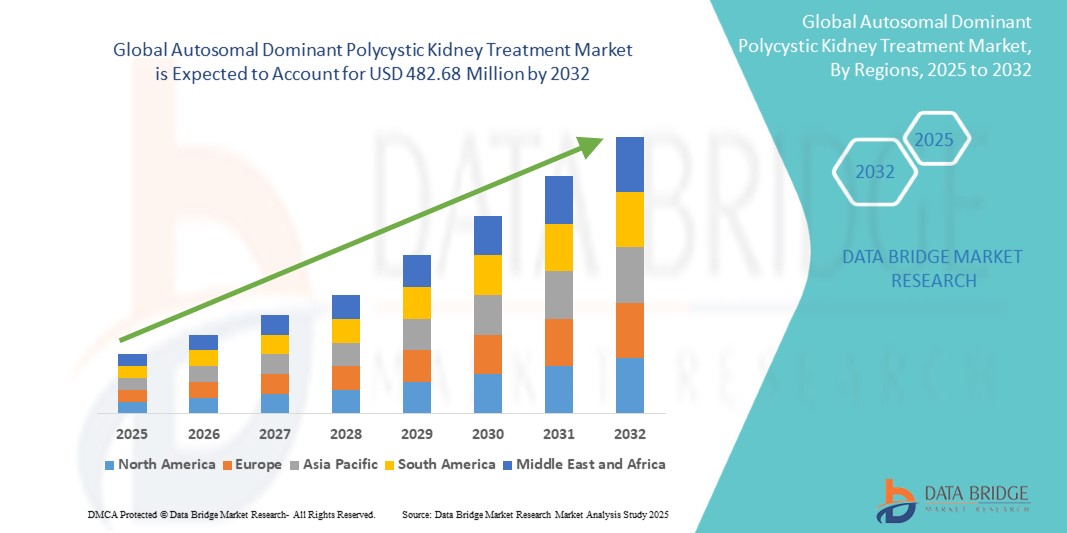
Global autosomal dominant polycystic kidney treatment market size was valued at USD 312.53 million in 2024 and is projected to reach USD 482.68 million by 2032, with a CAGR of 5.03% during the forecast period of 2025 to 2032. In addition to the insights on market scenarios such as market value, growth rate, segmentation, geographical coverage, and major players, the market reports curated by the Data Bridge Market Research also include depth expert analysis, patient epidemiology, pipeline analysis, pricing analysis, and regulatory framework.
Autosomal Dominant Polycystic Kidney Treatment Market Trends
“Increasing Focus on Early Diagnosis and Prevention”
Increasing Focus on Early Diagnosis and Prevention is becoming a significant trend in the global autosomal dominant polycystic kidney disease (ADPKD) treatment market. As advancements in genetic testing and imaging technologies improve, there is a growing emphasis on identifying ADPKD at earlier stages. This trend is allowing for a more proactive approach to disease management, enabling healthcare providers to initiate treatments before the disease progresses to more severe stages, such as kidney failure. Early diagnosis also facilitates closer monitoring of patients, improving the effectiveness of interventions and helping manage complications such as hypertension. As a result, patients are experiencing better long-term outcomes, and the focus on early detection is reshaping the treatment paradigm, with a stronger emphasis on prevention and managing disease progression from the outset.
Report Scope and Autosomal Dominant Polycystic Kidney Treatment Market Segmentation
|
Attributes |
Autosomal Dominant Polycystic Kidney Treatment Key Market Insights |
|
Segments Covered |
|
|
Countries Covered |
U.S., Canada, Mexico, Germany, France, U.K., Netherlands, Switzerland, Belgium, Russia, Italy, Spain, Turkey, Rest of Europe, China, Japan, India, South Korea, Singapore, Malaysia, Australia, Thailand, Indonesia, Philippines, Rest of Asia-Pacific, Saudi Arabia, U.A.E., South Africa, Egypt, Israel, Rest of Middle East and Africa, Brazil, Argentina, Rest of South America |
|
Key Market Players |
Otsuka Pharmaceutical Co., Ltd. (Japan), Novartis AG (Switzerland), Pfizer Inc. (U.S.), Sanofi S.A. (France), AbbVie Inc. (U.S.), Boehringer Ingelheim International GmbH (Germany), Johnson & Johnson Services, Inc. (U.S.), Amgen Inc. (U.S.), Eli Lilly and Co. (U.S.), F. Hoffmann-La Roche Ltd (Switzerland), Vertex Pharmaceuticals Incorporated (U.S.), Teva Pharmaceutical Industries Ltd. (Israel), Mylan N.V. (U.S.), Merck & Co., Inc. (U.S.), Horizon Therapeutics plc (Ireland), Akebia Therapeutics, Inc. (U.S.), Kadmon Holdings, Inc. (U.S.), and Medtronic (Ireland) |
|
Market Opportunities |
|
|
Value Added Data Infosets |
In addition to the insights on market scenarios such as market value, growth rate, segmentation, geographical coverage, and major players, the market reports curated by the Data Bridge Market Research also include depth expert analysis, patient epidemiology, pipeline analysis, pricing analysis, and regulatory framework. |
Autosomal Dominant Polycystic Kidney Treatment Market Definition
Autosomal dominant polycystic kidney disease (ADPKD) Treatment refers to medical interventions aimed at managing and slowing the progression of a genetic disorder that causes fluid-filled cysts to develop in the kidneys. ADPKD is inherited in an autosomal dominant manner, meaning a person only needs to inherit one copy of the defective gene to develop the disease. Treatment primarily focuses on controlling symptoms, slowing cyst growth, and preserving kidney function. This may include medications such as tyrosine kinase inhibitors (for instance, Tolvaptan), antihypertensive drugs to manage high blood pressure, and lifestyle modifications. In advanced cases, dialysis or kidney transplantation may be necessary when kidney failure occurs. The goal of treatment is to improve quality of life and extend kidney function as long as possible.
Autosomal Dominant Polycystic Kidney Treatment Market Dynamics
Drivers
- Advancements in Targeted Therapies
Advancements in Targeted Therapies have become a significant driver in the global autosomal dominant polycystic kidney disease (ADPKD) treatment market. The development and approval of therapies such as Tolvaptan, a tyrosine kinase inhibitor, have revolutionized the treatment of ADPKD by specifically targeting the mechanisms that drive cyst growth and kidney function decline. Tolvaptan works by blocking certain receptors, reducing cyst enlargement, and preserving kidney function, which slows disease progression. This advancement marks a shift from symptom management to therapies that address the root cause of the disease. As clinical evidence supporting the efficacy of targeted therapies continues to grow, their adoption is increasing among healthcare providers and patients. Additionally, ongoing research into other novel treatments and the refinement of existing therapies are expected to further improve patient outcomes, contributing to the market's growth. This innovation is a key factor in enhancing long-term management of ADPKD, providing hope for better disease control.
- Increasing Prevalence and Early Diagnosis of ADPKD
Increasing Prevalence and Early Diagnosis are key factors driving growth in the global autosomal dominant polycystic kidney disease (ADPKD) treatment market. ADPKD is a prevalent genetic disorder, affecting millions worldwide, and its early detection has become more feasible due to advancements in genetic testing and diagnostic imaging technologies. With improved awareness and diagnostic tools, more individuals are being diagnosed at earlier stages of the disease. Early identification allows for timely interventions, including lifestyle modifications and pharmacological treatments, to slow the progression of kidney cysts and preserve kidney function. By addressing the disease earlier, healthcare providers can manage complications such as hypertension and reduce the risk of kidney failure. This growing ability to detect ADPKD at early stages is contributing to a surge in diagnosed cases, increasing demand for effective treatment options and driving market expansion as patients seek therapies to manage the disease more effectively over time.
Opportunities
- Partnerships and Collaborations in Research
Partnerships and Collaborations in Research present a significant opportunity for accelerating the development of treatments for autosomal dominant polycystic kidney disease (ADPKD). By forming alliances between pharmaceutical companies, research institutions, and biotechnology firms, stakeholders can pool resources, knowledge, and technology to advance the discovery of novel therapies. Collaborating on clinical trials enables faster recruitment of diverse patient populations, enhances data sharing, and fosters innovation in drug development. These partnerships can help overcome the challenges of lengthy regulatory approval processes by combining expertise and optimizing trial designs. As a result, new therapies can reach the market more quickly, meeting the growing demand for effective ADPKD treatments. Furthermore, these collaborations open up opportunities for companies to expand their product portfolios and offer a broader range of treatment options to a larger patient population, driving overall market growth and improving outcomes for individuals with ADPKD.
- Growing Focus on Kidney Transplantation and Dialysis
Growing Focus on Kidney Transplantation and Dialysis presents a significant opportunity in the ADPKD Treatment Market as the disease progresses to end-stage kidney disease (ESKD). Many patients with ADPKD eventually require kidney transplantation or dialysis to manage renal failure. The increasing availability of advanced kidney transplantation techniques, such as improved organ preservation methods and minimally invasive surgical procedures, enhances patient outcomes and reduces recovery times. Similarly, innovations in dialysis technologies, including more efficient and comfortable home dialysis systems and automated peritoneal dialysis devices, are improving the quality of life for patients with ESKD. These advancements address the growing demand for renal care, driven by the increasing prevalence of ADPKD and other kidney diseases. As more patients require these treatments, there is significant potential for companies involved in renal care solutions to innovate and expand their offerings, ultimately improving the management of advanced kidney disease in ADPKD patients.
Restraints/Challenges
- High Cost of Treatment and Therapies
The high cost of treatment and therapies is a significant restraint for the global autosomal dominant polycystic kidney disease (ADPKD) treatment market. Treatments such as Tolvaptan and other advanced therapies can be expensive, creating a financial burden for patients and healthcare systems. ADPKD management requires long-term care, which includes not only medication but also regular diagnostic tests, kidney function monitoring, and potentially costly interventions such as dialysis or kidney transplantation in advanced stages. These high costs can make treatments inaccessible, especially in low- and middle-income regions, where healthcare budgets and patient affordability may be limited. As a result, the financial strain on patients and healthcare providers can restrict the widespread adoption of existing therapies, ultimately slowing market growth. This affordability issue poses a challenge for both healthcare systems trying to provide comprehensive care and pharmaceutical companies seeking to expand their market reach.
- Limited Availability of Effective Treatment Options
A significant challenge in the global autosomal dominant polycystic kidney disease (ADPKD) treatment market is the limited availability of effective treatment options. While Tolvaptan is approved to slow disease progression, there is currently no cure for ADPKD. Most treatments focus on symptom management and delaying the decline in kidney function rather than addressing the root causes of the disease. The absence of targeted therapies that specifically target the genetic mutations responsible for ADPKD limits the effectiveness of current therapies. Many existing treatments only delay progression, leaving patients vulnerable to long-term complications such as end-stage kidney disease (ESKD). This lack of comprehensive solutions poses a significant challenge for both patients and healthcare providers, as there is an unmet need for more effective, disease-modifying treatments. The market struggles with this limitation, as pharmaceutical companies and researchers continue to seek new ways to address the underlying causes and provide better management strategies for ADPKD.
This market report provides details of new recent developments, trade regulations, import-export analysis, production analysis, value chain optimization, market share, impact of domestic and localized market players, analyses opportunities in terms of emerging revenue pockets, changes in market regulations, strategic market growth analysis, market size, category market growths, application niches and dominance, product approvals, product launches, geographic expansions, technological innovations in the market. To gain more info on the market contact Data Bridge Market Research for an Analyst Brief, our team will help you take an informed market decision to achieve market growth.
Autosomal Dominant Polycystic Kidney Treatment Market Scope
The market is segmented on the basis of drug type, route of administration, treatment type, age group, end user, and distribution channel. The growth amongst these segments will help you analyze meagre growth segments in the industries and provide the users with a valuable market overview and market insights to help them make strategic decisions for identifying core market applications.
Drug Type
- Tyrosine Kinase Inhibitors
- Somatostatin Analogs
- Antihypertensive Drugs
- Others
Route of Administration
- Oral
- Intravenous
Treatment Type
- Chronic Treatment
- Acute Treatment
Age Group
- Pediatric
- Adult
- Geriatric
End User
- Hospitals
- Clinics
- Home Care
- Ambulatory Surgical Centers
Distribution Channel
- Hospital Pharmacies
- Retail Pharmacies
- Online Pharmacies
Autosomal Dominant Polycystic Kidney Treatment Market Regional Analysis
The market is analyzed and market size insights and trends are provided by country, drug type, route of administration, treatment type, age group, end user, and distribution channel as referenced above.
The countries covered in the market are U.S., Canada, Mexico, Germany, France, U.K., Netherlands, Switzerland, Belgium, Russia, Italy, Spain, Turkey, rest of Europe, China, Japan, India, South Korea, Singapore, Malaysia, Australia, Thailand, Indonesia, Philippines, rest of Asia-Pacific, Saudi Arabia, U.A.E., South Africa, Egypt, Israel, rest of Middle East and Africa, Brazil, Argentina, and rest of South America.
North America is expected to dominate the market due to its advanced healthcare infrastructure, high healthcare expenditure, widespread adoption of innovative treatments, and a strong presence of key pharmaceutical companies driving research and development in the region.
Asia-Pacific is expected to be the fastest growing due to the rising prevalence of ADPKD, improving healthcare infrastructure, and increasing investments in advanced medical technologies and treatment options.
The country section of the report also provides individual market impacting factors and changes in regulation in the market domestically that impacts the current and future trends of the market. Data points such as down-stream and upstream value chain analysis, technical trends and porter's five forces analysis, case studies are some of the pointers used to forecast the market scenario for individual countries. Also, the presence and availability of global brands and their challenges faced due to large or scarce competition from local and domestic brands, impact of domestic tariffs and trade routes are considered while providing forecast analysis of the country data.
Autosomal Dominant Polycystic Kidney Treatment Market Share
The market competitive landscape provides details by competitor. Details included are company overview, company financials, revenue generated, market potential, investment in research and development, new market initiatives, global presence, production sites and facilities, production capacities, company strengths and weaknesses, product launch, product width and breadth, application dominance. The above data points provided are only related to the companies' focus related to market.
Autosomal Dominant Polycystic Kidney Treatment Market Leaders Operating in the Market Are:
- Otsuka Pharmaceutical Co., Ltd. (Japan)
- Novartis AG (Switzerland)
- Pfizer Inc. (U.S.)
- Sanofi S.A. (France)
- AbbVie Inc. (U.S.)
- Boehringer Ingelheim International GmbH (Germany)
- Johnson & Johnson Services, Inc. (U.S.)
- Amgen Inc. (U.S.)
- Eli Lilly and Co. (U.S.)
- F. Hoffmann-La Roche Ltd (Switzerland)
- Vertex Pharmaceuticals Incorporated (U.S.)
- Teva Pharmaceutical Industries Ltd. (Israel)
- Mylan N.V. (U.S.)
- Merck & Co., Inc. (U.S.)
- Horizon Therapeutics plc (Ireland)
- Akebia Therapeutics, Inc. (U.S.)
- Kadmon Holdings, Inc. (U.S.)
- Medtronic (Ireland)
Latest Developments in Autosomal Dominant Polycystic Kidney Treatment Market
- In November 2024, Mitsui Chemicals, Inc. has invested in Rege Nephro Co., Ltd. through the 321FORCE Global Innovation Fund L.P. Rege Nephro, focused on R&D for kidney disease drugs, will benefit from this investment by accelerating the development of its innovative treatments
- In October 2024, Rege Nephro Co., Ltd. has secured approximately USD17 million in new Series B funding, bringing its total funding to USD30 million. The round was led by strategic investors such as DCI Partners Co., Ltd., JIC Venture Growth Investments, and several others. The funds will advance Phase II clinical trials for RN-014, a promising treatment for Autosomal Dominant Polycystic Kidney Disease (ADPKD), and support preclinical trials for RN-032, aimed at treating Chronic Kidney Disease (CKD) through cell therapy. This funding will enable Rege Nephro to accelerate the development of its innovative treatments, bringing them closer to improving outcomes for patients with kidney diseases
- In March 2024, Vertex Pharmaceuticals announced that the U.S. FDA has cleared the IND for VX-407, a first-in-class small molecule corrector targeting the underlying cause of ADPKD in patients with specific PKD1 genetic variants. This approval will help Vertex advance its development of innovative treatments for ADPKD, potentially expanding its pipeline and market presence
- In January 2024, XORTX Therapeutics has submitted a new patent for treating chronic kidney disease (CKD), focusing on safer and more effective oral and sublingual formulations of xanthine oxidase inhibitors (XOI) for conditions such as ADPKD, diabetic nephropathy, and others. This patent will help the company protect its innovative treatment strategies and enhance its portfolio in the kidney disease market

- Interactive Data Analysis Dashboard
- Company Analysis Dashboard for high growth potential opportunities
- Research Analyst Access for customization & queries
- Competitor Analysis with Interactive dashboard
- Latest News, Updates & Trend analysis
- Harness the Power of Benchmark Analysis for Comprehensive Competitor Tracking
Data collection and base year analysis are done using data collection modules with large sample sizes. The stage includes obtaining market information or related data through various sources and strategies. It includes examining and planning all the data acquired from the past in advance. It likewise envelops the examination of information inconsistencies seen across different information sources. The market data is analysed and estimated using market statistical and coherent models. Also, market share analysis and key trend analysis are the major success factors in the market report. To know more, please request an analyst call or drop down your inquiry.
The key research methodology used by DBMR research team is data triangulation which involves data mining, analysis of the impact of data variables on the market and primary (industry expert) validation. Data models include Vendor Positioning Grid, Market Time Line Analysis, Market Overview and Guide, Company Positioning Grid, Patent Analysis, Pricing Analysis, Company Market Share Analysis, Standards of Measurement, Global versus Regional and Vendor Share Analysis. To know more about the research methodology, drop in an inquiry to speak to our industry experts.
Data Bridge Market Research is a leader in advanced formative research. We take pride in servicing our existing and new customers with data and analysis that match and suits their goal. The report can be customized to include price trend analysis of target brands understanding the market for additional countries (ask for the list of countries), clinical trial results data, literature review, refurbished market and product base analysis. Market analysis of target competitors can be analyzed from technology-based analysis to market portfolio strategies. We can add as many competitors that you require data about in the format and data style you are looking for. Our team of analysts can also provide you data in crude raw excel files pivot tables (Fact book) or can assist you in creating presentations from the data sets available in the report.












