


What is the Auxiliary Power Unit (APU) Market Size and Growth Rate?
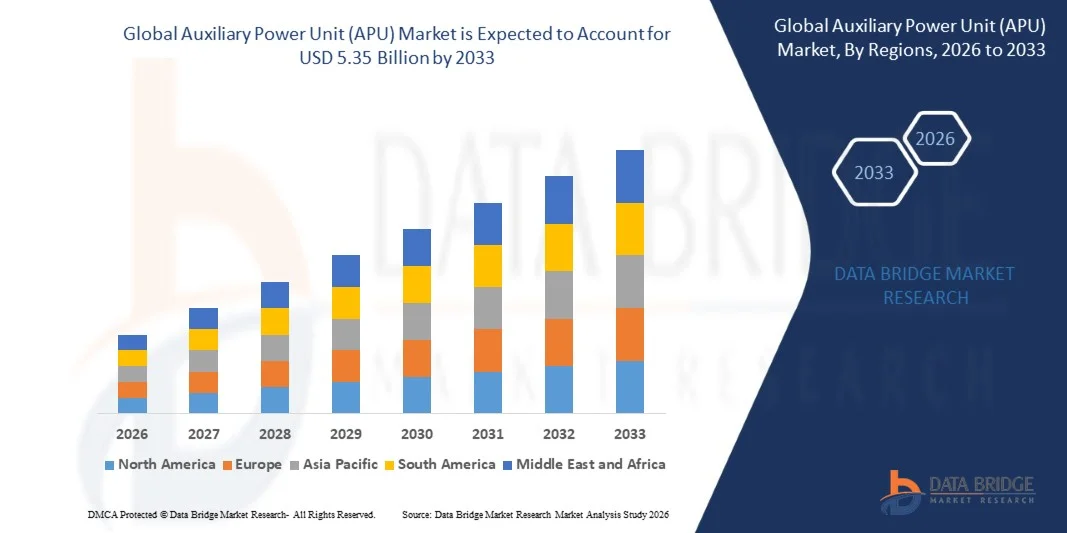
- As per Data Bridge Market Research analysis, the auxiliary power unit (APU) market was valued at USD 4.07 billion in 2025 and is projected to reach USD 5.35 billion by 2033, growing at a CAGR of 3.5% from 2026 to 2033.
- The market is experiencing steady growth driven by increasing demand for fuel-efficient power solutions, rising aircraft production, growing adoption of electric and hybrid auxiliary power systems, and expanding applications across commercial aviation, military aircraft, and ground support equipment.
- The growing focus on reducing aircraft emissions, improving operational efficiency, and minimizing dependency on external ground power units is encouraging airlines and defense organizations to adopt advanced APUs. Modern auxiliary power units provide reliable onboard electricity, engine starting capabilities, and environmental control support, enhancing aircraft performance while reducing fuel consumption and maintenance costs.
Market Size & Forecast
- Global Market Value (2025): USD 4.07 Billion
- Expected Market Value (2033): USD 5.35 Billion
- Forecast CAGR (2026–2033): 3.5%
- Leading Region in 2025: North America
- Fastest Growing Region: Asia-Pacific
What are the Major Takeaways of the Auxiliary Power Unit (APU) Market?
- North America dominated the aircraft auxiliary power unit (APU) market with the largest revenue share in 2025, supported by the presence of major aircraft manufacturers, strong defense aviation activities, expanding commercial aircraft fleets, and significant investments in aerospace research and development.
- Asia-Pacific is expected to be the fastest-growing region from 2026 to 2033, driven by rising aircraft deliveries, increasing air passenger traffic, expanding airline fleets, and growing investments in aviation infrastructure across China, India, and other emerging economies.
- The aircraft APUs segment led the market with a share in 2025, driven by increasing aircraft deliveries, fleet expansion, and rising demand for onboard power generation systems across commercial and military aviation.
- Vehicle APUs are the fastest-growing type, reflecting the surge in adoption in heavy-duty trucks, recreational vehicles, and commercial transportation applications.
- The non-electric segment dominated the technology category with a market share in 2025, led by its widespread adoption, high reliability, and established use across commercial and military aircraft.
- Commercial aviation accounted market share in 2025, preferred by the increasing aircraft production, rising passenger traffic, and expansion of airline fleets
- The defense and military segment is the fastest-growing application category, driven by increasing military aircraft modernization programs and rising defense spending.
Report Scope and Auxiliary Power Unit (APU) Market Segmentation
|
Attributes |
Auxiliary Power Unit (APU) Key Market Insights |
|
Segments Covered |
|
|
Countries Covered |
North America
Europe
Asia-Pacific
Middle East and Africa
South America
|
|
Key Market Players |
|
|
Market Opportunities |
|
|
Value Added Data Infosets |
In addition to the market insights such as market value, growth rate, market segments, geographical coverage, market players, and market scenario, the market report curated by the Data Bridge Market Research team includes in-depth expert analysis, import/export analysis, pricing analysis, production consumption analysis, and pestle analysis. |
What is the Key Trend in the Auxiliary Power Unit (APU) Market?
- Aircraft manufacturers are increasingly adopting advanced electric and hybrid-electric auxiliary power units to improve fuel efficiency, reduce emissions, and support the transition toward more sustainable aviation technologies.
- The integration of next-generation APUs with advanced energy management systems enables aircraft operators to optimize onboard power generation, reduce fuel consumption, and improve overall operational efficiency.
- For instance, in June 2024, Honeywell introduced its next-generation 1-megawatt electric generator technology designed to support hybrid-electric aircraft propulsion systems and future aviation electrification programs.
- Airlines and defense organizations are focusing on lightweight and high-performance APU solutions to enhance aircraft range, reliability, and mission capabilities while complying with evolving environmental regulations.
- For instance, in January 2025, Safran Electrical & Power continued development of ENGINeUS electric motors and hybrid-electric propulsion technologies, supporting future aircraft electrification and advanced onboard power management systems.
- The growing adoption of sustainable aviation technologies and increasing focus on aircraft electrification are expected to accelerate the development and deployment of advanced auxiliary power units across commercial and military aviation sectors.
What are the Key Drivers of the Auxiliary Power Unit (APU) Market?
- The rapid expansion of commercial aviation fleets and increasing aircraft deliveries have significantly increased demand for reliable auxiliary power units that provide onboard electricity, engine starting, and environmental control support.
- Aircraft manufacturers and airlines are integrating advanced APUs into next-generation aircraft programs to improve operational efficiency, reduce dependency on external ground power, and lower aircraft operating costs.
- For instance, in July 2024, Boeing released its 2024 Commercial Market Outlook (CMO), forecasting demand for nearly 44,000 new commercial airplanes through 2043, highlighting long-term aircraft fleet expansion and increasing demand for integrated aircraft systems, including auxiliary power units.
- The increasing demand for fuel-efficient aircraft and stringent aviation emission regulations are encouraging the adoption of advanced APU technologies with improved performance and reduced environmental impact.
- For instance, in February 2025, RTX’s Collins Aerospace announced that its Enhanced Power and Cooling System (EPACS) technology had successfully completed demonstrator testing, supporting future defense and commercial aircraft platforms with advanced power and thermal management capabilities.
- With global air traffic recovery, expanding aircraft fleets, and increasing emphasis on efficient aircraft operations, auxiliary power units will remain essential components for modern commercial and military aviation platforms.
Which Factors are Challenging the Growth of the Auxiliary Power Unit (APU) Market?
- Advanced auxiliary power units require significant investment due to complex engineering requirements, advanced materials, high-performance components, and extensive testing procedures involved in aircraft certification.
- These high development and maintenance costs can limit adoption among smaller aircraft operators, regional aviation companies, and organizations operating in cost-sensitive markets.
- For instance, in October 2024, Airbus UpNext and Toshiba Energy Systems & Solutions Corporation announced a partnership to research superconducting technologies for future hydrogen-powered aircraft, highlighting the extensive testing and technology validation required before next-generation aviation power systems can be commercially deployed.
- The increasing complexity of hybrid-electric and fuel-cell-based APU systems also creates technical challenges related to reliability, integration, certification, and long-term operational performance.
- For instance, in December 2024, Airbus completed the EcoPulse hybrid-electric aircraft demonstrator program after 50 test flights and 100 flight hours, providing critical insights into design, testing, certification, and operational challenges associated with future electric aviation technologies.
- The high capital requirements, lengthy certification processes, and technological complexities associated with advanced APUs continue to restrict faster market penetration despite rising demand for efficient aircraft power solutions.
How is the Auxiliary Power Unit (APU) Market Segmented?
The auxiliary power unit (APU) market is segmented on the basis of type, technology, power rating, application, and end user.
- By Type
On the basis of type, the auxiliary power unit (APU) market is segmented into aircraft APUs, vehicle APUs, marine and others. The aircraft APUs segment dominated the market with an estimated share in 2025, owing to increasing aircraft deliveries, fleet expansion, and rising demand for onboard power generation systems across commercial and military aviation. Aircraft APUs provide essential auxiliary electrical power, engine starting capability, and environmental control support during ground and flight operations. Growing air passenger traffic and airline fleet modernization programs are increasing demand for reliable aircraft power systems. The increasing replacement of aging aircraft fleets is further supporting segment growth. Extensive adoption across commercial aviation platforms continues to maintain the dominance of aircraft APUs.
The vehicle APUs segment is projected to be the fastest-growing type segment during the forecast period, driven by increasing adoption in heavy-duty trucks, recreational vehicles, and commercial transportation applications. Vehicle APUs help reduce engine idling, improve fuel efficiency, and lower emissions from transportation fleets. Growing regulatory pressure to reduce fuel consumption and greenhouse gas emissions is encouraging fleet operators to adopt auxiliary power solutions. Rising freight transportation activities are creating additional opportunities for vehicle APUs. Advancements in battery-powered and hybrid auxiliary systems are further supporting adoption. Increasing focus on sustainable transportation technologies is expected to accelerate segment growth.
- By Technology
On the basis of technology, the auxiliary power unit market is segmented into non-electric, electric, hybrid-electric, fuel cell, and others. The non-electric/gas turbine APU segment dominated the market share in 2025, due to its widespread adoption, high reliability, and established use across commercial and military aircraft. Gas turbine APUs provide dependable auxiliary power generation and remain the preferred choice for most existing aircraft platforms. Their compatibility with current aircraft architectures and mature maintenance ecosystem continue to support adoption. Major aircraft manufacturers continue integrating conventional APUs into new aircraft programs. However, emission reduction targets are encouraging development of alternative technologies. The segment continues to maintain leadership due to proven operational performance.
The fuel cell APU segment is projected to be the fastest-growing technology segment from 2026 to 2033, driven by increasing aircraft electrification initiatives and rising demand for sustainable aviation solutions. Fuel cell APUs offer reduced emissions and improved energy efficiency compared with conventional systems. Growing investments in hydrogen aviation technologies are accelerating research and development activities. These systems support future low-carbon and zero-emission aircraft concepts. Advancements in hydrogen storage and fuel cell efficiency are improving commercialization potential. Increasing environmental regulations are expected to further boost adoption.
- By Power Rating
On the basis of power rating, the auxiliary power unit market is segmented into below 90 kVA and above 90 kVA. The above 90 kVA segment dominated the market share in 2025, supported by increasing adoption of high-capacity auxiliary systems in commercial aircraft and large aviation platforms. These APUs provide sufficient power for multiple aircraft systems, including avionics, cabin systems, and environmental control units. Growing deployment of wide-body aircraft and long-range commercial aircraft is increasing demand for higher-output APUs. Airlines are adopting advanced power systems to improve operational efficiency and reduce ground support dependency. Increasing aircraft modernization programs are further strengthening demand. The segment remains dominant due to increasing electrical requirements of modern aircraft.
The below 90 kVA segment is expected to witness steady growth with an estimated CAGR during the forecast period, driven by increasing adoption in regional aircraft, business jets, and smaller aviation platforms. Compact APUs provide efficient auxiliary power solutions for aircraft with lower energy requirements. Growth in business aviation and regional air connectivity is supporting segment expansion. Manufacturers are focusing on lightweight and fuel-efficient auxiliary systems. Increasing adoption of hybrid-electric aircraft concepts is also creating opportunities. The segment is expected to benefit from rising aircraft electrification trends.
- By Application
On the basis of application, the auxiliary power unit market is segmented into commercial aviation, defense and military, ground transportation, and others. The commercial aviation segment dominated the market revenue share in 2025, driven by increasing aircraft production, rising passenger traffic, and expansion of airline fleets. Commercial aircraft extensively use APUs for engine starting, onboard electrical power generation, and cabin environmental control. Increasing aircraft utilization rates are creating strong demand for reliable auxiliary systems. Fleet replacement programs and adoption of fuel-efficient aircraft are further supporting growth. Airlines are increasingly focusing on reducing operational costs through efficient onboard systems. Commercial aviation remains the largest application segment due to widespread aircraft deployment.
The defense and military segment is projected to be the fastest-growing application segment with an estimated CAGR of during the forecast period, supported by increasing military aircraft modernization programs and rising defense spending. Military aircraft require reliable auxiliary power systems for mission readiness, electronic equipment, and operational flexibility. Growing procurement of advanced fighter aircraft, transport aircraft, and unmanned systems is creating additional demand. Defense organizations are focusing on improving aircraft efficiency and reducing dependency on external power sources. Increasing geopolitical tensions are encouraging defense investments globally. These factors are expected to support military APU adoption.
- By End User
On the basis of end user, the auxiliary power unit market is segmented into OEM and aftermarket. The OEM segment dominated the market with an estimated share in 2025, supported by increasing aircraft manufacturing activities and rising integration of APUs into newly delivered aircraft. Aircraft manufacturers collaborate with APU suppliers to integrate optimized power systems into commercial and military aircraft platforms. Growing aircraft production and fleet expansion are generating strong demand for factory-installed APUs. OEM systems provide improved compatibility, reliability, and performance efficiency. Increasing investments in next-generation aircraft programs are strengthening OEM opportunities. The segment continues to benefit from global aviation manufacturing growth.
The aftermarket segment is expected to register the fastest growth with an estimated CAGR during the forecast period, driven by increasing aircraft fleet age, rising maintenance requirements, and expansion of aircraft MRO activities. Airlines are focusing on extending aircraft service life through regular maintenance and component replacement. Growing aircraft utilization rates are increasing demand for APU repair and overhaul services. Expansion of global MRO facilities is supporting aftermarket opportunities. Aging fleets require frequent servicing to maintain operational efficiency. The segment is expected to gain importance as the global aircraft fleet continues expanding.
Which Region Holds the Largest Share of the Auxiliary Power Unit (APU) Market?
- North America dominated the aircraft auxiliary power unit (APU) market with the largest revenue share of in 2025, supported by the presence of major aircraft manufacturers, strong defense aviation activities, expanding commercial aircraft fleets, and significant investments in aerospace research and development.
- The region also benefits from significant investments in aircraft modernization, strong aerospace infrastructure, and the presence of leading APU manufacturers. Growing aircraft fleet expansion, increasing adoption of fuel-efficient aviation technologies, and rising demand for reliable onboard power solutions continue to strengthen North America’s leadership position in the global market.
U.S. Auxiliary Power Unit (APU) Market Insight
The U.S. auxiliary power unit (APU) market is witnessing strong growth due to increasing aircraft deliveries, rising military modernization programs, and growing demand for efficient onboard power systems across commercial and defense aviation. The country’s strong aerospace manufacturing ecosystem, presence of leading aircraft and APU manufacturers, and increasing adoption of advanced fuel-efficient aviation technologies are driving market expansion. In addition, the U.S. aviation industry’s focus on reducing emissions and improving aircraft operational efficiency is accelerating demand for next-generation auxiliary power solutions. Boeing’s Commercial Market Outlook projected demand for 43,975 new commercial airplanes globally through 2043, supporting increased demand for aircraft systems including auxiliary power units.
Asia-Pacific Auxiliary Power Unit (APU) Market Insight
The Asia-Pacific auxiliary power unit (APU) market is expected to witness rapid growth, driven by rising air passenger traffic, expanding airline fleets, increasing aircraft production, and growing investments in aviation infrastructure across countries such as China, India, and Japan. Growing demand for fuel-efficient aircraft, increasing adoption of advanced aviation technologies, and expansion of commercial aviation networks are supporting regional market growth. In addition, increasing aircraft manufacturing activities and modernization of military aviation fleets are accelerating APU adoption across commercial and defense applications. Airbus reported that the Asia-Pacific region would require more than 19,500 new aircraft deliveries over the next 20 years, representing the largest share of global aircraft demand and creating significant opportunities for aircraft component suppliers, including APU manufacturers.
Japan Auxiliary Power Unit (APU) Market Insight
The Japan auxiliary power unit (APU) market is witnessing consistent growth due to rising investments in aircraft modernization, advanced aerospace technologies, and sustainable aviation solutions. Japanese airlines and aerospace companies are increasingly focusing on improving aircraft operational efficiency and reducing emissions through advanced power systems. Moreover, the country’s strong aerospace manufacturing capabilities and participation in next-generation aircraft technology development are contributing to market growth. Japan Airlines announced initiatives to reduce aircraft emissions and improve operational efficiency through fleet modernization and sustainable aviation programs, supporting demand for advanced aircraft system
China Auxiliary Power Unit (APU) Market Insight
The China auxiliary power unit (APU) market is growing rapidly, driven by increasing aircraft fleet expansion, domestic aircraft manufacturing growth, and rising government focus on aviation development. Growing commercial aviation demand, expansion of airport infrastructure, and increasing adoption of advanced aircraft technologies are significantly boosting market opportunities. In addition, rising investments in domestic aerospace capabilities and military aviation modernization are positioning China as one of the fastest-growing aviation markets globally. COMAC expanded production capacity for its C919 aircraft program as orders increased, supporting the growth of China’s commercial aviation sector and increasing demand for integrated aircraft systems and components.
U.K. Auxiliary Power Unit (APU) Market Insight
The U.K. auxiliary power unit (APU) market is experiencing steady growth, supported by strong aerospace manufacturing capabilities, increasing aircraft maintenance activities, and investments in sustainable aviation technologies. The country’s established aviation industry, presence of major aerospace companies, and focus on reducing aviation emissions are contributing to demand for advanced aircraft power systems. Furthermore, development of hybrid-electric and low-carbon aviation technologies is creating opportunities for next-generation APUs. The U.K. government announced continued support for the Aerospace Technology Institute (ATI) programme with funding for advanced aerospace technologies, including cleaner aviation systems.
Germany Auxiliary Power Unit (APU) Market Insight
The Germany auxiliary power unit (APU) market is expanding steadily due to the country’s strong aerospace manufacturing base, advanced engineering capabilities, and increasing adoption of sustainable aviation technologies. German aircraft manufacturers, suppliers, and research organizations are focusing on improving aircraft efficiency through electrification and advanced propulsion technologies. Continuous investments in aerospace innovation, aircraft production, and emission reduction programs are further driving demand for advanced auxiliary power solutions. Airbus continued development of hydrogen and hybrid-electric aircraft technologies at its German facilities, supporting future demand for advanced aircraft power systems and components.
Which are the Top Companies in Auxiliary Power Unit (APU) Market?
The auxiliary power unit (APU) industry is primarily led by well-established companies, including:
- Honeywell International Inc. (U.S.)
- RTX Corporation (U.S.)
- Safran Group (France)
- The Boeing Company (U.S.)
- AIRBUS (Netherlands)
- Collins Aerospace (U.S.)
- Rolls-Royce plc (U.K.)
- Thales (France)
- Liebherr-International AG (Switzerland)
- Kawasaki Heavy Industries, Ltd. (Japan)
- PBS AEROSPACE (Czech Republic)
- Aegis Power Systems, Inc. (U.S.)
- Astronics Corporation (U.S.)
- Kinetic Data, Inc (U.S.)
- AMETEK, INC. (U.S.)
- PARKER-HANNIFIN CORP (U.S.)
- Kidde Aerospace (U.S.)
- Aero Engine Corporation of China (China)
What are Latest Developments in Auxiliary Power Unit (APU) Market?
- In February 2025, RTX’s Collins Aerospace announced the successful completion of testing for its Enhanced Power and Cooling System (EPACS), a next-generation aircraft power and thermal management technology designed to support future military and commercial aircraft platforms. The EPACS system integrates advanced electrical power generation and cooling capabilities, helping aircraft operators improve energy efficiency, reduce system weight, and meet increasing onboard power requirements. This development highlights the industry’s focus on advanced auxiliary power technologies and next-generation aircraft electrical systems.
- In June 2024, Honeywell introduced its 1-megawatt electric generator technology designed to support hybrid-electric aircraft propulsion systems and future aviation electrification programs. The advanced generator technology enables higher power generation efficiency while supporting the transition toward more sustainable aircraft architectures. This development reflects the increasing focus on electric power solutions, hybrid-electric propulsion, and reduced-emission aircraft technologies that are influencing the future design of auxiliary power systems.
- In February 2024, Safran Electrical & Power received EASA certification for its ENGINeUS electric motor, becoming one of the first electric motors certified for new air mobility applications. The ENGINeUS technology integrates advanced electrical power management capabilities and supports future hybrid-electric aircraft development. This achievement strengthens Safran’s position in aircraft electrification and demonstrates industry progress toward cleaner propulsion and next-generation onboard power systems.
- In October 2023, Airbus UpNext and Toshiba Energy Systems & Solutions Corporation announced a partnership to research superconducting technologies for future hydrogen-powered aircraft. The collaboration focuses on developing lightweight and highly efficient electrical systems required for future zero-emission aviation platforms. This initiative highlights the increasing importance of advanced electrical power technologies, including future auxiliary power solutions, as aerospace companies move toward hydrogen and hybrid-electric aircraft concepts.
- In June 2023, Honeywell announced a High-Efficiency Mode (HEM) upgrade for its 131-9B auxiliary power unit (APU), designed for Boeing 737 aircraft, to improve fuel efficiency, reduce emissions, and increase APU operational life. The upgraded APU system uses an advanced diffuser and software-controlled airflow management technology to reduce fuel consumption and CO₂ emissions while improving time-on-wing performance. This development highlights the industry’s focus on enhancing existing APU technologies to support more efficient and sustainable aircraft operations.

- Interactive Data Analysis Dashboard
- Company Analysis Dashboard for high growth potential opportunities
- Research Analyst Access for customization & queries
- Competitor Analysis with Interactive dashboard
- Latest News, Updates & Trend analysis
- Harness the Power of Benchmark Analysis for Comprehensive Competitor Tracking
Data collection and base year analysis are done using data collection modules with large sample sizes. The stage includes obtaining market information or related data through various sources and strategies. It includes examining and planning all the data acquired from the past in advance. It likewise envelops the examination of information inconsistencies seen across different information sources. The market data is analysed and estimated using market statistical and coherent models. Also, market share analysis and key trend analysis are the major success factors in the market report. To know more, please request an analyst call or drop down your inquiry.
The key research methodology used by DBMR research team is data triangulation which involves data mining, analysis of the impact of data variables on the market and primary (industry expert) validation. Data models include Vendor Positioning Grid, Market Time Line Analysis, Market Overview and Guide, Company Positioning Grid, Patent Analysis, Pricing Analysis, Company Market Share Analysis, Standards of Measurement, Global versus Regional and Vendor Share Analysis. To know more about the research methodology, drop in an inquiry to speak to our industry experts.
Data Bridge Market Research is a leader in advanced formative research. We take pride in servicing our existing and new customers with data and analysis that match and suits their goal. The report can be customized to include price trend analysis of target brands understanding the market for additional countries (ask for the list of countries), clinical trial results data, literature review, refurbished market and product base analysis. Market analysis of target competitors can be analyzed from technology-based analysis to market portfolio strategies. We can add as many competitors that you require data about in the format and data style you are looking for. Our team of analysts can also provide you data in crude raw excel files pivot tables (Fact book) or can assist you in creating presentations from the data sets available in the report.












