


What is the Axial Spondyloarthritis Treatment Market Size and Growth Rate?
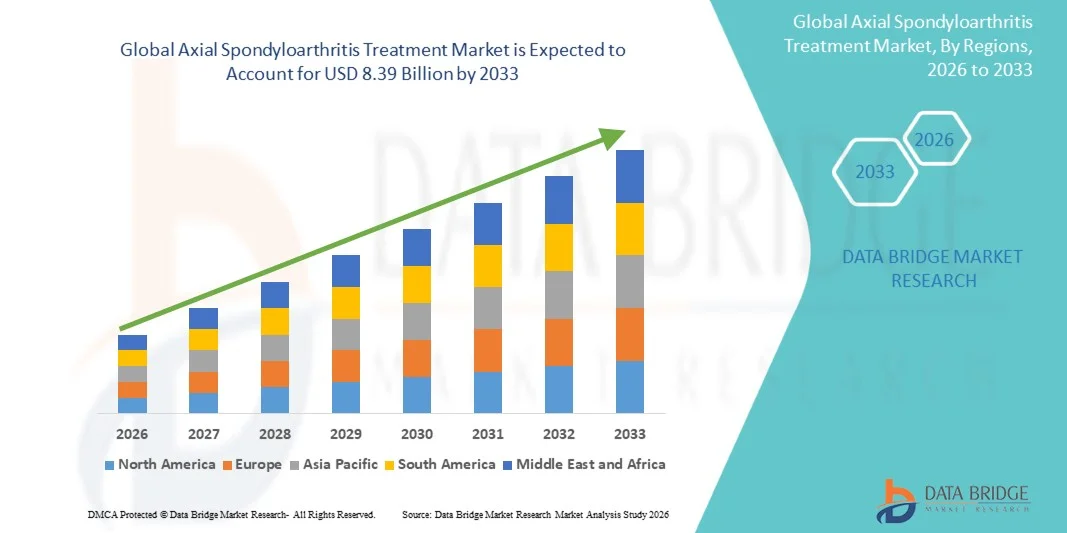
- As per Data Bridge Market Research Analysis the global axial spondyloarthritis treatment market size was valued at USD 4.58 billion in 2025 and is expected to reach USD 8.39 billion by 2033, at a CAGR of 7.87% during the forecast period
- The market growth is largely fueled by the rising prevalence of chronic inflammatory and autoimmune disorders, increasing awareness regarding early diagnosis of musculoskeletal diseases, and continuous advancements in biologic and targeted therapies, leading to greater adoption of advanced treatment solutions across healthcare settings
- Furthermore, growing demand for effective long-term pain management, improved mobility outcomes, and personalized treatment approaches is establishing Axial Spondyloarthritis Treatment solutions as an essential component of modern rheumatology care. These converging factors are accelerating the uptake of Axial Spondyloarthritis Treatment solutions, thereby significantly boosting the industry's growth
Market Size & Forecast
- Global Market Value (2025): USD 4.58 Billion
- Expected Market Value (2033): USD 8.39 Billion
- Forecast CAGR (2026–2033): 7.87%
Axial Spondyloarthritis Treatment Market Analysis
- Axial spondyloarthritis treatment solutions, including biologics, NSAIDs, JAK inhibitors, physical therapy programs, and supportive care options, are increasingly vital components of modern rheumatology management due to their role in reducing inflammation, relieving pain, improving spinal mobility, and slowing disease progression
- The escalating demand for Axial Spondyloarthritis Treatment solutions is primarily fueled by rising prevalence of autoimmune and inflammatory disorders, increasing awareness regarding early diagnosis, growing access to advanced biologic therapies, and continuous improvements in personalized rheumatology care
- North America dominated the axial spondyloarthritis treatment market with the largest revenue share of approximately 41.7% in 2025, characterized by advanced healthcare infrastructure, strong adoption of biologic therapies, favorable reimbursement systems, and increasing diagnosis rates across the U.S. and Canada
- Asia-Pacific is expected to be the fastest growing region in the axial spondyloarthritis treatment market during the forecast period due to expanding healthcare access, rising awareness of inflammatory spinal disorders, increasing healthcare expenditure, growing biologics penetration, and improving rheumatology care services across China, Japan, India, and Southeast Asia
- The Ankylosing Spondylitis Treatment segment dominated the largest market revenue share of 61.7% in 2025, driven by higher diagnosis rates, established treatment guidelines, and long-term dependence on pharmacological therapy
Report Scope and Axial Spondyloarthritis Treatment Market Segmentation
|
Attributes |
Axial Spondyloarthritis Treatment Key Market Insights |
|
Segments Covered |
|
|
Countries Covered |
North America
Europe
Asia-Pacific
Middle East and Africa
South America
|
|
Key Market Players |
|
|
Market Opportunities |
|
|
Value Added Data Infosets |
In addition to the insights on market scenarios such as market value, growth rate, segmentation, geographical coverage, and major players, the market reports curated by the Data Bridge Market Research also include in-depth expert analysis, patient epidemiology, pipeline analysis, pricing analysis, and regulatory framework. |
What is the Key Trend in the Axial Spondyloarthritis Treatment Market?
“Enhanced Adoption of Biologic Therapies and Precision Treatment Approaches”
- A significant and accelerating trend in the global Axial Spondyloarthritis Treatment market is the increasing adoption of biologic therapies and targeted treatment approaches aimed at improving long-term disease management, symptom control, and patient mobility. As awareness of early diagnosis grows, healthcare providers are increasingly shifting from conventional pain management therapies toward advanced biologics that address the underlying inflammatory pathways of the disease
- For instance, tumor necrosis factor (TNF) inhibitors such as adalimumab, etanercept, and infliximab, along with interleukin-17 (IL-17) inhibitors such as secukinumab and ixekizumab, are being widely prescribed for patients with moderate to severe axial spondyloarthritis who show inadequate response to NSAIDs. These therapies have demonstrated improved spinal mobility, reduced inflammation, and better quality of life outcomes
- Another important aspect of this trend is the growing use of precision medicine and biomarker-driven treatment strategies, where clinicians evaluate disease progression, imaging findings, and patient-specific responses before selecting therapies. This individualized approach is helping optimize treatment effectiveness while minimizing unnecessary drug exposure
- Pharmaceutical companies are also investing in next-generation oral therapies, biosimilars, and long-acting formulations to improve treatment accessibility and reduce overall healthcare costs. The emergence of biosimilar biologics in several countries is expanding patient access, particularly in cost-sensitive healthcare systems
- In addition, digital health monitoring tools and remote patient management programs are supporting regular symptom tracking, adherence monitoring, and physician follow-up, leading to better disease control over time. These innovations are reshaping treatment pathways globally
- The demand for advanced axial spondyloarthritis therapies is rising across North America and Europe due to strong biologic adoption, while Asia-Pacific, Latin America, and the Middle East are witnessing growing uptake due to improved rheumatology care infrastructure and increasing awareness
Axial Spondyloarthritis Treatment Market Dynamics
Driver
“Rising Prevalence of Chronic Inflammatory Disorders and Increasing Early Diagnosis Rates”
- The increasing prevalence of chronic inflammatory musculoskeletal disorders, combined with greater awareness of axial spondyloarthritis among healthcare professionals, is a major driver supporting market growth. Earlier recognition of symptoms such as chronic back pain, stiffness, and reduced mobility is enabling faster intervention and long-term treatment initiation
- For instance, several hospitals and rheumatology associations globally have introduced MRI-based diagnostic pathways and referral programs to identify non-radiographic axial spondyloarthritis at earlier stages, helping expand the eligible treatment population for biologics and specialty therapies
- Growing sedentary lifestyles, obesity prevalence, and delayed musculoskeletal care in some regions are also contributing to higher disease burden, thereby increasing demand for effective treatment solutions
- Furthermore, expanding insurance coverage for specialty biologics and increasing healthcare expenditure in emerging economies are improving access to advanced therapies, supporting stronger market penetration worldwide
- Rising patient preference for therapies that improve mobility, reduce pain flare-ups, and maintain productivity is further accelerating adoption of innovative treatment options
Restraint/Challenge
“High Cost of Biologic Therapies and Long-Term Treatment Management Challenges”
- The high cost associated with biologic therapies and specialty drugs remains a significant challenge for broader market expansion. Many patients require continuous or long-duration therapy, creating affordability concerns in regions with limited reimbursement support
- For instance, branded biologics such as secukinumab and adalimumab can create substantial annual treatment costs in several healthcare markets, leading some patients to delay therapy initiation or switch to lower-cost conventional alternatives
- Another challenge is the need for regular monitoring of side effects, infection risks, and therapy response, which increases the overall burden on healthcare systems and patients. Biologic therapies may require physician supervision, laboratory testing, and adherence management
- In developing countries, limited specialist availability, delayed diagnosis, and lower awareness levels can further restrict timely access to advanced treatments
- In addition, treatment discontinuation due to inadequate response, side effects, or payer restrictions may negatively impact long-term disease outcomes and market growth potential
- Overcoming these challenges through broader biosimilar adoption, improved reimbursement frameworks, patient support programs, and continued innovation in safer oral therapies will be essential for sustained market expansion
Axial Spondyloarthritis Treatment Market Scope
The market is segmented on the basis of category, drug class, product, and end user.
- By Category
On the basis of category, the Axial Spondyloarthritis Treatment market is segmented into Ankylosing Spondylitis Treatment and Non-Radiographic Axial Spondyloarthritis Treatment. The Ankylosing Spondylitis Treatment segment dominated the largest market revenue share of 61.7% in 2025, driven by higher diagnosis rates, established treatment guidelines, and long-term dependence on pharmacological therapy. Ankylosing spondylitis represents the more advanced radiographic form of axial spondyloarthritis, leading to sustained demand for anti-inflammatory and biologic drugs. Rising awareness among rheumatologists supports early treatment initiation. Increasing prevalence of chronic inflammatory back pain further boosts patient volumes. Strong availability of approved TNF inhibitors reinforces segment leadership. Expanding healthcare access in emerging markets continues to support growth.
The Non-Radiographic Axial Spondyloarthritis Treatment segment is expected to witness the fastest growth rate of 24.3% from 2026 to 2033, driven by improving diagnostic criteria and increasing use of MRI for early disease detection. Patients are being identified before structural damage appears, enabling earlier intervention. Rising awareness of inflammatory back disorders is supporting demand. Growing physician preference for preventive treatment approaches accelerates uptake. Expanding approvals for biologics in this indication strengthen market growth. Increasing patient education and screening initiatives further boost adoption. Continuous innovation in rheumatology therapeutics supports rapid expansion.
- By Drug Class
On the basis of drug class, the Axial Spondyloarthritis Treatment market is segmented into Non-Steroidal Anti-Inflammatory Drugs (NSAID), TNFα Inhibitors, and Conventional Disease Modifying Anti-Rheumatic Drugs & Glucocorticoids. The Non-Steroidal Anti-Inflammatory Drugs (NSAID) segment held the largest market revenue share of 42.9% in 2025, driven by their status as first-line therapy for pain relief and inflammation control. NSAIDs are widely prescribed at initial diagnosis and remain commonly used throughout disease management. Broad availability and lower treatment cost support segment dominance. Strong physician familiarity and rapid symptom relief reinforce continued use. Increasing prevalence of chronic musculoskeletal pain further boosts demand. Wide accessibility across hospital and retail channels strengthens leadership.
The TNFα Inhibitors segment is expected to witness the fastest CAGR of 25.8% from 2026 to 2033, driven by superior efficacy in patients with moderate to severe disease unresponsive to NSAIDs. These biologics help reduce inflammation, improve mobility, and slow disease progression. Rising adoption of targeted immunotherapies is accelerating demand. Expanding biosimilar launches improve affordability and accessibility. Strong clinical evidence supporting long-term outcomes boosts physician confidence. Increasing reimbursement coverage further strengthens uptake. Ongoing biologic innovation supports robust segment growth.
- By Product
On the basis of product, the Axial Spondyloarthritis Treatment market is segmented into COX-2 Antagonists, COX Inhibitors, and Others. The COX Inhibitors segment accounted for the largest market revenue share of 47.6% in 2025, driven by widespread use of traditional anti-inflammatory medications for pain and stiffness management. These products are commonly prescribed as first-line symptom control therapies due to proven efficacy and affordability. Strong patient familiarity supports repeat usage. Broad generic availability reinforces segment leadership. Rising demand for cost-effective chronic pain management boosts adoption. Established prescribing habits among physicians further sustain dominance.
The COX-2 Antagonists segment is expected to witness the fastest growth rate of 23.7% from 2026 to 2033, driven by increasing preference for safer gastrointestinal profiles compared with traditional NSAIDs. These products are particularly useful in long-term treatment patients requiring reduced GI side effects. Growing awareness regarding treatment tolerability supports growth. Rising aging patient population with comorbidities accelerates demand. Expanding branded and generic availability strengthens uptake. Physician focus on individualized therapy continues to drive adoption. Continuous product optimization supports rapid expansion.
- By End User
On the basis of end user, the Axial Spondyloarthritis Treatment market is segmented into Hospital, Clinics, Rehabilitation Center, Academic Research Institutes, and Others. The Hospital segment dominated the largest market revenue share of 49.8% in 2025, driven by high patient inflow for diagnosis, biologic infusions, imaging, and specialist rheumatology consultations. Hospitals remain the primary treatment centers for moderate and severe axial spondyloarthritis cases. Availability of multidisciplinary care teams supports segment leadership. Access to advanced imaging such as MRI strengthens diagnostic volumes. Strong reimbursement-linked treatment pathways further reinforce dominance. Increasing chronic disease burden supports sustained hospital demand.
The Rehabilitation Center segment is expected to witness the fastest CAGR of 24.6% from 2026 to 2033, driven by growing recognition of physiotherapy and mobility training as essential components of long-term disease management. These centers help improve posture, flexibility, and pain control alongside drug therapy. Rising patient preference for non-pharmacological support boosts demand. Increasing physician referrals for exercise-based management accelerate growth. Expanding musculoskeletal wellness infrastructure supports adoption. Greater awareness of quality-of-life improvement strategies further strengthens uptake. Continuous focus on integrated care models supports segment expansion.
Axial Spondyloarthritis Treatment Market Regional Analysis
- North America dominated the axial spondyloarthritis treatment market with the largest revenue share of approximately 41.7% in 2025, characterized by advanced healthcare infrastructure, strong adoption of biologic therapies, favorable reimbursement systems, and increasing diagnosis rates across the U.S. and Canada
- Patients and healthcare providers in the region highly value early diagnosis, access to innovative biologics, targeted therapies, and comprehensive rheumatology care programs that help improve mobility, pain management, and long-term disease control
- This widespread adoption is further supported by strong healthcare spending, established specialty care networks, increasing awareness of inflammatory spinal disorders, and continued research initiatives, establishing North America as a leading market for axial spondyloarthritis treatment solutions
U.S. Axial Spondyloarthritis Treatment Market Insight
The U.S. axial spondyloarthritis treatment market captured the largest revenue share in 2025 within North America, fueled by increasing diagnosis rates, widespread use of biologic therapies, and strong access to specialty rheumatology services. Patients are increasingly prioritizing early treatment to reduce pain, stiffness, and disease progression. The growing availability of advanced TNF inhibitors, IL inhibitors, and personalized treatment approaches further propels the market. Moreover, favorable reimbursement policies and strong pharmaceutical innovation are significantly contributing to market expansion.
Europe Axial Spondyloarthritis Treatment Market Insight
The Europe axial spondyloarthritis treatment market is projected to expand at a substantial CAGR throughout the forecast period, primarily driven by increasing awareness of chronic inflammatory disorders, supportive public healthcare systems, and growing demand for effective long-term therapies. Rising adoption of biologics and biosimilars, along with expanding rheumatology services, is fostering market growth. The region is experiencing significant demand across hospital, specialty clinic, and outpatient settings.
U.K. Axial Spondyloarthritis Treatment Market Insight
The U.K. axial spondyloarthritis treatment market is anticipated to grow at a noteworthy CAGR during the forecast period, driven by improved screening initiatives, rising patient awareness, and increasing access to biologic medicines through public healthcare channels. In addition, expanding use of multidisciplinary care approaches and digital patient monitoring tools is expected to continue stimulating market growth.
Germany Axial Spondyloarthritis Treatment Market Insight
The Germany axial spondyloarthritis treatment market is expected to expand at a considerable CAGR during the forecast period, fueled by strong healthcare infrastructure, increasing adoption of advanced biologics, and rising emphasis on early intervention strategies. Germany’s established rheumatology centers and focus on innovation support the uptake of effective treatment options, while biosimilar penetration is further enhancing affordability and access.
Asia-Pacific Axial Spondyloarthritis Treatment Market Insight
The Asia-Pacific axial spondyloarthritis treatment market is poised to grow at the fastest CAGR during the forecast period, due to expanding healthcare access, rising awareness of inflammatory spinal disorders, increasing healthcare expenditure, growing biologics penetration, and improving rheumatology care services across China, Japan, India, and Southeast Asia. The region’s large patient population and improving diagnostic capabilities are accelerating treatment adoption.
Japan Axial Spondyloarthritis Treatment Market Insight
The Japan axial spondyloarthritis treatment market is gaining momentum due to advanced healthcare systems, increasing elderly population, and growing awareness of musculoskeletal and autoimmune diseases. The adoption of biologic therapies and targeted medicines is rising steadily, supported by strong physician expertise and expanding specialty treatment centers.
China Axial Spondyloarthritis Treatment Market Insight
The China axial spondyloarthritis treatment market accounted for the largest market revenue share in Asia Pacific in 2025, attributed to the country’s large patient pool, improving healthcare infrastructure, rising biologics availability, and increasing healthcare expenditure. Expanding hospital networks, better access to rheumatology specialists, and government healthcare reforms are key factors propelling the market in China.
Which are the Top Companies in Global Axial Spondyloarthritis Treatment Market?
The Axial Spondyloarthritis Treatment industry is primarily led by well-established companies, including:
- AbbVie Inc. (U.S.)
- Johnson & Johnson (U.S.)
- Novartis AG (Switzerland)
- Pfizer Inc. (U.S.)
- Eli Lilly and Company (U.S.)
- UCB S.A. (Belgium)
- Amgen Inc. (U.S.)
- Bristol-Myers Squibb Company (U.S.)
- Merck & Co., Inc. (U.S.)
- AstraZeneca plc (U.K.)
- GlaxoSmithKline plc (U.K.)
- Hoffmann-La Roche Ltd. (Switzerland)
- Biogen Inc. (U.S.)
- Samsung Bioepis Co., Ltd. (South Korea)
- Celltrion Inc. (South Korea)
- Sun Pharmaceutical Industries Ltd. (India)
- Reddy’s Laboratories Ltd. (India)
- Teva Pharmaceutical Industries Ltd. (Israel)
- Cipla Limited (India)
- Viatris Inc. (U.S.)
Latest Developments in Global Axial Spondyloarthritis Treatment Market
- In June 2021, the U.S. Food and Drug Administration approved Rinvoq (upadacitinib) by AbbVie for adults with active ankylosing spondylitis who had an inadequate response or intolerance to TNF blockers. The approval expanded oral JAK inhibitor options in the axial spondyloarthritis treatment market
- In December 2021, Novartis reported positive Phase III data for Cosentyx (secukinumab) in non-radiographic axial spondyloarthritis, demonstrating significant improvement in signs and symptoms versus placebo. The results supported continued expansion of IL-17 inhibitor use in earlier-stage disease
- In January 2022, the U.S. Food and Drug Administration approved Rinvoq (upadacitinib) for adults with active non-radiographic axial spondyloarthritis with objective signs of inflammation. This marked an important label expansion for oral targeted therapy in the market
- In June 2023, the European Commission approved BIMZELX (bimekizumab) for adults with active axial spondyloarthritis, including both non-radiographic axial spondyloarthritis and ankylosing spondylitis. The approval introduced the first IL-17A and IL-17F dual inhibitor for this indication in Europe
- In December 2023, Japan’s Ministry of Health, Labour and Welfare approved BIMZELX (bimekizumab) for psoriatic arthritis, non-radiographic axial spondyloarthritis, and ankylosing spondylitis. This strengthened UCB’s presence in the Asia-Pacific rheumatology market
- In September 2024, UCB announced that the U.S. Food and Drug Administration approved BIMZELX (bimekizumab-bkzx) for adults with active non-radiographic axial spondyloarthritis and active ankylosing spondylitis. The approval added a novel dual-cytokine inhibition mechanism to the U.S. treatment landscape.
- In June 2025, UCB presented three-year Phase III data at EULAR 2025 showing sustained efficacy of BIMZELX in axial spondyloarthritis, with durable ASAS40 responses and long-term inflammation control. The results reinforced confidence in long-duration biologic therapy use
- In October 2025, UCB released new three-year rheumatology data at ACR 2025 demonstrating that half of treated axial spondyloarthritis patients maintained low disease activity from Week 16 through three years on BIMZELX. This highlighted the growing importance of durable remission-focused treatment strategies

- Interactive Data Analysis Dashboard
- Company Analysis Dashboard for high growth potential opportunities
- Research Analyst Access for customization & queries
- Competitor Analysis with Interactive dashboard
- Latest News, Updates & Trend analysis
- Harness the Power of Benchmark Analysis for Comprehensive Competitor Tracking
Data collection and base year analysis are done using data collection modules with large sample sizes. The stage includes obtaining market information or related data through various sources and strategies. It includes examining and planning all the data acquired from the past in advance. It likewise envelops the examination of information inconsistencies seen across different information sources. The market data is analysed and estimated using market statistical and coherent models. Also, market share analysis and key trend analysis are the major success factors in the market report. To know more, please request an analyst call or drop down your inquiry.
The key research methodology used by DBMR research team is data triangulation which involves data mining, analysis of the impact of data variables on the market and primary (industry expert) validation. Data models include Vendor Positioning Grid, Market Time Line Analysis, Market Overview and Guide, Company Positioning Grid, Patent Analysis, Pricing Analysis, Company Market Share Analysis, Standards of Measurement, Global versus Regional and Vendor Share Analysis. To know more about the research methodology, drop in an inquiry to speak to our industry experts.
Data Bridge Market Research is a leader in advanced formative research. We take pride in servicing our existing and new customers with data and analysis that match and suits their goal. The report can be customized to include price trend analysis of target brands understanding the market for additional countries (ask for the list of countries), clinical trial results data, literature review, refurbished market and product base analysis. Market analysis of target competitors can be analyzed from technology-based analysis to market portfolio strategies. We can add as many competitors that you require data about in the format and data style you are looking for. Our team of analysts can also provide you data in crude raw excel files pivot tables (Fact book) or can assist you in creating presentations from the data sets available in the report.












