


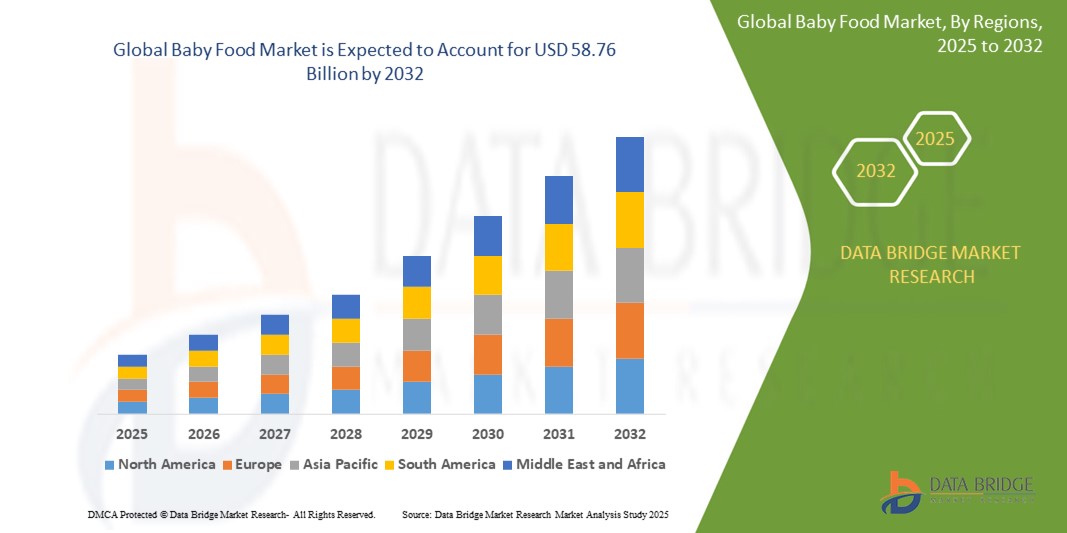
Baby Food Market Size
- The global baby food market size was valued at USD 38.88 billion in 2024 and is expected to reach USD 58.76 billion by 2032, at a CAGR of 5.3% during the forecast period
- This growth is driven by factors such as rising awareness about infant nutrition, increasing number of working parents, growing urbanization, and the demand for convenient and healthy baby food products
Baby Food Market Analysis
- Baby food products are essential for providing balanced nutrition to infants and toddlers during early developmental stages, including infant formula, prepared baby meals, and dried baby food
- The demand for baby food is significantly driven by increasing parental concerns about infant health, rising disposable incomes, and the growing trend toward organic and fortified baby food products
- Asia-Pacific is expected to dominate the global baby food market with the largest market share of approximately 64%, due to a large birth rate, rapid urbanization, and increasing awareness regarding infant nutrition, particularly in countries like China and India
- North America is expected to be the fastest growing region in the baby food market during the forecast period due to high purchasing power, evolving lifestyles, and a growing preference for premium, organic, and allergen-free baby food products
- Bottled baby foods segment is expected to dominate the market with a largest market share of approximately 32%, due to the convenience and mess-free feeding experience that bottled baby foods offer, making them particularly appealing to busy parents. The ready-to-feed format eliminates preparation time, allowing for easy consumption directly from bottles or pouches, which is especially beneficial for on-the-go feeding
Report Scope and Baby Food Market Segmentation
|
Attributes |
Baby Food Key Market Insights |
|
Segments Covered |
|
|
Countries Covered |
North America
Europe
Asia-Pacific
Middle East and Africa
South America
|
|
Key Market Players |
|
|
Market Opportunities |
|
|
Value Added Data Infosets |
In addition to the insights on market scenarios such as market value, growth rate, segmentation, geographical coverage, and major players, the market reports curated by the Data Bridge Market Research also include in-depth expert analysis, pricing analysis, brand share analysis, consumer survey, demography analysis, supply chain analysis, value chain analysis, raw material/consumables overview, vendor selection criteria, PESTLE Analysis, Porter Analysis, and regulatory framework. |
Baby Food Market Trends
“Growing Preference for Organic and Functional Baby Food Products”
- One prominent trend in the global baby food market is the increasing consumer preference for organic, clean-label, and functional baby food products that support overall infant health and development
- This trend is driven by rising awareness among parents regarding food safety, nutritional quality, and the long-term health impacts of early childhood nutrition
- For instance, many manufacturers are introducing baby foods enriched with probiotics, DHA, iron, and other essential nutrients to support brain development and immunity, while also ensuring products are free from artificial additives, preservatives, and GMOs
- These advancements are reshaping product innovation in the baby food industry, encouraging brands to develop healthier, sustainably sourced offerings, thereby gaining consumer trust and expanding their market share globally
Baby Food Market Dynamics
Driver
“Rising Awareness of Infant Nutrition and Health”
- The increasing awareness among parents about the importance of early childhood nutrition is significantly driving the demand for baby food products
- As more parents prioritize the health and development of their infants, the demand for nutritious, safe, and convenient baby food options continues to rise
- This trend is further supported by a growing number of health-conscious consumers who are more inclined to purchase organic, non-GMO, and additive-free baby food products
For instance,
- In 2022, according to a study by the World Health Organization, the global awareness regarding the importance of infant nutrition, particularly breastfeeding and balanced complementary feeding, has gained momentum, leading to an increasing preference for nutritious baby food products
- As a result, the demand for baby food enriched with essential vitamins, minerals, and functional ingredients is significantly increasing, thereby driving market growth globally
Opportunity
“Expansion of Baby Food Market in Emerging Economies”
- The growing middle-class population and rising disposable incomes in emerging economies such as India, China, and Brazil present a significant market opportunity for baby food manufacturers
- As urbanization increases and family structures change, there is a rising demand for convenient and nutritious baby food products in these regions
- This creates opportunities for companies to introduce affordable and culturally adapted baby food solutions that cater to the dietary needs of infants and toddlers in these fast-developing markets
For instance,
- In 2023, according to a report by the International Food Policy Research Institute, emerging markets are expected to see a significant increase in demand for baby food products as a result of improved access to modern retail channels and the growing focus on infant nutrition
- As a result, expanding into these regions with tailored offerings provides brands with the opportunity to tap into a large, untapped consumer base, accelerating market growth
Restraint/Challenge
“High Production and Distribution Costs Hindering Market Expansion”
- The high cost of raw materials, packaging, and distribution significantly challenges the baby food market, especially in price-sensitive regions
- Premium ingredients used in organic or specialized baby food products further raise production costs, which may deter smaller manufacturers from entering the market and limit price flexibility for consumers
- These financial constraints also affect the ability of companies to offer affordable baby food options in emerging markets, where affordability is a key consideration for families
For instance,
- In 2023, according to a report by the Global Baby Food Alliance, rising supply chain and raw material costs due to inflation and global disruptions have contributed to higher prices for baby food products, impacting consumer purchasing power
- As a result, the high production and distribution costs pose a challenge to market expansion, especially in developing regions where affordability is a significant barrier to growth
Baby Food Market Scope
The market is segmented on the basis of product type, type, ingredients, formulation, health benefit, and distribution channel
|
Segmentation |
Sub-Segmentation |
|
By Product type |
|
|
By Type |
|
|
By Ingredients |
|
|
By Formulations |
|
|
By Health benefits |
|
|
By Distribution Channel
|
|
In 2025, the bottled baby foods is projected to dominate the market with a largest share in product type segment
The bottled baby foods segment is expected to dominate the baby food market with the largest share of approximately 32%, due to the convenience and mess-free feeding experience that bottled baby foods offer, making them particularly appealing to busy parents. The ready-to-feed format eliminates preparation time, allowing for easy consumption directly from bottles or pouches, which is especially beneficial for on-the-go feeding
The milk formula is expected to account for the largest share during the forecast period in product type segment
In 2025, the milk formula segment is expected to dominate the market with the largest market share of approximately 64.5%, due to increasing lactation issues among mothers, declining infant mortality rates, rapid urbanization, and growing awareness about the benefits of milk formula. Additionally, milk formula offers convenience to parents, especially those with busy lifestyles or working mothers
Baby Food Market Regional Analysis
“Asia-Pacific Holds the Largest Share in the Baby Food Market”
- The Asia-Pacific region dominates the global baby food market driven by a large birth rate, rapid urbanization, and increasing awareness of infant nutrition
- China holds a significant share of approximately 65%, due to its large population, high birth rates, and growing middle class, which has increased demand for baby food products, particularly in urban areas
- The growing preference for nutritious and organic baby food options in these countries, along with improvements in the standard of living, contributes to the market's strength in the region
- The availability of a wide range of baby food products, including ready-to-feed, organic, and dairy-based products, also boosts market growth in the region
“North America is Projected to Register the Highest CAGR in the Baby Food Market”
- North America is expected to witness the highest growth rate in the baby food market during the forecast period, driven by increasing demand for premium, organic, and specialty baby food products
- The U.S., with its strong healthcare infrastructure, rising awareness regarding infant nutrition, and demand for convenience-based baby food products, is expected to be a key contributor to this growth
- The presence of leading global baby food manufacturers and increasing adoption of ready-to-eat, fortified, and allergen-free baby food products are further fueling market expansion in the region
- Rising concerns regarding the health and well-being of infants and a growing preference for plant-based alternatives are expected to continue driving the market in North America
Baby Food Market Share
The market competitive landscape provides details by competitor. Details included are company overview, company financials, revenue generated, market potential, investment in research and development, new market initiatives, global presence, production sites and facilities, production capacities, company strengths and weaknesses, product launch, product width and breadth, application dominance. The above data points provided are only related to the companies' focus related to market.
The Major Market Leaders Operating in the Market Are:
- Nestlé S.A. (Switzerland)
- Danone S.A. (France)
- Abbott Laboratories (U.S.)
- Reckitt Benckiser Group plc (UK)
- Mead Johnson & Company, LLC (U.S.)
- Hero Group (Switzerland)
- HiPP GmbH & Co. Vertrieb KG (Germany)
- Yili Group (China)
- Royal FrieslandCampina NV (Netherlands)
- Feihe International Inc. (China)
- Bellamy's Organic (Australia)
- Shijiazhuang Junlebao Dairy Co. Ltd (China)
- Ausnutria Dairy Corporation Ltd (China)
- The Kraft Heinz Company (U.S.)
- Perrigo Company plc (Ireland)
- Bristol-Myers Squibb Company (U.S.)
- Deutsches Milchkontor GmbH (Germany)
- H.J. Heinz Company (U.S.)
- SMA Nutrition (UK)
- Aptamil (UK)
Latest Developments in Global Baby Food Market
- In April 2021, The Kraft Heinz Company introduced a new plant-based baby food line aimed at offering high-quality vegan nutrition for infants. The product range includes three items such as Saucy Pasta Stars with beans and carrots, Potato Bake with green beans and sweet garden peas, and Risotto with chickpeas and pumpkin. This launch underscores a significant trend in the global baby food market, where consumers are increasingly seeking sustainable, nutritious, and allergen-friendly alternatives for infant diets
- In November 2020, Nestlé S.A. expanded its baby food portfolio by entering the frozen segment with the launch of Freshful Start, a line of organic, simple-ingredient meals made from vegetables and whole grains, conveniently packaged in bowls. This strategic move highlights a growing trend toward frozen baby food products that prioritize freshness, quality, and ease of preparation, key factors driving innovation and competition in the global market
- In August 2022, Abbott Laboratories announced the resumption of Similac infant formula production at its Sturgis manufacturing facility in Michigan, aiming to alleviate the nationwide shortage of infant formula in the United States. The move underscores the importance of resilient production infrastructure and the need for rapid response strategies in addressing supply disruptions
- In September 2022, Bellamy’s Organic Pty Ltd announced plans to introduce its infant milk formula in the United States to help address the country’s ongoing formula shortage and broaden its international consumer base. This move highlights the increasing globalization of the baby food market, where cross-border distribution and brand expansion are becoming key strategies in addressing supply gaps and tapping into new growth opportunities
- In July 2022, Danone Inc. introduced a new dairy and plant-based blend baby formula designed to cater to growing consumer demand for feeding options aligned with vegetarian, flexitarian, and plant-based lifestyles, while also fulfilling infants’ essential nutritional needs. This launch is accelerating trend toward plant-based and hybrid nutrition solutions, as consumers increasingly seek clean-label, allergen-conscious, and environmentally friendly products for their children

- Interactive Data Analysis Dashboard
- Company Analysis Dashboard for high growth potential opportunities
- Research Analyst Access for customization & queries
- Competitor Analysis with Interactive dashboard
- Latest News, Updates & Trend analysis
- Harness the Power of Benchmark Analysis for Comprehensive Competitor Tracking
Global Baby Food Market, Supply Chain Analysis and Ecosystem Framework
To support market growth and help clients navigate the impact of geopolitical shifts, DBMR has integrated in-depth supply chain analysis into its Global Baby Food Market research reports. This addition empowers clients to respond effectively to global changes affecting their industries. The supply chain analysis section includes detailed insights such as Global Baby Food Market consumption and production by country, price trend analysis, the impact of tariffs and geopolitical developments, and import and export trends by country and HSN code. It also highlights major suppliers with data on production capacity and company profiles, as well as key importers and exporters. In addition to research, DBMR offers specialized supply chain consulting services backed by over a decade of experience, providing solutions like supplier discovery, supplier risk assessment, price trend analysis, impact evaluation of inflation and trade route changes, and comprehensive market trend analysis.
Data collection and base year analysis are done using data collection modules with large sample sizes. The stage includes obtaining market information or related data through various sources and strategies. It includes examining and planning all the data acquired from the past in advance. It likewise envelops the examination of information inconsistencies seen across different information sources. The market data is analysed and estimated using market statistical and coherent models. Also, market share analysis and key trend analysis are the major success factors in the market report. To know more, please request an analyst call or drop down your inquiry.
The key research methodology used by DBMR research team is data triangulation which involves data mining, analysis of the impact of data variables on the market and primary (industry expert) validation. Data models include Vendor Positioning Grid, Market Time Line Analysis, Market Overview and Guide, Company Positioning Grid, Patent Analysis, Pricing Analysis, Company Market Share Analysis, Standards of Measurement, Global versus Regional and Vendor Share Analysis. To know more about the research methodology, drop in an inquiry to speak to our industry experts.
Data Bridge Market Research is a leader in advanced formative research. We take pride in servicing our existing and new customers with data and analysis that match and suits their goal. The report can be customized to include price trend analysis of target brands understanding the market for additional countries (ask for the list of countries), clinical trial results data, literature review, refurbished market and product base analysis. Market analysis of target competitors can be analyzed from technology-based analysis to market portfolio strategies. We can add as many competitors that you require data about in the format and data style you are looking for. Our team of analysts can also provide you data in crude raw excel files pivot tables (Fact book) or can assist you in creating presentations from the data sets available in the report.













