What is the Baby Shampoo and Conditioners Market Size and Overview ?
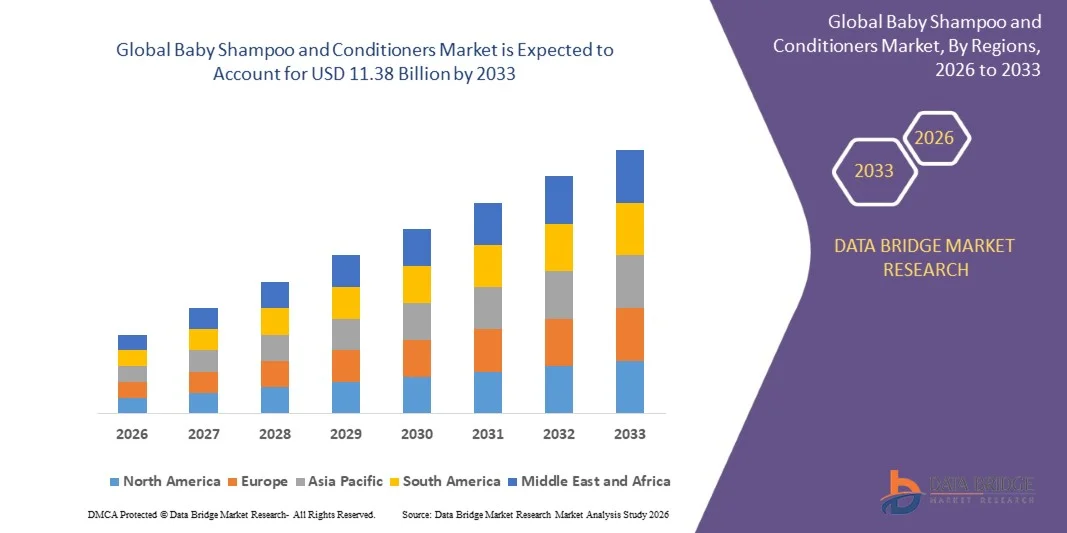
As per Data Bridge Market Research Analysis the Baby Shampoo and Conditioners Market was valued at USD 7.25 Billion in 2025 and is projected to reach USD 11.38 Billion by 2033, growing at a CAGR of 5.8% from 2026 to 2033. The market is experiencing consistent growth driven by rising parental awareness regarding infant hygiene, increasing demand for dermatologically tested baby care products, and growing preference for natural and organic formulations. Expanding penetration of e-commerce platforms, rising disposable income in emerging economies, and strong product innovation by leading personal care brands are further supporting market expansion across global regions.
The increasing global focus on infant health, safety, and chemical-free personal care is significantly influencing product development and consumption patterns in the baby personal care industry. Parents are increasingly shifting toward mild, hypoallergenic, and tear-free formulations that minimize skin irritation and support sensitive baby skin care needs. Strong regulatory emphasis on product safety standards, combined with growing demand for premium and organic baby care solutions, is encouraging manufacturers to introduce cleaner, safer, and more transparent ingredient-based products across both developed and emerging markets.
Market Size & Forecast
- Global Market Value (2025): USD 7.25 Billion
- Expected Market Value (2033): USD 11.38 Billion
- Forecast CAGR (2026–2033): 5.8%
- Leading Region in 2025: Asia-Pacific
- Fastest Growing Region: North America
What are the Major Takeaways of Baby Shampoo and Conditioners Market ?
- Asia-Pacific dominated the Baby Shampoo and Conditioners Market with the largest revenue share of 57.2% in 2025, supported by high birth rates, expanding middle-class population, and strong demand for affordable baby care products
- The non-organic segment led the market with a 62.7% share in 2025, driven by its wide product availability, cost effectiveness, and established presence of major multinational baby care brands
- North America is expected to be the fastest-growing region at a CAGR of 6.3% from 2026 to 2033, fueled by rising demand for premium baby care products, strong consumer awareness regarding ingredient safety, and high adoption of organic formulations
- Organic is the fastest-growing type, projected to register a CAGR of 13.6% from 2026 to 2033, supported by increasing parental shift toward chemical-free and plant-based baby care solutions
- The non-medicated segment dominated the product type category with a 58.4% revenue share in 2025, led by strong parental preference for gentle daily-use formulations that support regular cleansing without active pharmaceutical ingredients
- Offline accounted for 70.1% of the market in 2025, preferred by strong reliance on supermarkets, hypermarkets, pharmacies, and specialty baby stores for trusted product purchases
- The medicated segment is the fastest-growing product type category, with a CAGR of 9.2% from 2026 to 2033, driven by increasing cases of scalp sensitivity, cradle cap, and dermatological concerns among infants
Report Scope and Baby Shampoo and Conditioners Market Segmentation
|
Attributes |
Baby Shampoo and Conditioners Key Market Insights |
|
Segments Covered |
|
|
Countries Covered |
North America · U.S. · Canada · Mexico Europe · Germany · France · U.K. · Netherlands · Switzerland · Belgium · Russia · Italy · Spain · Turkey · Rest of Europe Asia-Pacific · China · Japan · India · South Korea · Singapore · Malaysia · Australia · Thailand · Indonesia · Philippines · Rest of Asia-Pacific Middle East and Africa · Saudi Arabia · U.A.E. · South Africa · Egypt · Israel · Rest of Middle East and Africa South America · Brazil · Argentina · Rest of South America |
|
Key Market Players |
· Johnson & Johnson Services, Inc. (U.S.) · Unilever (U.K.) · The Himalaya Drug Company (India) · Burt's Bees (U.S.) · Beiersdorf AG (Germany) · L’Oréal S.A. (France) · Mothercare IN Limited (U.K.) · Earth Mama Organics (U.S.) · PZ Cussons (U.K.) · Weleda UK (U.K.) · Mamaearth (India) · California Baby (U.S.) · Chicco (Italy) · Pigeon India (India) · Hain Celestial Group (U.S.) · S. C. Johnson & Son Inc. (U.S.) · Sebamed (Germany) · Aveeno (U.S.) · Sebapharma GmbH & Co. KG (Germany) · Mustela (France) · Aveeno Baby (U.S.) · Sebamed Baby (Germany) · Mee Mee (India) |
|
Market Opportunities |
|
|
Value Added Data Infosets |
In addition to the insights on market scenarios such as market value, growth rate, segmentation, geographical coverage, and major players, the market reports curated by the Data Bridge Market Research also include in-depth expert analysis, pricing analysis, brand share analysis, consumer survey, demography analysis, supply chain analysis, value chain analysis, raw material/consumables overview, vendor selection criteria, PESTLE Analysis, Porter Analysis, and regulatory framework. |
What is the Key Trend in the Baby Shampoo and Conditioners Market ?
Trend: Rising Demand for Organic and Natural Baby Care Formulations
The baby shampoo and conditioners market is witnessing a strong shift toward organic, natural, and plant-based formulations driven by increasing concerns over chemical exposure in infant care products. Parents are increasingly preferring sulfate-free, paraben-free, and dermatologist-tested products that ensure gentleness and safety for sensitive baby skin and scalp. This trend is further supported by rising awareness of clean-label personal care and sustainable sourcing practices across global markets.
Leading companies such as The Himalaya Drug Company and Weleda AG are expanding their herbal and natural baby care portfolios, while Johnson & Johnson’s reformulated baby care ranges continue to reflect the industry’s shift toward milder and safer ingredients.
Baby Shampoo and Conditioners Market Dynamics
Key Market Driver: Increasing Parental Awareness of Infant Hygiene and Skin Sensitivity
The growing awareness among parents regarding infant hygiene, scalp health, and skin sensitivity is significantly driving demand for specialized baby shampoo and conditioner products. Rising pediatric recommendations for hypoallergenic, tear-free, and pH-balanced formulations are further supporting product adoption across both developed and emerging economies. Increasing urbanization and access to infant care education through digital platforms are also strengthening consumer preference for safer baby personal care solutions.
Major brands such as Johnson’s Baby (Johnson & Johnson Services, Inc.) and Sebamed Baby by Sebapharma GmbH & Co. KG have strengthened their market position by offering clinically tested and dermatologically approved formulations tailored for sensitive infant skin.
Key Restraint/Challenge: High Competition from Established and Local Baby Care Brands
The market faces strong competition due to the presence of both global FMCG giants and rapidly growing regional and local baby care brands, creating pricing pressure and market fragmentation. Established players such as Unilever, Beiersdorf AG, and L’Oréal S.A. dominate premium and mass-market segments, while regional brands such as Mamaearth and Himalaya compete aggressively through natural and affordable product offerings. This intense competition makes it challenging for new entrants to gain market share and maintain brand loyalty.
In addition, frequent product innovation and aggressive marketing strategies further intensify rivalry across both online and offline distribution channels.
Key Market Opportunity: Growing Demand for Premium Dermatologically Tested Products
The increasing demand for premium, dermatologically tested, and clinically validated baby care products presents a strong growth opportunity in the global market. Parents are increasingly prioritizing product safety, ingredient transparency, and pediatrician-approved formulations, driving growth in the premium baby personal care segment. This shift is encouraging manufacturers to invest in advanced formulation technologies and certification-based product positioning.
Companies such as Burt’s Bees, California Baby, and Mustela are strengthening their premium portfolios by focusing on hypoallergenic, organic, and clinically tested baby shampoo and conditioner ranges, enhancing trust and expanding their global consumer base.
How is the Baby Shampoo and Conditioners Market Segmented ?
The baby shampoo and conditioners market is segmented on the basis of product type, type, and distribution channel.
- By Product Type
On the basis of product type, the Baby Shampoo and Conditioners Market is segmented into Medicated and Non-Medicated. The Non-Medicated segment dominated the market with the largest share of 58.4% in 2025, driven by strong parental preference for gentle daily-use formulations that support regular cleansing without active pharmaceutical ingredients. These products are widely adopted due to their mild composition, broader availability, and compatibility with sensitive infant skin. Strong brand penetration across mass retail channels further strengthens their leadership position. Consistent demand from urban households and rising infant care awareness continue to support segment dominance.
The Medicated segment is projected to register the fastest growth at a CAGR of 9.2% from 2026 to 2033, driven by increasing cases of scalp sensitivity, cradle cap, and dermatological concerns among infants. Rising pediatric recommendations for targeted therapeutic formulations are supporting adoption in clinical and homecare settings. Growing availability of dermatologist-approved baby care products is expanding consumer confidence. Expanding awareness of infant skincare health management further accelerates demand across developed and emerging markets.
- By Type
On the basis of type, the Baby Shampoo and Conditioners Market is segmented into Organic and Non-Organic. The Non-Organic segment dominated the market with a share of 62.7% in 2025, supported by its wide product availability, cost effectiveness, and established presence of major multinational baby care brands. These formulations benefit from long-standing consumer trust and extensive retail distribution networks. Higher shelf stability and standardized manufacturing processes further reinforce their dominance. Strong penetration in mass-market retail and pharmacies sustains consistent demand.
The Organic segment is projected to register the fastest growth at a CAGR of 13.6% from 2026 to 2033, driven by increasing parental shift toward chemical-free and plant-based baby care solutions. Rising concerns regarding synthetic additives and skin sensitivities are accelerating preference for certified organic formulations. Premiumization trends in baby personal care products are further strengthening adoption. Expanding availability through e-commerce platforms and specialty stores continues to enhance market accessibility across global regions.
- By Distribution Channel
On the basis of distribution channel, the Baby Shampoo and Conditioners Market is segmented into Online and Offline channels. The Offline segment dominated the market with the largest share of 70.1% in 2025, driven by strong reliance on supermarkets, hypermarkets, pharmacies, and specialty baby stores for trusted product purchases. Physical retail channels enable direct product inspection, strengthening consumer confidence in baby care selection. Established retail penetration and in-store promotional strategies further reinforce dominance. High accessibility in both urban and semi-urban regions continues to sustain strong offline sales.
The Online segment is projected to register the fastest growth at a CAGR of 7.4% from 2026 to 2033, driven by rapid expansion of e-commerce platforms and increasing digital adoption among new parents. Convenient doorstep delivery, wider product assortment, and competitive pricing are accelerating online purchases. Rising influence of parenting blogs and digital recommendations is further shaping consumer buying behavior. Continuous improvement in logistics infrastructure and secure payment systems is strengthening market expansion across developing economies.
Which Region Holds the Largest Share of the Baby Shampoo and Conditioners Market ?
Asia-Pacific dominated the baby shampoo and conditioners market and accounted for the largest revenue share of 57.2% in 2025, supported by high birth rates, expanding middle-class population, and strong demand for affordable baby care products. The region benefits from large-scale manufacturing bases, cost-efficient production, and wide availability of both mass-market and premium baby personal care brands. Increasing awareness of infant hygiene, rising urbanization, and rapid expansion of modern retail channels are further accelerating market growth. Strong presence of domestic and international FMCG companies continues to reinforce regional dominance. Growing penetration of e-commerce platforms is also enhancing product accessibility across urban and rural areas.
China Baby Shampoo and Conditioners Market Insight
China held the largest share in the Asia-Pacific Baby Shampoo and Conditioners market in 2025, driven by its vast infant population, strong domestic manufacturing ecosystem, and high penetration of branded baby care products. The country has a well-established personal care industry that supports large-scale production and distribution of baby shampoos and conditioners across urban centers. Rising parental focus on infant skin health, increasing preference for premium and dermatologically tested products, and growing influence of e-commerce platforms are further strengthening demand. In addition, expansion of local FMCG brands and aggressive marketing strategies are reinforcing China’s leadership position in the regional market.
India Baby Shampoo and Conditioners Market Insight
India is projected to register the fastest growth in the Asia-Pacific region, with a CAGR of 14.8% from 2026 to 2033, driven by a rapidly growing infant population, rising disposable income, and increasing awareness of baby hygiene products. Expanding penetration of organized retail, coupled with strong growth in online baby care purchases, is significantly boosting market accessibility. Growing preference for herbal, organic, and chemical-free baby care products is further accelerating demand. In addition, increasing influence of parenting awareness campaigns and rapid urbanization are supporting long-term market expansion across both metro and tier-2 cities.
Europe Baby Shampoo and Conditioners Market Insight
The Europe Baby Shampoo and Conditioners market is expanding steadily, supported by strong demand for organic, hypoallergenic, and dermatologically tested baby care products. Rising consumer preference for clean-label personal care solutions is driving adoption of premium baby shampoos and conditioners across the region. Strong regulatory frameworks promoting product safety and ingredient transparency are further supporting market growth. In addition, increasing demand from premium retail stores, pharmacies, and specialty baby care outlets is contributing to regional expansion. Growing focus on sustainability and eco-friendly packaging is also shaping product innovation in the European market.
Germany Baby Shampoo and Conditioners Market Insight
Germany accounted for the largest share in the Europe Baby Shampoo and Conditioners market in 2025, driven by high consumer preference for premium-quality, dermatologically safe baby care products. The country has a strong personal care manufacturing base and well-developed retail infrastructure that supports wide product availability. Increasing demand for organic and fragrance-free formulations is further strengthening market growth. In addition, strong trust in established FMCG brands and rising awareness of infant skin sensitivity are reinforcing Germany’s leading position in the regional market.
U.K. Baby Shampoo and Conditioners Market Insight
The U.K. market is supported by increasing demand for natural, organic, and hypoallergenic baby personal care products across retail and pharmacy channels. Rising awareness of infant skin health and growing preference for cruelty-free and sustainable products are driving market adoption. Expansion of premium baby care brands and strong influence of online parenting communities are further supporting growth. In addition, increasing availability of certified organic formulations through supermarkets and e-commerce platforms is strengthening market penetration.
North America Baby Shampoo and Conditioners Market Insight
North America is projected to grow at the fastest CAGR of 6.3% from 2026 to 2033, driven by rising demand for premium baby care products, strong consumer awareness regarding ingredient safety, and high adoption of organic formulations. Increasing preference for dermatologist-tested and hypoallergenic products is significantly supporting market expansion. Strong presence of leading global personal care brands and continuous product innovation are further accelerating growth. In addition, rising e-commerce penetration and subscription-based baby care product delivery models are enhancing regional accessibility and boosting demand.
U.S. Baby Shampoo and Conditioners Market Insight
The U.S. accounted for the largest share in the North America Baby Shampoo and Conditioners market in 2025, supported by strong consumer spending on premium baby personal care products and high awareness of infant skincare needs. The country benefits from a well-established retail and e-commerce ecosystem that ensures wide product availability. Increasing demand for organic, sulfate-free, and hypoallergenic formulations is further driving market growth. In addition, strong influence of pediatric recommendations and brand-driven marketing strategies is reinforcing the U.S. leadership position in the regional market.
Which are the Top Companies in Baby Shampoo and Conditioners Market ?
The baby shampoo and conditioners industry is primarily led by well-established companies, including:
- Johnson & Johnson Services, Inc. (U.S.)
- Unilever (U.K.)
- The Himalaya Drug Company (India)
- Burt's Bees (U.S.)
- Beiersdorf AG (Germany)
- L’Oréal S.A. (France)
- Mothercare IN Limited (U.K.)
- Earth Mama Organics (U.S.)
- PZ Cussons (U.K.)
- Weleda UK (U.K.)
- Mamaearth (India)
- California Baby (U.S.)
- Chicco (Italy)
- Pigeon India (India)
- Hain Celestial Group (U.S.)
- C. Johnson & Son Inc. (U.S.)
- Sebamed (Germany)
- Aveeno (U.S.)
- Sebapharma GmbH & Co. KG (Germany)
- Mustela (France)
- Aveeno Baby (U.S.)
- Sebamed Baby (Germany)
- Mee Mee (India)
What are Latest Developments in Baby Shampoo and Conditioners Market ?
- In March 2025, Himalaya Wellness expanded its baby care portfolio with an upgraded range of herbal baby shampoos and conditioners enriched with plant-based ingredients. The products are designed to meet rising consumer demand for Ayurveda-inspired and chemical-free infant care solutions. This expansion strengthens the company’s position in the herbal baby personal care segment and enhances its competitiveness in emerging markets. It also supports the broader shift toward natural and sustainable baby grooming products globally
- In September 2024, Johnson’s Baby introduced a reformulated line of hypoallergenic shampoos featuring improved tear-free technology and milder cleansing agents. The update addresses increasing parental concerns regarding infant skin sensitivity and product safety. This development reinforces brand trust and strengthens its leadership in the mass-market baby personal care segment. It also intensifies competition in the dermatologist-tested and sensitive-skin product category
- In January 2024, Ooume announced its brand launch, entering the baby hair care market with a focus on natural and gentle formulations for all age groups. The Hydrating Baby Shampoo, Conditioner, and bundled kits reflect rising demand for clean-label and curl-friendly baby care products. This launch strengthens the premium natural segment and increases competition among niche organic brands. It also supports the expansion of direct-to-consumer digital sales channels in the baby care market
- In June 2023, Plum expanded into the baby care segment through the launch of Baby Plum, offering pediatrician-tested and clinically validated products. The range includes tear-free and pH-balanced formulations such as baby shampoo, body wash, lotion, and massage oil. This development strengthens consumer confidence in safe and dermatologically tested baby care solutions. It also accelerates the shift toward clinically backed and toxin-free personal care products
- In July 2022, Johnson & Johnson launched Vivvi & Bloom, a skin and hair care line designed for babies and toddlers with simplified and purposeful ingredients. The brand targets Millennial and Gen Z parents with a focus on safety, scientific formulation, and minimal ingredient complexity. This launch strengthens the company’s premium positioning in modern baby care preferences. It also enhances competition in the science-driven and sensitive-skin product segment

- Interactive Data Analysis Dashboard
- Company Analysis Dashboard for high growth potential opportunities
- Research Analyst Access for customization & queries
- Competitor Analysis with Interactive dashboard
- Latest News, Updates & Trend analysis
- Harness the Power of Benchmark Analysis for Comprehensive Competitor Tracking
Data collection and base year analysis are done using data collection modules with large sample sizes. The stage includes obtaining market information or related data through various sources and strategies. It includes examining and planning all the data acquired from the past in advance. It likewise envelops the examination of information inconsistencies seen across different information sources. The market data is analysed and estimated using market statistical and coherent models. Also, market share analysis and key trend analysis are the major success factors in the market report. To know more, please request an analyst call or drop down your inquiry.
The key research methodology used by DBMR research team is data triangulation which involves data mining, analysis of the impact of data variables on the market and primary (industry expert) validation. Data models include Vendor Positioning Grid, Market Time Line Analysis, Market Overview and Guide, Company Positioning Grid, Patent Analysis, Pricing Analysis, Company Market Share Analysis, Standards of Measurement, Global versus Regional and Vendor Share Analysis. To know more about the research methodology, drop in an inquiry to speak to our industry experts.
Data Bridge Market Research is a leader in advanced formative research. We take pride in servicing our existing and new customers with data and analysis that match and suits their goal. The report can be customized to include price trend analysis of target brands understanding the market for additional countries (ask for the list of countries), clinical trial results data, literature review, refurbished market and product base analysis. Market analysis of target competitors can be analyzed from technology-based analysis to market portfolio strategies. We can add as many competitors that you require data about in the format and data style you are looking for. Our team of analysts can also provide you data in crude raw excel files pivot tables (Fact book) or can assist you in creating presentations from the data sets available in the report.