


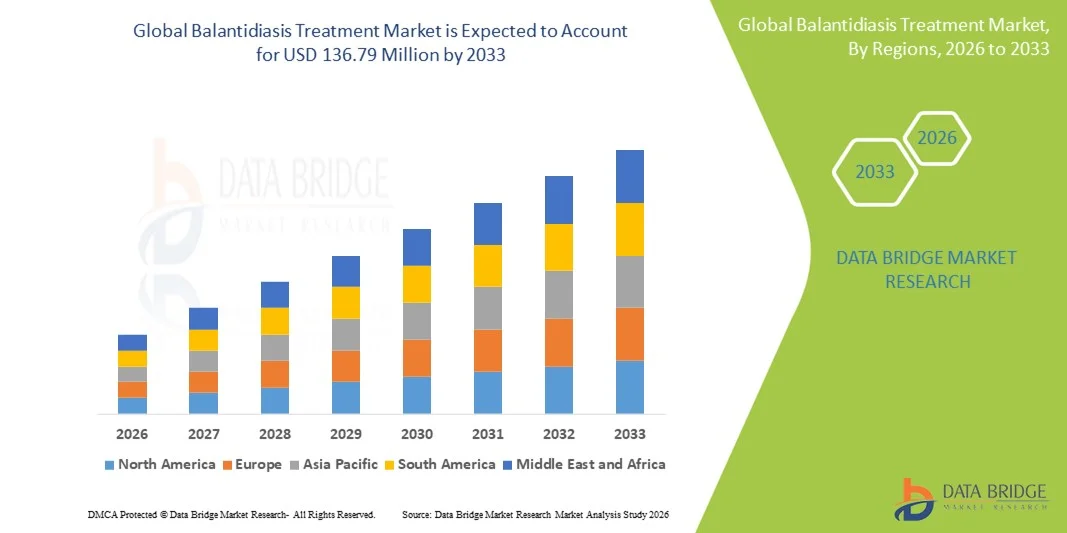
Balantidiasis Treatment Market Size
- The global balantidiasis treatment market size was valued at USD 90.50 million in 2025 and is expected to reach USD 136.79 million by 2033, at a CAGR of 5.3% during the forecast period
- The market expansion is primarily driven by the increasing prevalence of balantidiasis in tropical and subtropical regions, rising awareness of parasitic infections, and growing access to diagnostic facilities, which are collectively boosting the demand for effective antimicrobial therapies
- In addition, the rising need for safe, fast-acting, and affordable treatment options, along with advancements in drug research targeting protozoan infections, is strengthening the role of balantidiasis therapies in public health management. These factors are accelerating treatment adoption and significantly supporting overall market growth
Balantidiasis Treatment Market Analysis
- Balantidiasis treatments, primarily consisting of antibiotics such as tetracycline, metronidazole, and iodoquinol, are essential for managing Balantidium coli infections, especially in regions affected by poor sanitation and contaminated water sources. Increasing public health focus on parasitic infection control and improved access to medical care continue to support treatment demand
- The rising awareness of protozoan infections, expanding availability of antimicrobial therapies, and strengthening diagnostic capabilities are major factors driving the market. Global sanitation initiatives and programs targeting neglected tropical diseases further contribute to the growing adoption of treatment solutions
- North America dominated the balantidiasis treatment market with a revenue share of 38.9% in 2025, supported by advanced diagnostic technologies, strong pharmaceutical distribution networks, and high treatment awareness. The U.S. leads the region due to robust healthcare infrastructure, efficient disease management protocols, and ongoing clinical focus on antimicrobial resistance and infection prevention
- Asia-Pacific is expected to be the fastest-growing region, driven by rising incidence linked to livestock exposure, rapid urban development, and improving access to healthcare services in countries such as India, the Philippines, Indonesia, and China
- The tetracycline segment dominated the market with a share of 41.7% in 2025, attributed to its proven therapeutic effectiveness, long-standing clinical preference, and widespread availability across public and private healthcare systems
Report Scope and Balantidiasis Treatment Market Segmentation
|
Attributes |
Balantidiasis Treatment Key Market Insights |
|
Segments Covered |
|
|
Countries Covered |
North America
Europe
Asia-Pacific
Middle East and Africa
South America
|
|
Key Market Players |
|
|
Market Opportunities |
|
|
Value Added Data Infosets |
In addition to the insights on market scenarios such as market value, growth rate, segmentation, geographical coverage, and major players, the market reports curated by the Data Bridge Market Research also include in-depth expert analysis, patient epidemiology, pipeline analysis, pricing analysis, and regulatory framework |
Balantidiasis Treatment Market Trends
Growing Advancement in Antiparasitic Therapies and Diagnostic Integration
- A significant and accelerating trend in the global balantidiasis treatment market is the increasing integration of improved antiparasitic drugs with advanced diagnostic technologies, enabling faster detection, targeted therapy, and improved disease management outcomes for affected populations
- For instance, modern PCR-based diagnostic platforms are now being adopted in several healthcare systems, allowing clinicians to identify Balantidium coli infections more accurately and begin treatment rapidly with appropriate antimicrobial agents
- AI-enabled diagnostic support tools are increasingly being utilized to enhance parasite recognition accuracy and provide intelligent decision support for clinicians, helping optimize treatment regimes and reduce misdiagnosis in regions with overlapping parasitic infections
- The growing convergence between diagnostic platforms and treatment planning allows healthcare providers to manage cases more efficiently, enabling synchronized workflows that support early detection, drug selection, and monitoring of therapeutic response
- This shift toward more advanced, integrated treatment pathways is reshaping clinical expectations for parasitic infection management, prompting manufacturers to invest in improved drug formulations and expanded diagnostic applicability to enhance therapeutic effectiveness
- The demand for modernized treatment approaches that combine advanced diagnostics with more efficient antimicrobial therapy is increasing rapidly across both endemic and emerging regions, as healthcare systems prioritize faster, more reliable methods of managing protozoan infections
Balantidiasis Treatment Market Dynamics
Driver
Increasing Burden of Parasitic Infections and Improvements in Sanitation Programs
- The rising prevalence of waterborne parasitic infections across tropical and subtropical regions, combined with expanding public health initiatives aimed at improving sanitation and water safety, is a significant driver of increased demand for balantidiasis treatment solutions
- For instance, in several Latin American and Asia-Pacific countries, governments and NGOs have intensified programs targeting protozoan infection control, including expanded access to antimicrobials such as tetracycline and metronidazole, which is expected to support market growth in the forecast period
- As communities become increasingly aware of infection risks associated with contaminated water and livestock exposure, balantidiasis treatments offer reliable therapeutic outcomes and support rapid recovery, thereby strengthening their adoption in clinical settings
- Furthermore, the rising implementation of public sanitation, hygiene education, and water treatment initiatives is increasing the need for effective antimicrobial therapies, positioning balantidiasis treatments as a critical component of community health programs in endemic areas
- The convenience of oral antimicrobial therapy, widespread availability in primary healthcare centers, and the growing emphasis on early diagnosis and timely treatment are key factors supporting market expansion across both developed and emerging healthcare systems
- The increasing focus on disease surveillance, combined with improved drug accessibility and greater support from regional health authorities, further contributes to the steady growth of the balantidiasis treatment market
Restraint/Challenge
Treatment Limitations, Side Effects, and Diagnostic Accessibility Barriers
- Concerns surrounding the limited availability of advanced diagnostic tools in low-resource settings, along with challenges related to correct identification of Balantidium coli, pose a significant barrier to broader treatment penetration and timely therapeutic intervention
- For instance, delayed diagnosis due to laboratory constraints or misidentification of symptoms has caused some healthcare providers to hesitate in confirming cases, resulting in underreported infections and slower adoption of targeted treatment solutions
- Addressing these diagnostic limitations through expanded laboratory capacity, enhanced training, and improved access to testing technologies is essential for increasing treatment uptake and ensuring patients receive appropriate antimicrobial therapy
- In addition, the side effects associated with certain antiparasitic drugs such as gastrointestinal discomfort or contraindications in vulnerable patient groups can create challenges for clinicians and reduce patient adherence to full treatment courses
- While drug formulations are becoming more refined, the perceived limitations in diagnostic accessibility and concerns about adverse reactions continue to influence treatment decisions in some regions, particularly those with limited healthcare resources
- Overcoming these constraints through improved diagnostic coverage, clinician education, and development of more tolerable drug formulations will be critical for supporting sustained market growth
Balantidiasis Treatment Market Scope
The market is segmented on the basis of treatment, diagnosis, symptoms, dosage, route of administration, end-users, and distribution channel.
- By Treatment
On the basis of treatment, the balantidiasis treatment market is segmented into tetracycline, metronidazole, iodoquinol, appendectomy, and others. The tetracycline segment dominated the market with a market share of 41.7% due to its high clinical effectiveness as the preferred first-line therapy and its ability to rapidly clear Balantidium coli infections across diverse patient groups. Its broad availability in hospital, retail, and rural health center pharmacies ensures reliable access, supporting extensive usage even in resource-constrained regions. Tetracycline’s placement in established treatment guidelines, affordability compared to newer antiparasitic agents, and favorable safety profile significantly strengthen its market position. The segment also benefits from continuous demand in endemic settings where recurrent infections drive repeated treatment cycles and sustained drug consumption.
The metronidazole segment is anticipated to witness the fastest growth rate from 2026 to 2033, fueled by its increasing adoption as an effective alternative in patients with tetracycline intolerance or contraindications. Its strong antimicrobial spectrum, convenient dosing schedules, and ease of integration into multiple treatment protocols enhance clinician preference. Rising availability of cost-effective generic formulations supports rapid uptake in low- and middle-income regions. In addition, growing incidence of complicated gastrointestinal infections encourages broader use of metronidazole, further accelerating its expansion. The drug’s versatility across mild, moderate, and severe cases also enables wide clinical applicability, strengthening its growth prospects.
- By Diagnosis
On the basis of diagnosis, the balantidiasis treatment market is segmented into microscopy stool examination, biopsy, sigmoidoscopy, and others. The microscopy stool examination segment dominated the market, as it remains the most established, cost-effective, and widely adopted method for identifying trophozoites and cysts in both primary and advanced healthcare facilities. The technique requires minimal infrastructure, making it highly suitable for rural and semi-urban regions where balantidiasis prevalence is highest. Rapid turnaround time enables quick initiation of therapy, which is crucial in preventing disease progression. Furthermore, increasing investments in basic laboratory capabilities across developing countries continue to reinforce reliance on stool microscopy. Its acceptance by global clinical guidelines further ensures widespread use.
The sigmoidoscopy segment is anticipated to witness the fastest growth rate from 2026 to 2033, driven by rising demand for advanced diagnostic precision in severe cases that present with ulcerations and hemorrhagic symptoms. Sigmoidoscopy allows direct visualization of mucosal lesions, enabling accurate differentiation from other dysenteric infections. The growing expansion of gastroenterology departments and adoption of minimally invasive diagnostic tools in tertiary hospitals contribute to strong growth. Increasing awareness among clinicians regarding the importance of early detection in complicated cases further enhances utilization. Furthermore, advancements in endoscopic technologies and training initiatives in developing countries are accelerating the adoption of sigmoidoscopy as a reliable diagnostic modality.
- By Symptoms
On the basis of symptoms, the balantidiasis treatment market is segmented into weight loss, muscle weakness, diarrhea, headache, vomiting, dysentery, insomnia, stomach pain, and others. The diarrhea segment dominated the market due to its status as the most common, disruptive, and clinically recognizable symptom prompting immediate medical evaluation. High incidence of acute and chronic diarrhea in endemic regions drives diagnostic testing and therapeutic interventions, directly boosting market demand. Healthcare practitioners frequently encounter diarrhea in parasitic infections, increasing the such likelyhood of early stool examination and treatment. Furthermore, diarrhea-related complications accelerate the need for timely antiparasitic therapy, reinforcing dominance. Public health campaigns focusing on diarrheal disease management indirectly increase the diagnostic reach for balantidiasis.
The dysentery segment is anticipated to witness the fastest growth rate from 2026 to 2033, driven by the rising prevalence of severe symptomatic cases requiring urgent clinical attention. Dysentery, characterized by bloody stools, fever, and intense abdominal pain, typically leads to hospitalization, accelerating the use of advanced diagnostic procedures and aggressive treatment regimens. Increasing physician awareness of balantidiasis as a differential diagnosis for dysenteric illnesses supports earlier detection and intervention. Expanding hospital infrastructure in endemic regions enables more effective management of severe cases. Moreover, the rising burden of untreated parasitic infections in low-resource areas is contributing to higher presentations of dysentery, further supporting rapid segment growth.
- By Dosage
On the basis of dosage, the balantidiasis treatment market is segmented into tablet, injection, and others. The tablet segment dominated the market due to its widespread availability, ease of dosing, and suitability for outpatient care, which is vital in regions where healthcare facilities are limited. Tablets support high treatment adherence, especially among patients requiring multi-day regimens, and are preferred by clinicians for their cost-effectiveness. Their long shelf life makes them suitable for stockpiling in pharmacies and community health centers. In addition, tablet formulations are widely available in generic versions, increasing affordability and access. Growing awareness of oral antiparasitic therapy among populations in endemic regions further strengthens the dominance of this segment.
The injection segment is anticipated to witness the fastest growth rate from 2026 to 2033, driven by increasing use in severe or acute cases requiring immediate therapeutic action. Injectable formulations offer rapid onset, higher bioavailability, and improved outcomes in patients who cannot tolerate oral medications due to persistent vomiting or severe gastrointestinal distress. The rise in hospital admissions for complicated infections further supports demand for injectable therapies. In addition, improvements in emergency care infrastructure, availability of trained nursing personnel, and rising adoption of parenteral treatments in developing regions drive significant growth. Therapeutic preference for injections in life-threatening presentations also enhances the segment’s expansion.
- By Route of Administration
On the basis of route of administration, the balantidiasis treatment market is segmented into oral and intravenous. The oral segment dominated the market, reflecting the widespread clinical preference for oral antiparasitic medications that are effective, affordable, and easy to distribute through standard pharmacy channels. Oral therapy allows outpatient management, minimizing the need for hospitalization and reducing overall treatment costs. Patients often prefer oral formulations due to convenience and lower discomfort compared to invasive methods. The segment also benefits from the high global availability of oral tetracycline and metronidazole, supporting usage across both developed and developing healthcare settings. High adherence rates further reinforce its dominance.
The intravenous segment is anticipated to witness the fastest growth rate from 2026 to 2033, driven by an increase in severe or complicated cases requiring rapid therapeutic intervention and immediate stabilization. Intravenous administration is preferred in hospitalized patients who exhibit dehydration, severe dysentery, or impaired gastrointestinal absorption. Growing investments in critical care units and improved access to intravenous drug administration in rural and semi-urban hospitals are accelerating adoption. Physicians also prefer IV therapy for delivering high drug concentrations in acute infections. Increasing global recognition of severe balantidiasis as a medical emergency further supports segment expansion.
- By End-Users
On the basis of end-users, the balantidiasis treatment market is segmented into clinics, hospitals, and others. The hospital segment dominated the market due to the high number of severe cases that require inpatient management, advanced diagnostic testing, and continuous monitoring. Hospitals possess the necessary infrastructure for sigmoidoscopy, IV therapy, and emergency care, making them the primary point of treatment for advanced presentations. Their ability to handle complications such as dehydration and systemic infection drives high patient inflow. Hospitals also maintain comprehensive drug inventories, ensuring immediate access to essential antiparasitic therapies. Increasing global healthcare investments further reinforce hospital dominance.
The clinic segment is anticipated to witness the fastest growth rate from 2026 to 2033, driven by the growing demand for accessible, affordable primary care services capable of managing mild to moderate infections. Clinics are often the first point of contact for patients experiencing early gastrointestinal symptoms, facilitating prompt diagnosis through stool examination. The expansion of community health centers in developing regions enhances availability of basic diagnostic services, supporting rapid treatment initiation. Clinics also benefit from increased government emphasis on strengthening frontline healthcare infrastructure. Their convenience, shorter waiting times, and lower treatment costs further accelerate segment growth.
- By Distribution Channel
On the basis of distribution channel, the balantidiasis treatment market is segmented into hospital pharmacy, retail pharmacy, and online pharmacy. The hospital pharmacy segment dominated the market due to its direct integration with inpatient care, ensuring immediate availability of essential antiparasitic medications for severe and emergency cases. Hospital pharmacies typically stock a broader range of critical therapies, including injectable and intravenous formulations, supporting their leadership. Their structured procurement mechanisms ensure consistent drug supply, even during outbreaks. Hospital-based diagnosis often leads to on-site prescription fulfillment, maintaining high dispensing volumes. Increasing hospitalization rates for severe gastrointestinal infections further reinforce segment dominance.
The online pharmacy segment is anticipated to witness the fastest growth rate from 2026 to 2033, driven by rising digital adoption, increasing consumer preference for home-delivered medications, and the expanding penetration of e-pharmacy platforms in developing markets. Online pharmacies offer wider therapeutic choices, transparent pricing, and enhanced convenience for patients managing mild to moderate infections at home. Growth in telehealth services supports seamless prescription-to-delivery workflows, boosting usage. Improved regulation of digital pharmacies across major regions is increasing consumer trust, further propelling rapid segment expansion.
Balantidiasis Treatment Market Regional Analysis
- North America dominated the balantidiasis treatment market with a revenue share of 38.9% in 2025, supported by advanced diagnostic technologies, strong pharmaceutical distribution networks, and high treatment awareness
- Healthcare providers in the region prioritize early diagnosis and timely treatment, supported by access to advanced diagnostic tools such as stool microscopy and endoscopic procedures
- This dominance is further strengthened by high healthcare expenditure, strong regulatory frameworks ensuring drug quality, and the presence of key pharmaceutical companies, which collectively facilitate prompt access to medications and improve patient outcomes in both outpatient and inpatient settings
U.S. Balantidiasis Treatment Market Insight
The U.S. balantidiasis treatment market captured the largest revenue share of 79% in 2025 within North America, fueled by advanced healthcare infrastructure, widespread awareness of parasitic infections, and high adoption of standard treatment protocols such as tetracycline and metronidazole. Patients and healthcare providers increasingly prioritize early diagnosis through stool microscopy and rapid initiation of therapy. The availability of both oral and intravenous formulations in hospitals and clinics, coupled with strong regulatory oversight ensuring drug quality, further drives market expansion. Moreover, growing investments in research and development, clinical awareness programs, and advanced laboratory facilities significantly contribute to the treatment market. Increasing travel-related exposure and the presence of key pharmaceutical companies supporting drug accessibility also bolster U.S. market growth.
Europe Balantidiasis Treatment Market Insight
The Europe balantidiasis treatment market is projected to expand at a substantial CAGR throughout the forecast period, primarily driven by the region’s robust healthcare systems, high physician awareness, and the prevalence of gastrointestinal infections in travel-associated and immunocompromised populations. European healthcare providers emphasize early diagnosis and standardized treatment regimens, increasing the adoption of both oral and intravenous antiparasitic therapies. Public health surveillance programs and government initiatives focused on parasitic infections further stimulate market growth. Rising urbanization and technological integration in hospital settings are also fostering broader treatment accessibility. The market is witnessing significant expansion across hospitals, clinics, and retail pharmacies, with treatments incorporated into both routine care and specialized interventions.
U.K. Balantidiasis Treatment Market Insight
The U.K. balantidiasis treatment market is anticipated to grow at a noteworthy CAGR during the forecast period, driven by heightened awareness of parasitic infections and increasing travel-associated cases. Patients and healthcare providers are focusing on timely treatment to prevent severe complications, prompting higher demand for standard antiparasitic drugs. Government-led health programs and campaigns are improving access to essential medications in both urban and rural settings. In addition, strong healthcare infrastructure, advanced diagnostic laboratories, and widespread availability of oral and injectable therapies support market expansion. Rising interest in preventive healthcare and early diagnosis further reinforces the adoption of balantidiasis treatment in the U.K.
Germany Balantidiasis Treatment Market Insight
The Germany balantidiasis treatment market is expected to expand at a considerable CAGR during the forecast period, fueled by increasing awareness of parasitic infections, advanced hospital infrastructure, and the availability of comprehensive diagnostic facilities. Hospitals and clinics focus on both mild and severe cases, integrating stool microscopy, biopsy, and sigmoidoscopy as routine diagnostic procedures. The presence of a well-established pharmaceutical industry ensures steady availability of first-line treatments such as tetracycline and metronidazole. Patients are increasingly seeking timely intervention to prevent complications, which drives higher prescription rates. Integration of treatment protocols into standard hospital procedures and government-supported infection control initiatives further supports market growth.
Asia-Pacific Balantidiasis Treatment Market Insight
The Asia-Pacific balantidiasis treatment market is poised to grow at the fastest CAGR of 22% during the forecast period of 2026 to 2033, driven by high disease prevalence, improving healthcare access, and expanding public health initiatives. Rising urbanization, increasing disposable incomes, and the growing availability of affordable antiparasitic medications are accelerating treatment adoption. Government programs aimed at controlling parasitic infections, along with expansion of diagnostic laboratories and community health centers, are facilitating early detection and therapy. Furthermore, growing awareness of treatment options and the expansion of hospital, clinic, and pharmacy networks across China, India, and Southeast Asia are fueling market growth. Advancements in healthcare infrastructure and accessibility of both oral and injectable therapies further enhance uptake.
Japan Balantidiasis Treatment Market Insight
The Japan balantidiasis treatment market is gaining momentum due to increasing awareness of parasitic infections, rapid urbanization, and the demand for high-quality healthcare services. Healthcare providers focus on early diagnosis and treatment using stool microscopy and endoscopic procedures, ensuring prompt intervention. The integration of hospital-based and community healthcare services supports widespread access to oral and intravenous treatments. Rising concern for preventive healthcare and infection control in vulnerable populations, such as children and immunocompromised patients, is driving adoption. Moreover, Japan’s advanced healthcare infrastructure and technological capabilities facilitate accurate diagnosis and timely treatment, supporting steady market growth.
India Balantidiasis Treatment Market Insight
The India balantidiasis treatment market accounted for the largest market revenue share in Asia-Pacific in 2025, attributed to high disease prevalence, expanding healthcare infrastructure, and rising awareness of parasitic infections. India represents one of the largest markets for antiparasitic medications, with strong adoption in both hospitals and clinics. Government-led programs, such as rural health initiatives and public awareness campaigns, are enhancing access to early diagnosis and timely treatment. Availability of affordable oral medications, combined with increasing hospital and pharmacy networks, is driving widespread uptake. The growing focus on preventive healthcare and improved diagnostic facilities in urban and semi-urban regions further supports market expansion.
Balantidiasis Treatment Market Share
The Balantidiasis Treatment industry is primarily led by well-established companies, including:
- Sun Pharmaceutical Industries Ltd. (India)
- Dr. Reddy’s Laboratories Ltd. (India)
- Cipla (India)
- Aurobindo Pharma (India)
- Zydus Lifesciences (India)
- Alkem Laboratories Limited (India)
- Lupin (India)
- Torrent Pharmaceuticals Ltd. (India)
- Glenmark Pharmaceuticals Ltd. (India)
- Panacea Biotec Ltd. (India)
- Hetero Drugs Limited, (India)
- Taj Pharma Group, (India)
- Divi’s Laboratories Ltd., (India)
- Macleods Pharmaceuticals Ltd., (India)
- Apotex Inc., (Canada)
- Xellia ApS, (Denmark)
- Sandoz Group AG (Switzerland)
- Zhejiang Hisun Pharmaceutical Co., Ltd. (China)
- Jiangsu Hengrui Medicine Co., Ltd., (China)
- Amneal Pharmaceuticals Inc. (U.S.)
What are the Recent Developments in Global Balantidiasis Treatment Market?
- In September 2024, the leading public health agency Centers for Disease Control and Prevention (CDC) updated its guidance on clinical treatment of B. coli infection, reaffirming the use of tetracycline, metronidazole and iodoquinol for therapy, and noting alternative therapies have been tried this formal re‑statement helps reinforce standard-of-care protocols and clinician awareness internationally
- In September 2024, researchers reported a rare case in Morocco in which Balantidium coli infection revealed an underlying (CVID) in the patient the parasite was identified in both urine and stool samples, underscoring that B. coli infection may present atypically (e.g. urinary involvement) especially in immunocompromised individuals
- In May 2024, a clinical report documented a rare instance of acute appendicitis caused by Balantidium coli. A 7‑year‑old girl requiring appendectomy was found to have B. coli trophozoites in the appendix tissue, demonstrating that balantidiasis can present as surgical emergencies a reminder for clinicians worldwide to consider parasitic causes for appendicitis in endemic or zoonotic‑exposure regions
- In March 2023, a middle‑aged diabetic male in South India was successfully treated for B. coli infection presenting as acute diarrheal disease. The stool microscopy revealed motile ciliated trophozoites; treatment with metronidazole alongside supportive care led to full recovery. This cases adds to the limited documented human balantidiasis cases in India, underlining the need for clinician awareness even in regions with presumed low prevalence
- In June 2022, a case from Nepal was published in which a patient with presumed antibiotic‑associated diarrhea was eventually diagnosed with B. coli infection underscoring that balantidiasis often remains underdiagnosed or misdiagnosed due to nonspecific symptoms and low suspicion. The case highlights challenges in clinical recognition and the importance of stool microscopy or parasitological testing when diarrhea persists

- Interactive Data Analysis Dashboard
- Company Analysis Dashboard for high growth potential opportunities
- Research Analyst Access for customization & queries
- Competitor Analysis with Interactive dashboard
- Latest News, Updates & Trend analysis
- Harness the Power of Benchmark Analysis for Comprehensive Competitor Tracking
Data collection and base year analysis are done using data collection modules with large sample sizes. The stage includes obtaining market information or related data through various sources and strategies. It includes examining and planning all the data acquired from the past in advance. It likewise envelops the examination of information inconsistencies seen across different information sources. The market data is analysed and estimated using market statistical and coherent models. Also, market share analysis and key trend analysis are the major success factors in the market report. To know more, please request an analyst call or drop down your inquiry.
The key research methodology used by DBMR research team is data triangulation which involves data mining, analysis of the impact of data variables on the market and primary (industry expert) validation. Data models include Vendor Positioning Grid, Market Time Line Analysis, Market Overview and Guide, Company Positioning Grid, Patent Analysis, Pricing Analysis, Company Market Share Analysis, Standards of Measurement, Global versus Regional and Vendor Share Analysis. To know more about the research methodology, drop in an inquiry to speak to our industry experts.
Data Bridge Market Research is a leader in advanced formative research. We take pride in servicing our existing and new customers with data and analysis that match and suits their goal. The report can be customized to include price trend analysis of target brands understanding the market for additional countries (ask for the list of countries), clinical trial results data, literature review, refurbished market and product base analysis. Market analysis of target competitors can be analyzed from technology-based analysis to market portfolio strategies. We can add as many competitors that you require data about in the format and data style you are looking for. Our team of analysts can also provide you data in crude raw excel files pivot tables (Fact book) or can assist you in creating presentations from the data sets available in the report.












