


Baldness Treatment Market Size
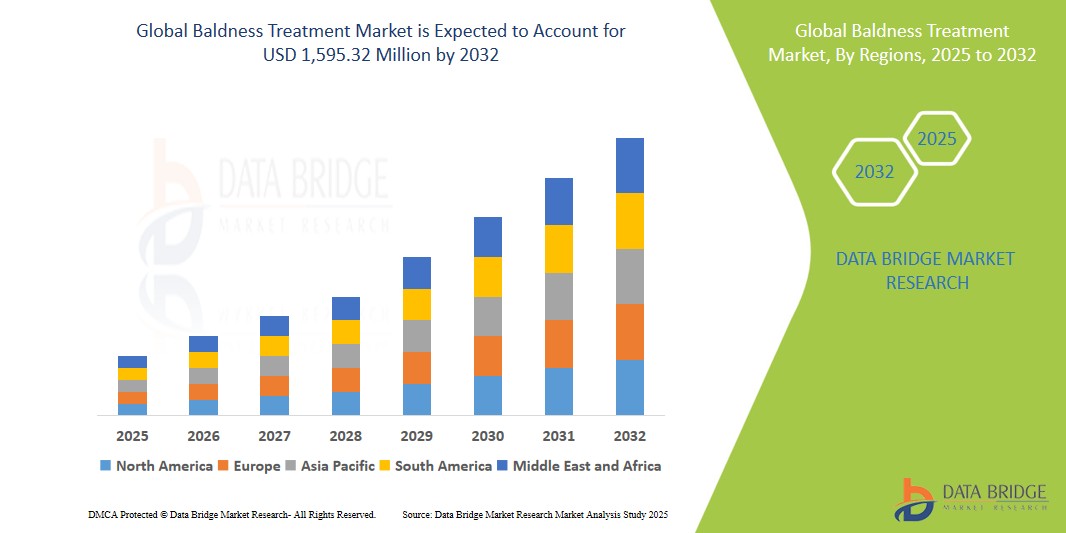
- The global baldness treatment market was valued at USD 946.740 million in 2024 and is expected to reach USD 1,595.32 million by 2032 at a CAGR of 6.74%, during the forecast period
- This growth is driven by factors the increase in the health consciousness among population across the globe
Baldness Treatment Market Analysis
- Baldness treatment options are essential for managing various forms of hair loss and restoring confidence among affected individuals These treatments address both the physiological and psychological impacts of baldness and are widely used in managing conditions such as androgenic alopecia, alopecia areata, and more severe variants
- The demand for baldness treatments is significantly driven by the increasing prevalence of hair loss disorders, rising awareness about aesthetic appearance, and advancements in drug therapies and hair restoration technologies, including topical agents, oral medications, and minimally invasive procedures
- North America is expected to dominate the baldness treatment market with a share of 38 7%, due to high consumer awareness, increasing aesthetic consciousness, well-established dermatology infrastructure, and the strong presence of pharmaceutical and cosmetic companies offering hair loss treatments
- Asia-Pacific is expected to be the fastest growing region in the baldness treatment market during the forecast period due to a large target population, growing medical tourism, rising income levels, and increasing adoption of both pharmaceutical and cosmetic hair loss treatments
- The androgenic alopecia segment is expected to dominate the market with a market share of 45 6% due to its high prevalence, especially among men over the age of 40, and its strong response to approved pharmacological treatments such as finasteride and minoxidil. Although other types of alopecia are gaining attention, androgenic alopecia remains the most commonly treated condition due to its chronic nature and societal pressure related to hair appearance
- Report Scope and Baldness Treatment Market Segmentation
|
Attributes |
Baldness treatment Key Market Insights |
|
Segments Covered |
|
|
Countries Covered |
North America
Europe
Asia-Pacific
Middle East and Africa
South America
|
|
Key Market Players |
|
|
Market Opportunities |
|
|
Value Added Data Infosets |
In addition to the insights on market scenarios such as market value, growth rate, segmentation, geographical coverage, and major players, the market reports curated by the Data Bridge Market Research also include import export analysis, production capacity overview, production consumption analysis, price trend analysis, climate change scenario, supply chain analysis, value chain analysis, raw material/consumables overview, vendor selection criteria, PESTLE Analysis, Porter Analysis, and regulatory framework |
Baldness Treatment Market Trends
“Growing Preference for Natural and Organic Formulations”
- This growth is driven by factors such as the increasing prevalence of hair loss due to aging, hormonal imbalances, stress, and lifestyle-related conditions, along with advancements in non-invasive treatment options
- One prominent trend in the baldness treatment market is the increasing consumer preference for natural and organic formulations to prevent hair loss and stimulate hair regrowth
- These formulations, often enriched with botanical ingredients such as saw palmetto, ginseng, aloe vera, and biotin, are perceived to offer fewer side effects and align with the wellness-focused lifestyles of modern consumers
For instance,
- The demand for clean-label, chemical-free, and plant-derived hair care solutions is influencing R&D strategies among cosmeceutical and pharmaceutical companies, encouraging them to expand product portfolios with organic, sulfate-free, and paraben-free formulations
- This trend is transforming the landscape of the baldness treatment market, as both medical and cosmetic brands increasingly blend therapeutic benefits with natural wellness attributes to improve consumer satisfaction, trust, and long-term treatment adherence
Baldness Treatment Market Dynamics
Driver
‘Growing Need Due to Rising Awareness and Diagnosis Rates of Hair Loss Conditions ”
- The increasing awareness and diagnosis of alopecia and other forms of hair loss, including androgenetic alopecia and alopecia areata, are significantly contributing to the growing demand for targeted treatment solutions
- As public knowledge improves, more individuals are seeking early interventions, leading to an increase in demand for topical, oral, and procedural treatment options
- The psychological impact of hair loss on self-esteem and social confidence has also led to greater acceptance and pursuit of therapeutic and cosmetic solutions
- Moreover, the expanding availability of dermatology consultations, hair clinics, and digital health platforms has facilitated early diagnosis and accessible treatment options
For instance,
- In August 2023, according to the American Academy of Dermatology, approximately 80 million people in the U.S. experience hereditary hair loss, with growing awareness contributing to higher consultation rates and treatment uptake
- In 2023, a study by the International Society of Hair Restoration Surgery noted a global rise in patients seeking treatment for alopecia, especially among younger demographics, driven by increased social media exposure and hair health awareness
- As diagnosis and consumer education increase globally, the demand for advanced and accessible baldness treatment solutions is expected to witness dominating growth in the global market
Opportunity
“Innovative Therapeutic Approaches Leveraging Stem Cell and Regenerative Technologies”
- Next-generation baldness treatment options are increasingly incorporating stem cell therapy, platelet-rich plasma (PRP), and regenerative medicine technologies to stimulate dormant hair follicles and promote regrowth
- Gene therapy and biomaterial-based delivery systems are also emerging, offering targeted treatment for hair loss with higher efficacy and fewer side effects compared to traditional therapies
For instance,
- In February 2025, according to a report published in Nature Biotechnology, multiple clinical trials began evaluating stem cell-derived exosome therapy and 3D bioprinted follicle implants for treating male and female pattern baldness
- A 2024 publication in Regenerative Medicine highlighted advancements in using autologous stem cells for treating androgenetic alopecia, demonstrating significant improvement in hair density and scalp health
These innovations are expected to unlock new opportunities for baldness treatment developers and significantly reshape therapeutic strategies in the hair loss treatment space
Restraint/Challenge
“High Cost of Baldness Treatment Development and Aesthetic Procedures Limiting Market Accessibility”
- The high cost associated with the research, development, and commercialization of therapies for ultra-rare conditions such as baldness treatment drug remains a major challenge
- Due to small patient populations and complex clinical endpoints, developing effective treatments often requires substantial investment with limited return on investment, deterring pharmaceutical interest
For instance,
- A 2023 report by the International Society of Hair Restoration Surgery revealed that hair transplant procedures could range from USD 4,000 to USD 15,000 per session, depending on geography and clinic
- As a result, this financial barrier hinders broader market penetration, delays regulatory approvals, and creates disparities in global access to cutting-edge treatments
Baldness Treatment Market Scope
The market is segmented on the basis of type, drugs, end user, and distribution channel
|
Segmentation |
Sub-Segmentation |
|
By type |
|
|
By Drugs |
|
|
By End User |
|
|
By Distribution Channel
|
|
In 2025, the androgenic alopecia segment is projected to dominate the market with the largest share in the type segment.
The androgenic alopecia segment is expected to dominate the baldness treatment market with the largest share of 45.6% in 2025 due to its widespread occurrence, especially in aging male populations. Its established clinical profile and the availability of effective treatments such as finasteride and minoxidil make it the most addressed form of hair loss. Despite advances in treatment options for other forms of alopecia, androgenic alopecia continues to drive the bulk of patient demand and pharmaceutical development.
The minoxidil segment is expected to account for the largest share during the forecast period in the drugs segment
In 2025, the minoxidil segment is expected to dominate the market due to its over-the-counter availability, strong efficacy in stimulating hair regrowth, and high adoption rate among patients. Minoxidil is widely accepted as the first-line therapy for both male and female pattern hair loss, and its ease of topical application and minimal side effects contribute to its broad usage. Its regulatory approval in multiple regions and consistent clinical outcomes support its continued leadership in the drugs segment.
Baldness Treatment Market Regional Analysis
“North America is the Dominant Region in the Baldness Treatment Market”
- North America dominates the baldness treatment market with a share of 38.7%, driven by a well-established healthcare infrastructure, high awareness regarding rare genetic disorders, and the strong presence of leading pharmaceutical companies focused on orphan diseases
- The U.S. holds a significant share due to increasing diagnosis rates of baldness treatment drug, extensive research funding, and the availability of approved therapies such as growth hormone treatments suppressants
- The presence of specialized care centers, genetic counseling services, and active support organizations such as the Foundation further accelerates market growth in this region
- Hence,continuous clinical trial activity, the development of novel baldness treatment drug formulations, and strong regulatory incentives under the orphan baldness treatment drug Act are contributing to the expansion of the baldness treatment market across North America
“Asia-Pacific is Projected to Register the Highest Growth Rate”
- The Asia-Pacific region is expected to witness the fastest growth in the baldness treatment market due to rising awareness, increasing healthcare investments, and improving diagnostic capabilities
- Countries such as India, China, and Japan are emerging as key markets, driven by growing medical genetics infrastructure, increasing inclusion of rare diseases in national healthcare agendas, and rising patient advocacy efforts
- Japan, known for its innovation in biotechnology and medical research, remains a crucial market with government-supported rare disease programs and advanced therapeutic development
- In India and China, the expansion of genetic screening initiatives, increasing availability of specialized treatment centers, and the involvement of both domestic and international pharmaceutical players offering cost-effective therapies continue to boost market penetration
Baldness Treatment Market Share
The market competitive landscape provides details by competitor Details included are company overview, company financials, revenue generated, market potential, investment in research and development, new market initiatives, global presence, production sites and facilities, production capacities, company strengths and weaknesses, product launch, product width and breadth, application dominance The above data points provided are only related to the companies' focus related to market
The Major Market Leaders Operating in the Market Are:
- Sanofi (France)
- Takeda Pharmaceutical Company Limited (Japan)
- BioMarin (U.S.)
- Pfizer Inc (U.S.)
- AbbVie Inc (U.S.)
- Amgen Inc (Ireland)
- Recordati Rare Diseases (Italy)
- Ultragenyx Pharmaceutical Inc (U.S.)
- Sangamo Therapeutics (U.S.)
- Orchard Therapeutics plc (U K )
- Amicus Therapeutics, Inc (U.S.)
- CHIESI Farmaceutici S p A (Italy)
- REGENXBIO Inc (U.S.)
- F Hoffmann-La Roche Ltd U.S.)
- Krystal Biotech, Inc (U.S.)
- Labcorp (U.S.)
- PerkinElmer (U.S.)
- bluebird bio, Inc (U.S.)
- Alexion Pharmaceuticals, Inc (U.S.)
- Bio-Techne (U.S.)
Latest Developments in Global Baldness Treatment Market
- In October 2022, Dr Groot, a South Korean hair care brand, introduced a shampoo containing brewer's yeast, claiming to benefit the scalp microbiome and reduce hair loss symptoms
- In August 2022, UNITE Hair debuted the BOOSTA PLUS+ Hair serum, formulated to stimulate hair growth and prevent hair loss by activating stem cells and rejuvenating hair follicles
- In August 2021, Adon Hair Care Clinic launched the Grow-Dense Hair Serum in the Indian market, an innovative product designed for both men and women to address hair loss and promote regrowth

- Interactive Data Analysis Dashboard
- Company Analysis Dashboard for high growth potential opportunities
- Research Analyst Access for customization & queries
- Competitor Analysis with Interactive dashboard
- Latest News, Updates & Trend analysis
- Harness the Power of Benchmark Analysis for Comprehensive Competitor Tracking
Data collection and base year analysis are done using data collection modules with large sample sizes. The stage includes obtaining market information or related data through various sources and strategies. It includes examining and planning all the data acquired from the past in advance. It likewise envelops the examination of information inconsistencies seen across different information sources. The market data is analysed and estimated using market statistical and coherent models. Also, market share analysis and key trend analysis are the major success factors in the market report. To know more, please request an analyst call or drop down your inquiry.
The key research methodology used by DBMR research team is data triangulation which involves data mining, analysis of the impact of data variables on the market and primary (industry expert) validation. Data models include Vendor Positioning Grid, Market Time Line Analysis, Market Overview and Guide, Company Positioning Grid, Patent Analysis, Pricing Analysis, Company Market Share Analysis, Standards of Measurement, Global versus Regional and Vendor Share Analysis. To know more about the research methodology, drop in an inquiry to speak to our industry experts.
Data Bridge Market Research is a leader in advanced formative research. We take pride in servicing our existing and new customers with data and analysis that match and suits their goal. The report can be customized to include price trend analysis of target brands understanding the market for additional countries (ask for the list of countries), clinical trial results data, literature review, refurbished market and product base analysis. Market analysis of target competitors can be analyzed from technology-based analysis to market portfolio strategies. We can add as many competitors that you require data about in the format and data style you are looking for. Our team of analysts can also provide you data in crude raw excel files pivot tables (Fact book) or can assist you in creating presentations from the data sets available in the report.












