


What is the Ballistic Materials Market Size and Growth Rate?
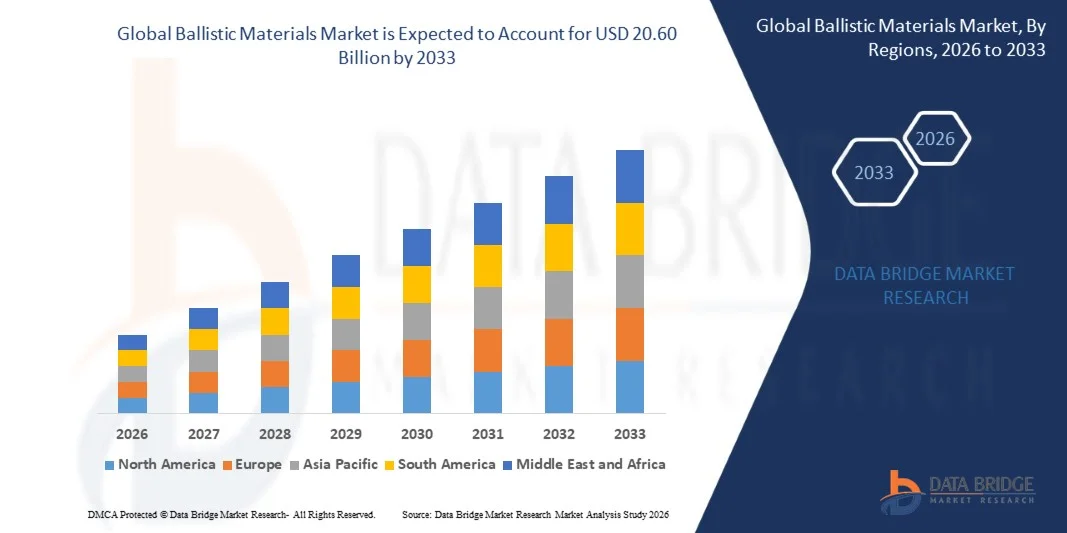
- As per Data Bridge Market Research analysis the ballistic materials market was valued at USD 14.20 billion in 2025 and is projected to reach USD 20.60 billion by 2033, growing at a CAGR of 6.80% from 2026 to 2033.
- The market is experiencing steady growth driven by increasing defense modernization programs, rising procurement of personal protective equipment, and growing demand for lightweight, high-performance ballistic protection materials across military, law enforcement, and homeland security applications.
- Continuous advancements in aramid fibers, ultra-high molecular weight polyethylene (UHMWPE), ceramic composites, and advanced armor technologies are enhancing protection levels while reducing weight, encouraging wider adoption in body armor, vehicle armor systems, aerospace protection, and naval defense applications.
Market Size & Forecast
- Market Value (2025): USD 14.20 Billion
- Expected Market Value (2033): USD 20.60 Billion
- Forecast CAGR (2026–2033): 6.80%
- Leading Region in 2025: North America
- Fastest Growing Region: Asia-Pacific
What are the Major Takeaways of the Ballistic Materials Market?
- North America dominated the ballistic materials market with the largest revenue share in 2025, supported by substantial defense spending, increasing procurement of advanced protective equipment, and rising demand for lightweight armor solutions across military, law enforcement, and homeland security applications.
- Asia-Pacific ballistic materials market is expected to witness the fastest growth rate from 2026 to 2033, supported by rising defense budgets, increasing military modernization initiatives, and growing security concerns across countries such as China, India, Japan, and South Korea.
- The aramid fibers segment held the largest market revenue share in 2025, driven by the extensive use of Kevlar and Twaron fibers in body armor, helmets, and vehicle protection systems. Aramid fibers are widely preferred due to their high strength-to-weight ratio, excellent impact resistance, thermal stability, and proven performance in military and law enforcement applications. The increasing procurement of lightweight personal protective equipment and advanced combat gear is further strengthening demand for aramid-based ballistic solutions.
- The UHMWPE segment is projected to register the fastest growth at a CAGR from 2026 to 2033, driven by increasing demand for lightweight armor systems, advanced combat helmets, and next-generation personal protective equipment. The material’s superior ballistic performance, high tensile strength, and low weight are accelerating its adoption across defense modernization programs. UHMWPE-based materials are increasingly utilized in applications where mobility and reduced soldier fatigue are critical factors.
- The fabrics segment accounted for the largest market revenue share in 2025, driven by its widespread application in soft body armor, tactical vests, helmets, and protective clothing. Ballistic fabrics provide flexibility, comfort, lightweight protection, and effective resistance against handgun and fragmentation threats. The rising demand for wearable protection solutions among military personnel and law enforcement officers is supporting segment growth. Moreover, continuous improvements in weaving technologies and fiber integration techniques are enabling manufacturers to develop stronger and more adaptable ballistic fabrics.
- The panels segment is expected to witness the fastest CAGR during the forecast period, driven by growing deployment in armored vehicles, military shelters, aircraft structures, and infrastructure protection applications requiring enhanced ballistic resistance. Composite ballistic panels are increasingly preferred due to their ability to provide high protection levels while maintaining reduced overall system weight. Increasing investments in vehicle modernization programs and survivability solutions are further contributing to the expansion of this segment.
Report Scope and Ballistic Materials Market Segmentation
|
Attributes |
Ballistic Materials Key Market Insights |
|
Segments Covered |
|
|
Countries Covered |
North America
Europe
Asia-Pacific
Middle East and Africa
South America
|
|
Key Market Players |
|
|
Market Opportunities |
|
|
Value Added Data Infosets |
|
What is the Key Trend in the Ballistic Materials Market?
- The increasing adoption of lightweight ballistic protection solutions based on advanced aramid fibers, ultra-high-molecular-weight polyethylene (UHMWPE), and composite materials is emerging as a major trend in the ballistic materials market, driven by the need to enhance mobility, comfort, and survivability for military personnel and law enforcement agencies.
- For instance, in December 2025, DuPont expanded the application of its Kevlar EXO next-generation aramid fiber into hard armor systems, including ballistic helmets and plate inserts, improving impact resistance and energy absorption while reducing overall armor weight.
- Manufacturers are increasingly focusing on developing lighter and stronger ballistic materials that provide multi-hit protection capabilities without compromising wearer comfort or operational effectiveness.
- In addition, defense organizations are accelerating the adoption of hybrid armor systems that combine aramid fibers, UHMWPE, ceramics, and advanced composites to address evolving battlefield threats.
- For instance, in January 2025, Teijin Aramid highlighted its collaboration with SAFECO Industries to develop advanced ballistic protection solutions utilizing Twaron aramid fibers for armored vehicle applications, enhancing protection while maintaining lightweight performance.
- As defense forces and security agencies continue prioritizing lightweight, high-performance personal protection systems, demand for advanced ballistic materials is expected to increase significantly, reinforcing innovation in next-generation armor technologies.
What are the Key Drivers of the Ballistic Materials Market?
- Rising global defense expenditure and increasing procurement of personal protective equipment, armored vehicles, and advanced combat systems are significantly driving demand for ballistic materials worldwide.
- Governments are investing heavily in modernizing military capabilities and improving soldier survivability against evolving ballistic and explosive threats, accelerating the adoption of high-performance protection materials.
- Also, the growing demand for aramid fibers and ballistic protection solutions contributed to capacity expansions and increased adoption of advanced ballistic materials across military and law-enforcement applications worldwide.
- In addition, increasing geopolitical tensions, border security concerns, and military modernization programs are encouraging defense organizations to deploy lightweight armor solutions that offer enhanced protection and mobility.
- For instance, in June 2025, Honeywell confirmed the continued global supply of its Spectra fiber platform, a high-strength UHMWPE material widely utilized in advanced protection applications due to its exceptional strength-to-weight ratio.
- With defense agencies increasingly focusing on advanced protection technologies and soldier modernization initiatives, ballistic materials will remain critical for the development of next-generation body armor, helmets, armored vehicles, and tactical protection systems.
Which Factors are Challenging the Growth of the Ballistic Materials Market?
- Advanced ballistic materials require substantial research, development, testing, and manufacturing investments to meet stringent military and law-enforcement performance standards.
- The production of high-performance aramid fibers, UHMWPE composites, and ceramic armor materials involves complex manufacturing processes, specialized raw materials, and rigorous certification requirements, resulting in elevated costs.
- For instance, ongoing research into advanced ballistic-resistant composite structures and next-generation protective materials continues to demonstrate the significant investment required to develop and validate innovative ballistic protection technologies.
- In addition, fluctuating raw material prices, supply chain constraints, and strict regulatory compliance requirements can further increase production costs and delay commercialization timelines.
- The high cost of advanced ballistic materials continues to limit adoption among budget-constrained defense organizations, law-enforcement agencies, and emerging economies. This cost challenge restricts widespread deployment despite growing demand for enhanced protection, creating a significant barrier to market expansion in price-sensitive regions.
How is the Ballistic Materials Market Segmented?
The market is segmented on the basis of material type, product form, protection type, threat level, manufacturing process, end product, end user, ballistic protection standard, and distribution channel.
- By Material Type
On the basis of material type, the ballistic materials market is segmented into aramid fibers, ultra-high molecular weight polyethylene (UHMWPE), ceramic materials, and metals and alloys. The aramid fibers segment held the largest market revenue share in 2025, driven by the extensive use of Kevlar and Twaron fibers in body armor, helmets, and vehicle protection systems. Aramid fibers are widely preferred due to their high strength-to-weight ratio, excellent impact resistance, thermal stability, and proven performance in military and law enforcement applications. The increasing procurement of lightweight personal protective equipment and advanced combat gear is further strengthening demand for aramid-based ballistic solutions. In addition, manufacturers are focusing on developing enhanced aramid fiber composites with improved durability and multi-hit protection capabilities to meet evolving battlefield requirements.
The UHMWPE segment is projected to register the fastest growth at a CAGR from 2026 to 2033, driven by increasing demand for lightweight armor systems, advanced combat helmets, and next-generation personal protective equipment. The material’s superior ballistic performance, high tensile strength, and low weight are accelerating its adoption across defense modernization programs. UHMWPE-based materials are increasingly utilized in applications where mobility and reduced soldier fatigue are critical factors. Furthermore, advancements in fiber processing technologies and composite manufacturing are supporting the wider adoption of UHMWPE materials in military, aerospace, and security applications.
- By Product Form
On the basis of product form, the ballistic materials market is segmented into fibers, fabrics, sheets, and panels. The fabrics segment accounted for the largest market revenue share in 2025, driven by its widespread application in soft body armor, tactical vests, helmets, and protective clothing. Ballistic fabrics provide flexibility, comfort, lightweight protection, and effective resistance against handgun and fragmentation threats. The rising demand for wearable protection solutions among military personnel and law enforcement officers is supporting segment growth. Moreover, continuous improvements in weaving technologies and fiber integration techniques are enabling manufacturers to develop stronger and more adaptable ballistic fabrics.
The panels segment is expected to witness the fastest CAGR during the forecast period, driven by growing deployment in armored vehicles, military shelters, aircraft structures, and infrastructure protection applications requiring enhanced ballistic resistance. Composite ballistic panels are increasingly preferred due to their ability to provide high protection levels while maintaining reduced overall system weight. Increasing investments in vehicle modernization programs and survivability solutions are further contributing to the expansion of this segment.
- By Protection Type
On the basis of protection type, the ballistic materials market is segmented into soft ballistic protection and hard ballistic protection. The soft ballistic protection segment held the largest market revenue share in 2025, driven by strong demand for concealable body armor, law enforcement vests, and personal protective equipment. Soft armor systems remain widely utilized due to their flexibility, lightweight characteristics, and wearer comfort during extended operational activities. Growing security concerns and increasing adoption of protective equipment by police forces and private security organizations are supporting market expansion.
The hard ballistic protection segment is projected to register the fastest growth at a CAGR from 2026 to 2033, supported by rising procurement of rifle-resistant armor plates, vehicle armor systems, and advanced combat protection solutions by defense organizations globally. Hard armor systems are gaining importance due to increasing battlefield threats involving high-caliber ammunition and armor-piercing projectiles. The integration of ceramics, composites, and hybrid materials is further enhancing the performance and adoption of hard ballistic protection systems.
- By Threat Level
On the basis of threat level, the ballistic materials market is segmented into handgun threat protection, rifle threat protection, armor-piercing threat protection, and blast & fragment threat protection. The handgun threat protection segment accounted for the largest market revenue share in 2025, primarily due to its widespread deployment among police forces, private security personnel, correctional facilities, and civilian protection applications. The growing requirement for lightweight and comfortable protective solutions is driving demand for handgun-resistant armor products.
The armor-piercing threat protection segment is anticipated to grow at the fastest CAGR during the forecast period, driven by increasing military requirements for advanced armor solutions capable of defeating high-velocity projectiles and emerging battlefield threats. Modern warfare scenarios have increased demand for advanced materials that provide protection against sophisticated ammunition types. Defense agencies are increasingly investing in multi-layered armor systems combining ceramics, composites, and advanced fibers to improve survivability.
- By Manufacturing Process
On the basis of manufacturing process, the ballistic materials market is segmented into fiber spinning, weaving, lamination, and compression molding. The weaving segment held the largest market revenue share in 2025, driven by its critical role in producing high-performance ballistic fabrics used in personal armor and protective equipment. Advanced weaving techniques enable manufacturers to improve material strength, flexibility, and impact resistance. The increasing demand for lightweight protective clothing and tactical equipment is supporting the growth of this segment.
The compression molding segment is projected to witness the fastest CAGR from 2026 to 2033, owing to growing adoption in the production of lightweight composite armor plates, vehicle protection systems, and structural defense components. Compression molding enables the manufacturing of highly durable and consistent ballistic components with improved mechanical properties. Rising investments in armored vehicle upgrades and advanced defense platforms are expected to further accelerate segment growth.
- By End Product
On the basis of end product, the ballistic materials market is segmented into personal ballistic protection, vehicle armor systems, aerospace armor systems, and naval protection systems. The personal ballistic protection segment accounted for the largest market revenue share in 2025, driven by continuous procurement of body armor, helmets, tactical protective equipment, and soldier protection systems by military and law enforcement agencies. Increasing focus on soldier survivability and operational effectiveness is driving demand for advanced personal protection products.
The aerospace armor systems segment is expected to register the fastest CAGR during the forecast period, supported by increasing investments in aircraft survivability solutions and lightweight armor technologies for military aviation platforms. Aerospace platforms require materials that provide protection against ballistic threats while minimizing additional weight. The development of advanced composite armor solutions is expected to create new growth opportunities in aerospace defense applications.
- By End User
On the basis of end user, the ballistic materials market is segmented into military & defense, homeland security, law enforcement agencies, and border security forces. The military & defense segment dominated the market revenue share in 2025, driven by rising defense budgets, military modernization initiatives, and growing procurement of advanced protection systems globally. Defense forces remain the primary consumers of ballistic materials due to increasing requirements for personnel protection, armored vehicles, and battlefield equipment.
The border security forces segment is projected to witness the fastest CAGR from 2026 to 2033, supported by increasing investments in border surveillance, force protection, and tactical equipment modernization programs. Rising geopolitical tensions and growing emphasis on securing national borders are encouraging governments to invest in advanced protective technologies. The adoption of lightweight armor solutions among border patrol units is expected to further support segment growth.
- By Ballistic Protection Standard
On the basis of ballistic protection standard, the ballistic materials market is segmented into NIJ Level IIA, NIJ Level II, NIJ Level IIIA, and NIJ Level III. The NIJ Level IIIA segment held the largest market revenue share in 2025, owing to its extensive use in law enforcement body armor and protective equipment designed to stop high-velocity handgun rounds. The segment benefits from increasing demand for protective vests that balance mobility, comfort, and protection levels.
The NIJ Level III segment is expected to grow at the fastest CAGR during the forecast period, driven by increasing demand for rifle-resistant armor systems among military personnel, tactical response units, and security agencies. The rising prevalence of rifle-based threats has encouraged organizations to adopt higher-level protection standards. Manufacturers are also developing advanced composite solutions to achieve improved protection while maintaining reduced weight.
- By Distribution Channel
On the basis of distribution channel, the ballistic materials market is segmented into direct sales, OEMs, defense contractors, and government procurement. The government procurement segment accounted for the largest market revenue share in 2025, driven by large-scale defense acquisition programs and public-sector procurement contracts for ballistic protection systems. Government agencies represent a major purchasing channel due to their requirement for large-volume and standardized protection equipment.
The defense contractors segment is projected to register the fastest CAGR from 2026 to 2033, supported by growing collaboration between material manufacturers and defense integrators for the development of advanced armor solutions. Defense contractors play a crucial role in integrating ballistic materials into vehicles, aircraft, naval platforms, and military equipment. Increasing public-private partnerships and defense modernization programs are expected to further strengthen this distribution channel.
Which Region Holds the Largest Share of the Ballistic Materials Market?
- North America dominated the ballistic materials market with the largest revenue share in 2025, supported by substantial defense spending, increasing procurement of advanced protective equipment, and rising demand for lightweight armor solutions across military, law enforcement, and homeland security applications.
- The region benefits from strong investments in research and development of advanced materials, including aramid fibers, UHMWPE composites, and ceramic-based armor systems. The presence of leading ballistic material manufacturers, established defense contractors, and continuous modernization programs of armed forces are further strengthening market growth.
- In addition, increasing adoption of advanced personal protection systems and armored vehicles across the U.S. and Canada is reinforcing North America’s leading position in the global ballistic materials industry.
U.S. Ballistic Materials Market Insight
The U.S. ballistic materials market captured the largest revenue share in 2025 within North America, driven by high defense expenditure, military modernization initiatives, and increasing demand for advanced body armor and vehicle protection systems. The country’s extensive military operations, growing focus on soldier survivability, and procurement of next-generation combat equipment are accelerating the adoption of high-performance ballistic materials. Furthermore, strong investments by defense organizations and manufacturers in lightweight composites, ceramic armor, and advanced fiber technologies are supporting market expansion. The increasing requirements of law enforcement agencies, border security forces, and tactical units for enhanced protection solutions are further contributing to the growth of the U.S. ballistic materials market.
Europe Ballistic Materials Market Insight
The Europe ballistic materials market is expected to witness significant growth from 2026 to 2033, primarily driven by increasing defense modernization programs, rising geopolitical tensions, and growing investments in military protection systems. European countries are focusing on enhancing battlefield readiness through the adoption of lightweight armor materials for personnel, vehicles, and aerospace platforms. The increasing demand for advanced composite materials, including aramid fibers and UHMWPE-based solutions, is supporting regional market growth. Moreover, collaborations between defense manufacturers and government agencies for developing next-generation protective systems are further accelerating the adoption of ballistic materials across the region.
U.K. Ballistic Materials Market Insight
The U.K. ballistic materials market is expected to witness strong growth from 2026 to 2033, driven by increasing defense investments, modernization of military equipment, and rising demand for advanced soldier protection systems. The country’s focus on improving operational capabilities and enhancing personnel survivability is encouraging the adoption of lightweight ballistic armor solutions. In addition, growing requirements for armored vehicles, tactical equipment, and protective gear among defense and homeland security organizations are contributing to market expansion. The U.K.’s emphasis on developing advanced defense technologies and strengthening domestic defense manufacturing capabilities is expected to further support the growth of the ballistic materials market.
Germany Ballistic Materials Market Insight
The Germany ballistic materials market is expected to witness steady growth from 2026 to 2033, fueled by increasing defense spending, modernization of military fleets, and rising demand for advanced protection technologies. Germany’s strong industrial base, expertise in engineering, and focus on innovation are supporting the development and adoption of high-performance ballistic materials. The growing requirement for lightweight armor solutions in military vehicles, personal protection systems, and aerospace applications is driving market opportunities. Furthermore, increasing investments in defense capabilities and collaboration between material manufacturers and defense contractors are expected to strengthen Germany’s position in the European ballistic materials market.
Asia-Pacific Ballistic Materials Market Insight
The Asia-Pacific ballistic materials market is expected to witness the fastest growth rate from 2026 to 2033, supported by rising defense budgets, increasing military modernization initiatives, and growing security concerns across countries such as China, India, Japan, and South Korea. The region is experiencing increased demand for advanced body armor, armored vehicles, and protective systems due to evolving geopolitical conditions and border security requirements. Furthermore, expanding domestic defense manufacturing capabilities and investments in lightweight composite materials are driving the adoption of advanced ballistic solutions. The presence of major manufacturing hubs for fibers, composites, and protective materials is also improving accessibility and supporting regional market expansion.
Japan Ballistic Materials Market Insight
The Japan ballistic materials market is expected to witness significant growth from 2026 to 2033, driven by increasing investments in defense modernization, technological advancements, and rising demand for lightweight protection systems. Japan’s focus on enhancing national security capabilities and strengthening defense infrastructure is encouraging the adoption of advanced ballistic materials for military applications. The integration of high-performance composites and lightweight armor technologies in defense equipment is supporting market growth. In addition, Japan’s strong expertise in material science and advanced manufacturing is contributing to the development of innovative ballistic protection solutions for military and aerospace applications.
China Ballistic Materials Market Insight
The China ballistic materials market accounted for the largest market revenue share in Asia-Pacific in 2025, attributed to significant defense expenditure, large-scale military modernization programs, and increasing domestic production of advanced protection materials. China’s expanding defense industry and focus on strengthening military capabilities are driving demand for ballistic materials used in body armor, armored vehicles, aircraft protection systems, and naval applications. The country’s strong manufacturing capabilities in advanced fibers, composites, and ceramics are supporting the production of cost-effective ballistic solutions. Furthermore, increasing investments in research and development of lightweight and high-strength materials are expected to further accelerate market growth in China.
Which are the Top Companies in Ballistic Materials Market?
The ballistic materials industry is primarily led by well-established companies, including:
- DuPont (U.S.)
- Honeywell International Inc. (U.S.)
- Avient Corporation (U.S.)
- Kolon Industries, Inc. (South Korea)
- Hyosung Advanced Materials Corporation (South Korea)
- Toray Industries, Inc. (Japan)
- Mitsubishi Chemical Group Corporation (Japan)
- Solvay SA (Belgium)
- Hexcel Corporation (U.S.)
- Gurit Holding AG (Switzerland)
- Owens Corning (U.S.)
- JPS Composite Materials Corporation (U.S.)
- Compagnie de Saint-Gobain S.A. (France)
- CoorsTek, Inc. (U.S.)
- CeramTec GmbH (Germany)
- Morgan Advanced Materials plc (U.K.)
- 3M Company (U.S.)
- SSAB AB (Sweden)
- Tata Steel Limited (India)
- Bisalloy Steel Group Limited (Australia)
- NLMK Clabecq S.A. (Belgium)
- MKU Limited (India)
- NP Aerospace Limited (U.K.)
- Craig International Ballistics Pty Ltd. (Australia)
- Point Blank Enterprises, Inc. (U.S.)
- BAE Systems plc (U.K.)
- Rheinmetall AG (Germany)
- Mehler Systems GmbH (Germany)
- Kordsa Teknik Tekstil A.Ş. (Türkiye)

- Interactive Data Analysis Dashboard
- Company Analysis Dashboard for high growth potential opportunities
- Research Analyst Access for customization & queries
- Competitor Analysis with Interactive dashboard
- Latest News, Updates & Trend analysis
- Harness the Power of Benchmark Analysis for Comprehensive Competitor Tracking
Data collection and base year analysis are done using data collection modules with large sample sizes. The stage includes obtaining market information or related data through various sources and strategies. It includes examining and planning all the data acquired from the past in advance. It likewise envelops the examination of information inconsistencies seen across different information sources. The market data is analysed and estimated using market statistical and coherent models. Also, market share analysis and key trend analysis are the major success factors in the market report. To know more, please request an analyst call or drop down your inquiry.
The key research methodology used by DBMR research team is data triangulation which involves data mining, analysis of the impact of data variables on the market and primary (industry expert) validation. Data models include Vendor Positioning Grid, Market Time Line Analysis, Market Overview and Guide, Company Positioning Grid, Patent Analysis, Pricing Analysis, Company Market Share Analysis, Standards of Measurement, Global versus Regional and Vendor Share Analysis. To know more about the research methodology, drop in an inquiry to speak to our industry experts.
Data Bridge Market Research is a leader in advanced formative research. We take pride in servicing our existing and new customers with data and analysis that match and suits their goal. The report can be customized to include price trend analysis of target brands understanding the market for additional countries (ask for the list of countries), clinical trial results data, literature review, refurbished market and product base analysis. Market analysis of target competitors can be analyzed from technology-based analysis to market portfolio strategies. We can add as many competitors that you require data about in the format and data style you are looking for. Our team of analysts can also provide you data in crude raw excel files pivot tables (Fact book) or can assist you in creating presentations from the data sets available in the report.












