


What is the Battery Sensor Market Size and Growth Rate?
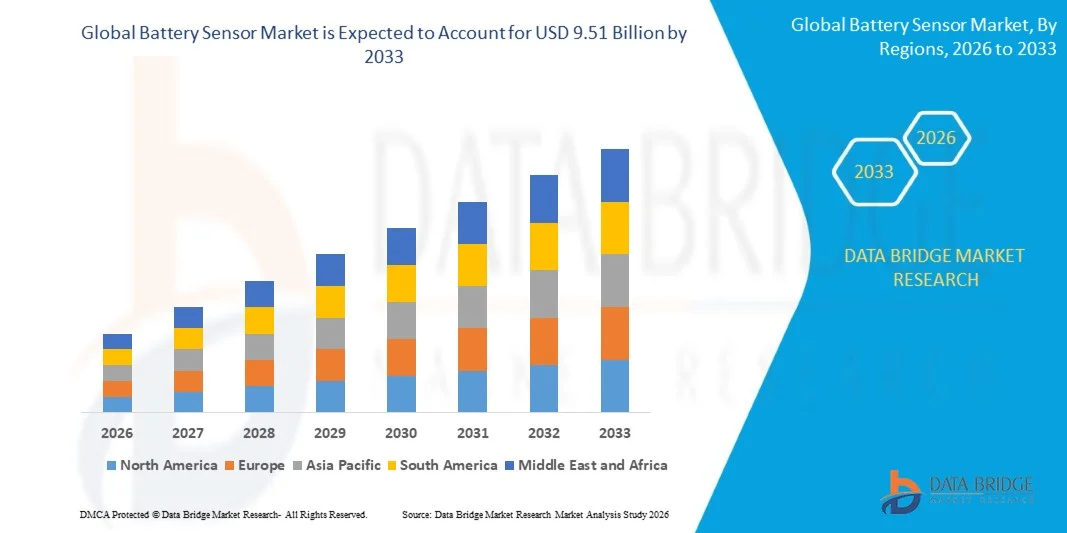
- As per Data Bridge Market Research analysis, the battery sensor market was valued at USD 4.10 billion in 2025 and is projected to reach USD 9.51 billion by 2033, growing at a CAGR of 11.10% from 2026 to 2033.
- The market is experiencing consistent growth driven by rising adoption of electric vehicles, increasing integration of advanced battery management systems, and growing demand for accurate monitoring of battery voltage, current, temperature, and state of charge.
- The rapid expansion of electric mobility, combined with increasing emphasis on battery safety, energy efficiency, and longer battery life, is compelling automotive manufacturers to integrate advanced battery sensors into modern vehicle architectures. Battery sensors are increasingly being deployed across passenger cars and commercial vehicles, while advancements in predictive diagnostics, wireless monitoring, and battery management are further supporting market growth.
Market Size & Forecast
- Global Market Value (2025): USD 4.10 Billion
- Expected Market Value (2033): USD 9.51 Billion
- Forecast CAGR (2026–2033): 11.10%
- Leading Region in 2025: North America
- Fastest Growing Region: Asia Pacific
What are the Major Takeaways of the Battery Sensor Market?
- North America dominated the battery sensor market with the largest revenue share of 35.6% in 2025, supported by strong electric vehicle adoption, advanced automotive electronics infrastructure, and increasing integration of battery management technologies.
- Asia-Pacific is expected to be the fastest-growing region at a CAGR of 11.1% from 2026 to 2033, fueled by expanding electric vehicle production, battery manufacturing, and increasing investments in advanced battery monitoring technologies.
- The hall-effect current sensors segment led the market with a 43.2% share in 2025, driven by their high accuracy, electrical isolation, and suitability for monitoring current in advanced battery systems.
- Fiber-optic battery sensors are the fastest-growing sensor type, projected to register a CAGR of 11.9%, reflecting the surge in demand for accurate and electrically isolated battery monitoring
- The closed-loop sensors segment dominated the technology category with a 40.5% revenue share in 2025, led by their high measurement accuracy, stability, and electrical isolation capabilities.
- Controller area network (CAN) accounted for 48.0% of the market share in 2025, preferred by its reliable communication capabilities across automotive electronic systems.
- The plug-in hybrid electric vehicles (PHEVs) segment is the fastest-growing vehicle type category, with a CAGR of 12.5%, driven by increasing demand for vehicles combining electric driving capability with conventional powertrains
Report Scope and Battery Sensor Market Segmentation
|
Attributes |
Battery Sensor Key Market Insights |
|
Segments Covered |
|
|
Countries Covered |
North America
Europe
Asia-Pacific
Middle East and Africa
South America
|
|
Key Market Players |
|
|
Market Opportunities |
|
|
Value Added Data Infosets |
In addition to the insights on market scenarios such as market value, growth rate, segmentation, geographical coverage, and major players, the market reports curated by the Data Bridge Market Research also include in-depth expert analysis, geographically represented company-wise production and capacity, network layouts of distributors and partners, detailed and updated price trend analysis and deficit analysis of supply chain and demand. |
What is the Key Trend in the Battery Sensor Market?
- Battery sensor manufacturers are increasingly developing multi-functional and high-accuracy sensing solutions that combine current, voltage, temperature, gas, and pressure monitoring to provide more comprehensive battery diagnostics and improve safety across electric vehicles and energy storage systems.
- For instance, in June 2025, LEM introduced its Hybrid Supervising Unit, combining shunt and open-loop Hall-effect technologies into a single high-voltage battery sensor designed to reduce space and costs while supporting electric-vehicle battery management systems.
- The integration of multiple sensing functions into compact battery-monitoring architectures is helping manufacturers reduce component count, wiring complexity, and system space while enabling battery management systems to receive more detailed real-time operating information.
- Advanced battery sensors are increasingly being designed to support early detection of thermal runaway, enabling battery management systems to identify electrolyte vapors, gases, pressure changes, and abnormal temperatures before critical battery failure occurs.
- Automotive manufacturers are also adopting battery sensors with longer operating lifetimes and low power consumption to enable continuous monitoring during vehicle operation, charging, and parking conditions.
- For instance, in February 2025, Sensirion Automotive highlighted its SABM battery state monitoring sensor, which detects thermal-runaway conditions through battery-compartment gas monitoring, offers approximately 300 µA current consumption, and is designed for operating lifetimes of up to 15 years.
- As electric vehicles and battery energy storage systems increasingly require accurate, compact, and predictive monitoring, the development of multifunctional battery sensors is expected to accelerate, reinforcing advanced sensing as a core component of next-generation battery management and safety systems.
What are the Key Drivers of the Battery Sensor Market?
- The rapid expansion of electric vehicles and high-capacity lithium-ion battery systems has significantly increased demand for accurate battery sensors capable of monitoring voltage, current, temperature, and other critical operating parameters.
- For instance, in October 2024, Honeywell launched its Battery Safety Electrolyte Sensor (BES) for electric vehicles, using electrolyte-gas detection to identify early signs of battery failure and provide warnings potentially 5–20 minutes before a fire, supporting the growing need for advanced battery sensing and safety monitoring
- Increasing emphasis on battery safety, charging efficiency, battery-life optimization, and predictive diagnostics is encouraging automotive manufacturers and battery-system developers to integrate advanced sensing technologies into battery management systems.
- Automotive OEMs, battery manufacturers, and energy-storage companies are integrating sensor data into intelligent battery management architectures to improve state-of-charge and state-of-health estimation, optimize charging, and identify abnormal operating conditions.
- For instance, in November 2024, NXP Semiconductors introduced an Ultra-Wideband wireless battery management system solution for EVs, designed to simplify battery-pack assembly, increase energy density, and provide reliable wireless data transfer within battery packs.
- With electric mobility and stationary energy storage increasingly dependent on reliable battery monitoring, demand for precise sensing technologies will continue to expand, supporting broader deployment of advanced battery sensors across automotive and energy applications.
Which Factors are Challenging the Growth of the Battery Sensor Market?
- Advanced battery sensors require stringent accuracy, calibration, thermal stability, and reliability because measurement errors can directly affect battery-management decisions, state estimation, charging control, and overall battery safety.
- For instance, in December 2024, researchers published a study in eTransportation showing that battery-management-system state-estimation performance depends on measurement accuracy, temperature, cell chemistry, initial state of charge, and calibration, highlighting the complexity of achieving reliable battery-sensor measurements across operating conditions.
- These technical requirements can increase development and integration costs, particularly for manufacturers designing sensors for high-voltage battery packs and applications requiring precise measurements across wide temperature and operating ranges.
- The need for continuous calibration and reliable performance across changing battery conditions continues to create challenges for sensor manufacturers and vehicle developers, particularly as battery chemistries, cell configurations, and operating environments become increasingly diverse.
- For instance, in August 2025, Texas Instruments documented that shunt-resistor tolerance and temperature coefficients can introduce current-measurement errors in battery-management systems, while temperature drift and thermal electromotive force can be difficult to calibrate, requiring careful component selection and thermal design.
- These accuracy, calibration, and reliability requirements can slow integration and increase system-development complexity, particularly for applications requiring long-term sensor stability and highly precise state-of-charge and state-of-health estimation.
How is the Battery Sensor Market Segmented?
The battery sensor market is segmented on the basis of sensor type, technology, communication, and vehicle type.
- By Sensor Type
On the basis of sensor type, the battery sensor market is segmented into hall-effect current sensors, shunt-based current sensors, voltage monitoring ics, temperature sensors, fiber-optic battery sensors, and MEMS pressure sensors. The hall-effect current sensors segment dominated the market with a 43.2% share in 2025, owing to their high accuracy, electrical isolation, and suitability for monitoring current in advanced battery systems. These sensors are widely used in electric and hybrid vehicles for measuring charging and discharging currents. Their non-contact measurement capability helps improve reliability and reduce electrical interference. Increasing adoption of high-voltage battery systems is supporting their integration into battery management systems. Manufacturers are also advancing Hall-effect technologies to improve sensing accuracy and energy efficiency.
The fiber-optic battery sensors segment is projected to register the fastest growth at CAGR of 11.9% from 2026 to 2033, driven by increasing demand for accurate and electrically isolated battery monitoring. These sensors can operate effectively in environments exposed to electromagnetic interference. Their electrical isolation makes them suitable for high-voltage battery architectures. Growing concerns regarding battery safety and thermal events are increasing interest in advanced sensing technologies. Continued development of compact fiber-optic sensing solutions is improving their suitability for battery-pack integration. Increasing deployment of high-energy-density batteries is creating greater demand for precise monitoring.
- By Technology
On the basis of technology, the battery sensor market is segmented into closed-loop sensors, open-loop sensors, digital output sensors, analog output sensors, and wireless battery sensors. The closed-loop sensors segment dominated the market with a 40.5% share in 2025, supported by their high measurement accuracy, stability, and electrical isolation capabilities. Closed-loop sensors are widely used where precise current measurement is required for battery management. They provide accurate feedback signals for monitoring charging and discharging conditions. Their suitability for demanding automotive operating environments supports their adoption in electric and hybrid vehicles. These sensors can also provide reliable measurement performance across changing operating conditions
The wireless battery sensors segment is projected to register the fastest growth at CAGR of 11.7% from 2026 to 2033, driven by increasing demand for reduced wiring complexity and more flexible battery-pack architectures. Wireless sensing can reduce the extensive wiring harnesses required for conventional battery monitoring. This can provide greater flexibility for battery-pack design and assembly. Increasing adoption of distributed battery monitoring is encouraging manufacturers to explore wireless communication architectures. Wireless solutions can also support modular battery designs and simplify sensor installation. Advances in low-power wireless communication are improving the feasibility of these systems.
- By Communication
On the basis of communication, the battery sensor market is segmented into controller area network (CAN) and local interconnect network (LIN). The controller area network (CAN) segment dominated the market with 48.0% share in 2025, supported by its reliable communication capabilities across automotive electronic systems. CAN enables battery sensors to transmit important battery information to vehicle control units. Its established presence in automotive electronic architectures supports widespread integration. The technology enables communication of battery monitoring data across interconnected vehicle systems. Increasing vehicle electrification is creating greater demand for reliable transmission of battery-related information.
The local interconnect network (LIN) segment is projected to register the fastest growth at CAGR of 10.0% from 2026 to 2033, driven by demand for cost-effective communication solutions in less complex automotive sensing applications. LIN provides a simpler communication architecture than CAN for selected battery-monitoring functions. Its comparatively lower implementation complexity supports applications where high communication bandwidth is not required. Increasing integration of electronic systems in vehicles is creating additional opportunities for LIN-based sensing. The technology can efficiently connect sensors with local electronic control units. Growing adoption of electronic battery-management functions is supporting demand for economical communication architectures.
- By Vehicle Type
On the basis of vehicle type, the battery sensor market is segmented into battery electric vehicles (BEVs), hybrid electric vehicles (HEVs), and plug-in hybrid electric vehicles (PHEVs). The battery electric vehicles (BEVs) segment dominated the market with 53.9% share in 2025, driven by the increasing deployment of high-capacity battery packs requiring continuous monitoring of critical operating conditions. BEVs depend primarily on battery systems for propulsion, making accurate battery sensing essential for vehicle performance and safety. Battery sensors support battery management systems in monitoring electrical and thermal conditions. Increasing electric vehicle production is expanding demand for battery monitoring technologies. Growing emphasis on driving range and battery durability is further increasing the importance of accurate sensing.
The plug-in hybrid electric vehicles (PHEVs) segment is projected to register the fastest growth at CAGR of 12.5% from 2026 to 2033, supported by increasing demand for vehicles combining electric driving capability with conventional powertrains. PHEVs require sophisticated battery monitoring because their batteries undergo repeated charging and discharging cycles. Battery sensors help monitor electrical and thermal conditions during different operating modes. Increasing deployment of PHEVs is creating additional demand for reliable battery management technologies. Improvements in charging infrastructure are also supporting the use of plug-in hybrid vehicles. Growing emphasis on battery durability and energy efficiency is encouraging more advanced sensing capabilities.
Which Region Holds the Largest Share of the Battery Sensor Market?
- North America dominated the battery sensor market with the largest revenue share of 35.6% in 2025, supported by strong electric vehicle adoption, advanced automotive electronics infrastructure, and increasing integration of battery management technologies.
- The region also benefits from increasing investments in electric mobility, battery manufacturing, and advanced battery-monitoring systems, while established automotive manufacturers and technology companies continue to integrate sophisticated sensing solutions into vehicle architectures. Growing emphasis on battery safety, energy efficiency, and real-time monitoring further strengthens North America's position in the global market.
U.S. Battery Sensor Market Insight
The U.S. battery sensor market is witnessing strong growth due to rising electric vehicle adoption, increasing investments in battery technologies, and growing demand for advanced battery management systems. The country’s mature automotive and technology ecosystem, along with increasing integration of current, voltage, temperature, and safety sensors, is driving demand across electric vehicles, hybrid vehicles, and energy storage applications. In addition, growing emphasis on battery safety, energy efficiency, and real-time monitoring is accelerating sensor adoption among automotive manufacturers and battery-system developers.
Asia-Pacific Battery Sensor Market Insight
The Asia-Pacific battery sensor market is expected to witness rapid growth, driven by expanding electric vehicle production, growing battery manufacturing capacity, and rising investments in advanced battery management systems across countries such as China, India, and Japan. Increasing adoption of electric mobility, growing demand for battery safety technologies, and expanding investments in lithium-ion battery production are supporting regional market expansion. In addition, the growing presence of battery manufacturers, automotive OEMs, and electronics companies is accelerating battery sensor adoption across electric and hybrid vehicle applications.
Japan Battery Sensor Market Insight
The Japan battery sensor market is witnessing consistent growth due to rising investments in electric and hybrid vehicle technologies, battery innovation, and advanced automotive electronics. Automotive manufacturers and battery technology companies are increasingly adopting high-precision sensors for battery monitoring, energy management, and safety applications. Moreover, increasing integration of advanced battery management systems and the country’s focus on energy-efficient and reliable mobility solutions are further contributing to market growth.
China Battery Sensor Market Insight
The China battery sensor market is growing rapidly, driven by expanding electric vehicle production, large-scale battery manufacturing, and increasing investments in new energy vehicle technologies. Growing adoption of advanced battery management systems across electric passenger cars, commercial vehicles, and energy storage systems is significantly boosting market demand. In addition, rising investments in battery R&D, increasing emphasis on thermal safety, and rapid development of high-voltage battery technologies are positioning China as one of the major markets for battery sensors globally.
U.K. Battery Sensor Market Insight
The U.K. battery sensor market is experiencing steady growth, supported by rising adoption of electric vehicles, increasing investments in battery technology, and growing demand for advanced energy-management solutions. Increasing deployment of sophisticated battery monitoring systems and demand for reliable, efficient battery technologies are contributing to market growth. Furthermore, integration of intelligent sensing, battery diagnostics, and safety-monitoring technologies is improving battery performance and reliability, positioning the U.K. as an important market for battery sensor technologies.
Germany Battery Sensor Market Insight
The Germany battery sensor market is expanding steadily due to the country’s strong automotive manufacturing base, advanced battery research capabilities, and increasing adoption of electric mobility technologies. Automotive companies, battery manufacturers, and technology providers are increasingly utilizing battery sensors for current monitoring, thermal management, battery diagnostics, and safety applications. Continuous advancements in battery management systems, high-voltage architectures, and intelligent sensing technologies, along with strong industry focus on vehicle electrification and efficiency, are further driving market growth in Germany.
Which are the Top Companies in Battery Sensor Market?
The battery sensor industry is primarily led by well-established companies, including:
- Robert Bosch GmbH (Germany)
- Continental AG (Germany)
- NXP Semiconductors (Netherlands)
- Texas Instruments Incorporated (U.S.)
- DENSO CORPORATION (Japan)
- Analog Devices, Inc. (U.S.)
- Infineon Technologies AG (Germany)
- TE Connectivity Ltd. (Switzerland)
- Murata Manufacturing Co., Ltd. (Japan)
- Renesas Electronics Corporation (Japan)
- STMicroelectronics (Switzerland)
- Melexis NV (Belgium)
- ROHM Co., Ltd. (Japan)
- Sensata Technologies, Inc. (U.S.)
- Midtronics, Inc. (U.S.)
- LEM International SA (Switzerland)
- TDK Corporation (Japan)
- Vishay Intertechnology, Inc. (U.S.)
- Littelfuse, Inc. (U.S.)
- Panasonic Holdings Corporation (Japan)
What are Latest Developments in Battery Sensor Market?
- In June 2025, LEM launched its Hybrid Supervising Unit (HSU), a high-voltage battery sensor that combines shunt and open-loop Hall-effect technologies in a single component for electric-vehicle battery management systems. The solution is designed to reduce system footprint and integration complexity while supporting high safety levels and accurate current measurement.
- In November 2024, NXP Semiconductors announced an industry-first Ultra-Wideband wireless battery management system solution for electric vehicles, enabling battery-cell voltage and temperature data to be transferred without conventional wiring. The technology is designed to simplify battery assembly, increase energy density, and provide more flexible battery-pack architectures.
- In June 2023, Metis Engineering introduced its Cell Guard battery health sensor for electric-vehicle battery packs, designed to monitor battery condition and detect parameters including temperature, volatile organic compounds, pressure changes, humidity, and cell venting. The technology supports improved assessment of battery health and early detection of thermal-runaway events.
- In May 2022, Continental launched its Current Sensor Module (CSM) and Battery Impact Detection (BID) system for electrified vehicles. The CSM measures battery current and temperature for battery-management applications, while the BID uses pressure sensing to detect potential underfloor battery impacts and alert the driver to possible battery damage.
- In January 2021, Texas Instruments introduced the BQ79616-Q1 automotive battery monitor and balancer, providing high-accuracy voltage measurement for battery systems up to 800 V and supporting battery safety functions in hybrid and electric vehicles. The device also enables accurate monitoring of battery-cell voltage and temperature in wired and wireless battery-management systems.

- Interactive Data Analysis Dashboard
- Company Analysis Dashboard for high growth potential opportunities
- Research Analyst Access for customization & queries
- Competitor Analysis with Interactive dashboard
- Latest News, Updates & Trend analysis
- Harness the Power of Benchmark Analysis for Comprehensive Competitor Tracking
Global Battery Sensor Market, Supply Chain Analysis and Ecosystem Framework
To support market growth and help clients navigate the impact of geopolitical shifts, DBMR has integrated in-depth supply chain analysis into its Global Battery Sensor Market research reports. This addition empowers clients to respond effectively to global changes affecting their industries. The supply chain analysis section includes detailed insights such as Global Battery Sensor Market consumption and production by country, price trend analysis, the impact of tariffs and geopolitical developments, and import and export trends by country and HSN code. It also highlights major suppliers with data on production capacity and company profiles, as well as key importers and exporters. In addition to research, DBMR offers specialized supply chain consulting services backed by over a decade of experience, providing solutions like supplier discovery, supplier risk assessment, price trend analysis, impact evaluation of inflation and trade route changes, and comprehensive market trend analysis.
Data collection and base year analysis are done using data collection modules with large sample sizes. The stage includes obtaining market information or related data through various sources and strategies. It includes examining and planning all the data acquired from the past in advance. It likewise envelops the examination of information inconsistencies seen across different information sources. The market data is analysed and estimated using market statistical and coherent models. Also, market share analysis and key trend analysis are the major success factors in the market report. To know more, please request an analyst call or drop down your inquiry.
The key research methodology used by DBMR research team is data triangulation which involves data mining, analysis of the impact of data variables on the market and primary (industry expert) validation. Data models include Vendor Positioning Grid, Market Time Line Analysis, Market Overview and Guide, Company Positioning Grid, Patent Analysis, Pricing Analysis, Company Market Share Analysis, Standards of Measurement, Global versus Regional and Vendor Share Analysis. To know more about the research methodology, drop in an inquiry to speak to our industry experts.
Data Bridge Market Research is a leader in advanced formative research. We take pride in servicing our existing and new customers with data and analysis that match and suits their goal. The report can be customized to include price trend analysis of target brands understanding the market for additional countries (ask for the list of countries), clinical trial results data, literature review, refurbished market and product base analysis. Market analysis of target competitors can be analyzed from technology-based analysis to market portfolio strategies. We can add as many competitors that you require data about in the format and data style you are looking for. Our team of analysts can also provide you data in crude raw excel files pivot tables (Fact book) or can assist you in creating presentations from the data sets available in the report.













