


Hall-Effect Current Sensor Market Size
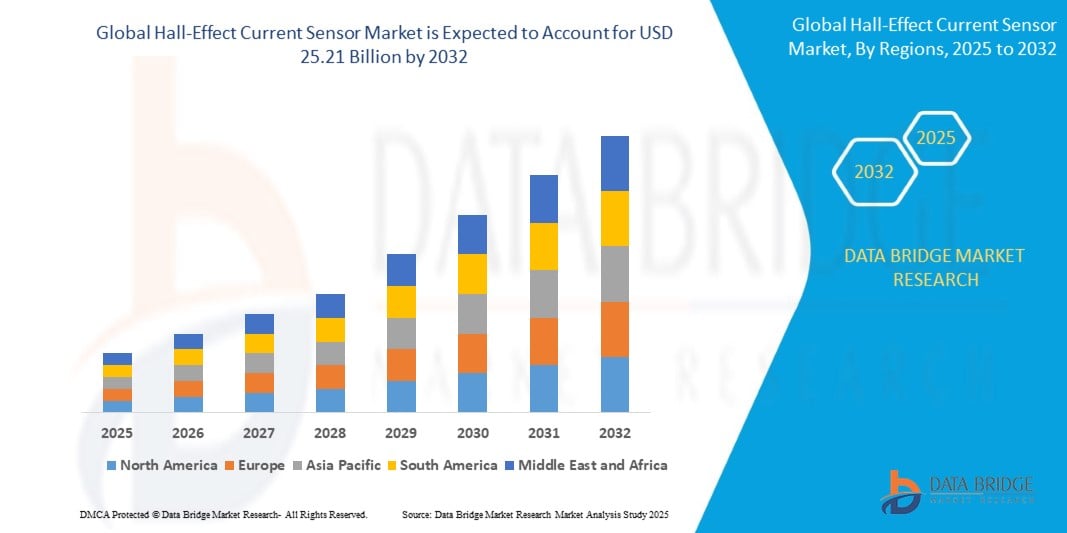
- The global hall-effect current sensor market size was valued at USD 10.62 billion in 2024 and is expected to reach USD 25.21 billion by 2032, at a CAGR of 11.4% during the forecast period
- The market growth is largely fuelled by the increasing adoption of electric vehicles (EVs), renewable energy systems, and industrial automation requiring accurate and efficient current measurement solutions
- Expanding applications in consumer electronics, smart grids, and power management systems further boost demand for contactless, compact, and energy-efficient current sensing technologies
Hall-Effect Current Sensor Market Analysis
- The rise in power electronics and motor control systems across automotive and industrial sectors is significantly driving the adoption of Hall-effect current sensors
- Emerging innovations in sensor packaging and integration, coupled with the demand for miniaturized and robust sensing devices, are expected to sustain the market’s strong momentum over the forecast period
- North America dominated the hall-effect current sensor market with the largest revenue share of 38.74% in 2024, driven by the growing adoption of electric vehicles, industrial automation, and renewable energy infrastructure across the region
- Asia-Pacific region is expected to witness the highest growth rate in the global hall-effect current sensor market, driven by the booming consumer electronics sector, growing investments in electric mobility, and government initiatives supporting clean energy across countries such as China, Japan, and India
- The open-loop current sensor segment accounted for the largest revenue share in 2024, owing to its cost-effectiveness, compact design, and suitability for various low-to-medium accuracy applications. These sensors are widely used in consumer electronics and renewable energy systems due to their energy efficiency and ease of integration with modern circuit designs. Open-loop sensors offer reliable non-contact current measurement and are commonly favored in solar inverters and power supplies for their performance-to-cost ratio
Report Scope and Hall-Effect Current Sensor Market Segmentation
|
Attributes |
Hall-Effect Current Sensor Key Market Insights |
|
Segments Covered |
|
|
Countries Covered |
North America
Europe
Asia-Pacific
Middle East and Africa
South America
|
|
Key Market Players |
|
|
Market Opportunities |
|
|
Value Added Data Infosets |
In addition to the insights on market scenarios such as market value, growth rate, segmentation, geographical coverage, and major players, the market reports curated by the Data Bridge Market Research also include in-depth expert analysis, geographically represented company-wise production and capacity, network layouts of distributors and partners, detailed and updated price trend analysis and deficit analysis of supply chain and demand. |
Hall-Effect Current Sensor Market Trends
“Rising Integration in Renewable Energy Systems”
- Hall-effect sensors are increasingly used in solar panel inverters to provide real-time current monitoring, enabling precise control of energy flow, quick fault detection, and improved inverter efficiency. This results in more stable and optimized solar power generation
- In wind energy systems, Hall-effect sensors monitor electrical current in turbine components to prevent overloads, reduce mechanical stress, and extend the operational life of equipment. This helps enhance reliability in remote and offshore wind farms
- These sensors are also integrated into battery energy storage systems (BESS) for both residential and commercial solar setups. They help balance load distribution, protect against overcurrent, and ensure safer energy storage and consumption
- Government initiatives promoting renewable energy transitions are encouraging the adoption of sensor-enabled technologies for energy monitoring, regulation compliance, and improved system performance in sustainable infrastructure projects
- For instance, companies such as ABB and Siemens utilize Hall-effect current sensors in solar inverters to monitor energy flow, enhance power conversion efficiency, and protect against electrical faults in high-demand solar installations
Hall-Effect Current Sensor Market Dynamics
Driver
“Growth In Electric Vehicles And Charging Infrastructure”
- Hall-effect sensors are integral to electric vehicle (EV) battery management systems, where they monitor current flow to prevent overheating, manage charging cycles, and extend battery lifespan by maintaining optimal operating conditions
- Major EV manufacturers such as Tesla, BYD, and Ford are scaling production rapidly, which drives significant demand for precise and durable current sensing solutions across powertrains, inverters, and battery modules
- EV charging stations—both public and private—rely on real-time current detection to regulate charging speed, detect faults, and avoid power surges. Hall-effect sensors enable safer and more efficient energy distribution in these systems
- The contactless nature of Hall-effect technology eliminates mechanical wear and reduces maintenance, making it highly suitable for the high-duty cycles and long lifespan expected in modern EV systems and infrastructure
- For instance, Tesla uses Hall-effect current sensors within its vehicle powertrains to manage bidirectional energy flow, ensuring proper battery discharge, charging accuracy, and thermal performance during rapid acceleration or regeneration
Restraint/Challenge
“Accuracy Limitations and Temperature Sensitivity”
- Hall-effect sensors are susceptible to performance degradation at extreme temperatures, where thermal drift can affect their output accuracy. This makes them less ideal for environments that demand high-precision under fluctuating thermal conditions
- Electromagnetic interference (EMI) from nearby components, such as motors or high-voltage systems, can disrupt sensor signals and reduce reliability, especially in densely packed electronic or industrial control environments
- Applications in defense, robotics, and industrial automation often require high-precision current sensing for safety and performance, where Hall-effect sensors may not meet the tight tolerances needed for critical operations
- Compensating for these limitations often involves complex and expensive calibration procedures, custom shielding, or temperature compensation circuits, which increase system complexity and implementation cost
- For instance, aerospace companies frequently choose fluxgate or zero-flux current sensors over Hall-effect models due to their superior precision, temperature resilience, and immunity to electromagnetic disturbances
Hall-Effect Current Sensor Market Scope
The market is segmented on the basis of type, technology, output, and end-use industry.
• By Type
On the basis of type, the hall-effect current sensor market is segmented into open-loop current sensor and closed-loop current sensor. The open-loop current sensor segment accounted for the largest revenue share in 2024, owing to its cost-effectiveness, compact design, and suitability for various low-to-medium accuracy applications. These sensors are widely used in consumer electronics and renewable energy systems due to their energy efficiency and ease of integration with modern circuit designs. Open-loop sensors offer reliable non-contact current measurement and are commonly favored in solar inverters and power supplies for their performance-to-cost ratio.
The closed-loop current sensor segment is expected to witness a fastest growth rate from 2025 to 2032, driven by its superior accuracy, linearity, and fast response time. These sensors are ideal for applications requiring high-precision current measurement, such as industrial motor drives, medical equipment, and aerospace systems. Their ability to maintain performance across wide temperature ranges enhances their appeal in mission-critical and high-performance environments.
• By Technology
Based on technology, the market is categorized into BiCMOS and CMOS. The BiCMOS segment led the market in 2024, attributed to its combined advantages of high-speed digital logic and robust analog performance. BiCMOS-based hall-effect sensors are used extensively in automotive and industrial sectors, where both reliability and performance under extreme conditions are crucial. These sensors are valued for their noise immunity and stability in fluctuating power conditions.
The CMOS segment is expected to witness a fastest growth rate from 2025 to 2032, supported by its lower power consumption, reduced cost, and easy integration with compact electronic circuits. As miniaturization continues to trend across consumer electronics and portable medical devices, CMOS hall-effect sensors are increasingly adopted for their energy efficiency and scalability.
• By Output
By output, the market is divided into linear and threshold. The linear output segment dominated the market in 2024 due to its real-time current measurement capabilities, making it suitable for applications requiring continuous monitoring, such as motor controllers, battery management systems, and power inverters. Linear sensors offer precise analog output proportional to current levels, ensuring better control and fault detection.
The threshold output segment is expected to witness a fastest growth rate from 2025 to 2032, fueled by demand in protective circuits and safety systems. These sensors activate when a current exceeds a preset level, making them ideal for overcurrent protection in smart appliances, telecommunications systems, and EV chargers.
• By End-Use Industry
On the basis of end-use industry, the market is segmented into industrial automation, automotive, consumer electronics, telecommunication, utilities, medical, railways, and aerospace & defense. The industrial automation segment held the highest market share in 2024, driven by the rising demand for energy-efficient systems and real-time monitoring across manufacturing processes. Hall-effect sensors in this segment enable seamless machine control and predictive maintenance, improving operational uptime.
The automotive segment is expected to witness a fastest growth rate from 2025 to 2032, due to the proliferation of electric and hybrid vehicles. These sensors are integral to battery management, motor control, and regenerative braking systems. Furthermore, increasing vehicle electrification and smart safety features are accelerating sensor adoption in the global automotive market.
Hall-Effect Current Sensor Market Regional Analysis
- North America dominated the hall-effect current sensor market with the largest revenue share of 38.74% in 2024, driven by the growing adoption of electric vehicles, industrial automation, and renewable energy infrastructure across the region
- Industries in the region are increasingly integrating hall-effect sensors into power monitoring systems, battery management, and current control solutions due to their non-intrusive measurement capability and high accuracy
- The presence of leading automotive manufacturers and technology companies, along with favorable government initiatives to promote green energy and smart grid development, is strengthening the market’s position in both the United States and Canada
U.S. Hall-Effect Current Sensor Market Insight
The U.S. hall-effect current sensor market captured the largest revenue share within North America in 2024, fueled by the expansion of electric vehicle charging infrastructure and the increased demand for precise current measurement in advanced driver assistance systems (ADAS) and battery management systems. The nation’s push for clean energy and industrial modernization further drives sensor integration in solar inverters and motor control systems. For instance, several U.S.-based manufacturers are incorporating hall-effect sensors in smart meters and grid-connected energy storage devices to enable real-time energy flow tracking and improve grid reliability.
Europe Hall-Effect Current Sensor Market Insight
The Europe hall-effect current sensor market is expected to witness a fastest growth rate from 2025 to 2032, supported by stringent energy efficiency regulations and the transition towards electric mobility. With an increasing number of hybrid and electric vehicles and the growth of smart factories, hall-effect sensors are being used for monitoring current in automotive subsystems and industrial automation. Countries such as Germany and France are advancing their clean energy agendas, contributing to the demand for precise and durable sensor technologies in energy and utility sectors.
Germany Hall-Effect Current Sensor Market Insight
The Germany hall-effect current sensor market is expected to witness a fastest growth rate from 2025 to 2032, driven by the nation’s strong presence in automotive innovation, renewable energy projects, and advanced manufacturing. German manufacturers are actively integrating hall-effect sensors in electric drivetrains and solar inverters to ensure system efficiency and safety. The high level of investment in Industry 4.0 technologies is encouraging the use of sensors for real-time data acquisition and monitoring in smart factories, further supporting market growth.
U.K. Hall-Effect Current Sensor Market Insight
The U.K. hall-effect current sensor market is expected to witness a fastest growth rate from 2025 to 2032, driven by the nation’s increasing investment in electric vehicles, smart grid development, and energy-efficient technologies. The country’s strong emphasis on decarbonization and electrification across transport and industrial sectors is prompting the integration of hall-effect sensors into battery systems, motor controllers, and power converters. The rise of smart home and building automation systems is also encouraging the use of current sensors for real-time monitoring and energy optimization. Furthermore, government-backed initiatives such as the zero-emission vehicle mandate and green energy subsidies are supporting the expansion of current sensing technologies in both consumer and commercial applications.
Asia-Pacific Hall-Effect Current Sensor Market Insight
The Asia-Pacific hall-effect current sensor market is expected to witness a fastest growth rate from 2025 to 2032, led by rising industrial automation, electric vehicle adoption, and consumer electronics manufacturing in countries such as China, Japan, South Korea, and India. The region’s expanding EV market, combined with government-backed incentives for clean energy and domestic semiconductor production, is significantly driving sensor demand. Moreover, Asia-Pacific’s role as a global hub for electronics assembly and component manufacturing continues to enhance accessibility and innovation in hall-effect sensor technologies.
China Hall-Effect Current Sensor Market Insight
The China hall-effect current sensor market held the highest revenue share in Asia-Pacific in 2024, supported by the country’s dominance in electric vehicle production and its growing investments in solar energy and 5G infrastructure. Chinese companies are increasingly deploying hall-effect sensors across EV batteries, power electronics, and industrial machinery to improve performance and reliability. As a major supplier and consumer of electronic components, China’s proactive push towards smart manufacturing and digital energy management is expected to sustain robust growth in the sensor market.
Japan Hall-Effect Current Sensor Market Insight
The Japan hall-effect current sensor market is expected to witness a fastest growth rate from 2025 to 2032, due to its advanced automotive and robotics sectors. Japanese manufacturers rely on hall-effect sensors for current measurement in hybrid vehicle powertrains, industrial robots, and energy storage systems. The focus on miniaturization, energy efficiency, and safety is driving sensor innovation across consumer electronics and medical devices. Japan’s leadership in precision engineering and its investments in smart infrastructure are key factors contributing to the consistent expansion of the hall-effect current sensor market.
Hall-Effect Current Sensor Market Share
The Hall-Effect Current Sensor industry is primarily led by well-established companies, including:
- ABB (Switzerland)
- Allegro MicroSystems, Inc. (U.S.)
- Asahi Kasei Microdevices Corporation (Japan)
- Infineon Technologies AG (Germany)
- Honeywell International Inc. (U.S.)
- Digi-Key Electronics (U.S.)
- LEM (Switzerland)
- KOHSHIN ELECTRIC CORPORATION (Japan)
- Melexis (Belgium)
- TDK Corporation (Japan)
- VACUUMSCHMELZE GmbH & Co. KG (Germany)
- American Aerospace Controls (U.S.)
- ELECTROHMS PRIVATE LIMITED (India)
- Magnesensor Technology (U.S.)
- Pulse Electronics (U.S.)
- Aceinna (U.S.)
- Littelfuse, Inc (U.S.)
- OMRON Corporation (Japan)
- Sensitec GmbH (Germany)
- Silicon Laboratories (U.S.)
- TE Connectivity (Switzerland)
- TAMURA Corporation (Japan)
- NVE Corporation (U.S.)
Latest Developments in Global Hall-Effect Current Sensor Market
- In June 2022, Qorvo introduced a 20W GaN-on-SiC power amplifier (QPA1724), targeting defense and commercial satellite applications, including low Earth orbit constellations. This product operates across the 17.3 to 21.2 GHz Ku-K Band and delivers twice the output power of competing solutions. Its compact surface-mount design, combined with superior wideband linear power, gain, and power-added efficiency, enhances system performance. This launch strengthens Qorvo’s position in the satellite communication segment, driving innovation and competitiveness in the RF amplifier market
- In January 2023, NXP Semiconductors announced its ongoing development of GaN-on-silicon technology for mmWave applications. According to RF Systems Engineering Director Geoff Tucker, the company is expanding its portfolio to include a broad range of RF power technologies such as GaN-on-silicon, silicon LDMOS, SiGe, and GaAs. This strategic move aims to meet rising demand for high-performance RF solutions across automotive, telecom, and industrial sectors, potentially accelerating growth and diversification in the global RF power device market

- Interactive Data Analysis Dashboard
- Company Analysis Dashboard for high growth potential opportunities
- Research Analyst Access for customization & queries
- Competitor Analysis with Interactive dashboard
- Latest News, Updates & Trend analysis
- Harness the Power of Benchmark Analysis for Comprehensive Competitor Tracking
Global Hall Effect Current Sensor Market, Supply Chain Analysis and Ecosystem Framework
To support market growth and help clients navigate the impact of geopolitical shifts, DBMR has integrated in-depth supply chain analysis into its Global Hall Effect Current Sensor Market research reports. This addition empowers clients to respond effectively to global changes affecting their industries. The supply chain analysis section includes detailed insights such as Global Hall Effect Current Sensor Market consumption and production by country, price trend analysis, the impact of tariffs and geopolitical developments, and import and export trends by country and HSN code. It also highlights major suppliers with data on production capacity and company profiles, as well as key importers and exporters. In addition to research, DBMR offers specialized supply chain consulting services backed by over a decade of experience, providing solutions like supplier discovery, supplier risk assessment, price trend analysis, impact evaluation of inflation and trade route changes, and comprehensive market trend analysis.
Data collection and base year analysis are done using data collection modules with large sample sizes. The stage includes obtaining market information or related data through various sources and strategies. It includes examining and planning all the data acquired from the past in advance. It likewise envelops the examination of information inconsistencies seen across different information sources. The market data is analysed and estimated using market statistical and coherent models. Also, market share analysis and key trend analysis are the major success factors in the market report. To know more, please request an analyst call or drop down your inquiry.
The key research methodology used by DBMR research team is data triangulation which involves data mining, analysis of the impact of data variables on the market and primary (industry expert) validation. Data models include Vendor Positioning Grid, Market Time Line Analysis, Market Overview and Guide, Company Positioning Grid, Patent Analysis, Pricing Analysis, Company Market Share Analysis, Standards of Measurement, Global versus Regional and Vendor Share Analysis. To know more about the research methodology, drop in an inquiry to speak to our industry experts.
Data Bridge Market Research is a leader in advanced formative research. We take pride in servicing our existing and new customers with data and analysis that match and suits their goal. The report can be customized to include price trend analysis of target brands understanding the market for additional countries (ask for the list of countries), clinical trial results data, literature review, refurbished market and product base analysis. Market analysis of target competitors can be analyzed from technology-based analysis to market portfolio strategies. We can add as many competitors that you require data about in the format and data style you are looking for. Our team of analysts can also provide you data in crude raw excel files pivot tables (Fact book) or can assist you in creating presentations from the data sets available in the report.













