


Becker’s Myotonia Treatment Market Size
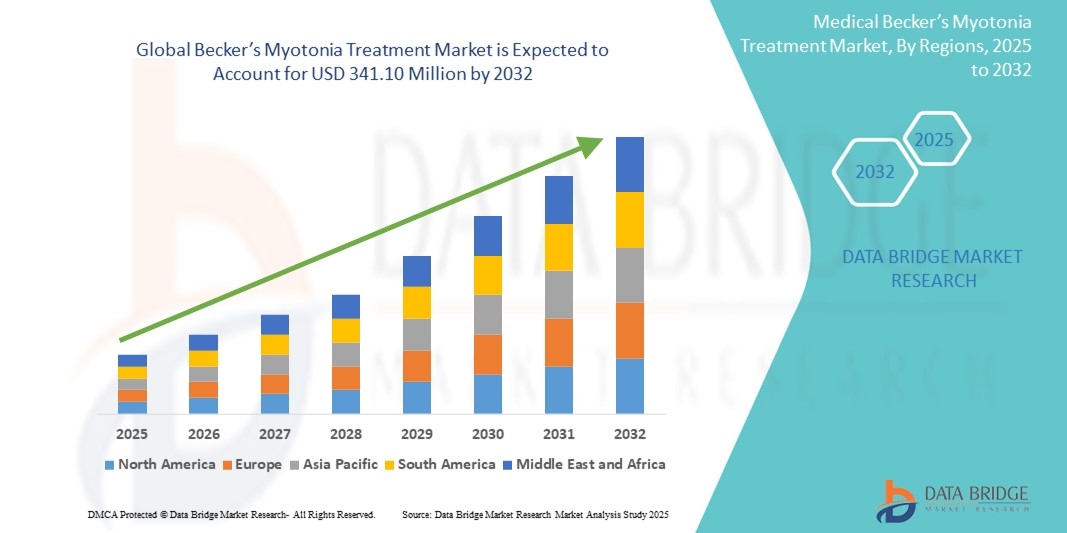
- The global Becker’s myotonia treatment market size was valued at USD 210.17 Million in 2024 and is expected to reach USD 341.10 Million by 2032, at a CAGR of 6.24% during the forecast period
- The market growth is largely fueled by increasing awareness of rare neuromuscular disorders, advancements in genetic testing, and improved clinical understanding of Becker’s Myotonia. This has led to earlier diagnosis and more targeted therapeutic strategies, driving the demand for effective treatment options and diagnostic solutions
- Furthermore, rising investment in orphan drug development and supportive regulatory frameworks such as orphan drug designation by the FDA and EMA are establishing Becker’s Myotonia Treatment as a focal area for rare disease research. These converging factors are accelerating the uptake of Becker’s Myotonia Treatment solutions, thereby significantly boosting the industry's growth
Becker’s Myotonia Treatment Market Analysis
- Becker’s Myotonia, a form of myotonia congenita caused by mutations in the CLCN1 gene, is gaining clinical attention due to advancements in rare disease diagnostics and neuromuscular disorder management. It is increasingly being addressed through improved access to genetic testing, electrophysiological analysis, and patient registries
- The escalating demand for effective treatment and management of Becker’s Myotonia Treatment is primarily driven by the growing awareness of rare neuromuscular disorders, increased funding in orphan drug research, and the inclusion of such diseases in national rare disease policies
- North America dominated the Becker’s myotonia treatment market with the largest revenue share of 40.1% in 2024, due to strong research infrastructure, high diagnosis rates, and the presence of leading academic institutions and biotech firms engaged in neuromuscular disease research. The U.S., in particular, is leading in patient identification and access to experimental therapies under FDA orphan drug programs
- Asia-Pacific is expected to be the fastest-growing region in the Becker’s myotonia treatment market during the forecast period, with a projected CAGR of 10.6%, driven by rising healthcare awareness, improving access to genetic testing in countries such as China and India, and increased investment in rare disease initiatives
- The legs segment dominated the Becker’s myotonia treatment market market with the largest revenue share of 36.2% in 2024, as myotonia symptoms such as stiffness and delayed relaxation are most commonly experienced in the lower limbs, impacting mobility and daily function.
Report Scope and Becker’s Myotonia Treatment Market Segmentation
|
Attributes |
Becker’s Myotonia Treatment Key Market Insights |
|
Segments Covered |
|
|
Countries Covered |
North America
Europe
Asia-Pacific
Middle East and Africa
South America
|
|
Key Market Players |
|
|
Market Opportunities |
|
|
Value Added Data Infosets |
In addition to the insights on market scenarios such as market value, growth rate, segmentation, geographical coverage, and major players, the market reports curated by the Data Bridge Market Research also include in-depth expert analysis, pricing analysis, brand share analysis, consumer survey, demography analysis, supply chain analysis, value chain analysis, raw material/consumables overview, vendor selection criteria, PESTLE Analysis, Porter Analysis, and regulatory framework. |
Becker’s Myotonia Treatment Market Trends
“Increasing Focus on Personalized Therapies and Early Diagnosis”
- A significant and accelerating trend in the global Becker’s Myotonia Treatment Market is the growing focus on personalized treatment approaches and early diagnosis, driven by rising patient awareness and advancements in genetic testing technologies. These developments are allowing healthcare providers to better understand disease variations and tailor treatment plans accordingly
- For instance, leading pharmaceutical and biotech companies are increasingly investing in novel gene-targeted therapies and ion channel modulators that aim to reduce myotonia severity and muscle stiffness. This shift is helping transform the treatment landscape for rare neuromuscular disorders like Becker’s Myotonia
- Personalized therapy approaches also leverage data from next-generation sequencing (NGS) and clinical biomarkers to enhance treatment accuracy and predict disease progression. This helps clinicians proactively manage symptoms and adjust medications to reduce side effects and improve outcomes
- The growing availability of point-of-care diagnostics and improved neurological screening tools is facilitating faster diagnosis, especially in specialized neurology clinics and academic hospitals. Early detection is critical in minimizing long-term disability and improving quality of life for patients
- In addition, pharmaceutical collaborations and rare disease research funding are enabling the development of advanced therapies—including antisense oligonucleotides and CRISPR-based research—targeting the root causes of Becker’s Myotonia. These innovations are expanding the market potential across North America, Europe, and parts of Asia
- The increasing demand for customized, efficient, and well-tolerated treatment solutions is fundamentally reshaping patient and clinician expectations, creating new opportunities for pharmaceutical companies and research institutions in the rare disease treatment space
Becker’s Myotonia Treatment Market Dynamics
Driver
“Increasing Prevalence of Neuromuscular Disorders”
- The increasing prevalence of neuromuscular disorders and heightened awareness of rare genetic conditions are significant drivers behind the demand for Becker’s Myotonia Treatment treatment. Patients suffering from delayed muscle relaxation and stiffness seek more targeted and efficient therapies
- Advances in genetic testing and molecular diagnostics have improved early and accurate diagnosis of Becker’s Myotonia, leading to timely interventions and better management outcomes
- Pharmaceutical companies are focusing on repurposing existing anticonvulsants and muscle relaxants to reduce symptoms such as myotonia and improve quality of life
- Moreover, growing research into chloride channel mutations (specifically in the CLCN1 gene) has prompted interest in personalized and gene-targeted therapies
- The rise in global healthcare expenditure, rare disease funding, and patient support networks has also created a supportive environment for innovation and clinical trials targeting Becker’s Myotonia Treatment
Restraint/Challenge
“Limited Therapeutic Options and Low Awareness in Emerging Markets”
- The Becker’s Myotonia Treatment market faces challenges due to the limited number of approved therapies specifically indicated for this condition. Treatment often relies on off-label use of drugs such as mexiletine and carbamazepine, which may not be universally accessible or effective for all patients.
- In addition, awareness of Becker’s Myotonia Treatment remains low in developing regions, leading to frequent underdiagnosis or misdiagnosis. This results in delayed treatment and worsened clinical outcomes
- The high cost associated with genetic testing and long-term symptom management can also act as a barrier to care, particularly in low-income settings
- Another significant limitation is the lack of large-scale clinical trials due to the rarity of the condition, which slows down drug development and approval processes
- To overcome these barriers, stakeholders must focus on raising global awareness, increasing funding for research, and developing affordable diagnostic and treatment options tailored to underserved populations
Becker’s Myotonia Treatment Market Scope
The Becker’s Myotonia Treatment treatment market is segmented on the basis of muscle affected, drug, drug type, route of administration, population type, end user, and distribution channel.
• By Muscle Affected
On the basis of muscle affected, the Becker’s Myotonia Treatment treatment market is segmented into legs, arms, trunk, face, and others. The legs segment dominated the market with the largest revenue share of 36.2% in 2024, as myotonia symptoms such as stiffness and delayed relaxation are most commonly experienced in the lower limbs, impacting mobility and daily function.
The arms segment is anticipated to witness the fastest CAGR of 8.5% from 2025 to 2032, due to increasing recognition of upper limb disability in day-to-day functionality and early intervention.
• By Drug
On the basis of drug, the Becker’s Myotonia Treatment treatment market is segmented into anticonvulsants, muscle relaxants, calcium channel blockers, and others. The anticonvulsants segment held the largest revenue share of 41.7% in 2024, driven by the effectiveness of mexiletine and other sodium channel blockers in improving muscle relaxation.
The calcium channel blocker segment is expected to grow at the fastest CAGR of 9.3% during the forecast period due to increased clinical research and off-label prescribing trends.
• By Drug Type
On the basis of drug type, the Becker’s Myotonia Treatment treatment market is segmented into branded and generics. The generics segment accounted for a revenue share of 58.9% in 2024, owing to affordability and wide availability.
The branded segment is expected to grow at a fastest CAGR of 7.8% during the forecast period, driven by the introduction of novel formulations and improved tolerability.
• By Route of Administration
On the basis of route of administration, the Becker’s Myotonia Treatment treatment market is segmented into oral and parenteral. The oral segment dominated with the largest market share of 66.4% in 2024, due to convenience and suitability for long-term use.
The parenteral segment is expected to witness the fastest CAGR from 2025 to 2032, particularly in hospital settings for severe or acute cases.
• By Population Type
On the basis of population type, the Becker’s Myotonia Treatment treatment market is segmented into children and adults. The adult segment held the majority share of 71.5% in 2024, as Becker’s Myotonia Treatment commonly manifests in adulthood and persists chronically.
The children segment is expected to witness the fastest CAGR from 2025 to 2032, supported by better early diagnosis and pediatric neurology services.
• By End User
On the basis of end user, the Becker’s Myotonia Treatment treatment market is segmented into hospitals, specialty clinics, ambulatory services, and others. The hospitals segment held the highest revenue share of 44.8% in 2024, attributed to access to diagnostics and specialized treatment.
The specialty clinics segment is expected to witness the fastest CAGR from 2025 to 2032, driven by demand for specialized care and long-term management.
• By Distribution Channel
On the basis of distribution channel, the Becker’s Myotonia Treatment treatment market is segmented into hospital pharmacy, retail pharmacy, online pharmacies, and others. The hospital pharmacy segment accounted for the largest share at 38.5% in 2024, due to direct supply during in-hospital care.
The online pharmacy segment is expected to grow at the fastest CAGR of 10.2%, boosted by convenience, telemedicine growth, and e-prescription models.
Becker’s Myotonia Treatment Market Regional Analysis
- North America dominated the Becker’s myotonia treatment market with the largest revenue share of 40.1% in 2024, driven by robust research infrastructure, favorable reimbursement policies, and early diagnosis supported by high disease awareness
- The strong presence of leading pharmaceutical and biotech companies in the region also contributes to the rapid advancement of genetic therapies and novel drug development for Becker’s Myotonia
- Increasing investment in rare disease research and collaborations between healthcare institutions and regulatory authorities further bolster market growth
U.S. Becker’s Myotonia Treatment Market Insight
The U.S. Becker’s myotonia treatment market accounted for the largest share of 71% of the North America Becker’s Myotonia Treatment market in 2024. This dominance is attributed to strong funding for clinical trials, a growing number of patients undergoing genetic testing, and access to specialized neuromuscular care centers. Moreover, increasing patient advocacy, improved diagnostic techniques, and ongoing development of precision therapies, such as exon skipping and gene-editing strategies, are accelerating market expansion.
Europe Becker’s Myotonia Treatment Market Insight
The Europe Becker’s myotonia treatment market is projected to grow at a substantial CAGR of 10.2% from 2025 to 2032, supported by initiatives promoting rare disease registries and early intervention programs. The region benefits from established healthcare infrastructure, cross-border research programs under the EU’s Horizon framework, and growing accessibility to novel diagnostics. France, Germany, and the U.K. are spearheading therapeutic innovation and personalized treatment pathways in Becker’s Myotonia.
U.K. Becker’s Myotonia Treatment Market Insight
The U.K. Becker’s myotonia treatment market is anticipated to grow at a noteworthy CAGR of 10.2% over the forecast period, driven by increased awareness campaigns, integration of genetic testing in national healthcare, and the availability of early-stage clinical trial opportunities. Strong collaboration between government, biotech startups, and research foundations is facilitating advancements in both symptomatic and disease-modifying treatments.
Germany Becker’s Myotonia Treatment Market Insight
The Germany Becker’s myotonia treatment market is expected to register a CAGR of 9.8% during the forecast period due to a high level of genetic diagnostics adoption, coupled with a strong national focus on orphan diseases. The country’s commitment to funding rare disease research and fostering biotech innovation supports continued developments in RNA-based therapies and patient-specific care protocols.
Asia-Pacific Becker’s Myotonia Treatment Market Insight
The Asia-Pacific Becker’s myotonia treatment market is poised to grow at the fastest CAGR of 10.6% from 2025 to 2032, fueled by expanding diagnostic capabilities, increasing healthcare expenditure, and rising awareness of neuromuscular disorders in countries such as China, Japan, and India. Favorable regulatory reforms and growing clinical trial participation in the region are contributing to improved access to treatment and diagnostics for Becker’s Myotonia.
Japan Becker’s Myotonia Treatment Market Insight
The Japan’s Becker’s myotonia treatment market is witnessing significant momentum, supported by its technologically advanced healthcare infrastructure and increasing inclusion of genetic diseases in national health screening programs. With a CAGR of 12.1%, the country is seeing growing interest in next-generation sequencing, patient support initiatives, and academic-industry collaborations focused on precision therapies.
China Becker’s Myotonia Treatment Market Insight
The China Becker’s myotonia treatment market accounted for the largest market revenue share in the Asia-Pacific region in 2024, representing 38.4% of the APAC market. This leadership is fueled by rising awareness of rare genetic conditions, expanding middle-class healthcare access, and aggressive R&D efforts led by domestic pharmaceutical companies. Moreover, the inclusion of genetic muscular disorders in national insurance schemes and growing investment in gene therapy pipelines are accelerating market growth.
Becker’s Myotonia Treatment Market Share
The Becker’s myotonia treatment industry is primarily led by well-established companies, including:
- Hikma Pharmaceuticals PLC (Jordan)
- Pfizer Inc. (U.S.)
- Bristol-Myers Squibb Company (U.S.)
- Halozyme, Inc. (U.S.)
- Novartis AG (Switzerland)
- Teva Pharmaceutical Industries Ltd. (Israel)
- B.P. Pharma (U.S.)
- Fresenius Kabi AG (Germany)
- Accord Healthcare (U.K.)
- Lilly (U.S.)
- Sanofi (France)
- Bayer AG (Germany)
- Amgen Inc. (U.S.)
Latest Developments in Global Becker’s Myotonia Treatment Market
- In May 2024, Edgewise Therapeutics announced promising Phase II results for Sevasemten (EDG-5506), a selective fast skeletal myosin inhibitor for the treatment of Becker muscular dystrophy. The trial showed reduced muscle damage and stabilization of functional performance in patients, highlighting the drug’s potential as a first-in-class therapy. This development underscores Edgewise’s commitment to transforming treatment landscapes for rare neuromuscular disorders and strengthens its positioning in the evolving Becker’s Myotonia Treatment market
- In April 2024, the TREAT-NMD Neuromuscular Network initiated a new global patient registry expansion for Becker muscular dystrophy and related myotonic disorders. This initiative aims to accelerate clinical trial readiness, enable real-world data generation, and support long-term observational studies. The registry is expected to enhance trial recruitment and foster global collaboration between researchers, patients, and therapeutic developers
- In February 2024, a case report published in the Journal of Neuromuscular Diseases demonstrated the successful use of mexiletine in managing Becker-type myotonia congenita symptoms. The findings emphasize the ongoing role of repurposed medications in improving quality of life for patients with myotonia and highlight the need for wider access to symptomatic treatment options in both developed and emerging markets
- In January 2024, Dyne Therapeutics advanced its DYNE-251 pipeline candidate, initially targeted at Duchenne muscular dystrophy, with preclinical studies suggesting potential application in Becker muscular dystrophy as well. The company is exploring antisense oligonucleotide approaches to modulate dystrophin expression, reinforcing its presence in the neuromuscular therapy space and expanding the scope of Becker’s Myotonia Treatment treatment development

- Interactive Data Analysis Dashboard
- Company Analysis Dashboard for high growth potential opportunities
- Research Analyst Access for customization & queries
- Competitor Analysis with Interactive dashboard
- Latest News, Updates & Trend analysis
- Harness the Power of Benchmark Analysis for Comprehensive Competitor Tracking
Data collection and base year analysis are done using data collection modules with large sample sizes. The stage includes obtaining market information or related data through various sources and strategies. It includes examining and planning all the data acquired from the past in advance. It likewise envelops the examination of information inconsistencies seen across different information sources. The market data is analysed and estimated using market statistical and coherent models. Also, market share analysis and key trend analysis are the major success factors in the market report. To know more, please request an analyst call or drop down your inquiry.
The key research methodology used by DBMR research team is data triangulation which involves data mining, analysis of the impact of data variables on the market and primary (industry expert) validation. Data models include Vendor Positioning Grid, Market Time Line Analysis, Market Overview and Guide, Company Positioning Grid, Patent Analysis, Pricing Analysis, Company Market Share Analysis, Standards of Measurement, Global versus Regional and Vendor Share Analysis. To know more about the research methodology, drop in an inquiry to speak to our industry experts.
Data Bridge Market Research is a leader in advanced formative research. We take pride in servicing our existing and new customers with data and analysis that match and suits their goal. The report can be customized to include price trend analysis of target brands understanding the market for additional countries (ask for the list of countries), clinical trial results data, literature review, refurbished market and product base analysis. Market analysis of target competitors can be analyzed from technology-based analysis to market portfolio strategies. We can add as many competitors that you require data about in the format and data style you are looking for. Our team of analysts can also provide you data in crude raw excel files pivot tables (Fact book) or can assist you in creating presentations from the data sets available in the report.













