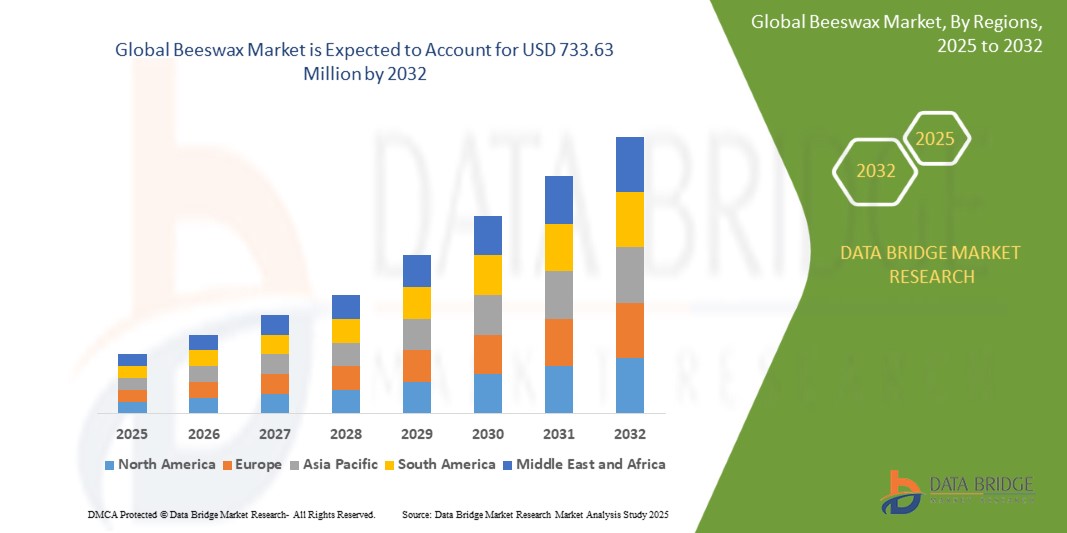
Beeswax Market Size
- The global beeswax market was valued at USD 579.14 million in 2024 and is expected to reach USD 733.63 million by 2032
- During the forecast period of 2025 to 2032 the market is likely to grow at a CAGR of 3.00%, primarily driven by various applications of beeswax in agriculture industry
- This growth is driven by factors such as seed coating & preservation, organic pest control and uses in coating for fruits & vegetables
Beeswax Market Analysis
- Beeswax is a natural secretion produced by wax glands located in the abdomens of worker bees. Its composition, including colour and additional components, varies based on factors such as the bees' geographical location, diet, seasonal changes, and environmental influences. Initially, beeswax is typically white in its pure form but turns yellow upon exposure to honey and pollen
- The beeswax market is expanding due to rising consumer preference for natural and organic products, increasing demand for sustainable packaging, and its growing use in cosmetics, personal care, and pharmaceuticals. As industries shift towards eco-friendly solutions, beeswax is gaining traction as a viable alternative to synthetic wax and petroleum-based products
- The adoption of biodegradable and sustainable materials in food packaging, pharmaceuticals, and personal care is driving demand for beeswax. In addition, the rising focus on organic farming practices has increased its use in agriculture for seed coatings, grafting, and pest control
- For instance, beeswax wraps have emerged as an eco-friendly alternative to plastic food wraps, aligning with global sustainability trends and government regulations against single-use plastics.
- As businesses focus on reducing environmental impact and enhancing product sustainability, the demand for beeswax is expected to rise, positioning it as a key material in the shift towards a greener economy
Report Scope and Beeswax Market Segmentation
|
Attributes |
Beeswax Key Market Insights |
|
Segments Covered |
|
|
Countries Covered |
North America
Europe
Asia-Pacific
Middle East and Africa
South America
|
|
Key Market Players |
|
|
Market Opportunities |
|
|
Value Added Data Infosets |
In addition to the insights on market scenarios such as market value, growth rate, segmentation, geographical coverage, and major players, the market reports curated by the Data Bridge Market Research also include import export analysis, production capacity overview, production consumption analysis, price trend analysis, climate change scenario, supply chain analysis, value chain analysis, raw material/consumables overview, vendor selection criteria, PESTLE Analysis, Porter Analysis, and regulatory framework. |
Beeswax Market Trends
“Growing Use of Beeswax in Organic and Natural Cosmetics”
- One prominent trend in the global beeswax market is the growing use of beeswax in organic and natural cosmetics
- This trend is driven by rising consumer demand for chemical-free skincare, the shift toward sustainable beauty products, and the increasing adoption of beeswax as a natural emulsifier and moisturizer in cosmetics and personal care formulations
- For instance, Burt’s Bees has integrated beeswax into its lip balms and skincare products, leveraging its natural hydrating and protective properties to enhance product appeal and effectiveness
- As consumers and brands prioritize clean beauty, beeswax is being incorporated into a wide range of products, including lip balms, lotions, creams, and makeup, replacing synthetic waxes and petroleum-based ingredients
- This shift is expected to drive innovation in organic cosmetics, expand the adoption of beeswax-based formulations, and contribute to the sustained growth of the market as regulatory bodies and consumers continue to favor natural, eco-friendly alternatives
Beeswax Market Dynamics
Driver
“Increasing Use in Pharmaceuticals & Healthcare”
- The increasing use of beeswax in pharmaceuticals and healthcare is a key driver of growth in the beeswax market. With its natural anti-inflammatory, antimicrobial, and wound-healing properties, beeswax is widely utilized in medicinal ointments, drug formulations, and wound-care products
- Beeswax is also thought to be highly effective in treating burns. Its pharmaceutical use for burn treatment dates back to ancient Egypt, where it served as a key ingredient in numerous ointments and creams
- With healthcare providers and researchers exploring safer and more effective natural remedies, beeswax is increasingly used in burn treatments, wound healing, skin barrier protection, and drug delivery systems due to its biocompatibility and moisture-retaining properties
- The growing demand for natural excipients in pharmaceutical formulations has led to significant investments in beeswax-based medical products, focusing on improving therapeutic efficacy, stability, and controlled drug release
- This includes the development of beeswax-infused wound-care treatments, bioadhesive drug formulations, and herbal medicinal applications that enhance patient outcomes
For instance,
- Researchers have developed beeswax-based bioadhesive films for wound healing, leveraging its natural properties to create dressings that promote moisture retention and protect against infection, leading to faster recovery
- Perrigo Company plc has incorporated beeswax in its topical ointments and medicated balms to enhance texture, stability, and skin barrier protection
- With increasing demand for natural and sustainable pharmaceutical ingredients, the beeswax market is poised for steady growth as manufacturers continue to explore innovative healthcare applications and expand their product offerings to meet evolving consumer and regulatory expectations
Opportunity
“Technological Advancements in Beeswax Processing”
- Technological advancements in beeswax processing present a significant opportunity for market expansion. Innovations in refining techniques, purification methods, and extraction processes are enhancing the quality, consistency, and functionality of pharmaceutical-grade beeswax, making it more suitable for advanced medical and healthcare applications
- Leading manufacturers are developing improved filtration and decolorization processes to produce ultra-pure beeswax with enhanced stability, increased bioavailability, and superior emulsifying properties, expanding its usability in pharmaceuticals, dermatology, and biomedical applications
- New processing technologies are also enabling the development of beeswax-based microencapsulation and nano-formulations, improving controlled-release drug delivery systems and enhancing therapeutic efficacy in pharmaceutical products
For instance,
- Koster Keunen has introduced highly refined and deodorized beeswax for pharmaceutical applications, ensuring compliance with stringent industry standards while maintaining natural functionality
- Strahl & Pitsch has developed advanced filtration techniques that improve the purity and performance of beeswax in medical and cosmetic formulations, making it a preferred choice for pharmaceutical manufacturers
- As demand for natural and high-performance excipients continues to rise, technological innovations in beeswax processing present a major opportunity for manufacturers to expand their product offerings, cater to evolving industry requirements, and strengthen their market presence in the healthcare and pharmaceutical sectors
Restraint/Challenge
“Potential Health Risks of Excessive Beeswax Consumption”
- The excessive consumption of beeswax poses a significant challenge to the beeswax market, particularly in pharmaceutical and food applications where it is used as a coating, stabilizer, or binding agent. While beeswax is generally recognized as safe (GRAS) by regulatory authorities, consuming large quantities may lead to digestive issues and other health concerns
- Beeswax is indigestible by the human body, and excessive intake can cause gastrointestinal discomfort, including bloating, nausea, and intestinal blockages, particularly in individuals with sensitive digestive systems or pre-existing conditions
- There is also a risk of allergic reactions in some individuals, especially those with sensitivities to bee products, leading to potential regulatory scrutiny and consumer hesitancy in certain markets
For instance,
- According to some studies, excessive consumption of beeswax-coated supplements or confections has been reported to cause digestive discomfort, prompting manufacturers to evaluate alternative formulations or adjust dosage recommendations
- As consumer awareness of dietary health risks increases, manufacturers must focus on ensuring proper labeling, dosage guidelines, and education about beeswax consumption to mitigate concerns and maintain trust in its applications across food, pharmaceutical, and nutraceutical markets
Beeswax Market Scope
The market is segmented on the basis of type, product type, and application.
|
Segmentation |
Sub-Segmentation |
|
By Type |
|
|
By Product Type |
|
|
By Application |
|
Beeswax Market Regional Analysis
“North America is the Dominant Region in the Beeswax Market”
- North America dominates the beeswax market, driven by the well-established industries in pharmaceuticals, cosmetics, and personal care products, where natural ingredients such as beeswax are highly valued for their purity and multifunctionality
- The U.S. holds a significant share due to high consumer demand for natural and sustainable products, robust R&D investments, and advanced processing technologies that ensure premium-quality beeswax for various applications
- The region benefits from mature regulatory frameworks and extensive distribution networks, which support steady growth in industries such as healthcare, food preservation, and eco-friendly packaging
- The region benefits from mature regulatory frameworks and extensive distribution networks, which support steady growth in industries such as healthcare, food preservation, and eco-friendly packaging
“Asia-Pacific is Projected to Register the Highest Growth Rate”
- The Asia-Pacific region is expected to witness the highest growth rate in the beeswax market, driven by rapid urbanization, rising disposable incomes, and expanding consumer awareness of natural products
- Countries such as China, India, Japan, and several Southeast Asian nations are experiencing robust growth in sectors such as cosmetics, food processing, and traditional medicine, where beeswax is increasingly utilized for its natural benefits
- The region is witnessing significant investments in modern extraction and processing technologies, coupled with favorable government policies supporting sustainable and organic industries, which are propelling market growth
- In addition, strategic collaborations between local producers and global brands are enhancing product innovation and expanding market reach, positioning Asia-Pacific as the fastest-growing region in the beeswax market
Beeswax Market Share
The market competitive landscape provides details by competitor. Details included are company overview, company financials, revenue generated, market potential, investment in research and development, new market initiatives, global presence, production sites and facilities, production capacities, company strengths and weaknesses, product launch, product width and breadth, application dominance. The above data points provided are only related to the companies' focus related to market.
The Major Market Leaders Operating in the Market Are:
- Heavenly Organics (U.S.)
- Nature Nate's (U.S.)
- Y.S. ORGANIC BEE FARMS (U.S.)
- Manuka Health (New Zealand)
- Barkman Honey, LLC (U.S.)
- Wedderspoon Organic (U.S.)
- Rowse Honey (U.K)
- Hilltop Honey (U.K)
- GloryBee (U.S.)
- Whole Earth Brands, Inc. (U.S.)
- Lamex Food Group Limited (U.K)
- Amish honey (U.S.)
- Little Bee Impex (India)
- Organic Valley (U.S.)
- Waitrose & Partners (U.K)
- United Natural Foods, Inc. (U.S.)
- Conagra Brands, Inc. (U.S.)
- Mondelez International group (U.S.)
- The Kraft Heinz Company (U.S.)
Latest Developments in Global Beeswax Market
- In February 2024, FreeWheel, a global technology leader in television advertising, announced the launch of its new Beeswax Inventory Desk. This innovative offering provides agencies and advertisers using FreeWheel’s Beeswax technology a more streamlined and efficient way to access premium video ad inventory from its publisher clients and other supply partners, covering both connected television and programmatic video streaming. The move is expected to significantly bolster the beeswax market by showcasing the technology's expanding capabilities and driving broader adoption across the advertising ecosystem

- Interactive Data Analysis Dashboard
- Company Analysis Dashboard for high growth potential opportunities
- Research Analyst Access for customization & queries
- Competitor Analysis with Interactive dashboard
- Latest News, Updates & Trend analysis
- Harness the Power of Benchmark Analysis for Comprehensive Competitor Tracking
Data collection and base year analysis are done using data collection modules with large sample sizes. The stage includes obtaining market information or related data through various sources and strategies. It includes examining and planning all the data acquired from the past in advance. It likewise envelops the examination of information inconsistencies seen across different information sources. The market data is analysed and estimated using market statistical and coherent models. Also, market share analysis and key trend analysis are the major success factors in the market report. To know more, please request an analyst call or drop down your inquiry.
The key research methodology used by DBMR research team is data triangulation which involves data mining, analysis of the impact of data variables on the market and primary (industry expert) validation. Data models include Vendor Positioning Grid, Market Time Line Analysis, Market Overview and Guide, Company Positioning Grid, Patent Analysis, Pricing Analysis, Company Market Share Analysis, Standards of Measurement, Global versus Regional and Vendor Share Analysis. To know more about the research methodology, drop in an inquiry to speak to our industry experts.
Data Bridge Market Research is a leader in advanced formative research. We take pride in servicing our existing and new customers with data and analysis that match and suits their goal. The report can be customized to include price trend analysis of target brands understanding the market for additional countries (ask for the list of countries), clinical trial results data, literature review, refurbished market and product base analysis. Market analysis of target competitors can be analyzed from technology-based analysis to market portfolio strategies. We can add as many competitors that you require data about in the format and data style you are looking for. Our team of analysts can also provide you data in crude raw excel files pivot tables (Fact book) or can assist you in creating presentations from the data sets available in the report.