


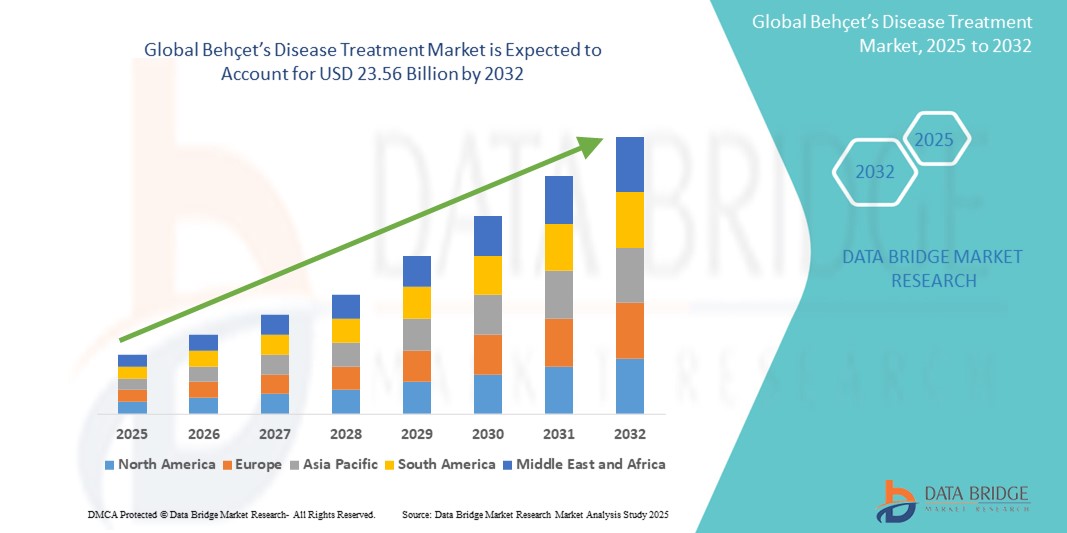
Behçet’s Disease Treatment Market Size
- The global Behçet’s disease treatment market size was valued at USD 14.23 billion in 2024 and is expected to reach USD 23.56 billion by 2032, at a CAGR of 6.50% during the forecast period
- The market growth is primarily driven by increasing awareness and improved diagnostic capabilities, leading to early detection and treatment of Behçet’s disease. In addition, advancements in medical treatments, including the development of novel therapies and biologics, are enhancing patient outcomes and fueling market expansion
- Furthermore, the rising prevalence of Behçet’s disease, particularly in regions such as Asia-Pacific and the Middle East, coupled with increasing healthcare investments and improving access to advanced treatments, is contributing to the market's growth. The introduction of targeted therapies and personalized treatment approaches is also playing a significant role in the market's positive trajectory
Behçet’s Disease Treatment Market Analysis
- Behçet’s disease treatments, involving corticosteroids, immunosuppressive agents, and newer biologics, are increasingly vital components of managing this chronic, multisystemic autoimmune disorder, which affects various organ systems such as the eyes, skin, blood vessels, and nervous system, due to their ability to control inflammation, reduce flare-ups, and improve patient quality of life
- The escalating demand for Behçet’s disease treatment is primarily fueled by the rising prevalence of autoimmune and rare diseases, growing awareness among healthcare professionals and patients, and continuous advancements in targeted biologic therapies that offer more effective and personalized treatment options
- North America dominates the Behçet’s disease treatment market with the largest revenue share of 40.5% in 2024, characterized by a well-established healthcare infrastructure, high awareness and diagnosis rates, and a strong presence of leading pharmaceutical companies investing in rare disease research and innovative treatment options
- Asia-Pacific is expected to be the fastest growing region in the Behçet’s disease treatment market during the forecast period due to increasing awareness, rising healthcare investments, expanding access to medical services, and a higher disease prevalence particularly across countries along the ancient Silk Road, such as Turkey, Iran, Japan, and China
- Corticosteroids segment dominates the Behçet’s disease treatment market with a market share of 45.5% in 2024, driven by its established role as the primary treatment option to manage acute symptoms and inflammation, combined with its widespread availability, cost-effectiveness, and adaptability to both oral and injectable forms suitable for various clinical settings
Report Scope and Behçet’s Disease Treatment Market Segmentation
|
Attributes |
Behçet’s Disease Treatment Key Market Insights |
|
Segments Covered |
|
|
Countries Covered |
North America
Europe
Asia-Pacific
Middle East and Africa
South America
|
|
Key Market Players |
|
|
Market Opportunities |
|
|
Value Added Data Infosets |
In addition to the insights on market scenarios such as market value, growth rate, segmentation, geographical coverage, and major players, the market reports curated by the Data Bridge Market Research also include in-depth expert analysis, pricing analysis, brand share analysis, consumer survey, demography analysis, supply chain analysis, value chain analysis, raw material/consumables overview, vendor selection criteria, PESTLE Analysis, Porter Analysis, and regulatory framework. |
Behçet’s Disease Treatment Market Trends
“Advancement in Targeted Biologics and Personalized Therapies”
- A significant and accelerating trend in the global Behçet’s disease treatment market is the shift toward targeted biologics and personalized therapeutic approaches, aiming to improve disease management and reduce side effects compared to conventional treatments. This evolution in treatment methodology is transforming patient outcomes and expanding options for long-term disease control
- For instance, Apremilast (a phosphodiesterase 4 inhibitor) has emerged as a novel targeted therapy, receiving FDA approval specifically for oral ulcers associated with Behçet’s disease, offering patients a well-tolerated and effective oral option. Similarly, biologic agents such as Interleukin-1β blockers and TNF-α inhibitors are increasingly being used to manage refractory and severe cases with more precision
- The integration of personalized medicine principles into Behçet’s disease treatment is enabling healthcare providers to tailor therapies based on patient-specific disease manifestations, genetic profiles, and treatment response, which not only enhances clinical efficacy but also minimizes adverse effects. Clinical trials and research are focusing on stratifying patients to match them with the most suitable biologic or immunosuppressive therapy, paving the way for more individualized treatment plans
- The adoption of biologics and personalized therapies is further supported by improvements in diagnostic techniques and growing awareness among healthcare professionals, allowing earlier intervention and more effective disease control. Pharmaceutical companies are expanding R&D investments into rare autoimmune diseases, further accelerating innovation in this field
- The demand for advanced and targeted Behçet’s disease therapies is growing rapidly across both developed and emerging healthcare markets, as patients and clinicians increasingly prioritize efficacy, safety, and quality of life. This has led to a surge in clinical pipeline activity and regulatory approvals, with more biologic agents expected to enter the market in the coming years
Behçet’s Disease Treatment Market Dynamics
Driver
“Rising Awareness, Early Diagnosis, and Expansion of Targeted Therapies”
- The increasing global awareness of Behçet’s disease and improvements in early diagnosis are significant drivers contributing to the rising demand for advanced treatment solutions. Enhanced disease recognition among healthcare providers and patients has led to more timely interventions and increased utilization of therapeutic options
- For instance, several national and international health bodies, such as the American Behçet’s Disease Association (ABDA) and Rare Diseases Europe (EURORDIS), are actively working to improve patient education, diagnosis, and access to specialized care. These initiatives are helping reduce diagnostic delays, which have historically hindered effective treatment and management
- As the medical community gains a deeper understanding of the pathophysiology of Behçet’s disease, targeted therapies such as TNF-α inhibitors and interleukin inhibitors are increasingly being adopted. These biologics provide more precise disease control, particularly in severe or refractory cases, and are establishing new standards in clinical care
- Furthermore, the growing emphasis on personalized medicine and tailored treatment approaches is driving pharmaceutical innovation. Companies are actively investing in R&D to develop more effective, targeted therapies that minimize systemic side effects and offer improved quality of life for patients
- The expansion of healthcare infrastructure, especially in emerging markets, is also contributing to increased access to diagnostic services and biologic treatments. Government-led rare disease frameworks, combined with rising patient advocacy efforts, are creating a supportive environment for therapeutic advancement and market growth
- Overall, the combination of heightened awareness, better diagnostic tools, and the expanding therapeutic arsenal is significantly propelling the Behçet’s disease treatment market forward, offering hope for more effective and individualized patient care globally
Restraint/Challenge
“Limited Awareness in Developing Regions and High Cost of Biologic Therapies”
- A major challenge restraining the growth of the Behçet’s disease treatment market is the limited awareness and delayed diagnosis in many developing and under-resourced regions. Despite its potentially debilitating effects, Behçet’s disease remains underdiagnosed due to its complex, multisystemic symptoms and lack of disease-specific diagnostic tests, leading to delayed treatment initiation and suboptimal outcomes
- For instance, in low-to-middle income countries across parts of Africa, Latin America, and South Asia, there is often a lack of trained specialists and inadequate infrastructure to support early and accurate diagnosis. This contributes to patient mismanagement and underreporting of actual disease prevalence, ultimately hampering market expansion in these regions
- In addition, the high cost of biologic therapies—such as TNF-α inhibitors and interleukin blockers—presents a significant barrier to access, especially for patients without comprehensive insurance or reimbursement coverage. These advanced therapies, while effective, are often priced beyond the reach of many healthcare systems and individual patients, limiting their widespread adoption
- The affordability challenge is further intensified by the chronic nature of Behçet’s disease, which may require long-term or lifelong treatment, thereby increasing the economic burden on patients and healthcare providers asuch as. While generic immunosuppressants and corticosteroids are available at lower costs, they may not be sufficient for patients with severe or refractory forms of the disease
- Overcoming these challenges will require a multi-pronged approach involving increased global awareness campaigns, training for healthcare professionals, improved diagnostic tools, and policy initiatives aimed at expanding insurance coverage and reducing the cost of biologic treatments through biosimilars or government subsidy programs. Addressing these key issues will be essential for enhancing treatment accessibility and supporting sustainable market growth
Behçet’s Disease Treatment Market Scope
The market is segmented on the basis of type, treatment, route of administration, and end users.
- By Type
On the basis of type, the Behçet’s disease treatment market is segmented into Neuro-Behcet, Ocular-Behcet, and Vasculo-Behcet. The Neuro-Behcet segment dominated the largest market revenue share in 2024, driven by the severe neurological manifestations that require aggressive and long-term management. Patients with Neuro-Behcet often need combination therapies including immunosuppressants and biologics, which contribute to higher treatment costs and market demand.
The Ocular-Behcet segment is anticipated to witness strong growth during the forecast period, due to the risk of vision loss and increasing adoption of advanced immunomodulators and biologics to prevent ocular complications. Vasculo-Behcet, while less prevalent, requires specialized vascular interventions alongside drug therapy, supporting steady market growth.
- By Treatment
On the basis of treatment, the market is segmented into corticosteroids, immunosuppressive agents, immunomodulators, phosphodiesterase 4 (PDE4) inhibitors, interleukin-1β blockers, and others. The corticosteroids segment held the largest market revenue share of 45.5% in 2024, owing to its established role as the first-line therapy to rapidly control inflammation and acute flare-ups. Immunosuppressive agents and immunomodulators are also significant contributors, driven by their use in moderate to severe cases to maintain long-term remission.
The PDE4 inhibitor segment, led by Apremilast, is expected to witness the fastest growth during the forecast period due to its novel mechanism of action, favorable safety profile, and recent regulatory approvals. Interleukin-1β blockers are gaining traction in refractory cases, supporting niche market expansion.
- By Route Of Administration
On the basis of route of administration, the Behçet’s disease treatment market is segmented into oral and injectable therapies. The oral segment dominates the market share in 2024, largely because oral corticosteroids and PDE4 inhibitors offer convenient administration for chronic management.
Injectable therapies segment is expected to witness the fastest CAGR from 2025 to 2032, fueled by increasing use in severe or resistant cases, and by improvements in drug delivery technologies reducing injection frequency and improving patient compliance.
- By End Users
On the basis of end users, the market is segmented into hospitals, homecare, specialty clinics, and others. Hospitals segment held the largest revenue share in 2024, driven by their role in diagnosing and managing complex Behçet’s disease cases requiring multidisciplinary care and advanced treatment protocols.
Specialty clinics focused on autoimmune and rare diseases are experiencing fast growth during forecast period, due to their expertise in administering biologic therapies and personalized patient management. The homecare segment is emerging steadily, supported by advances in self-administered injectable treatments and remote patient monitoring technologies, enhancing treatment accessibility and convenience for chronic patients
Behçet’s Disease Treatment Market Regional Analysis
- North America dominates the Behçet’s disease treatment market with the largest revenue share of 40.5% in 2024, driven by a well-established healthcare infrastructure, high awareness and diagnosis rates, and a strong presence of leading pharmaceutical companies investing in rare disease research and innovative treatment options
- Patients and healthcare providers in the region highly value early diagnosis, access to advanced biologic therapies, and personalized treatment approaches that improve patient outcomes and quality of life
- This widespread adoption is further supported by strong government support for rare diseases, favorable reimbursement policies, and the presence of key pharmaceutical players actively investing in R&D, establishing North America as a preferred market for Behçet’s disease treatment in both hospital and specialty clinic settings
U.S. Behçet’s Disease Treatment Market Insight
The U.S. Behçet’s disease treatment market captured the largest revenue share in 2024 within North America, fueled by the presence of advanced healthcare systems, high disease awareness, and early diagnosis capabilities. Patients are increasingly seeking specialized treatment regimens, including biologics and immunosuppressants, as part of comprehensive disease management. The strong focus on rare disease research, supported by government funding and pharmaceutical investment, further propels market growth. Moreover, the widespread availability of expert rheumatologists and immunologists, along with increasing clinical trial activity, significantly contributes to the expansion of the U.S. market.
Europe Behçet’s Disease Treatment Market Insight
The Europe Behçet’s disease treatment market is projected to expand at a substantial CAGR throughout the forecast period, primarily driven by rising awareness of autoimmune and autoinflammatory disorders and increasing availability of innovative treatment options. The prevalence of Behçet’s disease in Mediterranean and Eastern European populations contributes to sustained demand. European healthcare systems are increasingly offering access to advanced biologics and specialized care, with ongoing clinical studies and improved diagnostic protocols further supporting market expansion across both Western and Eastern Europe.
U.K. Behçet’s Disease Treatment Market Insight
The U.K. Behçet’s disease treatment market is anticipated to grow at a noteworthy CAGR during the forecast period, driven by heightened awareness among healthcare providers and patients, alongside strong support from the National Health Service (NHS) for rare disease initiatives. The increasing focus on precision medicine and personalized biologic therapies is improving treatment outcomes. In addition, the establishment of specialized Behçet’s centers and research collaborations within the U.K. are expected to further stimulate market growth.
Germany Behçet’s Disease Treatment Market Insight
The Germany Behçet’s disease treatment market is expected to expand at a considerable CAGR during the forecast period, fueled by the country’s emphasis on innovative treatment solutions and strong reimbursement infrastructure. Germany’s highly developed healthcare ecosystem and commitment to rare disease management contribute to the early diagnosis and effective treatment of Behçet’s disease. The market also benefits from increased pharmaceutical R&D, growing use of targeted immunotherapies, and integration of digital health tools for ongoing patient monitoring and disease tracking.
Asia-Pacific Behçet’s Disease Treatment Market Insight
The Asia-Pacific Behçet’s disease treatment market is poised to grow at the fastest CAGR during the forecast period of 2025 to 2032, driven by high disease prevalence in countries along the ancient Silk Road, such as Turkey, Iran, China, and Japan. Rising healthcare access, expanding middle-class populations, and increased investments in rare disease research are boosting the demand for effective therapies. Moreover, ongoing government efforts to improve diagnostic capabilities and expand access to specialty treatments are further accelerating market growth across the region
Japan Behçet’s Disease Treatment Market Insight
The Japan Behçet’s disease treatment market is gaining momentum due to the country’s relatively high prevalence of the condition and its mature healthcare infrastructure. Japan has established itself as a leader in Behçet’s disease research, offering advanced diagnostic tools and targeted treatment options, including interleukin inhibitors and immunosuppressants. The integration of novel therapies and the country’s focus on early-stage diagnosis and continuous care management are fueling growth, with particular emphasis on outpatient and specialty clinic-based treatments.
India Behçet’s Disease Treatment Market Insight
The India Behçet’s disease treatment market accounted for the largest market revenue share in Asia Pacific in 2024, attributed to increasing disease awareness, growing healthcare access, and expanding diagnostic services across urban centers. India’s rising middle-class population and significant investments in specialty hospitals and clinical research are enhancing treatment availability. The presence of domestic pharmaceutical manufacturers offering cost-effective therapies, along with the growth of rheumatology and immunology departments, are key factors driving the market’s upward trajectory in India
Behçet’s Disease Treatment Market Share
The Behçet’s disease treatment industry is primarily led by well-established companies, including:
- Eisai Co., Ltd. (Japan)
- Abbvie Inc. (U.S.)
- Xoma Royalty Corporation (U.S.)
- Mitsubishi Tanabe Pharma Corporation (Japan)
- Amneal Pharmaceuticals LLC (U.S.)
- Annora Pharma Pvt. Limited (India)
- Novartis AG (Switzerland)
- Pfizer Inc. (U.S.)
- Celltrion Inc. (South Korea)
- F. Hoffmann-La Roche Ltd. (Switzerland)
- Takeda Pharmaceutical Company Limited. (Japan)
- Abbott (U.S.)
- Les Laboratoires Servier (France)
- Panacea Biotec (India)
- Coherus Biosciences (U.S.)
- Lupin (U.S.)
- Bausch + Lomb Corporation (Canada)
- Regeneron Pharmaceuticals, Inc. (U.S.)
- Sun Pharmaceutical Industries Ltd. (India)
Latest Developments in Global Behçet’s Disease Treatment Market
- In November 2024, Soligenix announced the initiation of a Phase 2 clinical trial (DUS-AUBD-01) for SGX945 (dusquetide) in the treatment of aphthous ulcers in Behçet's Disease. This open-label study aims to enroll approximately 25 patients with mild to moderate BD and active oral and/or genital ulcers, with results anticipated in the first half of 2025
- In October 2022, Pfizer finalized its acquisition of Global Blood Therapeutics (GBT) for USD 5.4 billion, enhancing its portfolio in rare hematology. GBT's expertise in sickle cell disease, including its lead drug Oxbryta, strengthens Pfizer's commitment to addressing underserved patient populations
- In June 2022, Amgen announced the progression of its Phase 3 clinical trials for apremilast in pediatric patients aged 6–17 with active oral ulcers associated with Behçet’s disease. The study is expected to conclude by 2029, potentially offering a new treatment option for this patient group
- In December 2021, Novartis announced the acquisition of Gyroscope Therapeutics, a UK-based company specializing in ocular gene therapy. This acquisition, valued at up to USD 1.5 billion, adds Gyroscope's lead program, GT005, a one-time gene therapy for geographic atrophy, to Novartis' portfolio

- Interactive Data Analysis Dashboard
- Company Analysis Dashboard for high growth potential opportunities
- Research Analyst Access for customization & queries
- Competitor Analysis with Interactive dashboard
- Latest News, Updates & Trend analysis
- Harness the Power of Benchmark Analysis for Comprehensive Competitor Tracking
Data collection and base year analysis are done using data collection modules with large sample sizes. The stage includes obtaining market information or related data through various sources and strategies. It includes examining and planning all the data acquired from the past in advance. It likewise envelops the examination of information inconsistencies seen across different information sources. The market data is analysed and estimated using market statistical and coherent models. Also, market share analysis and key trend analysis are the major success factors in the market report. To know more, please request an analyst call or drop down your inquiry.
The key research methodology used by DBMR research team is data triangulation which involves data mining, analysis of the impact of data variables on the market and primary (industry expert) validation. Data models include Vendor Positioning Grid, Market Time Line Analysis, Market Overview and Guide, Company Positioning Grid, Patent Analysis, Pricing Analysis, Company Market Share Analysis, Standards of Measurement, Global versus Regional and Vendor Share Analysis. To know more about the research methodology, drop in an inquiry to speak to our industry experts.
Data Bridge Market Research is a leader in advanced formative research. We take pride in servicing our existing and new customers with data and analysis that match and suits their goal. The report can be customized to include price trend analysis of target brands understanding the market for additional countries (ask for the list of countries), clinical trial results data, literature review, refurbished market and product base analysis. Market analysis of target competitors can be analyzed from technology-based analysis to market portfolio strategies. We can add as many competitors that you require data about in the format and data style you are looking for. Our team of analysts can also provide you data in crude raw excel files pivot tables (Fact book) or can assist you in creating presentations from the data sets available in the report.












