What is the Global Bicycle Helmet Market Size and Growth Rate?
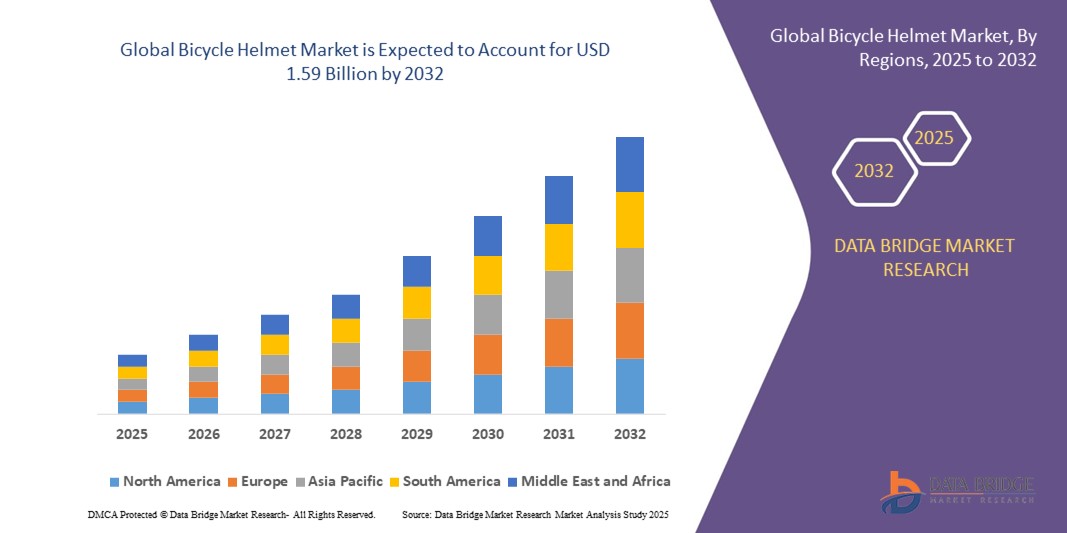
- The global bicycle helmet market size was valued at USD 1.06 billion in 2024 and is expected to reach USD 1.59 billion by 2032, at a CAGR of 5.20% during the forecast period
- The bicycle helmet market is experiencing consistent growth worldwide, due to a growing emphasis on safety among cyclists and the growing trend of cycling for leisure and physical fitness
- The increase in urbanization and efforts to promote cycling infrastructure in different areas also play a role in the market's expansion. Innovations in helmet design, including lighter materials, improved ventilation, and better impact protection, are catching the attention of consumers and encouraging adoption. In addition, the proliferation of online retail platforms makes it easier for consumers to find a wide selection of helmets to suit their preferences and budgets
What are the Major Takeaways of Bicycle Helmet Market?
- Growing awareness about road safety, particularly among cyclists, is a significant driver for the global bicycle helmet market. Governments and non-profit organizations are actively promoting the use of helmets to reduce the risk of head injuries in cycling accidents. This heightened consciousness is driving the demand for bicycle helmets globally as consumers prioritize safety equipment during their cycling endeavors
- North America dominated the bicycle helmet market with the largest revenue share of 36.81% in 2024, driven by high awareness of safety standards, the growing cycling culture, and increasing adoption of advanced helmet technologies
- Asia-Pacific bicycle helmet market is poised to grow at the fastest CAGR of 8.47% during the forecast period from 2025 to 2032, driven by increasing urbanization, rising disposable incomes, and the growing popularity of cycling as a fitness and commuting option
- The Road Helmets segment dominated the market with the largest revenue share of 42% in 2024, driven by their lightweight design, aerodynamic features, and popularity among professional and recreational cyclists
Report Scope and Bicycle Helmet Market Segmentation
|
Attributes |
Bicycle Helmet Key Market Insights |
|
Segments Covered |
|
|
Countries Covered |
North America
Europe
Asia-Pacific
Middle East and Africa
South America
|
|
Key Market Players |
|
|
Market Opportunities |
|
|
Value Added Data Infosets |
In addition to the insights on market scenarios such as market value, growth rate, segmentation, geographical coverage, and major players, the market reports curated by the Data Bridge Market Research also include in-depth expert analysis, pricing analysis, brand share analysis, consumer survey, demography analysis, supply chain analysis, value chain analysis, raw material/consumables overview, vendor selection criteria, PESTLE Analysis, Porter Analysis, and regulatory framework. |
What is the Key Trend in the Bicycle Helmet Market?
Smart and Connected Bicycle Helmets with Integrated Safety Features
-
A significant and accelerating trend in the global bicycle helmet market is the integration of smart technologies, including sensors, Bluetooth connectivity, and AI-driven safety features, enhancing user convenience and protection during rides
- For instance, helmets such as Lumos Matrix offer integrated turn signals, brake lights, and automatic lighting adjustments, improving rider visibility and safety in urban traffic conditions. Similarly, Livall helmets incorporate fall detection and SOS alert systems, providing immediate assistance during accidents
- AI and sensor integration in bicycle helmets allows monitoring of rider behavior, real-time accident detection, and automated alerts to emergency contacts. These helmets can track cycling patterns, optimize safety features, and provide actionable insights for safer riding
- The seamless connectivity of smart helmets with mobile apps and wearable devices enables centralized monitoring, ride analytics, and interaction with navigation tools, creating a more intuitive and safer riding experience
- This trend toward intelligent, safety-focused, and connected helmets is reshaping rider expectations, encouraging companies such as LEXI and Coros to develop helmets with adaptive lighting, voice alerts, and connectivity to fitness and navigation apps
- The demand for Bicycle Helmets with smart safety features and connected capabilities is growing rapidly across urban commuters, professional cyclists, and recreational riders, as consumers increasingly prioritize convenience, protection, and data-driven insights
What are the Key Drivers of Bicycle Helmet Market?
- The growing focus on rider safety and increasing awareness about traffic-related accidents are significant drivers for the heightened demand for smart bicycle helmets
- For instance, in March 2024, Livall launched its next-generation connected helmet featuring SOS alerts, fall detection, and ride-tracking capabilities, reflecting the industry's focus on rider protection and connectivity
- Consumers are increasingly seeking helmets that go beyond standard protection, offering integrated lighting, navigation aids, and communication systems to enhance cycling safety and convenience
- Rising popularity of e-bikes, urban commuting, and recreational cycling is further pushing demand for helmets with advanced technologies that support connectivity and safety monitoring
- Features such as Bluetooth communication, integrated cameras, and mobile app connectivity enable hands-free navigation, social sharing of rides, and improved accident response, driving adoption among tech-savvy cyclists
- The increasing availability of user-friendly smart helmets with customizable designs, multiple safety features, and compatibility with mobile apps supports market growth across both professional and casual cycling segments
Which Factor is Challenging the Growth of the Bicycle Helmet Market?
- Concerns regarding device reliability, battery life, and potential cybersecurity vulnerabilities of connected helmets pose challenges to broader adoption. Smart Bicycle Helmets rely on sensors, connectivity, and apps, making them susceptible to technical issues or unauthorized access
- For instance, reported cases of Bluetooth connectivity issues and app malfunctions in some helmets have led to consumer hesitation in adopting advanced helmets over traditional models
- High initial costs of smart helmets compared to conventional helmets can be a barrier, particularly for price-sensitive or casual cyclists. Premium features such as integrated cameras, lights, or AI safety systems often command higher prices
- While prices are gradually decreasing, the perceived premium for smart technology can still limit adoption among users who do not immediately value the additional features
- Addressing these challenges through improved device reliability, cybersecurity, extended battery life, and cost-effective solutions is essential for sustained growth in the Bicycle Helmet market
How is the Bicycle Helmet Market Segmented?
The market is segmented on the basis of type, communication protocol, unlocking mechanism, and application.
- By Type
On the basis of type, the bicycle helmet market is segmented into Road Helmets, Sports Helmets, MTB Helmets, Mountain, Commuter, Skate, BMX, and Downhill Racing. The Road Helmets segment dominated the market with the largest revenue share of 42% in 2024, driven by their lightweight design, aerodynamic features, and popularity among professional and recreational cyclists. Road Helmets are highly sought after due to their comfort, ventilation, and safety certifications, making them a preferred choice for long-distance cycling and competitive events.
The MTB Helmets segment is expected to witness the fastest CAGR of 19% from 2025 to 2032, fueled by the rising popularity of mountain biking and off-road cycling sports. Enhanced features such as advanced impact protection, integrated visors, and compatibility with action cameras contribute to their adoption, especially among adventure enthusiasts and sports-focused riders.
- By Application
On the basis of application, the bicycle helmet market is segmented into Sports/Adventure, Daily Transportation, and Recreational Mountain. The Sports/Adventure segment held the largest market revenue share of 47% in 2024, supported by the increasing participation in competitive cycling events, triathlons, and outdoor adventure activities. Helmets in this segment often feature premium safety certifications, advanced ventilation, and lightweight construction, making them ideal for performance-driven users.
The Daily Transportation segment is expected to witness the fastest CAGR of 18% from 2025 to 2032, driven by the growing trend of eco-friendly commuting in urban areas, rising adoption of e-bikes, and increasing government initiatives promoting cycling for daily transport. Helmets for daily use emphasize comfort, visibility, and ease of use to encourage consistent rider adoption.
- By Distribution Channel
On the basis of distribution channel, the bicycle helmet market is segmented into Online and Offline. The Offline segment dominated the market with a 55% revenue share in 2024, owing to the ability of consumers to physically examine helmet fit, style, and safety features before purchase. Specialty sports stores and retail outlets remain popular for their wide selection and expert guidance.
The Online segment is expected to witness the fastest CAGR of 20% from 2025 to 2032, driven by the increasing penetration of e-commerce platforms, ease of doorstep delivery, and availability of diverse helmet models with customer reviews. Online channels also benefit from attractive discounts, customization options, and integrated virtual fitting tools that enhance the consumer shopping experience.
- By End User
On the basis of end user, the bicycle helmet market is segmented into Men, Women, and Child. The Men’s segment held the largest market revenue share of 50% in 2024, reflecting higher participation rates in cycling, sports, and adventure activities among male consumers. Helmets in this segment often prioritize performance, safety, and style to cater to competitive and recreational riders.
The Child segment is expected to witness the fastest CAGR of 21% from 2025 to 2032, driven by increasing awareness among parents about child safety, rising adoption of cycling among children for recreation, and the launch of colorful, lightweight helmets designed specifically for younger users. Safety features such as impact resistance, adjustable sizing, and fun designs are boosting adoption in this segment.
Which Region Holds the Largest Share of the Bicycle Helmet Market?
- North America dominated the bicycle helmet market with the largest revenue share of 36.81% in 2024, driven by high awareness of safety standards, the growing cycling culture, and increasing adoption of advanced helmet technologies
- Consumers in the region prioritize features such as impact protection, ventilation, aerodynamic designs, and smart helmet integrations such as Bluetooth and connectivity with cycling apps
- This adoption is further supported by high disposable incomes, strong sports and outdoor activity trends, and a technologically inclined population, establishing Bicycle Helmets as a preferred choice for recreational, sports, and professional cyclists
U.S. Bicycle Helmet Market Insight
U.S. bicycle helmet market captured the largest revenue share of 81% in 2024 within North America, driven by a strong cycling culture, adoption of smart helmets, and government initiatives promoting cycling safety. Consumers are increasingly prioritizing helmets with advanced safety features, comfort, and integrated technology for navigation and communication. The demand for online and offline purchase options, along with awareness campaigns about head injury prevention, further propels the market growth.
Europe Bicycle Helmet Market Insight
Europe bicycle helmet market is projected to grow at a substantial CAGR during the forecast period, driven by stringent safety regulations, increased urban cycling, and growing adoption of electric bicycles. Helmets offering lightweight construction, enhanced ventilation, and stylish designs are in demand. Countries such as Germany, France, and the U.K. are witnessing strong adoption in both recreational and professional cycling segments, supported by organized cycling events and campaigns promoting bicycle safety.
U.K. Bicycle Helmet Market Insight
U.K. bicycle helmet market is expected to expand steadily during the forecast period, driven by rising awareness of cycling safety and government incentives for cycling adoption. Consumers increasingly prefer helmets with certifications, visibility enhancements, and comfort features. The growth of urban cycling infrastructure, e-commerce availability, and cycling events further encourage market expansion in the region.
Germany Bicycle Helmet Market Insight
Germany bicycle helmet market is anticipated to grow at a notable CAGR, fueled by strong regulatory support for cycling safety and increasing environmental consciousness. Helmets integrating safety certifications, modern designs, and eco-friendly materials are gaining popularity. The trend toward electric bicycles and smart mobility solutions is further enhancing adoption among both urban commuters and sports enthusiasts.
Which Region is the Fastest Growing Region in the Bicycle Helmet Market?
Asia-Pacific bicycle helmet market is poised to grow at the fastest CAGR of 8.47% during the forecast period from 2025 to 2032, driven by increasing urbanization, rising disposable incomes, and the growing popularity of cycling as a fitness and commuting option. Government initiatives promoting sustainable transport, coupled with smart city projects, are boosting helmet adoption.
Japan Bicycle Helmet Market Insight
Japan bicycle helmet market is expanding rapidly due to high-tech adoption, urban cycling culture, and safety-conscious consumers. Helmets with smart features, ergonomic designs, and connectivity options are gaining traction. The aging population and focus on recreational cycling further enhance market potential.
China Bicycle Helmet Market Insight
China bicycle helmet market accounted for the largest revenue share in Asia-Pacific in 2024, fueled by rising awareness about cycling safety, growing urban middle class, and adoption of e-bikes. The presence of domestic manufacturers offering affordable and technologically advanced helmets is driving widespread adoption across urban and suburban areas, making China a key market in the region.
Which are the Top Companies in Bicycle Helmet Market?
The bicycle helmet industry is primarily led by well-established companies, including:
- Specialized Bicycle Components (U.S.)
- SCOTT Sports SA (Switzerland)
- Trek Bicycle Corporation (U.S.)
- Merida & Centurion Germany GmbH (Germany)
- Moon Helmet (Germany)
- Dorel (Canada)
- Vista Outdoor (U.S.)
- GIRO SPORT DESIGN (U.S.)
What are the Recent Developments in Global Bicycle Helmet Market?
- In June 2023, according to BikeToday News, UNIT 1, an urban mobility startup, launched AURA, its advanced smart helmet for urban and road riders on Kickstarter. AURA combines sleek design with safety features such as high-intensity lights, crash detection, and turn signal compatibility. Additional accessories, including Smart Lights and a Navigation Remote, integrate seamlessly with the UNIT 1 app to provide a safer and more connected riding experience. This launch positions UNIT 1 as a key innovator in smart cycling safety
- In March 2023, TVS, a Hosur-based company, unveiled the S20X and Smart Xonnect S10X helmet communication devices at MotoSoul2023 in Goa. These helmet-mounted devices offer advanced communication features for riders, enhancing coordination and safety during rides. The introduction strengthens TVS's footprint in the connected mobility segment and promotes safer riding practices
- In March 2023, Hedkayse announced plans to integrate twICEme smart technology into its foldable helmets. Renowned for durability and multi-impact resistance, Hedkayse helmets provide long-lasting protection, and the Enkays liner ensures equivalent safety to conventional helmets. Tapping the twICEme symbol with a smartphone allows first responders to access vital safety information, underscoring Hedkayse’s commitment to rider safety and innovation
- In February 2023, MapmyIndia, an Indian digital mapping and geospatial company, launched Mappls Gadgets for cars and bikes, including GPS trackers, in-dash systems, dash cameras, and smart helmet kits. These products aim to improve driver and rider safety through enhanced navigation and real-time tracking features, reinforcing MapmyIndia’s focus on smarter mobility solutions
- In November 2022, according to Cision US Inc., Giro Sport Design introduced the Ethos Mips and Ethos Mips Shield helmets, featuring integrated LED lights and handlebar-controlled turn signals. Equipped with the Mips Brain Protection System, in-mold construction, quick-dry padding, adjustable eye shields, and rechargeable batteries, these helmets provide lightweight durability and superior rider protection. This launch highlights Giro Sport Design’s focus on combining safety, technology, and style in modern cycling gear

- Interactive Data Analysis Dashboard
- Company Analysis Dashboard for high growth potential opportunities
- Research Analyst Access for customization & queries
- Competitor Analysis with Interactive dashboard
- Latest News, Updates & Trend analysis
- Harness the Power of Benchmark Analysis for Comprehensive Competitor Tracking
Data collection and base year analysis are done using data collection modules with large sample sizes. The stage includes obtaining market information or related data through various sources and strategies. It includes examining and planning all the data acquired from the past in advance. It likewise envelops the examination of information inconsistencies seen across different information sources. The market data is analysed and estimated using market statistical and coherent models. Also, market share analysis and key trend analysis are the major success factors in the market report. To know more, please request an analyst call or drop down your inquiry.
The key research methodology used by DBMR research team is data triangulation which involves data mining, analysis of the impact of data variables on the market and primary (industry expert) validation. Data models include Vendor Positioning Grid, Market Time Line Analysis, Market Overview and Guide, Company Positioning Grid, Patent Analysis, Pricing Analysis, Company Market Share Analysis, Standards of Measurement, Global versus Regional and Vendor Share Analysis. To know more about the research methodology, drop in an inquiry to speak to our industry experts.
Data Bridge Market Research is a leader in advanced formative research. We take pride in servicing our existing and new customers with data and analysis that match and suits their goal. The report can be customized to include price trend analysis of target brands understanding the market for additional countries (ask for the list of countries), clinical trial results data, literature review, refurbished market and product base analysis. Market analysis of target competitors can be analyzed from technology-based analysis to market portfolio strategies. We can add as many competitors that you require data about in the format and data style you are looking for. Our team of analysts can also provide you data in crude raw excel files pivot tables (Fact book) or can assist you in creating presentations from the data sets available in the report.