


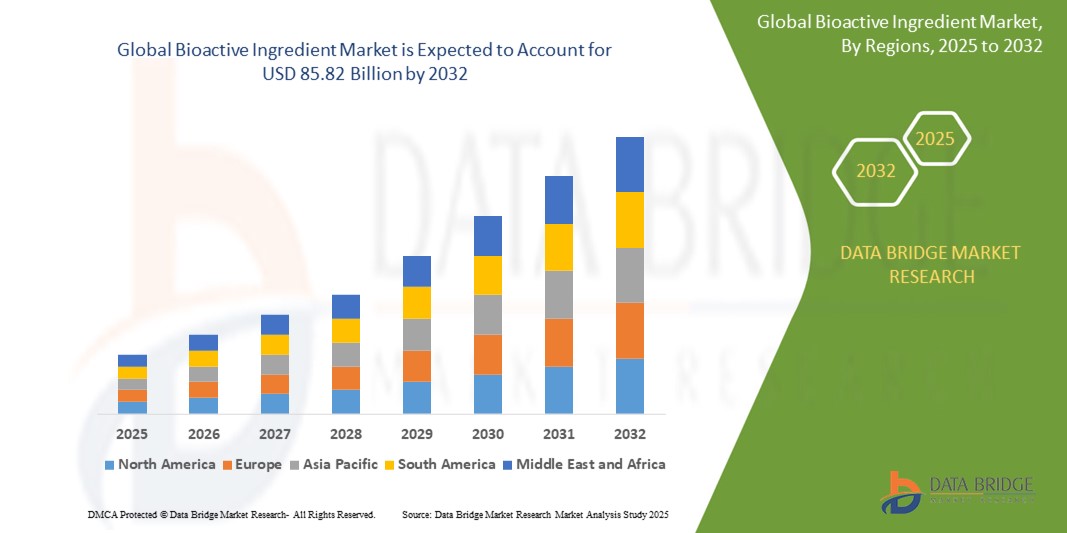
Bioactive Ingredient Market Size
- The global bioactive ingredient market size was valued at USD 47.41 billion in 2024 and is expected to reach USD 85.82 billion by 2032, at a CAGR of 7.70% during the forecast period
- The market growth is primarily driven by increasing consumer awareness of health and wellness, growing demand for functional foods and dietary supplements, and advancements in extraction and formulation technologies for bioactive compounds
- Rising preference for natural and sustainable ingredients in personal care and pharmaceutical applications is further propelling the adoption of bioactive ingredients, positioning them as a cornerstone of health-focused products
Bioactive Ingredient Market Analysis
- Bioactive ingredients, encompassing compounds with health-promoting properties, are integral to functional foods, dietary supplements, and personal care products, offering benefits such as improved immunity, digestive health, and anti-aging effects
- The surge in demand for bioactive ingredients is fueled by growing consumer focus on preventive healthcare, rising prevalence of chronic diseases, and increasing adoption of plant-based and clean-label products
- North America held the largest market share of 38.5% in 2024, driven by high consumer spending on health and wellness products, a strong presence of key industry players, and advanced R&D infrastructure. The U.S. leads in the adoption of bioactive ingredients, particularly in functional foods and dietary supplements
- Asia-Pacific is anticipated to be the fastest-growing region during the forecast period, propelled by rising health consciousness, increasing disposable incomes, and rapid urbanization in countries such as China and India
- The fibers and specialty carbohydrates segment held the largest market revenue share of 24.95% in 2024, driven by their critical role in digestive health, heart disease prevention, and versatility in applications such as functional foods and dietary supplements
Report Scope and Bioactive Ingredient Market Segmentation
|
Attributes |
Bioactive Ingredient Key Market Insights |
|
Segments Covered |
|
|
Countries Covered |
North America
Europe
Asia-Pacific
Middle East and Africa
South America
|
|
Key Market Players |
|
|
Market Opportunities |
|
|
Value Added Data Infosets |
In addition to the insights on market scenarios such as market value, growth rate, segmentation, geographical coverage, and major players, the market reports curated by the Data Bridge Market Research also include in-depth expert analysis, pricing analysis, brand share analysis, consumer survey, demography analysis, supply chain analysis, value chain analysis, raw material/consumables overview, vendor selection criteria, PESTLE Analysis, Porter Analysis, and regulatory framework. |
Bioactive Ingredient Market Trends
“Increasing Integration of AI and Big Data Analytics”
- The global bioactive ingredient market is experiencing a notable trend toward the integration of Artificial Intelligence (AI) and Big Data analytics
- These technologies enable advanced analysis of consumer health data, ingredient efficacy, and market trends, providing deeper insights into product development and personalized nutrition solutions
- AI-driven platforms are being developed to analyze consumer preferences and health outcomes, enabling manufacturers to tailor bioactive ingredients for specific health benefits, such as gut health or immune support
- For instance, companies are leveraging AI to optimize the formulation of functional foods and dietary supplements by analyzing consumer dietary patterns and health data to create personalized product
- This trend enhances the value proposition of bioactive ingredients, making them more appealing to health-conscious consumers and industries such as nutraceuticals and personal care
- AI algorithms can process vast datasets on ingredient interactions, bioavailability, and consumer feedback to improve product efficacy and innovation
Bioactive Ingredient Market Dynamics
Driver
“Rising Demand for Functional Foods and Preventive Healthcare”
- Growing consumer demand for functional foods, dietary supplements, and personal care products enriched with bioactive ingredients, such as probiotics, omega-3 fatty acids, and plant extracts, is a key driver for the global bioactive ingredient market
- Bioactive ingredients enhance health benefits by supporting immunity, improving gut health, reducing inflammation, and addressing chronic conditions such as obesity and cardiovascular diseases
- Government initiatives promoting health and wellness, particularly in regions such as Asia-Pacific and Europe, are encouraging the adoption of bioactive ingredients in food and pharmaceutical applications
- The proliferation of IoT and advancements in supply chain technologies are enabling faster production and distribution of bioactive ingredients, supporting scalability for manufacturers
- Companies are increasingly incorporating bioactive ingredients such as phytochemicals and antioxidants as standard or premium components in products to meet consumer expectations for natural and health-enhancing solutions
Restraint/Challenge
“High Cost of Development and Regulatory Compliance Concerns”
- The significant initial investment required for research, development, and production of bioactive ingredients, including extraction, formulation, and testing, can be a barrier to market entry, particularly for small-scale manufacturers in emerging markets
- Developing and integrating bioactive ingredients into functional foods, supplements, or personal care products can be complex and costly due to the need for advanced technologies such as microencapsulation
- Data security and regulatory compliance pose major challenges, as bioactive ingredient applications involve collecting and analyzing sensitive consumer health data, raising concerns about privacy, data breaches, and adherence to stringent regulations such as GDPR in Europe
- The fragmented regulatory landscape across countries, with varying standards for safety, efficacy, and labeling of bioactive ingredients, complicates operations for global manufacturers and service providers
- These factors can deter market expansion, particularly in regions with high cost sensitivity or stringent regulatory environments, limiting adoption among price-conscious consumers and manufacturers
Bioactive Ingredient market Scope
The market is segmented on the basis of Ingredient Type, Application, and Source.
- By Ingredient Type
On the basis of ingredient type, the market is segmented into prebiotics, probiotics, amino acids, peptides, omega-3 and structured lipids, phytochemicals and plant extracts, minerals, vitamins, fibers and specialty carbohydrates, carotenoids and antioxidants, and others. The fibers and specialty carbohydrates segment held the largest market revenue share of 24.95% in 2024, driven by their critical role in digestive health, heart disease prevention, and versatility in applications such as functional foods and dietary supplements. Their ability to reduce chronic disease risks, such as type 2 diabetes, further boosts demand.
The probiotics segment is expected to witness the fastest growth rate from 2025 to 2032, fueled by rising consumer awareness of gut health benefits and increasing incorporation into functional foods, beverages, and supplements. Advancements in microbial technology and demand for immune-boosting products accelerate adoption.
- By Application
On the basis of application, the market is segmented into functional food, dietary supplements, gummy supplements, animal nutrition, personal care, pharmaceutical, and others. The dietary supplements segment dominated with a revenue share of 31.2% in 2024, driven by growing consumer demand for preventive healthcare and personalized nutrition. Supplements incorporating vitamins, minerals, and probiotics cater to diverse health needs, such as immunity and digestion.
The functional food segment is anticipated to experience the fastest growth rate of 8.1% from 2025 to 2032, propelled by increasing health consciousness and demand for nutrient-enriched products such as energy bars, fortified beverages, and snacks. Innovations in bioactive compound integration enhance product appeal and market expansion.
- By Source
On the basis of source, the market is segmented into plant, animal, and microbial. The plant source segment held the largest market revenue share of 58.7% in 2024, owing to the rising popularity of plant-based diets, veganism, and the abundance of bioactive compounds such as phytochemicals and polyphenols in fruits, vegetables, and grains. Consumer preference for natural and organic ingredients further drives this segment.
The microbial source segment is expected to witness significant growth from 2025 to 2032, driven by advancements in fermentation technologies and the increasing use of probiotics and other microbial-derived compounds in functional foods and supplements. Their scalability and efficacy in health applications fuel market growth.
Bioactive Ingredient Market Regional Analysis
- North America held the largest market share of 38.5% in 2024, driven by high consumer spending on health and wellness products, a strong presence of key industry players, and advanced R&D infrastructure. The U.S. leads in the adoption of bioactive ingredients, particularly in functional foods and dietary supplements
- Consumers prioritize bioactive ingredients such as probiotics, omega-3 fatty acids, and plant extracts for their health benefits, including improved immunity, digestive health, and chronic disease prevention, particularly in regions with high health consciousness
- Growth is supported by advancements in ingredient extraction technologies, such as enhanced bioavailability and novel formulations, alongside rising adoption in both functional food and personal care segments
U.S. Bioactive Ingredient Market Insight
The U.S. bioactive ingredient market captured the largest revenue share of 75% in 2024 within North America, driven by growing consumer awareness of health benefits such as UV protection and immune support. The trend toward personalized nutrition and clean-label products further boosts market expansion. The integration of bioactive ingredients such as vitamins and probiotics in both retail and pharmaceutical applications complements market growth.
Europe Bioactive Ingredient Market Insight
The Europe bioactive ingredient market is expected to witness rapid growth, supported by stringent regulations promoting health and safety in food and cosmetics. Consumers seek ingredients such as phytochemicals and antioxidants that enhance wellness and provide anti-aging benefits. Growth is prominent in functional foods and personal care products, with countries such as Germany and France showing significant uptake due to rising environmental concerns and health-conscious lifestyles.
U.K. Bioactive Ingredient Market Insight
The U.K. market for bioactive ingredients is expected to experience strong growth, driven by demand for functional foods and personal care products that improve health and aesthetics in urban and suburban settings. Increased awareness of benefits such as digestive health and skin protection encourages adoption. Evolving regulations balancing health claims with compliance further shape consumer preferences.
Germany Bioactive Ingredient Market Insight
Germany is expected to witness significant growth in the bioactive ingredient market, attributed to its advanced food and pharmaceutical sectors and high consumer focus on preventive healthcare and wellness. German consumers prefer technologically advanced ingredients such as peptides and carotenoids that support immunity and reduce chronic disease risks. The integration of these ingredients in premium functional foods and aftermarket supplements supports sustained market growth.
Asia-Pacific Bioactive Ingredient Market Insight
The Asia-Pacific region is expected to witness the fastest growth rate, driven by expanding food and beverage production and rising disposable incomes in countries such as China, India, and Japan. Increasing awareness of health benefits such as immune support and cognitive health boosts demand for ingredients such as probiotics and plant extracts. Government initiatives promoting nutritional health and sustainable sourcing further encourage the use of advanced bioactive ingredients.
Japan Bioactive Ingredient Market Insight
Japan’s bioactive ingredient market is expected to grow rapidly due to strong consumer preference for high-quality, scientifically backed ingredients that enhance health and wellness. The presence of major food and pharmaceutical manufacturers and the integration of ingredients such as bioactive peptides in functional foods accelerate market penetration. Rising interest in beauty-from-within supplements also contributes to growth.
China Bioactive Ingredient Market Insight
China holds the largest share of the Asia-Pacific bioactive ingredient market, propelled by rapid urbanization, rising health consciousness, and increasing demand for functional foods and dietary supplements. The country’s growing middle class and focus on preventive healthcare support the adoption of ingredients such as fibers and omega-3 fatty acids. Strong domestic manufacturing capabilities and competitive pricing enhance market accessibility.
Bioactive Ingredient Market Share
The bioactive ingredient industry is primarily led by well-established companies, including:
- DSM (Netherlands)
- BASF SE (Germany)
- Kerry Group plc. (Ireland)
- DuPont (U.S.)
- ADM (U.S.)
- Evonik Industries AG (Germany)
- Cargill,Incorporated (U.S.)
- Arla Food Ingredients Group P/S (Denmark)
- FMC Corporation (U.S.)
- Sunrise Nutrachem Group (China)
- Adisseo (France)
- Chr. Hansen A/S (Denmark)
- Sabinsa (U.S.)
- Ajinomoto Co., Inc (Japan)
- Ingredion (U.S.)
What are the Recent Developments in Global Bioactive Ingredient Market?
- In May 2025, Givaudan acquired Amyris's biotechnology assets, enhancing its expertise in developing and scaling sustainable ingredients. This strategic move strengthens Givaudan’s capabilities in bioactive ingredient creation through fermentation, aligning with the rising consumer demand for natural and eco-friendly products. The acquisition includes Amyris’s advanced biomanufacturing technology, which enables the production of high-performance biofermented ingredients for beauty, health, and wellness markets. Givaudan aims to leverage this partnership to drive innovation in sustainable solutions.
- In March 2025, Lonza Group AG enhanced its biopharmaceutical manufacturing capabilities by opening a new facility in Visp, Switzerland, dedicated to highly potent active pharmaceutical ingredients (HPAPIs). This expansion supports the growing demand for complex bioactive molecules, particularly in oncology and specialized therapeutics. The Visp site houses advanced production suites, enabling efficient drug development and commercial supply. Lonza’s investment strengthens its global leadership in pharmaceutical manufacturing, ensuring cutting-edge solutions for evolving medical needs
- In February 2025, Royal DSM partnered with Avril, a leading French agro-industrial group, to develop and commercialize sustainable protein ingredients for the food and beverage industry. This collaboration combines DSM’s expertise in biotechnology with Avril’s legacy in oilseed processing, aiming to introduce innovative plant-based bioactive proteins. The partnership addresses the growing demand for healthier and eco-friendly food solutions, supporting advancements in alternative protein sources. By leveraging their combined strengths, DSM and Avril seek to enhance nutritional offerings while promoting sustainability in food production
- In March 2023, Symrise launched a new range of bioactive ingredients for its Beauty from within product line, catering to the growing nutricosmetics market. This collection includes naturally sourced bioactives, such as collagen type I, vitamins C and A, and polyphenols from various fruits, designed to support skin anti-aging, brightening, and hair and nail care. The ingredients aim to enhance inside-out beauty benefits, complementing traditional skincare routines. Symrise’s innovation aligns with consumer demand for holistic and sustainable beauty solutions
- In January 2023, FrieslandCampina Ingredients partnered with Triplebar Bio Inc. to develop and scale cell-based proteins using precision fermentation. This collaboration aims to advance sustainable protein solutions, addressing the growing demand for nutritional innovation. FrieslandCampina leverages its expertise in dairy protein processing, while Triplebar contributes biotechnology capabilities to create bioactive proteins that support human health and nutrition. The partnership reinforces their commitment to future-proof food technology, ensuring high-quality protein production with minimal environmental impact

- Interactive Data Analysis Dashboard
- Company Analysis Dashboard for high growth potential opportunities
- Research Analyst Access for customization & queries
- Competitor Analysis with Interactive dashboard
- Latest News, Updates & Trend analysis
- Harness the Power of Benchmark Analysis for Comprehensive Competitor Tracking
Global Bioactive Ingredient Market, Supply Chain Analysis and Ecosystem Framework
To support market growth and help clients navigate the impact of geopolitical shifts, DBMR has integrated in-depth supply chain analysis into its Global Bioactive Ingredient Market research reports. This addition empowers clients to respond effectively to global changes affecting their industries. The supply chain analysis section includes detailed insights such as Global Bioactive Ingredient Market consumption and production by country, price trend analysis, the impact of tariffs and geopolitical developments, and import and export trends by country and HSN code. It also highlights major suppliers with data on production capacity and company profiles, as well as key importers and exporters. In addition to research, DBMR offers specialized supply chain consulting services backed by over a decade of experience, providing solutions like supplier discovery, supplier risk assessment, price trend analysis, impact evaluation of inflation and trade route changes, and comprehensive market trend analysis.
Data collection and base year analysis are done using data collection modules with large sample sizes. The stage includes obtaining market information or related data through various sources and strategies. It includes examining and planning all the data acquired from the past in advance. It likewise envelops the examination of information inconsistencies seen across different information sources. The market data is analysed and estimated using market statistical and coherent models. Also, market share analysis and key trend analysis are the major success factors in the market report. To know more, please request an analyst call or drop down your inquiry.
The key research methodology used by DBMR research team is data triangulation which involves data mining, analysis of the impact of data variables on the market and primary (industry expert) validation. Data models include Vendor Positioning Grid, Market Time Line Analysis, Market Overview and Guide, Company Positioning Grid, Patent Analysis, Pricing Analysis, Company Market Share Analysis, Standards of Measurement, Global versus Regional and Vendor Share Analysis. To know more about the research methodology, drop in an inquiry to speak to our industry experts.
Data Bridge Market Research is a leader in advanced formative research. We take pride in servicing our existing and new customers with data and analysis that match and suits their goal. The report can be customized to include price trend analysis of target brands understanding the market for additional countries (ask for the list of countries), clinical trial results data, literature review, refurbished market and product base analysis. Market analysis of target competitors can be analyzed from technology-based analysis to market portfolio strategies. We can add as many competitors that you require data about in the format and data style you are looking for. Our team of analysts can also provide you data in crude raw excel files pivot tables (Fact book) or can assist you in creating presentations from the data sets available in the report.













