Biochar based Fertilizers Market Size
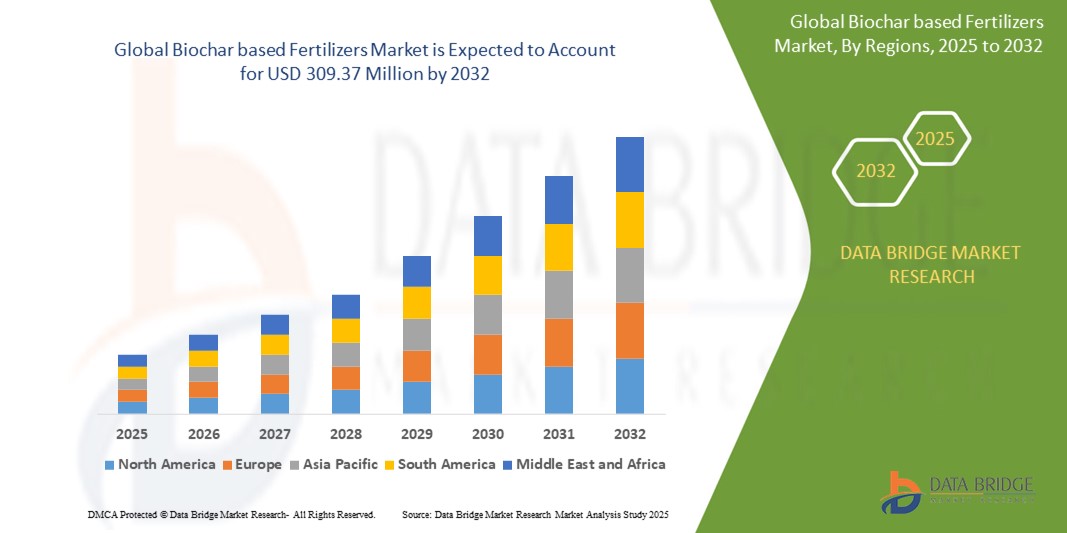
- The global ophthalmic operational microscope market was valued at USD 191.20 million in 2024 and is expected to reach USD 309.37 million by 2032
- During the forecast period of 2025 to 2032 the market is likely to grow at a CAGR of 6.2%, primarily driven by the growing demand for sustainable agricultural inputs
- This growth is driven by factors such as rising awareness of soil health, increasing adoption of organic farming practices, and the environmental benefits of carbon sequestration through biochar
Biochar based Fertilizers Market Analysis
- Biochar-based fertilizers are soil amendments made by combining biochar—a carbon-rich product from biomass pyrolysis—with nutrients to enhance soil fertility, water retention, and microbial activity. These fertilizers are increasingly seen as sustainable alternatives to traditional chemical fertilizers
- The demand for biochar-based fertilizers is significantly driven by the global push toward sustainable agriculture, organic farming, and carbon-negative solutions. Their ability to improve soil health while sequestering carbon makes them attractive to both farmers and environmental policymakers
- The Asia Pacific region stands out as one of the dominant regions for biochar-based fertilizers, driven by its large agricultural base, government incentives for sustainable farming, and increasing awareness of regenerative practices
- For instance, countries such as India, China, and Australia have initiated pilot programs and research projects encouraging biochar use to combat soil degradation and enhance crop yields, thereby boosting regional adoption
- Globally, biochar-based fertilizers are gaining traction as a key component in climate-smart agriculture, especially in regions facing challenges such as soil erosion, nutrient depletion, and erratic rainfall patterns. Their role in carbon sequestration and long-term soil conditioning positions them as an integral part of future agricultural sustainability strategies
Report Scope and Biochar based Fertilizers Market Segmentation
|
Attributes |
Ophthalmic Operational Microscope Key Market Insights |
|
Segments Covered |
|
|
Countries Covered |
North America
Europe
Asia-Pacific
Middle East and Africa
South America
|
|
Key Market Players |
|
|
Market Opportunities |
|
|
Value Added Data Infosets |
In addition to the insights on market scenarios such as market value, growth rate, segmentation, geographical coverage, and major players, the market reports curated by the Data Bridge Market Research also include import export analysis, production capacity overview, production consumption analysis, price trend analysis, climate change scenario, supply chain analysis, value chain analysis, raw material/consumables overview, vendor selection criteria, PESTLE Analysis, Porter Analysis, and regulatory framework. |
Biochar based Fertilizers Market Trends
“Growing Emphasis on Carbon Sequestration and Climate-Smart Agriculture”
- One prominent trend in the global biochar-based fertilizers market is the growing emphasis on carbon sequestration and climate-smart agriculture
- Biochar’s ability to trap carbon in soil for long periods is gaining attention as a key solution for reducing greenhouse gas emissions and mitigating climate change impacts
- For instance, several countries are integrating biochar into their carbon offset strategies, and its inclusion in carbon credit systems is attracting both farmers and investors
- In addition, biochar-based fertilizers improve soil structure, water retention, and nutrient efficiency, making them ideal for drought-prone and nutrient-depleted regions
- This trend is transforming biochar from a niche product to a mainstream agricultural input, positioning it as a critical tool for sustainable land management and regenerative farming
Biochar based Fertilizers Market Dynamics
Driver
“Growing Need for Sustainable Soil Management and Climate Resilience”
- The increasing depletion of soil quality, loss of organic matter, and excessive use of chemical fertilizers are significantly contributing to the rising demand for biochar-based fertilizers
- As global agriculture faces mounting pressure to become more climate-resilient, biochar offers a solution by improving soil structure, enhancing nutrient retention, and sequestering carbon for long-term environmental benefit
- Biochar-based fertilizers are especially effective in addressing issues such as soil acidity, nutrient leaching, and low microbial activity, making them a preferred choice in regions with degraded or arid soils
- The growing awareness among farmers and agricultural organizations about the long-term benefits of biochar—including higher crop yields, reduced input costs, and improved water efficiency—is driving adoption
- Governments and environmental bodies are also recognizing biochar's role in meeting sustainability goals, with support growing for its integration into carbon credit systems and green farming initiatives
For instance,
- In February 2023, the Indian Council of Agricultural Research (ICAR) launched several field trials using biochar-enhanced fertilizers to restore soil fertility and reduce dependency on synthetic inputs across drought-affected regions
- In May 2022, the European Biochar Industry Consortium (EBI) reported a doubling of biochar demand across EU nations, driven by incentives under the EU Green Deal for carbon sequestration and sustainable agriculture
- As concerns over soil degradation and climate change intensify, the demand for biochar-based fertilizers continues to rise—offering a sustainable and effective solution to modern agricultural challenges
Opportunity
“Advancing Sustainable Agriculture through Technological Innovation in Biochar Application”
- Technological advancements in biochar production and formulation are unlocking new opportunities to integrate biochar-based fertilizers into mainstream sustainable agriculture
- Emerging innovations—such as precision agriculture, biochar-enriched compost, and customized biochar blends—are making it easier for farmers to apply biochar more efficiently and at scale
- Enhanced production methods, like pyrolysis optimization and microbial inoculation of biochar, are improving nutrient profiles and making biochar-based fertilizers more effective for different crop types and soil conditions
For instance,
- In March 2024, researchers from Wageningen University (Netherlands) developed a microbial biochar fertilizer capable of improving soil fertility and carbon retention by up to 40% more than conventional biochar
- In October 2023, a startup in the U.S. launched sensor-integrated biochar application systems that use real-time soil data to apply biochar-based fertilizers precisely, reducing waste and increasing crop yield
- According to a 2023 report from the International Biochar Initiative, smart integration of biochar with digital farming tools (like IoT and AI-based platforms) is helping farmers monitor soil health, optimize usage, and track environmental benefits, positioning biochar as a future-ready agricultural input
- The fusion of technology and sustainability goals presents a significant opportunity for the biochar-based fertilizers market, enhancing productivity while supporting climate resilience and regenerative farming practices
Restraint/Challenge
“High Production and Processing Costs Hindering Widespread Adoption”
- The high cost associated with biochar production and processing poses a significant challenge for market expansion, particularly in developing regions with limited financial resources
- Producing high-quality biochar requires specialized equipment, controlled pyrolysis processes, and in some cases, feedstock pre-treatment, all of which contribute to increased operational expenses
- These high costs can deter smallholder farmers and low-income agricultural regions from adopting biochar-based fertilizers, despite their long-term environmental and agronomic benefits
For instance,
- In June 2023, a report by the Biochar Journal highlighted that setting up a small-scale biochar production unit can cost between USD 20,000 to USD 50,000, depending on capacity and technology, making it inaccessible for many rural farming communities
- According to a 2022 study by the International Renewable Energy Agency (IRENA), biochar production costs in regions like Sub-Saharan Africa and Southeast Asia are still 2–3 times higher than traditional fertilizers, limiting adoption despite the ecological advantages
- Limited access to financial incentives and lack of standardized guidelines for biochar usage also add to the barriers, slowing down the pace of market penetration
- As a result, the high cost of biochar production and application presents a substantial barrier to mass adoption, particularly in regions that could benefit most from its soil-enhancing and climate-smart properties
Biochar based Fertilizers Market Scope
The market is segmented on the basis of product type, application, distribution channel, and crop type.
|
Segmentation |
Sub-Segmentation |
|
By Product Type |
|
|
By Application |
|
|
By Distribution Channel
|
|
|
By Crop Type
|
|
Biochar based Fertilizers Market Regional Analysis
“Asia Pacific is the Dominant Region in the Biochar-based Fertilizers Market”
- Asia Pacific dominates the biochar-based fertilizers market, driven by its large agricultural sector, growing adoption of sustainable farming practices, and strong government support for climate-resilient agriculture
- Countries like India, China, and Australia hold significant shares due to increasing awareness about soil degradation, the benefits of biochar in enhancing crop productivity, and the urgent need for eco-friendly agricultural inputs
- The presence of government-led pilot projects, subsidies, and research initiatives promoting biochar production and use has further accelerated market penetration across the region
- In addition, the rising demand for organic food, combined with efforts to reduce dependency on chemical fertilizers, is fueling the rapid adoption of biochar-based fertilizers, making Asia Pacific a central hub for market innovation and expansion
“Asia-Pacific is Projected to Register the Highest Growth Rate”
- The Asia-Pacific region is expected to witness the highest growth rate in the biochar-based fertilizers market, driven by rapid agricultural expansion, growing focus on sustainable practices, and increasing awareness of soil health restoration
- Countries such as China, India, and Australia are emerging as key markets due to the rising need to combat soil degradation, enhance crop productivity, and reduce dependency on chemical fertilizers
- India and China, with their large farming populations, are witnessing increased government initiatives, research investments, and support for biochar pilot programs aimed at improving long-term soil fertility
- Australia, known for its climate-smart agricultural policies, continues to lead in biochar research and adoption, supported by collaborations between academic institutions, agri-tech startups, and government agencies
Biochar based Fertilizers Market Share
The market competitive landscape provides details by competitor. Details included are company overview, company financials, revenue generated, market potential, investment in research and development, new market initiatives, global presence, production sites and facilities, production capacities, company strengths and weaknesses, product launch, product width and breadth, application dominance. The above data points provided are only related to the companies' focus related to market.
The Major Market Leaders Operating in the Market Are:
- Biochar Supreme (U.S.)
- Cool Planet (U.S.)
- Biochar Now, LLC (U.S.)
- Phoenix Energy (U.S.)
- Pacific Biochar Benefit Corporation (U.S.)
- ArSta Eco (India)
- Terra Char (U.S.)
- Carbon Gold (U.K.)
- Black Owl Biochar (U.S.)
- Green Man Char (Australia)
- CharGrow USA LLC (U.S.)
- Wakefield Biochar (U.S.)
- Bioforcetech Corporation (U.S.)
- Agri-Tech Producers, LLC (U.S.)
- Carbo Culture (Finland)
- Charborn (Canada)
- Ecoera (Sweden)
- Biochar Products, Inc. (U.S.)
- Earth Systems Bioenergy (Australia)
- NextChar (U.S.)
Latest Developments in Global Biochar based Fertilizers Market
- In January 2025, Google entered into an agreement with Indian supplier Varaha to purchase 100,000 tons of carbon credits by 2030. This initiative involves converting agricultural waste into biochar, which sequesters carbon dioxide and serves as an alternative fertilizer. This marks Google's first involvement in India's carbon dioxide removal sector
- In June 2024, Swiss Re partnered with Carbonfuture to purchase at least 70,000 metric tons of biochar carbon removal credits over seven years. The credits will be sourced from Exomad Green's project in Bolivia, supporting Swiss Re's strategy to achieve 100% carbon removal in its compensation mix by 2030
- In January 2024, Saratoga Biochar's application for air and solid waste permits was denied by the New York State Department of Environmental Conservation due to insufficient information on emissions and waste management. The company is appealing the decision amid community opposition over environmental concerns
- In December 2022, EVOIA, a US-based manufacturer of biostimulants, introduced AmpliFYR, a biochar-based seed treatment product. AmpliFYR aids in seed establishment and is suitable for crops such as corn, soybeans, and wheat, helping farmers increase potential profits
- In June 2021, Airex Energy and SUEZ Group collaborated to increase biochar production capacity from 10,000 to 30,000 tonnes per year. This partnership aims to address the growing demand for biochar in sustainable agriculture and energy production

- Interactive Data Analysis Dashboard
- Company Analysis Dashboard for high growth potential opportunities
- Research Analyst Access for customization & queries
- Competitor Analysis with Interactive dashboard
- Latest News, Updates & Trend analysis
- Harness the Power of Benchmark Analysis for Comprehensive Competitor Tracking
Data collection and base year analysis are done using data collection modules with large sample sizes. The stage includes obtaining market information or related data through various sources and strategies. It includes examining and planning all the data acquired from the past in advance. It likewise envelops the examination of information inconsistencies seen across different information sources. The market data is analysed and estimated using market statistical and coherent models. Also, market share analysis and key trend analysis are the major success factors in the market report. To know more, please request an analyst call or drop down your inquiry.
The key research methodology used by DBMR research team is data triangulation which involves data mining, analysis of the impact of data variables on the market and primary (industry expert) validation. Data models include Vendor Positioning Grid, Market Time Line Analysis, Market Overview and Guide, Company Positioning Grid, Patent Analysis, Pricing Analysis, Company Market Share Analysis, Standards of Measurement, Global versus Regional and Vendor Share Analysis. To know more about the research methodology, drop in an inquiry to speak to our industry experts.
Data Bridge Market Research is a leader in advanced formative research. We take pride in servicing our existing and new customers with data and analysis that match and suits their goal. The report can be customized to include price trend analysis of target brands understanding the market for additional countries (ask for the list of countries), clinical trial results data, literature review, refurbished market and product base analysis. Market analysis of target competitors can be analyzed from technology-based analysis to market portfolio strategies. We can add as many competitors that you require data about in the format and data style you are looking for. Our team of analysts can also provide you data in crude raw excel files pivot tables (Fact book) or can assist you in creating presentations from the data sets available in the report.