


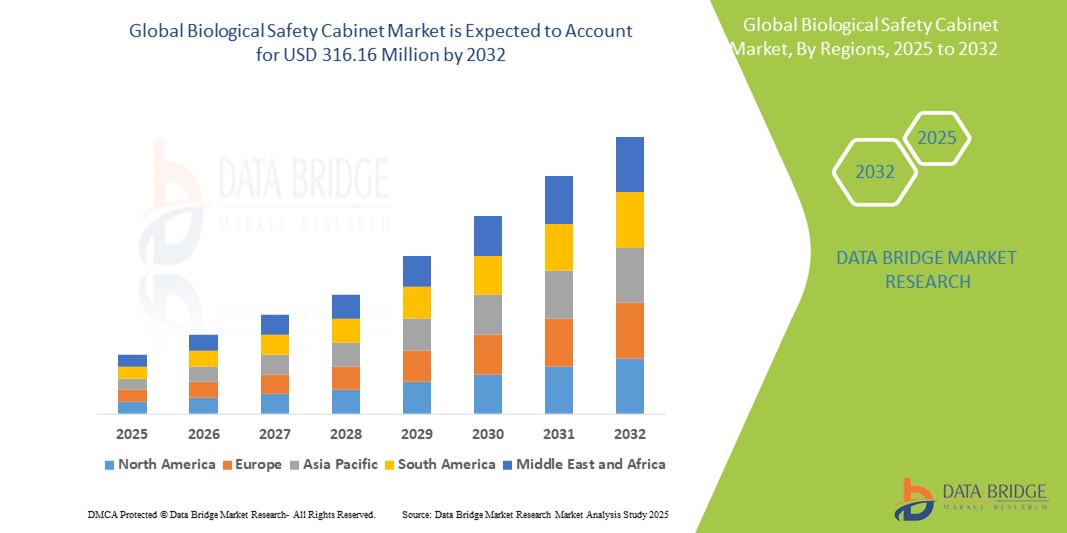
Biological Safety Cabinet Market Size
- The global biological safety cabinet market size was valued at USD 163.89 million in 2024 and is expected to reach USD 316.16 million by 2032, at a CAGR of 8.56% during the forecast period
- The market growth is largely fueled by the growing adoption and technological progress within connected home devices and smart home technology, leading to increased digitalization in both residential and commercial settings.
- Furthermore, rising consumer demand for secure, user-friendly, and integrated solutions for their homes and businesses is establishing smart locks as the modern access control system of choice. These converging factors are accelerating the uptake of smart lock solutions, thereby significantly boosting the industry's growth
Biological Safety Cabinet Market Analysis
- Biological safety cabinets are increasingly vital components of modern laboratory safety and containment systems in research, clinical, and industrial settings due to their enhanced protection for personnel, products, and the environment when working with biological agents
- The escalating demand for biological safety cabinets is primarily fueled by the rising incidences of infectious diseases, growing awareness about laboratory safety, and increasing investments in research and development activities
- North America dominates the biological safety cabinet market with market share of 32.26% in 2025, characterized by stringent regulatory standards, a strong emphasis on laboratory safety, and a significant presence of leading manufacturers and research institutions, with the U.S. experiencing substantial demand across pharmaceutical, biotechnology, and academic sectors
- Asia-Pacific is expected to be the fastest-growing region in the biological safety cabinet market with a CAGR of 8.6% during the forecast period due to increasing investments in life sciences research, the expansion of the pharmaceutical and biotechnology industries, and rising healthcare expenditure
- Class II biological safety cabinets are expected to dominate the market with market share of 42.3% in 2025, driven by their versatility in providing personnel, product, and environmental protection, making them the most commonly used type across various laboratory applications
Report Scope and Biological Safety Cabinet Market Segmentation
|
Attributes |
Biological Safety Cabinet Key Market Insights |
|
Segments Covered |
|
|
Countries Covered |
North America
Europe
Asia-Pacific
Middle East and Africa
South America
|
|
Key Market Players |
|
|
Market Opportunities |
|
|
Value Added Data Infosets |
In addition to the insights on market scenarios such as market value, growth rate, segmentation, geographical coverage, and major players, the market reports curated by the Data Bridge Market Research also include in-depth expert analysis, pricing analysis, brand share analysis, consumer survey, demography analysis, supply chain analysis, value chain analysis, raw material/consumables overview, vendor selection criteria, PESTLE Analysis, Porter Analysis, and regulatory framework. |
Biological Safety Cabinet Market Trends
“Enhanced Safety and Efficiency Through Advanced Filtration and Monitoring”
- A significant and accelerating trend in the global biological safety cabinet market is the deepening integration of advanced filtration technologies and sophisticated monitoring systems. This fusion of technologies is significantly enhancing user safety and operational efficiency in laboratory environments
- For instance, High-Efficiency Particulate Air (HEPA) and Ultra-Low Penetration Air (ULPA) filters, which are standard in many modern BSCs, are continuously being improved for higher capture efficiency and longer lifespans. Some advanced systems incorporate real-time filter monitoring to alert users about filter degradation or potential breaches, ensuring continuous protection
- Integration of sophisticated airflow management systems, such as digital control systems that maintain precise airflow velocities and directional airflow, is becoming increasingly common. These systems often include sensors that continuously monitor airflow and automatically adjust fan speeds to maintain optimal safety conditions. Furthermore, some models incorporate features such as automatic balancing and alarm systems for airflow disruptions
- The seamless integration of BSCs with laboratory management systems for monitoring usage, maintenance schedules, and certification status is also gaining traction. Advanced models may include features such as digital displays providing real-time data on airflow, pressure, and temperature, as well as connectivity for remote monitoring and diagnostics
- This trend towards more intelligent, efficient, and interconnected containment systems is fundamentally reshaping user expectations for laboratory safety. Consequently, companies are developing BSCs with features such as programmable cycles for decontamination, automated sash control, and integrated UV sterilization with timer functions to minimize contamination risks and enhance workflow efficiency
- The demand for biological safety cabinets that offer seamless integration of advanced filtration and monitoring technologies is growing rapidly across research institutions, pharmaceutical companies, and clinical laboratories, as end-users increasingly prioritize safety, reliability, and compliance with stringent regulatory standards
Biological Safety Cabinet Market Dynamics
Driver
“Increasing Demand Due to Growing Biosafety Awareness and Regulatory Stringency”
- The increasing prevalence of infectious diseases, coupled with a heightened awareness of laboratory-acquired infections and stringent regulatory standards, is a significant driver for the heightened demand for biological safety cabinets
- For instance, in March 2025, the World Health Organization (WHO) released updated guidelines on laboratory biosafety, emphasizing the critical role of BSCs in preventing the transmission of airborne pathogens. Such recommendations from global health organizations are expected to drive the biological safety cabinet industry growth in the forecast period
- As researchers and laboratory personnel become more aware of potential biological hazards and seek enhanced protection in their work environments, biological safety cabinets offer essential features such as HEPA filtration, controlled airflow, and containment, providing a compelling safety measure compared to working without such equipment
- Furthermore, the growing emphasis on workplace safety and the increasing adoption of standardized laboratory practices are making biological safety cabinets an indispensable component of modern laboratories across various sectors, including research, pharmaceuticals, and clinical diagnostics
- The necessity for maintaining sterile and contamination-free environments in sensitive applications, such as cell culture and drug preparation, along with the legal and ethical obligations to protect laboratory workers, are key factors propelling the adoption of biological safety cabinets in both research and commercial settings. The trend towards advanced laboratory designs and the increasing availability of certified and compliant BSC options further contribute to market growth
Restraint/Challenge
“High Initial Costs and Concerns Regarding Maintenance and Certification"
- Concerns surrounding the cybersecurity vulnerabilities of connected devices, including biological safety cabinets with remote monitoring or control features, pose a significant challenge to broader market penetration. As these advanced BSCs rely on network connectivity and software, they are potentially susceptible to hacking attempts or data breaches, raising anxieties among laboratory personnel and IT departments about the security of sensitive data and the integrity of the equipment
- For instance, reports of vulnerabilities in other connected laboratory equipment could make some institutions hesitant to adopt network-enabled biological safety cabinets without robust security measures. Addressing these cybersecurity concerns through strong encryption, secure authentication protocols, and regular software updates from manufacturers is crucial for building user trust and ensuring the secure operation of these devices
- In addition, the relatively high initial cost of some advanced biological safety cabinet systems, especially those with sophisticated monitoring capabilities, ergonomic designs, or specialized filtration, compared to basic models can be a barrier to adoption for price-sensitive laboratories, particularly in academic settings or developing regions with limited budgets. While more basic and affordable BSC options are available, the perceived premium for advanced features can still hinder widespread adoption for those who do not see an immediate or critical need for them
- While the long-term benefits of advanced BSCs in terms of enhanced safety, efficiency, and data logging may outweigh the initial investment, overcoming this challenge requires manufacturers to offer a range of price points and clearly articulate the value proposition of advanced features to justify the higher cost. Furthermore, exploring financing options or government subsidies could help alleviate the financial burden for some institutions
- Overcoming these challenges through enhanced cybersecurity measures, clear communication about security protocols, the development of more affordable advanced BSC options, and highlighting the long-term benefits will be vital for sustained market growth and the wider adoption of cutting-edge biological safety cabinet technology
Biological Safety Cabinet Market Scope
The market is segmented on the basis of type, application, and end user
- By Type
On the basis of type, the biological safety cabinet market is segmented into Class I, Class II, and Class III. The Class II segment dominates the largest market revenue share of 42.3% in 2025, driven by its versatility in providing protection for personnel, product, and the environment, making it the most widely adopted type across various laboratory settings. Its ability to offer a balance of safety and usability contributes to its strong market position.
The Class III segment is anticipated to witness the fastest growth rate from 2025 to 2032, fueled by increasing demand in high-containment laboratories handling highly infectious and hazardous biological agents. The stringent safety features and absolute containment provided by Class III BSCs are becoming increasingly crucial in specialized research and diagnostic facilities
- By Application
On the basis of application, the biological safety cabinet market is segmented into Industrial, R&D, and Academic. The R&D segment held the largest market revenue share in 2025, driven by substantial investments in pharmaceutical, biotechnology, and life sciences research globally. Biological safety cabinets are essential equipment in R&D laboratories for ensuring the safety of researchers and the integrity of experiments.
The Industrial segment is expected to witness a significant CAGR from 2025 to 2032, driven by the increasing adoption of BSCs in pharmaceutical and biopharmaceutical manufacturing processes to maintain product sterility and protect workers from exposure to active pharmaceutical ingredients and biological materials
- By End User
On the basis of end-users, the biological safety cabinet market is segmented into pharmaceutical and biotechnology companies, and diagnostic and testing laboratories. The pharmaceutical and biotechnology companies segment held the largest market revenue share in 2025, driven by the critical need for sterile and safe environments in drug discovery, development, and manufacturing. The increasing focus on biologics and advanced therapies further fuels the demand for high-quality BSCs
The diagnostic and testing laboratories segment is expected to witness a steady CAGR from 2025 to 2032, driven by the rising volume of diagnostic tests, increasing awareness of biosafety protocols in clinical settings, and the need to protect laboratory personnel from potentially infectious samples
Biological Safety Cabinet Market Regional Analysis
- North America dominates the biological safety cabinet market with the largest revenue share of 32.26% in 2024, driven by stringent regulatory standards, a strong emphasis on laboratory safety across research and healthcare sectors, and significant investments in pharmaceutical and biotechnology industries
- The presence of leading research institutions, major pharmaceutical companies, and well-established safety protocols in the region contributes to the high adoption rate of advanced biological safety cabinets. Furthermore, a strong focus on worker safety and environmental protection further fuels market growth in North America
- This widespread adoption is supported by robust funding for life sciences research, the presence of key market players, and a mature healthcare infrastructure that prioritizes biosafety measures in laboratories and manufacturing facilities. The increasing focus on advanced therapies and diagnostics also drives the demand for high-quality biological safety cabinets in both academic and commercial settings across North America
U.S. Biological Safety Cabinet Market Insight
The U.S. biological safety cabinet market captured the largest revenue share within North America in 2025 with 54.6% market share, fueled by stringent regulatory frameworks, substantial investments in biopharmaceutical research, and a strong emphasis on laboratory worker safety. The increasing adoption of advanced therapies and diagnostics necessitates high-performance containment solutions. Furthermore, the presence of numerous leading pharmaceutical and biotechnology companies, coupled with robust funding for research institutions, propels the demand for sophisticated biological safety cabinets
Europe Biological Safety Cabinet Market Insight
The European biological safety cabinet market is projected to expand at a substantial CAGR throughout the forecast period, primarily driven by stringent biosafety regulations and increasing investments in life sciences research across the region. Growing awareness of laboratory-acquired infections and the need for contamination control in pharmaceutical manufacturing are key growth drivers. The region is experiencing significant adoption in research laboratories, hospitals, and pharmaceutical production facilities, with a focus on energy-efficient and ergonomically designed BSCs
U.K. Biological Safety Cabinet Market Insight
The U.K. biological safety cabinet market is anticipated to grow at a noteworthy CAGR during the forecast period, driven by a strong focus on health and safety regulations in laboratories and a growing biopharmaceutical sector. Concerns regarding biological hazards and the need for high-quality containment solutions are encouraging both research institutions and commercial entities to invest in advanced BSCs. The UK's well-established research infrastructure and stringent quality standards further stimulate market growth
Germany Biological Safety Cabinet Market Insight
The German biological safety cabinet market is expected to expand at a considerable CAGR during the forecast period, fueled by increasing awareness of biosafety protocols and a strong emphasis on quality and technological innovation in laboratory equipment. Germany's robust pharmaceutical and biotechnology industries, coupled with its advanced research infrastructure, promotes the adoption of high-performance BSCs. The integration of ergonomic designs and energy-efficient technologies in BSCs also aligns with local consumer preferences
Asia-Pacific Biological Safety Cabinet Market Insight
The Asia-Pacific biological safety cabinet market is poised to grow at the fastest CAGR of 8.6% in 2025, driven by increasing investments in life sciences research, the expanding pharmaceutical and biotechnology sectors, and rising healthcare expenditure in countries such as China, Japan, and India. The region's growing focus on drug development and manufacturing, coupled with increasing awareness of laboratory safety standards, is driving the adoption of biological safety cabinets. Furthermore, the emergence of APAC as a manufacturing hub for laboratory equipment is improving the affordability and accessibility of BSCs
Japan Biological Safety Cabinet Market Insight
The Japan biological safety cabinet market is gaining momentum due to the country’s advanced research and development activities, stringent regulatory environment for pharmaceuticals, and emphasis on high-quality laboratory equipment. The increasing focus on regenerative medicine and biopharmaceuticals is driving the demand for advanced containment solutions. Moreover, Japan's focus on precision and reliability in laboratory equipment contributes to the adoption of high-performance biological safety cabinets in both research and industrial settings
India Biological Safety Cabinet Market Insight
The India biological safety cabinet market is demonstrating promising growth in the Asia Pacific region in 2025. This growth is primarily fueled by the country's increasing investments in its pharmaceutical and biotechnology sectors. Furthermore, a rising awareness of stringent laboratory safety standards, coupled with growing government support for research initiatives, is significantly boosting the demand for biological safety cabinets across various research and healthcare institutions in India. The expanding healthcare infrastructure and the presence of both international and domestic manufacturers contributing to affordability are also key factors that are propelling the market forward in India.
Biological Safety Cabinet Market Share
The biological safety cabinet industry is primarily led by well-established companies, including:
- Thermo Fisher Scientific Inc. (U.S.)
- Esco Micro Pte. Ltd. (Singapore)
- Labconco (U.S.)
- Baker (U.S.)
- Kewaunee International Group, (U.S.)
- NuAire (U.S.)
- Germfree (U.S.)
- Euroclone S.p.A. (Italy)
- CRUMA (Spain)
- Air Science USA LLC (U.S.)
- Berner International (Germany)
- Biobase Biodusty(Shandong), Co., Ltd. (China)
- Erlab (U.S.)
- ACMAS Technologies (P) Ltd. (India)
- AirClean Systems Inc. (U.S.)
- Bassaire Ltd. (U.K.)
Latest Developments in Global Biological Safety Cabinet Market
- In April 2024, Thermo Fisher Scientific, a global leader in scientific instrumentation, announced the expansion of its biosafety cabinet portfolio with the launch of a new energy-efficient Class II BSC designed to minimize operational costs and environmental impact. This development underscores the company's commitment to providing sustainable and high-performance containment solutions for laboratories worldwide. The new BSC incorporates advanced airflow management and intelligent control systems to optimize energy consumption without compromising safety
- In March 2024, Esco Micro Pte. Ltd., a prominent manufacturer of laboratory equipment, introduced a new range of Class III biological safety cabinets featuring enhanced ergonomic designs and integrated decontamination systems. These advancements aim to improve user comfort and streamline laboratory workflows while maintaining the highest levels of containment for handling highly hazardous biological agents. The new series reflects Esco's focus on user-centric design and advanced safety features
- In March 2024, NuAire, Inc., a leading provider of laboratory equipment, successfully partnered with several academic institutions in the U.S. to supply customized biological safety cabinets for advanced research in infectious diseases. This initiative highlights NuAire's expertise in providing tailored solutions to meet the specific needs of research laboratories, contributing to advancements in scientific understanding and public health. The collaboration underscores the increasing importance of specialized containment equipment in cutting-edge research
- In February 2024, Baker Company, a manufacturer of biological safety and containment equipment, announced a strategic partnership with a European distributor to expand its market reach across the European Union. This collaboration is designed to enhance the accessibility of Baker's high-quality biological safety cabinets to a wider range of laboratories and research facilities in Europe, facilitating safer and more efficient scientific work. The initiative reflects Baker Company's commitment to global market expansion and providing reliable containment solutions internationally
- In January 2024, Labconco Corporation, a long-standing provider of laboratory equipment, unveiled a new series of Class II biological safety cabinets with integrated digital monitoring and control systems at a major laboratory equipment trade show. These advanced systems offer real-time data on airflow, filter performance, and usage, enhancing user awareness and facilitating proactive maintenance. The new series highlights Labconco's commitment to incorporating smart technology into laboratory safety equipment, offering users improved control and monitoring capabilities

- Interactive Data Analysis Dashboard
- Company Analysis Dashboard for high growth potential opportunities
- Research Analyst Access for customization & queries
- Competitor Analysis with Interactive dashboard
- Latest News, Updates & Trend analysis
- Harness the Power of Benchmark Analysis for Comprehensive Competitor Tracking
Data collection and base year analysis are done using data collection modules with large sample sizes. The stage includes obtaining market information or related data through various sources and strategies. It includes examining and planning all the data acquired from the past in advance. It likewise envelops the examination of information inconsistencies seen across different information sources. The market data is analysed and estimated using market statistical and coherent models. Also, market share analysis and key trend analysis are the major success factors in the market report. To know more, please request an analyst call or drop down your inquiry.
The key research methodology used by DBMR research team is data triangulation which involves data mining, analysis of the impact of data variables on the market and primary (industry expert) validation. Data models include Vendor Positioning Grid, Market Time Line Analysis, Market Overview and Guide, Company Positioning Grid, Patent Analysis, Pricing Analysis, Company Market Share Analysis, Standards of Measurement, Global versus Regional and Vendor Share Analysis. To know more about the research methodology, drop in an inquiry to speak to our industry experts.
Data Bridge Market Research is a leader in advanced formative research. We take pride in servicing our existing and new customers with data and analysis that match and suits their goal. The report can be customized to include price trend analysis of target brands understanding the market for additional countries (ask for the list of countries), clinical trial results data, literature review, refurbished market and product base analysis. Market analysis of target competitors can be analyzed from technology-based analysis to market portfolio strategies. We can add as many competitors that you require data about in the format and data style you are looking for. Our team of analysts can also provide you data in crude raw excel files pivot tables (Fact book) or can assist you in creating presentations from the data sets available in the report.













