


What is the Black-Mass Recycling Market Size and Growth Rate?
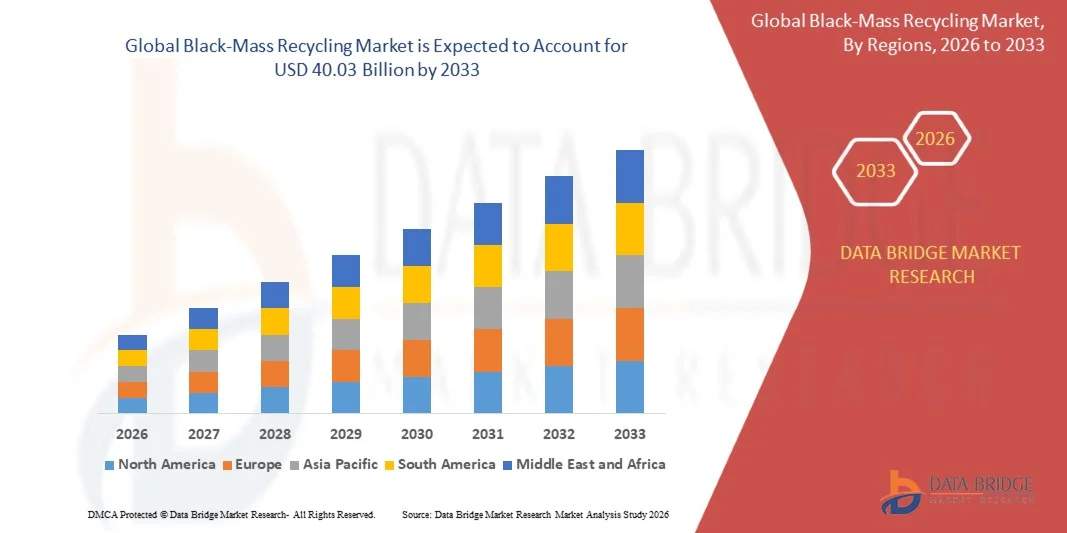
- As per Data Bridge Market Research analysis, the black-mass recycling market was valued at USD 11.80 billion in 2025 and is projected to reach USD 40.03 billion by 2033, growing at a CAGR of 16.50% from 2026 to 2033.
- The market is experiencing consistent growth driven by rising volumes of end-of-life electric vehicle batteries and manufacturing scrap, tightening battery recycling regulations, and growing demand for secure, low-carbon supplies of lithium, nickel, cobalt, and manganese across battery manufacturing, metal refining, and chemical industries.
- The increasing shift toward battery circularity, domestic critical mineral supply chains, and closed-loop cathode production, combined with growing integration of black-mass processing with cathode and precursor manufacturing, is supporting market adoption. Black mass is being processed within lithium-ion battery recycling networks, electric vehicle battery supply chains, energy storage systems, and battery materials production, offering manufacturers a cost-competitive and lower-carbon source of nickel, cobalt, lithium, and manganese from battery recycling streams.
Market Size & Forecast
- Global Market Value (2025): USD 11.80 Billion
- Expected Market Value (2033): USD 40.03 Billion
- Forecast CAGR (2026–2033): 16.50%
- Leading Region in 2025: Asia-Pacific
- Fastest Growing Region: Europe
What are the Major Takeaways of the Black-Mass Recycling Market?
- Asia-Pacific dominated the black-mass recycling market with the largest revenue share of 58.72% in 2025, supported by extensive battery manufacturing, large recycling and refining capacity in China, and strong domestic demand for recovered nickel, cobalt, and lithium.
- Europe is expected to be the fastest-growing region at a CAGR of 19.84% from 2026 to 2033, fueled by the EU Battery Regulation, the hazardous waste classification of black mass, and expanding domestic recycling and refining capacity.
- The NMC segment led the market with a 63.4% share in 2025, driven by the high nickel and cobalt content of NMC batteries and their wide use in electric vehicles.
- LFP is the fastest-growing battery chemistry, projected to register a CAGR of 21.70%, reflecting the rapid rise of LFP batteries in electric vehicles and energy storage and the growing recovery of lithium from them.
- The hydrometallurgical segment dominated the recycling process category with a 56.28% revenue share in 2025, led by its high metal recovery rates and ability to produce battery-grade materials.
- Manufacturing scrap accounted for 47.56% of the market share in 2025, preferred by recyclers for its consistent composition, high metal content, and predictable availability from cell and cathode production.
- The end-of-life electric vehicle batteries segment is the fastest-growing source category, with a CAGR of 20.90%, driven by the growing number of electric vehicles reaching the end of their service life.
Report Scope and Black-Mass Recycling Market Segmentation
|
Attributes |
Black-Mass Recycling Key Market Insights |
|
Segments Covered |
|
|
Countries Covered |
North America
Europe
Asia-Pacific
Middle East and Africa
South America
|
|
Key Market Players |
|
|
Market Opportunities |
|
|
Value Added Data Infosets |
In addition to the insights on market scenarios such as market value, growth rate, segmentation, geographical coverage, and major players, the market reports curated by the Data Bridge Market Research also include import export analysis, production capacity overview, production consumption analysis, price trend analysis, climate change scenario, supply chain analysis, value chain analysis, raw material/consumables overview, vendor selection criteria, PESTLE Analysis, Porter Analysis, and regulatory framework. |
What is the Key Trend in the Black-Mass Recycling Market?
- Black-mass recycling is increasingly evolving from a simple intermediate step in battery recycling into a strategic critical-minerals platform, combining mechanical pre-treatment, hydrometallurgical refining, and integration with cathode production to recover battery-grade nickel, cobalt, lithium, and manganese for use in new batteries.
- Regulation is increasingly shaping trade flows, as governments classify black mass either as a hazardous waste or as a tradable raw material, encouraging processing closer to the point of battery collection and creating distinct regional markets for compliant material.
- Battery makers, automakers, and mining and metals companies are integrating vertically into battery recycling through acquisitions, partnerships, and in-house plants, seeking secure feedstock, control over recycled content, and a lower-carbon supply of battery metals.
- For instance, in June 2025, according to Bergeson & Campbell, China announced that qualifying black mass would no longer be treated as solid waste and could be imported freely from 1 August 2025, reflecting the country’s large unused refining capacity, with some estimates placing more than 85% of worldwide black-mass refining capacity in China and 70–80% of it idle, indicating the formation of a more open trade in compliant black mass.
- As recycling technologies, regional regulations, and integration with cathode manufacturing continue to advance, black-mass recycling is expected to expand from a supporting recycling step into a core source of battery-grade metals across electric mobility, energy storage, and consumer electronics.
What are the Key Drivers of the Black-Mass Recycling Market?
- The rapid growth of electric vehicles, energy storage systems, and battery manufacturing is generating rising volumes of production scrap and end-of-life batteries, significantly increasing the supply of black mass and the need for domestic, secure sources of nickel, cobalt, lithium, and manganese.
- For instance, in March 2025, according to Resource Media, the European Commission amended the European List of Waste to classify black mass from battery recycling as hazardous waste, restricting exports to non-OECD countries and helping retain critical battery materials within the EU’s circular economy, highlighting the role of regulation in building domestic recycling capacity.
- Battery regulations and recycled content and recovery targets are increasingly requiring manufacturers to use recovered materials in new batteries, while automakers and cell makers seek to reduce exposure to volatile primary metal supply and lower the carbon footprint of their batteries.
- For instance, in December 2025, according to Malay Mail, the European Commission’s REsourceEU plan committed €3 billion over the next year to fast-track critical raw materials projects, with the Joint Research Centre estimating that the EU could treat around 50–65% of the black mass it produces, supporting the expansion of European recycling capacity.
- With electric vehicle fleets ageing, recycling regulations tightening, and governments prioritizing critical mineral security, black-mass recycling can support a steady supply of recovered battery metals, lower the carbon footprint of battery production, and integrate with cathode and precursor manufacturing.
What Factors Are Challenging the Growth of the Black-Mass Recycling Market?
- Black-mass recycling requires substantial capital investment in collection, pre-treatment, and refining facilities, and its profitability depends on volatile prices of nickel, cobalt, and lithium, increasing financial risk for recyclers.
- For instance, in May 2025, according to Manufacturing Dive, Li-Cycle initiated bankruptcy proceedings after its USD 485 million Rochester Hub project was paused because of rising costs, and its assets were later acquired by Glencore, highlighting the financial challenges of scaling recycling infrastructure.
- Variations in feedstock composition, including changing battery chemistries such as LFP, contamination, and inconsistent black-mass quality, can reduce recovery yields and complicate processing, making it difficult for recyclers to maintain consistent output specifications.
- Differences in how regions classify and regulate black mass, together with safety, storage, and transport requirements for end-of-life batteries, can restrict cross-border trade, increase compliance costs, and limit the flexibility of recyclers to source feedstock and sell output.
- For instance, in February 2026, according to Fraunhofer ISI, recycling capacities for lithium-ion batteries in Europe are expected to exceed demand for the time being, with spoke capacity projected to rise to 420 kilotonnes per year by the end of 2026 despite several cancelled projects, indicating a risk of underutilized capacity.
- The combination of high capital requirements, metal price volatility, feedstock variability, and regulatory divergence can constrain the profitability and scale-up of black-mass recyclers, particularly smaller and newly established operators without secure feedstock or offtake agreements.
How is the Black-Mass Recycling Market Segmented?
The black-mass recycling market is segmented on the basis of battery chemistry, recycling process, source, and recovered material.
- By Battery Chemistry
On the basis of battery chemistry, the black-mass recycling market is segmented into lithium nickel manganese cobalt oxide (NMC), lithium iron phosphate (LFP), lithium cobalt oxide (LCO), lithium nickel cobalt aluminum oxide (NCA), and others. The NMC segment dominated the market with 63.4% share in 2025, supported by the high nickel and cobalt content of NMC batteries and their wide use in electric vehicles. NMC black mass carries a higher metal value than most other chemistries, making it the preferred feedstock for refiners. Large volumes of NMC production scrap from cell and cathode manufacturers further support supply. Established hydrometallurgical processes are well suited to recovering nickel, cobalt, and manganese from NMC. Demand from battery makers seeking recycled nickel and cobalt for new cathodes also strengthens the segment.
The LFP segment is projected to register the fastest growth at a CAGR of 21.70% from 2026 to 2033, driven by the rapid rise of LFP batteries in electric vehicles and energy storage systems. As LFP batteries reach end of life, they are creating a growing stream of black mass in which lithium, rather than nickel or cobalt, is the main recoverable value. Processes designed for lithium, graphite, and iron phosphate recovery are improving the economics of LFP recycling. Regulatory targets for lithium recovery are further encouraging investment in LFP-capable capacity. Recyclers are also developing direct recycling and cathode regeneration routes suited to LFP.
- By Recycling Process
On the basis of recycling process, the black-mass recycling market is segmented into hydrometallurgical, pyrometallurgical, and direct recycling. The hydrometallurgical segment dominated the market with 56.28% share in 2025, supported by high recovery rates for lithium, nickel, cobalt, and manganese and the ability to produce battery-grade salts. Hydrometallurgical plants can process a wide range of chemistries and operate at lower temperatures than smelting. The process integrates well with precursor and cathode manufacturing, allowing recovered metals to return directly to battery supply chains. Growing investment in refining capacity in Asia-Pacific and Europe further supports the segment.
The direct recycling segment is projected to register the fastest growth at a CAGR of 22.60% from 2026 to 2033, supported by its potential to recover cathode materials without fully breaking them down into elemental components. Direct recycling can preserve the structure of cathode materials, reducing energy use, chemical consumption, and processing steps compared with other routes. It is particularly relevant for LFP and for high-quality production scrap. Pilot and demonstration plants are moving toward commercial scale. Collaboration between recyclers, cell makers, and research institutions is further improving process performance and material quality.
- By Source
On the basis of source, the black-mass recycling market is segmented into manufacturing scrap, end-of-life electric vehicle batteries, consumer electronics batteries, and energy storage batteries. The manufacturing scrap segment dominated the source category with 47.56% share in 2025, supported by the consistent composition, high metal content, and predictable availability of scrap from cell and cathode production. Gigafactory ramp-ups, electrode rejects, and off-specification cells generate large volumes of clean material. Producers often secure offtake and recycling agreements for their scrap. Because scrap is available before large volumes of vehicles retire, it currently provides the most reliable feedstock for recyclers.
The end-of-life electric vehicle batteries segment is projected to register the fastest growth at a CAGR of 20.90% from 2026 to 2033, driven by the growing number of electric vehicles reaching the end of their service life. Rising vehicle sales over the past decade are expected to translate into larger volumes of retired battery packs. Automakers are establishing take-back programs and partnerships with recyclers to secure these batteries. Collection, dismantling, and safe transport networks are expanding. Producer responsibility and recycled content requirements are further increasing the volume routed to recycling.
- By Recovered Material
On the basis of recovered material, the black-mass recycling market is segmented into nickel, cobalt, lithium, manganese, graphite, and others. The nickel segment dominated the recovered material category with 34.72% share in 2025, supported by its high content in NMC black mass and its use in cathode precursors, stainless steel, and alloys. Recovered nickel can be supplied as sulfate for battery cathodes or as metal for industrial uses. Demand from battery makers and metals producers supports offtake. Established refining routes and mature markets for nickel products help recyclers monetize black mass. Rising interest in lower-carbon nickel further strengthens the segment.
The lithium segment is projected to register the fastest growth at a CAGR of 21.30% from 2026 to 2033, driven by regulatory recovery targets, growing volumes of LFP black mass, and improving lithium extraction technologies. Recovered lithium can be supplied as lithium carbonate or hydroxide for new batteries. Recycled lithium offers battery makers a domestic and lower-carbon source of supply. Advances in selective extraction are improving yields and purity. Government support for critical mineral recycling is further encouraging investment.
Which Region Holds the Largest Share of the Black-Mass Recycling Market?
- Asia-Pacific dominated the black-mass recycling market with the largest revenue share of 58.72% in 2025, supported by extensive battery manufacturing, large recycling and refining capacity in China, and strong domestic demand for recovered nickel, cobalt, and lithium.
- The region also benefits from a dense network of cathode and precursor producers, established hydrometallurgical refiners, and government support for battery recycling and circular economy programs. Growing imports of compliant black mass, expanding electric vehicle fleets, and integration of recyclers with battery makers continue to strengthen Asia-Pacific’s position in the global market.
Asia-Pacific Black-Mass Recycling Market Insight
The Asia-Pacific black-mass recycling market is expected to witness rapid growth, driven by large-scale battery manufacturing, expanding electric vehicle fleets, and strong refining capacity across countries such as China, South Korea, and Japan. Growing volumes of production scrap, supportive recycling policies, and integration of recyclers with cathode and precursor producers are supporting regional market expansion. In addition, the region’s established hydrometallurgical infrastructure and growing trade in compliant black mass are accelerating demand for processing capacity.
China Black-Mass Recycling Market Insight
The China black-mass recycling market is growing rapidly, driven by the world’s largest battery manufacturing and electric vehicle base, extensive refining capacity, and supportive national standards for recycled black mass. Growing volumes of manufacturing scrap and retired batteries are significantly boosting feedstock supply, while the relaxation of import rules for qualifying black mass is expanding access to overseas material. In addition, strong integration between recyclers, battery makers, and cathode producers is positioning China as a key market for black-mass recycling in Asia-Pacific.
South Korea Black-Mass Recycling Market Insight
The South Korea black-mass recycling market is witnessing consistent growth due to its large cell manufacturing industry, established recyclers, and strong demand for recycled nickel and cobalt from domestic battery producers. Battery makers, automakers, and recyclers are increasingly forming partnerships to secure production scrap and end-of-life batteries. Moreover, government focus on critical mineral security and circular battery supply chains is further contributing to market growth in South Korea.
Europe Black-Mass Recycling Market Insight
The Europe black-mass recycling market is expected to expand rapidly, supported by the EU Battery Regulation, recycled content and recovery targets, and the classification of black mass as hazardous waste, which keeps material within the region. Automakers, cell producers, and recyclers are investing in pre-treatment and refining capacity to serve the growing regional battery industry. Furthermore, funding programs under the Critical Raw Materials Act and the REsourceEU plan are supporting new recycling projects across the region.
Germany Black-Mass Recycling Market Insight
The Germany black-mass recycling market is expanding steadily due to the country’s strong automotive industry, advanced chemical sector, and growing investment in battery recycling plants. Chemical companies, automakers, and recyclers are increasingly developing black-mass production and refining capacity to support domestic cathode production and comply with EU requirements. Continuous advancements in process technology, along with Germany’s focus on environmental standards and resource efficiency, are further driving market growth in the country.
U.S. Black-Mass Recycling Market Insight
The U.S. black-mass recycling market is witnessing steady growth due to rising electric vehicle adoption, expanding domestic battery manufacturing, and policy support for critical mineral supply chains. The country’s growing base of recyclers, automakers, and battery makers is increasing investment in collection, pre-treatment, and refining capacity. In addition, growing emphasis on domestic supply of nickel, cobalt, and lithium is accelerating adoption of black-mass processing across recycling and battery manufacturing applications.
Which are the Top Companies in Black-Mass Recycling Market?
The black-mass recycling industry is primarily led by well-established companies, including:
- Umicore (Belgium)
- Glencore plc (Switzerland)
- BASF SE (Germany)
- Redwood Materials, Inc. (U.S.)
- Fortum Oyj (Finland)
- Guangdong Brunp Recycling Technology Co., Ltd. (China)
- GEM Co., Ltd. (China)
- Zhejiang Huayou Cobalt Co., Ltd. (China)
- SungEel HiTech Co., Ltd. (South Korea)
- Sumitomo Metal Mining Co., Ltd. (Japan)
- Cirba Solutions (U.S.)
- American Battery Technology Company (U.S.)
- Ascend Elements, Inc. (U.S.)
- Stena Recycling AB (Sweden)
- Altilium (U.K.)
- Electra Battery Materials Corporation (Canada)
- Aqua Metals, Inc. (U.S.)
- Duesenfeld GmbH (Germany)
- Ace Green Recycling, Inc. (U.S.)
- TES (Singapore)
What are Latest Developments in Black-Mass Recycling Market?
- In September 2026, Electra Battery Materials Corporation announced preliminary engineering results for the initial phase of a proposed two-phase nickel refinery designed to process mine-derived feedstock and recycled battery black mass, with a second phase that could add black-mass processing and about 20,000 tonnes per year of contained nickel capacity, along with cobalt, lithium, and graphite by-products.
- In August 2025, Glencore completed its acquisition of Li-Cycle, covering spoke facilities in Arizona, Alabama, New York, Ontario, and Germany that convert used batteries into black mass, the Rochester hub project, and Li-Cycle’s intellectual property, with services to be provided through Glencore Battery Recycling, following a purchase agreement signed in May 2025 and approval by the Ontario Superior Court of Justice.
- In July 2025, China’s national standard for recycled black mass for lithium-ion batteries (GB/T 45203-2024) took effect, classifying recycled black mass into two categories and setting quality specifications to support more transparent cross-border trade, distinguishing black mass by battery chemistry and by whether it derives from batteries or electrode scrap, ahead of China opening imports of qualifying black mass from 1 August 2025.
- In June 2025, BASF started commercial operation of its black mass plant in Schwarzheide, Germany, complementing the site’s fully automated cathode active materials plant and prototype metal refinery for battery recycling, and forming part of BASF’s European offering that covers collection, dismantling, black mass production, and refining with partners such as Stena Recycling.
- In January 2025, Ace Green Recycling entered a strategic partnership with Spiro to serve as its exclusive global recycling partner for end-of-life lithium-ion and LFP batteries, as well as manufacturing waste, supporting closed-loop recovery of battery materials from Spiro’s used batteries and production scrap.

- Interactive Data Analysis Dashboard
- Company Analysis Dashboard for high growth potential opportunities
- Research Analyst Access for customization & queries
- Competitor Analysis with Interactive dashboard
- Latest News, Updates & Trend analysis
- Harness the Power of Benchmark Analysis for Comprehensive Competitor Tracking
Global Black Mass Recycling Market, Supply Chain Analysis and Ecosystem Framework
To support market growth and help clients navigate the impact of geopolitical shifts, DBMR has integrated in-depth supply chain analysis into its Global Black Mass Recycling Market research reports. This addition empowers clients to respond effectively to global changes affecting their industries. The supply chain analysis section includes detailed insights such as Global Black Mass Recycling Market consumption and production by country, price trend analysis, the impact of tariffs and geopolitical developments, and import and export trends by country and HSN code. It also highlights major suppliers with data on production capacity and company profiles, as well as key importers and exporters. In addition to research, DBMR offers specialized supply chain consulting services backed by over a decade of experience, providing solutions like supplier discovery, supplier risk assessment, price trend analysis, impact evaluation of inflation and trade route changes, and comprehensive market trend analysis.
Data collection and base year analysis are done using data collection modules with large sample sizes. The stage includes obtaining market information or related data through various sources and strategies. It includes examining and planning all the data acquired from the past in advance. It likewise envelops the examination of information inconsistencies seen across different information sources. The market data is analysed and estimated using market statistical and coherent models. Also, market share analysis and key trend analysis are the major success factors in the market report. To know more, please request an analyst call or drop down your inquiry.
The key research methodology used by DBMR research team is data triangulation which involves data mining, analysis of the impact of data variables on the market and primary (industry expert) validation. Data models include Vendor Positioning Grid, Market Time Line Analysis, Market Overview and Guide, Company Positioning Grid, Patent Analysis, Pricing Analysis, Company Market Share Analysis, Standards of Measurement, Global versus Regional and Vendor Share Analysis. To know more about the research methodology, drop in an inquiry to speak to our industry experts.
Data Bridge Market Research is a leader in advanced formative research. We take pride in servicing our existing and new customers with data and analysis that match and suits their goal. The report can be customized to include price trend analysis of target brands understanding the market for additional countries (ask for the list of countries), clinical trial results data, literature review, refurbished market and product base analysis. Market analysis of target competitors can be analyzed from technology-based analysis to market portfolio strategies. We can add as many competitors that you require data about in the format and data style you are looking for. Our team of analysts can also provide you data in crude raw excel files pivot tables (Fact book) or can assist you in creating presentations from the data sets available in the report.













