


Blastic Plasmacytoid Dendritic Cell Neoplasm Treatment Market Size
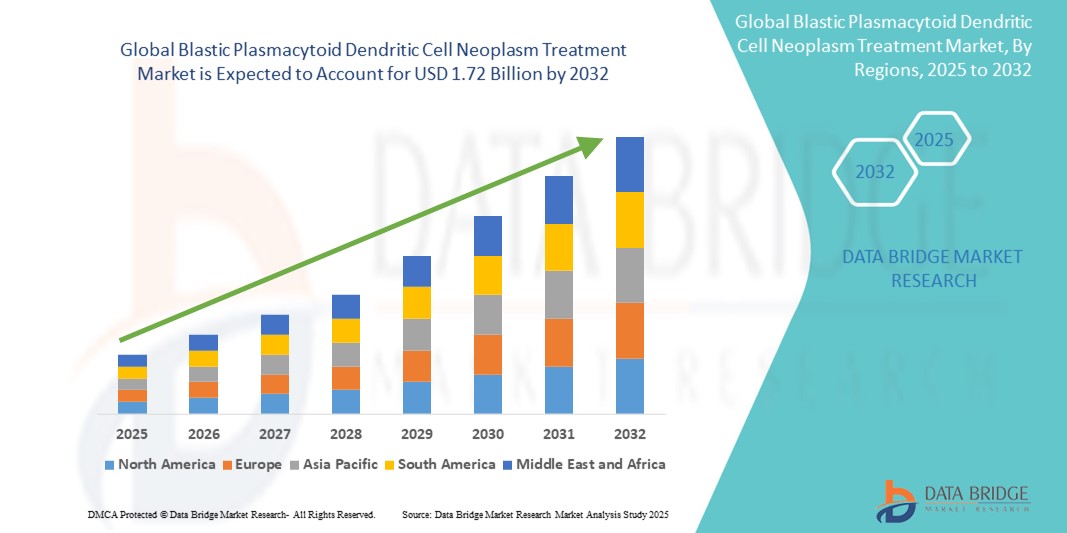
- The global blastic plasmacytoid dendritic cell neoplasm treatment market size was valued at USD 1.3 Billion in 2024 and is expected to reach USD 1.72 Billion by 2032, at a CAGR of 3.60% during the forecast period
- This growth is driven by factors such as the increasing incidence of hematologic malignancies, rising use of novel agents such as tagraxofusp (Elzonris), and growing clinical awareness among oncologists regarding early diagnosis and personalized treatment of BPDCN
Blastic Plasmacytoid Dendritic Cell Neoplasm Treatment Market Analysis
- Blastic Plasmacytoid Dendritic Cell Neoplasm is a rare and aggressive hematologic cancer derived from plasmacytoid dendritic cells, most often affecting older adults and characterized by skin lesions, bone marrow involvement, and a poor prognosis if left untreated. The primary goal of treatment is disease remission and long-term survival, often achieved through targeted therapies, chemotherapy, or hematopoietic stem cell transplantation
- The demand for Blastic Plasmacytoid Dendritic Cell Neoplasm treatment is fueled by improved diagnostic accuracy using immunophenotyping and cytogenetics, increased regulatory approvals of novel therapies such as tagraxofusp, and the expansion of clinical trials investigating combination regimens and immune-based strategies
- North America is expected to dominate the Blastic Plasmacytoid Dendritic Cell Neoplasm treatment market with a share of 33.4%, owing to robust clinical infrastructure, the presence of key players, early adoption of FDA-approved therapies, and supportive reimbursement frameworks
- Asia-Pacific is projected to be the fastest-growing region in the Blastic Plasmacytoid Dendritic Cell Neoplasm treatment market during the forecast period due to increasing patient awareness, a rise in cancer screening programs, and expanding access to hematology and oncology care across emerging economies
- The targeted therapy segment is expected to lead the market with a market share of 44.15% due to its specificity for CD123-positive malignant cells, favorable safety profile compared to intensive chemotherapy, and growing global uptake following regulatory endorsements in multiple region
Report Scope and Blastic Plasmacytoid Dendritic Cell Neoplasm Treatment Market Segmentation
|
Attributes |
Blastic Plasmacytoid Dendritic Cell Neoplasm Treatment Key Market Insights |
|
Segments Covered |
|
|
Countries Covered |
North America
Europe
Asia-Pacific
Middle East and Africa
South America
|
|
Key Market Players |
|
|
Market Opportunities |
|
|
Value Added Data Infosets |
In addition to the insights on market scenarios such as market value, growth rate, segmentation, geographical coverage, and major players, the market reports curated by the Data Bridge Market Research also include depth expert analysis, patient epidemiology, pipeline analysis, pricing analysis, and regulatory framework. |
Blastic Plasmacytoid Dendritic Cell Neoplasm Treatment Market Trends
“Increasing Diagnosis and Availability of Targeted Therapies”
- One prominent trend in the Blastic Plasmacytoid Dendritic Cell Neoplasm (BPDCN) Treatment market is the increasing rate of diagnosis coupled with the launch of targeted biologics such as tagraxofusp-erzs (Elzonris)
- As clinical awareness grows among hematologists and oncologists, especially regarding early-stage BPDCN, more patients are being diagnosed before the disease progresses to advanced stages
- For instance, novel treatments such as Elzonris by Stemline Therapeutics have demonstrated strong efficacy in targeting CD123-positive cells, providing a much-needed solution for a previously underserved patient population
- This trend is significantly transforming BPDCN management, enabling earlier intervention, reducing the need for intensive chemotherapy, and improving patient survival outcomes
- The BPDCN Treatment market is expected to witness sustained growth, supported by increased diagnostic capabilities, ongoing innovation in targeted oncology therapies, and a focus on improving quality of life for patients with rare hematologic malignancies
Blastic Plasmacytoid Dendritic Cell Neoplasm Treatment Market Dynamics
Driver
“Growing Need Due to Rising Prevalence and Awareness of Rare Diseases”
- The increasing recognition and diagnosis of Blastic Plasmacytoid Dendritic Cell Neoplasm (BPDCN)—a rare and aggressive hematologic malignancy—are significantly contributing to the growing demand for effective targeted and cytotoxic treatments
- As awareness of rare and orphan blood cancers improves globally, more patients are being correctly diagnosed, which drives the demand for specialized therapies, including CD123-targeted agents, monoclonal antibodies, and stem cell transplantation protocols
- The growing prevalence of associated conditions, such as myelodysplastic syndromes and chronic myelomonocytic leukemia, further elevates the need for targeted treatments
- Ongoing advances in molecular diagnostics and precision oncology highlight the necessity for disease-specific drug development, improving response rates and long-term remission
- With a greater number of patients seeking medical intervention and access to treatment programs, the demand for BPDCN therapies continues to rise, supporting long-term market growth
For instance,
- In August 2023, according to a study published by the American Society of Hematology (ASH), increased awareness initiatives and improved diagnostic protocols led to a surge in BPDCN detection, which had historically been underdiagnosed due to symptom overlap with other hematologic disorders
- In March 2022, an article published in the Orphanet Journal of Rare Diseases reported that enhanced rare disease surveillance and biomarker testing identified rising incidences of BPDCN, boosting demand for novel targeted therapeutics.
- As a result of rising disease prevalence and global rare disease advocacy, there is a substantial increase in demand for innovative therapies in the Blastic Plasmacytoid Dendritic Cell Neoplasm Treatment market.
Opportunity
“Breakthroughs in Targeted Therapies and Orphan Drug Designations”
- The development of targeted therapies, including CD123-directed cytotoxins and monoclonal antibodies, presents significant opportunities in the Blastic Plasmacytoid Dendritic Cell Neoplasm Treatment market
- Orphan drug designations and regulatory incentives such as priority review, market exclusivity, and research grants are encouraging pharmaceutical firms to invest in R&D for this aggressive hematologic malignancy
- Targeted treatments such as tagraxofusp-erzs (Elzonris) and novel agents in clinical development show promising results in improving remission rates and reducing relapse risk
For instance,
- In January 2025, a clinical update published in Blood Advances highlighted that CD123-targeted therapies significantly improved overall survival in patients with newly diagnosed and relapsed/refractory BPDCN, supporting their adoption as standard of care
- In October 2023, the U.S. FDA granted Orphan Drug Designation to an investigational antibody-drug conjugate developed by a U.S.-based biotech firm, expediting its clinical pathway and attracting strategic investments
- The regulatory and scientific momentum surrounding targeted hematologic therapies, backed by orphan drug policies, positions the Blastic Plasmacytoid Dendritic Cell Neoplasm Treatment market for substantial growth in the coming years
Restraint/Challenge
“High Treatment Costs Limiting Accessibility”
- The high cost of BPDCN treatments, particularly biologic agents such as Elzonris, poses a significant challenge, limiting accessibility for many patients worldwide, especially in developing regions
- These treatments, which are often essential for disease remission and survival, can cost hundreds of thousands of dollars per treatment course, placing financial pressure on healthcare systems and patients
- Limited reimbursement support and restricted insurance coverage for orphan oncology drugs in various markets further exacerbate the affordability issue
For instance,
- In November 2024, an article by Health Affairs Oncology reported that the annual cost of tagraxofusp-erzs therapy could exceed USD 300,000, deterring broad access despite its proven efficacy in aggressive hematologic malignancies
- In May 2023, a review published in Rare Disease Reports highlighted the cost-related challenges faced by BPDCN patients in low-resource settings, where access to novel biologics remains limited due to pricing and infrastructure constraints
- These economic limitations contribute to disparities in treatment availability and outcomes, ultimately impeding broader adoption of advanced BPDCN therapies and slowing global market expansion
Blastic Plasmacytoid Dendritic Cell Neoplasm Treatment Market Scope
The market is segmented on the basis of treatment Type, disease stages, and end user.
|
Segmentation |
Sub-Segmentation |
|
By treatment Type |
|
|
By Disease Stages |
|
|
By End User |
|
In 2025, the Targeted Therapy segment is projected to dominate the market with the largest share in the treatment type segment.
The Targeted Therapy segment is expected to dominate the Global Blastic Plasmacytoid Dendritic Cell Neoplasm (BPDCN) Treatment Market with the largest share of 44.15% in 2025 due to its specificity in targeting malignant cells, regulatory approvals, and increasing adoption among oncologists. Tagraxofusp-erzs, the first FDA-approved CD123-directed therapy for Blastic Plasmacytoid Dendritic Cell Neoplasm (BPDCN), has demonstrated significant clinical efficacy. Its ability to selectively target and eradicate malignant plasmacytoid dendritic cells, coupled with growing awareness and reimbursement support, continues to solidify its leading position in the Blastic Plasmacytoid Dendritic Cell Neoplasm (BPDCN) treatment landscape.
The Stage II segment is expected to account for the largest share during the forecast period in the disease stage segment.
In 2025, the Stage II segment is expected to dominate the market due to the increasing diagnosis rate at this intermediate disease stage, where patients show systemic involvement but remain eligible for aggressive targeted and combination therapy. Timely diagnosis and intervention at this stage provide a therapeutic window for improved clinical outcomes and potential remission. The availability of advanced diagnostic tools and CD123-targeted therapeutics is driving rapid uptake in this segment
Blastic Plasmacytoid Dendritic Cell Neoplasm (BPDCN) Treatment Market Regional Analysis
“North America Holds the Largest Share in the Blastic Plasmacytoid Dendritic Cell Neoplasm (BPDCN) Treatment Market”
• North America dominates the Blastic Plasmacytoid Dendritic Cell Neoplasm (BPDCN) Treatment Market with a share of 36.4%, driven by advanced healthcare infrastructure, early access to approved therapies such as Elzonris, and the strong presence of leading biopharmaceutical companies
• The U.S. holds a significant share of 78.3% due to strong demand for targeted therapies, robust clinical trial activity, and a growing patient pool benefiting from early diagnosis and treatment of rare hematologic malignancies such as Blastic Plasmacytoid Dendritic Cell Neoplasm (BPDCN)
• The presence of key market players such as Stemline Therapeutics, Pfizer, and Jazz Pharmaceuticals, along with continuous advancements in molecular diagnostics and orphan drug research, supports innovation in the Blastic Plasmacytoid Dendritic Cell Neoplasm (BPDCN) treatment space
• Additionally, increased healthcare investment in research and development (R&D), as well as comprehensive reimbursement frameworks, enhances patient access to novel treatments, further supporting market expansion in the region
“Asia-Pacific is Projected to Register the Highest CAGR in the Blastic Plasmacytoid Dendritic Cell Neoplasm (BPDCN) Treatment Market”
• The Asia-Pacific region is expected to witness the highest growth rate in the Blastic Plasmacytoid Dendritic Cell Neoplasm (BPDCN) Treatment Market, driven by expanding healthcare systems, improving awareness of rare hematologic cancers, and rising demand for advanced cancer therapies
• Countries such as China, India, and Japan are emerging as key markets for Blastic Plasmacytoid Dendritic Cell Neoplasm (BPDCN) therapeutics due to improved disease recognition, increased investment in oncology infrastructure, and broader access to advanced therapies through international collaborations and regulatory harmonization
• Japan, with its highly developed clinical research environment and established oncology care network, remains a critical market for Blastic Plasmacytoid Dendritic Cell Neoplasm (BPDCN) treatments. The country is advancing in the adoption of precision oncology and orphan drug therapeutics, improving patient care and survival outcomes
• Rising government focus on rare disease management, investment in cancer research, and increasing participation in global clinical trials position the APAC region as the fastest-growing market for Blastic Plasmacytoid Dendritic Cell Neoplasm (BPDCN) treatment
Blastic Plasmacytoid Dendritic Cell Neoplasm Treatment Market Share
The market competitive landscape provides details by competitor. Details included are company overview, company financials, revenue generated, market potential, investment in research and development, new market initiatives, global presence, production sites and facilities, production capacities, company strengths and weaknesses, product launch, product width and breadth, application dominance. The above data points provided are only related to the companies' focus related to market.
The Major Market Leaders Operating in the Market Are:
- Stemline Therapeutics (U.S.)
- Pfizer Inc. (U.S.)
- F. Hoffmann-La Roche Ltd. (Switzerland)
- AbbVie Inc. (U.S.)
- Incyte Corporation (U.S.)
- Novartis AG (Switzerland)
- Genentech, Inc. (U.S.)
- Merck & Co., Inc. (U.S.)
- Regeneron Pharmaceuticals, Inc. (U.S.)
- Santen Pharmaceutical Co., Ltd. (Japan)
- Eyevance Pharmaceuticals (U.S.)
- Alcon Inc. (Switzerland)
- Kala Pharmaceuticals, Inc. (U.S.)
- Johnson & Johnson (U.S.)
- Ocuphire Pharma, Inc. (U.S.)
- Nicox S.A. (France)
Latest Developments in Global Blastic Plasmacytoid Dendritic Cell Neoplasm Treatment Market
- In February 2025, Stemline Therapeutics announced the global expansion of Elzonris (tagraxofusp-erzs), the first FDA-approved CD123-targeted therapy for BPDCN, to additional markets including Brazil, South Korea, and select EU countries. This expansion is expected to improve access to frontline targeted therapy, strengthening the company’s global footprint and improving patient outcomes in previously underserved regions.
- In October 2024, Jazz Pharmaceuticals launched a clinical development program for its next-generation CD123 x CD3 bispecific antibody designed specifically for relapsed or refractory BPDCN. This investigational therapy is aimed at enhancing T-cell mediated cytotoxicity with a better safety profile, offering a promising alternative to current therapies and marking a significant innovation in immunotherapeutic approaches.
- In August 2024, AbbVie announced the initiation of a Phase II trial evaluating its novel BCL-2 inhibitor, navitoclax, in combination with hypomethylating agents for BPDCN patients unfit for intensive chemotherapy. This combination is being studied for its potential to induce apoptosis in malignant dendritic cells and expand treatment options for elderly or high-risk patients.
- In May 2024, Genentech (a member of the Roche Group) launched preclinical studies of a CD123-directed antibody-drug conjugate (ADC) for BPDCN under its hematologic malignancy pipeline. This ADC is engineered to deliver a cytotoxic payload directly to CD123-expressing cells, offering a highly selective and potent mechanism of action aimed at improving remission rates in early-stage trials

- Interactive Data Analysis Dashboard
- Company Analysis Dashboard for high growth potential opportunities
- Research Analyst Access for customization & queries
- Competitor Analysis with Interactive dashboard
- Latest News, Updates & Trend analysis
- Harness the Power of Benchmark Analysis for Comprehensive Competitor Tracking
Data collection and base year analysis are done using data collection modules with large sample sizes. The stage includes obtaining market information or related data through various sources and strategies. It includes examining and planning all the data acquired from the past in advance. It likewise envelops the examination of information inconsistencies seen across different information sources. The market data is analysed and estimated using market statistical and coherent models. Also, market share analysis and key trend analysis are the major success factors in the market report. To know more, please request an analyst call or drop down your inquiry.
The key research methodology used by DBMR research team is data triangulation which involves data mining, analysis of the impact of data variables on the market and primary (industry expert) validation. Data models include Vendor Positioning Grid, Market Time Line Analysis, Market Overview and Guide, Company Positioning Grid, Patent Analysis, Pricing Analysis, Company Market Share Analysis, Standards of Measurement, Global versus Regional and Vendor Share Analysis. To know more about the research methodology, drop in an inquiry to speak to our industry experts.
Data Bridge Market Research is a leader in advanced formative research. We take pride in servicing our existing and new customers with data and analysis that match and suits their goal. The report can be customized to include price trend analysis of target brands understanding the market for additional countries (ask for the list of countries), clinical trial results data, literature review, refurbished market and product base analysis. Market analysis of target competitors can be analyzed from technology-based analysis to market portfolio strategies. We can add as many competitors that you require data about in the format and data style you are looking for. Our team of analysts can also provide you data in crude raw excel files pivot tables (Fact book) or can assist you in creating presentations from the data sets available in the report.













