


What is the Blockchain Smartphones Market Size and Growth Rate?
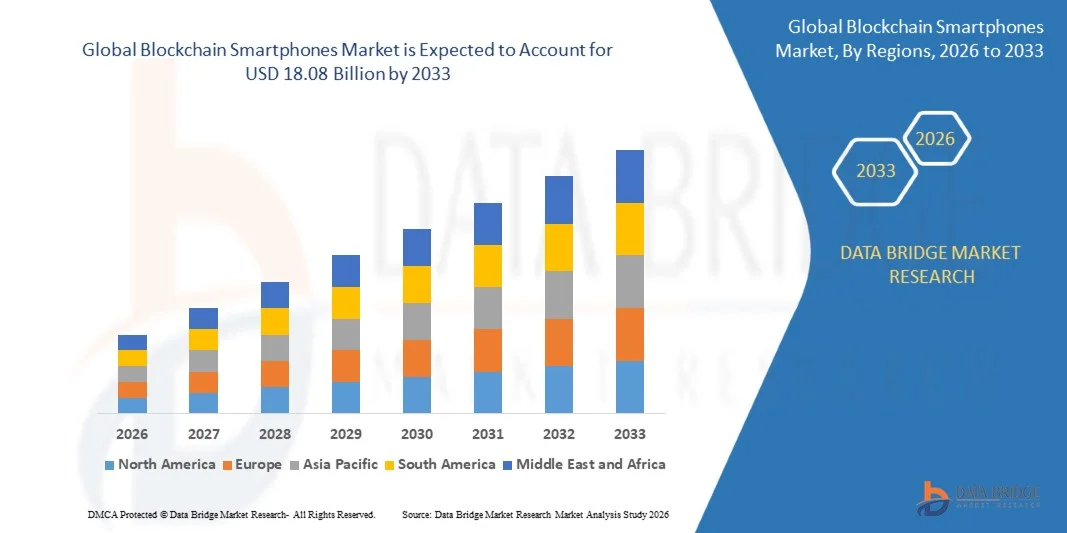
- As per Data Bridge Market Research analysis, the blockchain smartphones market was valued at USD 1.61 billion in 2025 and is projected to reach USD 18.08 billion by 2033, growing at a CAGR of 35.30% from 2026 to 2033.
- The market is experiencing rapid growth driven by increasing demand for enhanced mobile security and privacy, rising adoption of cryptocurrencies and decentralized applications, and the integration of blockchain-based features such as secure digital wallets, decentralized identity, and private-key management into smartphones.
- The growing need for secure digital transactions, combined with increasing concerns over data breaches, identity theft, and centralized control of personal information, is encouraging consumers and enterprises to adopt blockchain-enabled smartphones. Advanced cryptographic security, Web3 applications, secure communication, and blockchain-based digital asset management are expanding the use of these devices across emerging and developed markets.
Market Size & Forecast
- Global Market Value (2025): USD 1.61 Billion
- Expected Market Value (2033): USD 18.08 Billion
- Forecast CAGR (2026–2033): 35.30%
- Leading Region in 2025: North America
- Fastest Growing Region: Asia Pacific
What are the Major Takeaways of the Blockchain Smartphones Market?
- North America dominated the blockchain smartphones market with the largest revenue share of 35.02% in 2025, supported by high cryptocurrency adoption, a mature blockchain ecosystem, strong demand for digital-asset security, and advanced telecommunications infrastructure.
- Asia-Pacific is expected to be the fastest-growing region at a CAGR of 22.5% from 2026 to 2033, fueled by rising cryptocurrency adoption, expanding Web3 ecosystems, increasing smartphone penetration, and growing demand for secure digital-asset management
- The crypto-integrated mainstream handsets segment led the market with a 60% share in 2025, driven by the broader availability and accessibility of blockchain-enabled features through conventional smartphones.
- Crypto-centric smartphones are the fastest-growing product type, projected to register a CAGR of 18%, reflecting the surge in demand from cryptocurrency users and Web3 enthusiasts.
- The cryptographic security segment dominated the technology category with a 35% revenue share in 2025, led by increasing demand for secure private-key storage, cryptocurrency wallet protection, and hardware-based authentication among blockchain smartphone users.
- Wireless accounted for 75% of the market share in 2025, preferred by cryptocurrency users, Web3 users, and consumers accessing blockchain-based applications and digital-asset services through smartphones.
- The digital identity segment is the fastest-growing application category, with a CAGR of 21%, driven by increasing demand for secure, decentralized, and user-controlled digital credentials.
Report Scope and Blockchain Smartphones Market Segmentation
|
Attributes |
Blockchain Smartphones Key Market Insights |
|
Segments Covered |
|
|
Countries Covered |
North America
Europe
Asia-Pacific
Middle East and Africa
South America
|
|
Key Market Players |
|
|
Market Opportunities |
|
|
Value Added Data Infosets |
In addition to the market insights such as market value, growth rate, market segments, geographical coverage, market players, and market scenario, the market report curated by the Data Bridge Market Research team includes in-depth expert analysis, import/export analysis, pricing analysis, production consumption analysis, and pestle analysis. |
What is the Key Trend in the Blockchain Smartphones Market?
- Blockchain smartphones are increasingly evolving from dedicated crypto devices into broader Web3 platforms, combining secure wallets, decentralized applications, digital identity, and blockchain-native services within a single mobile ecosystem for consumers.
- For instance, in July 2025, Samsung expanded its crypto ecosystem through a partnership with Coinbase, enabling eligible Galaxy users in the U.S. and Canada to access crypto services through Samsung Wallet, including crypto transactions and account funding via Samsung Pay
- Hardware-backed key storage is becoming a core differentiator as manufacturers integrate secure enclaves and trusted execution environments to protect private keys, transaction signing, and sensitive digital assets from software-based attacks.
- Web3 application ecosystems are expanding around blockchain smartphones, with decentralized finance, non-fungible tokens, gaming, payments, and decentralized physical infrastructure applications becoming increasingly accessible directly through mobile devices for everyday users.
- Samsung’s Blockchain Wallet supports virtual asset management and decentralized applications, while its Blockchain Keystore uses Samsung Knox and a Trusted Execution Environment to protect private keys and blockchain transactions securely.
- For instance, in May 2021, Samsung enabled Galaxy smartphones to connect with Ledger hardware wallets, allowing users to import and manage cryptocurrency assets alongside decentralized applications through Samsung Blockchain Wallet, strengthening the integration of blockchain services into mainstream smartphones.
- Overall, blockchain smartphones are increasingly positioned as secure Web3 access points rather than niche cryptocurrency handsets, strengthening demand for integrated wallets, decentralized applications, identity tools, and hardware-level security directly
What are the Key Drivers of the Blockchain Smartphones Market?
- The rising cryptocurrency adoption and expanding decentralized applications are increasing demand for smartphones that provide convenient access to digital assets, blockchain transactions, decentralized finance, and Web3 services through integrated mobile platforms.
- For instance, in December 2023, Solana Mobile’s Saga smartphone experienced a sharp increase in demand after each device became eligible for a 30 million BONK token airdrop, leading Solana Mobile to announce that its U.S. inventory had sold out, demonstrating how cryptocurrency incentives can accelerate consumer demand for blockchain-enabled smartphones.
- The growing importance of digital-asset security is encouraging manufacturers to integrate hardware-backed private-key storage, biometric authentication, trusted execution environments, and secure transaction signing directly into smartphones for improved protection.
- Increasing demand for decentralized digital identity and user-controlled data is creating opportunities for blockchain smartphones to provide secure identity credentials, wallet-based authentication, and ownership of digital assets without centralized intermediaries.
- For instance, in August 2025, Solana Mobile began shipping its second-generation Seeker Web3 smartphone to customers in more than 50 countries, with tens of thousands of units being shipped and built-in features including Seed Vault key storage, a Solana dApp Store, and an on-chain Genesis Token, highlighting growing consumer adoption of smartphones designed for blockchain and Web3 applications.
- With smartphone manufacturers increasingly integrating secure blockchain infrastructure and Web3 functionality into mainstream mobile experiences, blockchain smartphones are expected to gain broader adoption among cryptocurrency users and digital-native consumers
Which Factors are Challenging the Growth of the Blockchain Smartphones Market?
- Blockchain smartphones face adoption challenges because consumers must understand cryptocurrency wallets, private keys, decentralized applications, transaction signing, and blockchain security, creating additional complexity compared with conventional smartphones.
- For instance, in October 2025, Solana Mobile discontinued support for its Saga smartphone only about two years after launch, with reports highlighting that the lack of security updates could leave users more vulnerable to security threats, raising concerns about the long-term security and support of blockchain-enabled smartphones.
- Limited compatibility across devices, blockchain networks, applications, and geographic markets can restrict functionality, reducing the consistency of blockchain experiences and limiting adoption among mainstream smartphone users seeking simple services.
- The relatively niche nature of dedicated blockchain smartphones also creates challenges in achieving economies of scale, broad retail distribution, application availability, and competitive pricing compared with established mainstream smartphone manufacturers.
- For instance, in March 2026, security researchers disclosed a vulnerability affecting MediaTek-powered Android smartphones that could allow attackers to extract cryptographic keys, bypass the Android operating system, and access sensitive information including cryptocurrency wallet seed phrases, highlighting the security risks associated with using smartphones to store digital asset
- These usability, compatibility, ecosystem, and pricing constraints continue to restrict blockchain smartphones from achieving mass-market adoption, particularly among consumers unfamiliar with cryptocurrency and decentralized technologies.
How is the Blockchain Smartphones Market Segmented?
The blockchain smartphones market is segmented on the basis of product type, technology, connectivity, application, and end user.
- By Product Type
On the basis of product type, the blockchain smartphones market is segmented into crypto-centric smartphones and crypto-integrated mainstream handsets. The crypto-integrated mainstream handsets segment dominated the market with 60% share in 2025, owing to the broader availability and accessibility of blockchain-enabled features through conventional smartphones. Mainstream handsets can incorporate cryptocurrency wallets, blockchain authentication, and secure digital-asset management capabilities. Their established distribution networks and familiar operating environments make them more accessible to general consumers. Integration of blockchain functionality into existing smartphone ecosystems also reduces the need for consumers to purchase specialized devices. Increasing interest from established smartphone manufacturers in blockchain and Web3 functionality is supporting adoption.
The crypto-centric smartphones segment is projected to register the fastest growth at CAGR of 18% from 2026 to 2033, driven by increasing demand from cryptocurrency users and Web3 enthusiasts. These devices are specifically designed around cryptocurrency management, decentralized applications, and blockchain-based services. Dedicated security architecture can provide enhanced protection for private keys and digital assets. Increasing adoption of decentralized finance and Web3 applications is creating additional demand for specialized smartphones. Manufacturers are also introducing blockchain-specific application stores and interfaces to improve user access to decentralized services.
- By Technology
On the basis of technology, the blockchain smartphones market is segmented into cryptographic security, decentralized applications, smart contracts, and blockchain integration. The cryptographic security segment dominated the market with 35% share in 2025, as secure protection of private keys and digital assets is a fundamental requirement of blockchain smartphones. Cryptographic security supports secure authentication and transaction verification on mobile devices. Hardware-based security mechanisms can isolate sensitive blockchain credentials from the main operating environment. Increasing concerns regarding cryptocurrency theft and unauthorized access are encouraging manufacturers to strengthen cryptographic protection. Secure elements and trusted execution environments can further improve protection for blockchain-related information.
The decentralized applications segment is projected to register the fastest growth at CAGR of 20% from 2026 to 2033, supported by the expansion of the Web3 application ecosystem. Decentralized applications allow users to interact directly with blockchain networks through mobile devices. Blockchain smartphones can provide dedicated environments for decentralized finance, blockchain gaming, digital collectibles, and other Web3 applications. Dedicated dApp stores can simplify application discovery and improve accessibility for consumers. Increasing developer activity is expanding the number of decentralized applications optimized for smartphones. Growing consumer familiarity with Web3 services is further encouraging demand for mobile dApp functionality.
- By Connectivity
On the basis of connectivity, the blockchain smartphones market is segmented into wired and wireless. The wireless segment dominated the market with 75% share in 2025, reflecting the mobile nature of smartphones and their reliance on wireless networks for blockchain services. Wireless connectivity allows users to access cryptocurrency wallets, decentralized applications, and digital-asset platforms while on the move. Wi-Fi and cellular networks enable smartphones to communicate with blockchain platforms without requiring physical network connections. The growing availability of high-speed mobile networks is improving the performance of blockchain-based applications. Smartphone users increasingly depend on wireless connectivity for financial and digital services.
The wired segment is projected to register the fastest growth at CAGR of 14% from 2026 to 2033, supported by increasing use of wired connections for secure data transfer, device synchronization, and hardware-based blockchain security applications. Wired connections can provide stable and controlled communication when smartphones interact with external security devices or digital-asset management hardware. Increasing concerns regarding wireless cybersecurity are encouraging some users to consider physically connected security solutions. USB-based connectivity can also support secure interaction with external hardware wallets and authentication devices. Growing demand for additional layers of digital-asset protection may create opportunities for wired blockchain applications. Improvements in high-speed wired interfaces are further supporting data transfer capabilities.
- By Application
On the basis of application, the blockchain smartphones market is segmented into cryptocurrency transactions, secure communications, digital identity, decentralized applications, digital asset management, and others. The cryptocurrency transactions segment dominated the market with 32% share in 2025, owing to the direct relationship between blockchain smartphones and digital-currency functionality. Integrated cryptocurrency wallets allow users to send, receive, and manage digital assets directly through smartphones. Dedicated security features can help protect private keys and transaction credentials. Increasing acceptance of cryptocurrencies is creating greater demand for convenient mobile transaction capabilities. Blockchain smartphones can also provide direct access to cryptocurrency ecosystems and decentralized financial platforms.
The digital identity segment is projected to register the fastest growth at CAGR of 21% from 2026 to 2033, driven by increasing demand for secure, decentralized, and user-controlled digital credentials. Blockchain-based identity solutions can allow users to store and verify credentials without depending entirely on centralized databases. Smartphones provide a convenient platform for managing digital identities through cryptographic security and biometric authentication. Increasing digitization of government, banking, travel, and commercial services is creating additional opportunities for decentralized identity. Blockchain-based credentials can also provide greater user control over personal information and authentication.
- By End User
On the basis of end user, the global blockchain smartphones market is segmented into BFSI, government, retail, travel and hospitality, and transportation and logistics. The BFSI segment dominated the market with 30% share in 2025, owing to the sector's strong requirement for secure transactions, authentication, digital identity, and digital-asset management. Financial institutions are increasingly exploring blockchain technology for secure and transparent financial services. Blockchain smartphones can provide users with secure access to banking, cryptocurrency, and digital-payment applications. Cryptographic security can help protect sensitive financial credentials and transaction information. Growing interest in digital assets and tokenized financial products is creating additional opportunities for blockchain-enabled mobile devices.
The government segment is projected to register the fastest growth at CAGR of 19% from 2026 to 2033, supported by increasing adoption of blockchain for digital identity, secure communications, authentication, and public-service applications. Government agencies are increasingly exploring blockchain technology to improve the integrity and security of digital services. Blockchain smartphones can provide secure access to digital identity credentials and government platforms. Cryptographic authentication can strengthen access controls for sensitive government applications. Growing digital-government initiatives are creating additional opportunities for blockchain-enabled mobile devices. Demand for secure digital credentials and decentralized identity management is also increasing across public-sector applications.
Which Region Holds the Largest Share of the Blockchain Smartphones Market?
- North America dominated the blockchain smartphones market with the largest revenue share of 35.02% in 2025, supported by high cryptocurrency adoption, a mature blockchain ecosystem, strong demand for digital-asset security, and advanced telecommunications infrastructure.
- The region also benefits from the presence of leading technology companies, growing consumer interest in digital assets, and increasing adoption of blockchain-based applications and secure digital wallets. Rising investments in decentralized applications, cryptocurrency transactions, and digital identity solutions continue to strengthen North America’s leadership position in the global market.
U.S. Blockchain Smartphones Market Insight
The U.S. blockchain smartphones market is witnessing strong growth due to rising cryptocurrency adoption, expanding Web3 ecosystems, and increasing investments in blockchain technologies. The country’s mature technology ecosystem, along with the presence of cryptocurrency platforms, blockchain developers, and established smartphone manufacturers, is driving demand for secure blockchain-enabled devices. In addition, growing emphasis on digital-asset security, decentralized applications, and cryptocurrency transactions is accelerating adoption across financial, commercial, and technology applications.
Asia-Pacific Blockchain Smartphones Market Insight
The Asia-Pacific blockchain smartphones market is expected to witness rapid growth, driven by increasing smartphone adoption, expanding cryptocurrency ecosystems, and rising investments in blockchain infrastructure across countries such as China, Japan, and South Korea. Growing awareness regarding digital assets, rising adoption of decentralized applications, and increasing demand for secure mobile transactions are supporting regional market expansion. In addition, the growing presence of technology manufacturers, blockchain developers, and Web3 companies is accelerating blockchain smartphone adoption across consumer and commercial sectors.
Japan Blockchain Smartphones Market Insight
The Japan blockchain smartphones market is witnessing consistent growth due to rising investments in blockchain technologies, cryptocurrency adoption, and secure digital-asset management solutions. Technology companies, financial institutions, and consumers are increasingly adopting blockchain-enabled smartphones for cryptocurrency transactions, decentralized applications, and digital identity applications. Moreover, increasing integration of cryptographic security features and the country’s focus on digital innovation and secure financial technologies are further contributing to market growth.
China Blockchain Smartphones Market Insight
The China blockchain smartphones market is growing rapidly, driven by increasing smartphone penetration, expanding blockchain development, and rising adoption of digital technologies. Growing integration of blockchain, cryptographic security, and decentralized application capabilities across mobile platforms is significantly boosting market demand. In addition, rising investments in blockchain infrastructure, increasing interest in digital-asset technologies, and rapid technological advancements are positioning China as one of the important markets for blockchain smartphones globally.
U.K. Blockchain Smartphones Market Insight
The U.K. blockchain smartphones market is experiencing steady growth, supported by rising adoption of cryptocurrency technologies, blockchain applications, and secure digital-asset management solutions. Increasing investments in blockchain infrastructure and growing demand for secure mobile cryptocurrency transactions are contributing to market growth. Furthermore, integration of cryptographic security, decentralized applications, and digital identity technologies is improving smartphone functionality and supporting the U.K.'s position as a key market for blockchain smartphone innovation.
Germany Blockchain Smartphones Market Insight
The Germany blockchain smartphones market is expanding steadily due to the country’s strong technology ecosystem, increasing blockchain adoption, and growing demand for secure digital transactions. Financial institutions, technology companies, and consumers are increasingly utilizing blockchain-enabled smartphones for cryptocurrency management, digital identity, and decentralized applications. Continuous advancements in cryptographic security, blockchain integration, and mobile Web3 technologies, along with growing focus on secure digital transformation, are further driving market growth in Germany.
Which are the Top Companies in Blockchain Smartphones Market?
The blockchain smartphones industry is primarily led by well-established companies, including:
- Samsung (South Korea)
- HTC Corporation (Taiwan)
- Solana Labs, Inc. (U.S.)
- Pundi X Labs Pte. Ltd. (Singapore)
- WISeKey International Holding Ltd. (Switzerland)
- VERTU (U.K.)
- Huawei Technologies Co., Ltd. (China)
- Bittium (Finland)
- Sikur (France)
- Multi Ways International L.L.C. (U.A.E.)
- DARIA (U.A.E.)
- Jambo Technology (U.S.)
- Punkt Tronics AG (Switzerland)
- Thales (France)
- Kaymera Technologies Ltd. (Israel)
- X-SYSTEMS (Netherlands)
- Endoacustica Europe s.r.l. (Italy)
- Delavero Technologijos, UAB (Lithuania)
- Electroneum Limited (U.K.)
What are Latest Developments in Blockchain Smartphones Market?
- In May 2025, Solana Mobile announced that its second-generation Seeker Web3 smartphone would begin shipping on August 4, 2025, while also introducing the SKR token and a new TEEPIN architecture designed to support a more decentralized mobile ecosystem. The Seeker incorporates blockchain-focused features including the Seed Vault Wallet, Seeker ID, and access to decentralized applications, strengthening the integration of cryptocurrency and Web3 functionality into smartphones.
- In September 2024, Solana Mobile unveiled the Seeker, its next-generation Web3 smartphone, at Token2049 in Singapore, following the earlier Saga device. The handset was designed with deeper integration of blockchain functionality, including an improved Seed Vault, Seeker ID, and a dedicated decentralized application ecosystem. The launch represented Solana Mobile’s continued effort to make Web3 services more accessible through dedicated mobile hardware.
- In January 2024, Solana Mobile revealed that demand for its Saga blockchain smartphone had surged after cryptocurrency users discovered a BONK token reward available through the device. The resulting demand caused the Saga to sell out after initially experiencing weak sales, demonstrating how blockchain-based rewards and decentralized applications could influence demand for specialized smartphones. Solana Mobile subsequently confirmed plans for a second-generation device.
- In October 2022, Vertu unveiled the Metavertu, a luxury Web3 smartphone designed to integrate blockchain functionality into a high-end mobile device. The smartphone incorporated Web3-oriented features including cryptocurrency wallet capabilities, NFT-related functionality, encrypted storage, and a dedicated blockchain ecosystem. The launch demonstrated the expansion of blockchain smartphone applications beyond dedicated crypto devices into the premium smartphone segment.
- In May 2021, Samsung announced an update allowing Galaxy smartphone users to connect and manage assets stored in select third-party hardware wallets through the Samsung Blockchain Wallet. The update enabled users to import and manage cryptocurrency assets and decentralized applications from a more centralized mobile interface while retaining the security advantages of hardware wallets. This development expanded blockchain and digital-asset functionality across mainstream smartphones rather than limiting it to dedicated blockchain devices.

- Interactive Data Analysis Dashboard
- Company Analysis Dashboard for high growth potential opportunities
- Research Analyst Access for customization & queries
- Competitor Analysis with Interactive dashboard
- Latest News, Updates & Trend analysis
- Harness the Power of Benchmark Analysis for Comprehensive Competitor Tracking
Data collection and base year analysis are done using data collection modules with large sample sizes. The stage includes obtaining market information or related data through various sources and strategies. It includes examining and planning all the data acquired from the past in advance. It likewise envelops the examination of information inconsistencies seen across different information sources. The market data is analysed and estimated using market statistical and coherent models. Also, market share analysis and key trend analysis are the major success factors in the market report. To know more, please request an analyst call or drop down your inquiry.
The key research methodology used by DBMR research team is data triangulation which involves data mining, analysis of the impact of data variables on the market and primary (industry expert) validation. Data models include Vendor Positioning Grid, Market Time Line Analysis, Market Overview and Guide, Company Positioning Grid, Patent Analysis, Pricing Analysis, Company Market Share Analysis, Standards of Measurement, Global versus Regional and Vendor Share Analysis. To know more about the research methodology, drop in an inquiry to speak to our industry experts.
Data Bridge Market Research is a leader in advanced formative research. We take pride in servicing our existing and new customers with data and analysis that match and suits their goal. The report can be customized to include price trend analysis of target brands understanding the market for additional countries (ask for the list of countries), clinical trial results data, literature review, refurbished market and product base analysis. Market analysis of target competitors can be analyzed from technology-based analysis to market portfolio strategies. We can add as many competitors that you require data about in the format and data style you are looking for. Our team of analysts can also provide you data in crude raw excel files pivot tables (Fact book) or can assist you in creating presentations from the data sets available in the report.













