


What is the Border Surveillance Systems Market Size and Growth Rate?
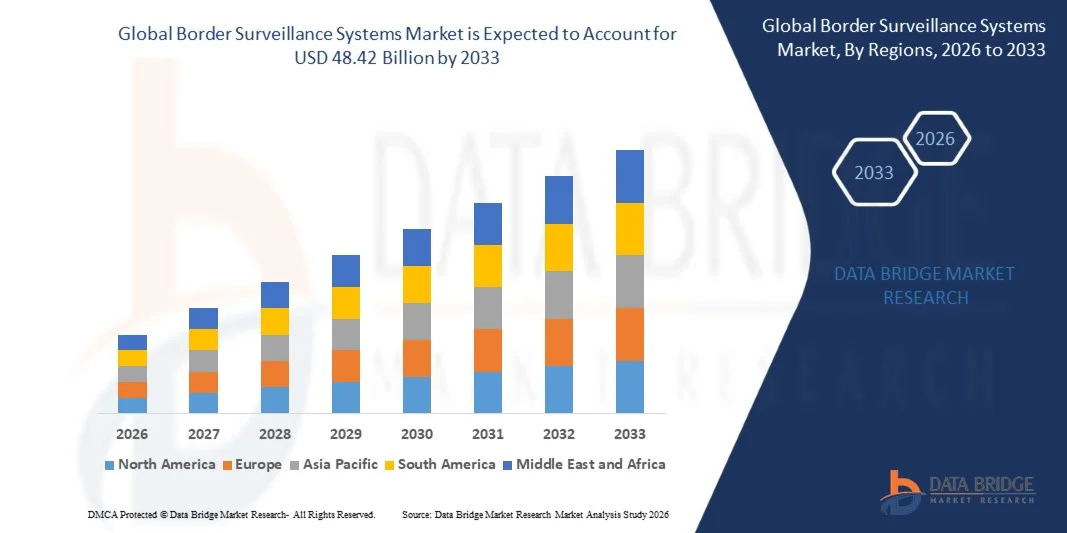
- As per Data Bridge Market Research analysis, the border surveillance systems market was valued at USD 25.40 billion in 2025 and is projected to reach USD 48.42 billion by 2033, growing at a CAGR of 8.40% from 2026 to 2033.
- The market is experiencing consistent growth driven by rising geopolitical tensions, increasing territorial disputes, growing cross-border security concerns, and higher government investments in advanced border protection infrastructure.
- The increasing threats associated with illegal migration, smuggling, human trafficking, and unauthorized border crossings, combined with the adoption of advanced surveillance technologies such as integrated radar, electro-optical and infrared (EO/IR) systems, thermal imaging, and automated monitoring solutions, are encouraging governments and defense organizations to deploy advanced border surveillance systems. These systems provide real-time monitoring, enhanced threat detection, and improved situational awareness across land, maritime, and airborne borders.
Market Size & Forecast
- Global Market Value (2025): USD 25.40 Billion
- Expected Market Value (2033): USD 48.42 Billion
- Forecast CAGR (2026–2033): 8.40%
- Leading Region in 2025: North America
- Fastest Growing Region: Asia Pacific
What are the Major Takeaways of the Border Surveillance Systems Market?
- North America dominated the border surveillance systems market with the largest revenue share of 34.1% in 2025, supported by significant government spending on homeland security, advanced defense infrastructure, and integrated border monitoring technologies.
- Asia-Pacific is expected to be the fastest-growing region at a CAGR of 9.0% from 2026 to 2033, fueled by increasing border security concerns, rising defense budgets, territorial disputes, and growing adoption of advanced surveillance technologies across China, India, and Japan.
- The hardware segment led the market with a 54.2% share in 2025, driven by extensive deployment of radar systems, cameras, sensors, unmanned platforms, communication infrastructure, and monitoring equipment.
- Software are the fastest-growing component type, projected to register a CAGR of 10.5%, reflecting the surge in adoption of artificial intelligence, machine learning analytics, command-and-control platforms, and automated threat detection.
- The land border surveillance systems segment dominated the system type category with a 52% revenue share in 2025, led by extensive deployment across international land boundaries.
- Radar-based surveillance accounted for 32% of the market share in 2025, preferred by its ability to provide long-range detection and continuous monitoring.
- The airborne platforms segment is the fastest-growing platform category, with a CAGR of 11.0%, driven by increasing adoption of unmanned aerial vehicles and airborne intelligence, surveillance, and reconnaissance systems.
Report Scope and Border Surveillance Systems Market Segmentation
|
Attributes |
Border Surveillance Systems Key Market Insights |
|
Segments Covered |
|
|
Countries Covered |
North America
Europe
Asia-Pacific
Middle East and Africa
South America
|
|
Key Market Players |
|
|
Market Opportunities |
|
|
Value Added Data Infosets |
In addition to the market insights such as market value, growth rate, market segments, geographical coverage, market players, and market scenario, the market report curated by the Data Bridge Market Research team includes in-depth expert analysis, import/export analysis, pricing analysis, production consumption analysis, and pestle analysis. |
What is the Key Trend in the Border Surveillance Systems Market?
- Border agencies are increasingly adopting AI-enabled multi-sensor surveillance platforms combining radar, satellite imagery, thermal cameras, and unmanned systems to improve threat detection across complex land and maritime environments.
- For instance, in July 2025, the European Commission funded the ORBIS project with USD 1.69 million to develop AI-driven maritime border surveillance integrating satellites, autonomous UAVs, radar, optical, and thermal imagery for real-time monitoring.
- Real-time data fusion enables border authorities to correlate sensor feeds, identify suspicious movements, prioritize alerts, and strengthen situational awareness across geographically dispersed surveillance zones while supporting faster coordinated responses.
- Governments and border agencies are increasingly deploying autonomous and semi-autonomous unmanned platforms to extend surveillance coverage across remote terrain, coastlines, waterways, and difficult-to-access border areas with persistent monitoring capabilities.
- For instance, in April 2025, the European Commission reported that the SEAGUARD project was developing integrated maritime surveillance combining unmanned aerial, surface, and underwater vehicles with fixed buoys and advanced analytics for real-time threat detection.
- As border security agencies prioritize persistent monitoring, automated analytics, and multi-domain situational awareness, integrated surveillance systems are expected to become increasingly important for border protection, threat detection, and rapid response operations globally.
What are the Key Drivers of the Border Surveillance Systems Market?
- The growing need to counter illegal crossings, smuggling, trafficking, terrorism, and other cross-border threats is increasing demand for advanced surveillance technologies that provide continuous monitoring and early threat detection capabilities.
- For instance, in September 2025, Elbit Systems launched Frontier, an AI-based wide-area persistent surveillance system designed for border defense. The system uses AI to autonomously detect, classify, and assess threats in real time while integrating data from multiple sensors across land, air, and maritime environments.
- Governments are increasing investments in integrated surveillance infrastructure to strengthen border monitoring capabilities across difficult terrain, riverine areas, coastlines, and high-risk crossing points while improving response times and operational visibility.
- For instance, in December 2025, WIRED reported that U.S. Customs and Border Protection (CBP) was expanding its use of small, human-portable drones as standard surveillance tools, enabling frontline teams to track activity in real time and extend surveillance coverage beyond traditional fixed monitoring infrastructure.
- With governments prioritizing stronger border protection and greater technological coverage, investments in radar, sensors, thermal imaging, unmanned platforms, and command-and-control systems are expected to support sustained market expansion globally.
What Factors are Challenging the Growth of the Border Surveillance Systems Market?
- Advanced border surveillance systems require substantial capital expenditure for radar networks, integrated sensors, communications infrastructure, command centers, unmanned platforms, and specialized installation and maintenance.
- For instance, in September 2025, the U.S. Government Accountability Office (GAO) reported that U.S. Customs and Border Protection’s large-scale non-intrusive inspection system deployments had cost more than initially estimated, with some system installations requiring significantly higher construction and infrastructure expenditure.
- These financial and operational requirements can constrain adoption among agencies with limited budgets, particularly when systems must cover extensive borders and operate continuously under harsh environmental conditions.
- For instance, in October 2024, The Verge reported that approximately 150 of 500 Remote Video Surveillance System cameras along the U.S.-Mexico border were out of operation because of technical and maintenance issues, highlighting the difficulty of keeping large surveillance networks operational in remote border environments.
- Complex integration requirements can further increase deployment costs because agencies must connect heterogeneous sensors, communications networks, analytics platforms, and legacy security infrastructure while maintaining interoperability and operational availability.
How is the Border Surveillance Systems Market Segmented?
The border surveillance systems market is segmented on the basis of component, system type, technology, platform, surveillance range, application, and end user.
- By Component
On the basis of component, the border surveillance systems market is segmented into hardware, software, and services. The hardware segment dominated the market with 54.2% share in 2025, owing to extensive deployment of radar systems, cameras, sensors, unmanned platforms, communication infrastructure, and monitoring equipment. Hardware forms the physical foundation of border surveillance networks and enables continuous detection and monitoring. Governments and defense agencies are investing in advanced physical surveillance infrastructure to improve situational awareness. Rising concerns regarding illegal crossings, smuggling, trafficking, and territorial security are supporting procurement of hardware.
The software segment is projected to register the fastest growth at a CAGR of 10.5% during the forecast period, driven by increasing adoption of artificial intelligence, machine learning analytics, command-and-control platforms, and automated threat detection. Software enables real-time processing of information collected from multiple surveillance sources. Integration with radar, cameras, drones, biometric databases, and sensor networks is expanding software capabilities. AI-based analytics can support automated anomaly detection and improve the processing of large volumes of surveillance data. Governments are increasingly moving toward integrated and intelligent border-management architectures.
- By System Type
On the basis of system type, the border surveillance systems market is segmented into land border surveillance systems, coastal border surveillance systems, maritime border surveillance systems, air border surveillance systems, underwater border surveillance systems, and others. The land border surveillance systems segment dominated the market with 52% share in 2025, supported by extensive deployment across international land boundaries. These systems integrate cameras, radar, thermal imaging, ground sensors, and communication equipment to provide continuous monitoring. Land-based surveillance is particularly important for detecting unauthorized crossings, smuggling, trafficking, and armed infiltration. Governments are increasingly modernizing surveillance infrastructure across remote and difficult border terrain. Integration of multiple sensors enables security agencies to improve detection and response capabilities.
The maritime border surveillance systems segment is expected to witness the fastest growth at a CAGR of 10.0% during the forecast period, driven by increasing emphasis on coastal and offshore security. Maritime systems combine radar, electro-optical sensors, satellite monitoring, sonar, and unmanned platforms to monitor large water areas. Governments are strengthening maritime surveillance to address illegal fishing, smuggling, trafficking, piracy, and unauthorized vessel movements. Growing maritime trade is increasing the importance of protecting ports, shipping routes, and offshore assets. Naval modernization programs are also supporting investments in advanced surveillance capabilities.
- By Technology
On the basis of technology, the border surveillance systems market is segmented into radar-based surveillance, electro-optical & infrared surveillance, acoustic & seismic detection, fiber-optic sensing, satellite-based surveillance, AI & machine learning technologies, biometric & identity technologies, communication & networking technologies, and others. The radar-based surveillance segment dominated the market with 32% share in 2025, owing to its ability to provide long-range detection and continuous monitoring. Radar systems can detect moving objects across large areas and support monitoring under challenging visibility conditions. They are extensively deployed for land, coastal, and maritime border protection. Radar can also provide early detection and tracking before targets are visually identified. Advanced radar technologies are increasingly integrated with electro-optical and infrared systems for sensor fusion.
The AI & machine learning technologies segment is projected to register the fastest growth at a CAGR of 12.0% during the forecast period, driven by growing demand for automated surveillance and intelligent threat detection. AI can analyze video feeds, radar information, sensor data, and behavioral patterns in real time. Machine learning algorithms can identify anomalies and support automated classification of potential threats. Integration with existing surveillance infrastructure allows governments to enhance capabilities without completely replacing installed systems. AI also supports predictive analytics and improves the prioritization of alerts. Increasing deployment of autonomous drones and smart surveillance networks is further accelerating demand.
- By Platform
On the basis of platform, the border surveillance systems market is segmented into ground-based platforms, airborne platforms, naval & maritime platforms, space-based platforms, underwater platforms, and others. The ground-based platforms segment dominated the market with 49% share in 2025, supported by widespread deployment of fixed and mobile surveillance infrastructure along land borders. Ground-based platforms include surveillance towers, radar installations, thermal cameras, electro-optical systems, and ground sensors. These platforms provide persistent monitoring and can operate continuously across designated border zones. They are widely used by defense and homeland security agencies for perimeter monitoring. Ground-based infrastructure can also be integrated with command-and-control centers and communication networks.
The airborne platforms segment is expected to register the fastest growth at a CAGR of 11.0% during the forecast period, driven by increasing adoption of unmanned aerial vehicles and airborne intelligence, surveillance, and reconnaissance systems. Airborne platforms can monitor large areas that may be difficult to cover through fixed surveillance infrastructure. UAVs can carry cameras, thermal sensors, radar, and communication equipment for flexible surveillance missions. Their deployment can extend monitoring capabilities across remote and difficult terrain. Integration with AI-based analytics is improving automated detection and target classification. Governments and defense organizations are increasingly incorporating unmanned platforms into layered border surveillance networks.
- By Surveillance Range
On the basis of surveillance range, the border surveillance systems market is segmented into short-range surveillance, medium-range surveillance, long-range surveillance, very-long-range, and beyond-line-of-sight surveillance. The long-range surveillance segment dominated the market with 35% share in 2025, owing to its ability to monitor extensive geographic areas. Long-range systems are particularly important for large land boundaries, coastal zones, and strategic security areas. They commonly incorporate radar, electro-optical systems, thermal imaging, and long-distance communications. Early detection of potential threats allows security personnel to receive additional time for assessment and response. Long-range surveillance can also reduce dependence on closely spaced physical monitoring stations.
The beyond-line-of-sight surveillance segment is projected to register the fastest growth at a CAGR of 11.5% during the forecast period, driven by increasing use of satellite communications, unmanned systems, and networked surveillance technologies. BLOS systems enable monitoring and information transmission beyond the physical range of conventional surveillance equipment. This capability is particularly valuable for remote borders, offshore territories, and geographically challenging environments. Satellite connectivity can transmit surveillance information across significant distances. Integration with UAVs and autonomous platforms is further extending operational coverage. AI-based processing can help analyze information collected from geographically dispersed sources.
- By Application
On the basis of application, the border surveillance systems market is segmented into illegal immigration detection, smuggling & trafficking prevention, terrorism & armed infiltration prevention, maritime security, counter-unmanned aircraft systems, territorial & sovereignty protection, environmental & resource protection, and others. The illegal immigration detection segment dominated the market with 30% share in 2025, driven by government efforts to identify and prevent unauthorized border crossings. Surveillance cameras, radar, thermal imaging, sensors, and biometric technologies are increasingly used to detect suspicious movements. Integrated surveillance networks can provide real-time information across extensive border areas. Automated monitoring can also help border personnel improve patrol efficiency and response times. Increasing migration-management requirements are supporting government investment in advanced detection systems.
The counter-unmanned aircraft systems segment is expected to witness the fastest growth at a CAGR of 13.0% during the forecast period, driven by increasing demand to detect and manage unauthorized drone activity. Commercial and recreational drones can be used to enter restricted airspace or transport unauthorized materials across borders. Counter-UAS technologies combine radar, radio-frequency detection, electro-optical systems, and software analytics. AI-based systems can assist in identifying and classifying aerial objects. Border agencies are increasingly integrating counter-drone capabilities into broader surveillance architectures. Growing protection requirements around sensitive border infrastructure are supporting investment.
- By End User
On the basis of end user, the border surveillance systems market is segmented into defense forces, homeland security agencies, law enforcement agencies, maritime authorities, government intelligence agencies, critical infrastructure authorities, and others. The homeland security agencies segment dominated the market with 32% share in 2025, supported by their responsibility for monitoring and protecting national borders. These agencies use radar, cameras, biometric technologies, sensors, communication systems, and command platforms for continuous surveillance. Homeland security organizations are increasingly deploying integrated systems capable of monitoring multiple threat types. Concerns surrounding unauthorized crossings, trafficking, smuggling, and cross-border criminal activities are supporting procurement. Modern surveillance technologies are improving situational awareness and enabling faster responses.
The government intelligence agencies segment is projected to register the fastest growth at a CAGR of 11.5% during the forecast period, driven by increasing demand for advanced intelligence gathering and real-time threat assessment. Intelligence agencies are adopting satellite surveillance, AI-based analytics, advanced sensors, and integrated information platforms. These technologies allow agencies to process and correlate information obtained from multiple surveillance sources. Increasing geopolitical tensions are strengthening demand for timely intelligence regarding cross-border activities. Integration between intelligence databases and border surveillance systems is improving information sharing. Advanced analytics can support identification of patterns and emerging security threats.
Which Region Holds the Largest Share of the Border Surveillance Systems Market?
- North America dominated the border surveillance systems market with the largest revenue share of 34.1% in 2025, supported by significant government spending on homeland security, advanced defense infrastructure, and integrated border monitoring technologies.
- The region also benefits from increasing deployment of integrated surveillance systems, including radar, electro-optical/infrared systems, unmanned aerial vehicles (UAVs), and AI-enabled monitoring platforms across land and maritime borders. Rising concerns related to illegal immigration, cross-border security threats, and modernization of border protection infrastructure continue to strengthen North America’s leadership position in the global market.
U.S. Border Surveillance Systems Market Insight
The U.S. border surveillance systems market is witnessing strong growth due to rising investments in advanced border security technologies, persistent surveillance infrastructure, and integrated monitoring systems. The country’s extensive land borders, along with increasing deployment of AI-enabled surveillance, autonomous surveillance towers, sensor networks, and unmanned aerial systems, is driving demand across homeland security and defense applications. In addition, growing emphasis on preventing illegal crossings, smuggling, and cross-border security threats is accelerating adoption of advanced surveillance solutions.
Asia-Pacific Border Surveillance Systems Market Insight
The Asia-Pacific border surveillance systems market is expected to witness rapid growth, driven by increasing geopolitical tensions, expanding defense investments, and rising modernization of border protection infrastructure across countries such as China, India, Japan, and South Korea. Growing adoption of radar, thermal imaging, unmanned aerial vehicles, satellite monitoring, and AI-enabled surveillance technologies is supporting regional market expansion. In addition, increasing focus on territorial security, maritime monitoring, and advanced situational awareness is accelerating deployment of integrated border surveillance systems across the region.
Japan Border Surveillance Systems Market Insight
The Japan border surveillance systems market is witnessing consistent growth due to rising investments in advanced defense capabilities, maritime surveillance, and unmanned monitoring technologies. Government agencies are increasingly strengthening surveillance capabilities to improve situational awareness across maritime and territorial boundaries. Moreover, increasing adoption of unmanned systems, advanced sensors, and integrated surveillance technologies is supporting demand. The country’s focus on strengthening national security and modernizing defense infrastructure is further contributing to market growth in Japan.
China Border Surveillance Systems Market Insight
The China border surveillance systems market is growing rapidly, driven by increasing investments in border security infrastructure, military modernization, and advanced surveillance technologies. Growing deployment of artificial intelligence, satellite monitoring, unmanned aerial systems, and intelligent video surveillance platforms across land and maritime borders is significantly boosting market demand. In addition, China’s focus on strengthening territorial security, improving border management efficiency, and expanding digital surveillance capabilities is positioning the country as a major market for advanced border monitoring systems.
U.K. Border Surveillance Systems Market Insight
The U.K. border surveillance systems market is experiencing steady growth, supported by increasing adoption of advanced monitoring technologies across land, maritime, and critical border environments. Rising demand for integrated surveillance, biometric identification, sensor-based monitoring, and automated threat detection is contributing to market expansion. Furthermore, growing emphasis on maritime security, illegal migration prevention, and protection against cross-border threats is encouraging investment in advanced surveillance infrastructure. Increasing integration of AI and networked technologies is further supporting the modernization of border security operations.
Germany Border Surveillance Systems Market Insight
The Germany border surveillance systems market is expanding steadily due to increasing focus on border protection, advanced security infrastructure, and adoption of next-generation surveillance technologies. Government and security agencies are increasingly utilizing radar, electro-optical systems, thermal imaging, biometric technologies, and integrated monitoring platforms to strengthen situational awareness. Continuous technological advancements in AI-enabled surveillance and automated detection are further supporting adoption. In addition, growing emphasis on protecting national and external borders, preventing unauthorized movement, and strengthening European security cooperation is contributing to market growth in Germany.
Which are the Top Companies in Border Surveillance Systems Market?
The border surveillance systems industry is primarily led by well-established companies, including:
- Airbus SE (France)
- Leonardo S.p.a. (Italy)
- Thales (France)
- RTX Corporation (U.S.)
- Saab AB (Sweden)
- Elbit Systems Ltd. (Israel)
- Indra Sistemas, S.A. (Spain)
- Teledyne Technologies Incorporated (U.S.)
- HENSOLDT AG (Germany)
- L3Harris Technologies, Inc. (U.S.)
- Northrop Grumman (U.S.)
- Lockheed Martin Corporation (U.S.)
- General Dynamics Corporation (U.S.)
- Leidos, Inc. (U.S.)
- Rohde & Schwarz GmbH & Co. KG (Germany)
- Axis Communications AB (Sweden)
- Hexagon AB (Sweden)
- IDEMIA (France)
- Israel Aerospace Industries Ltd. (Israel)
- Rafael Advanced Defense Systems Ltd. (Israel)
What are Latest Developments in Border Surveillance Systems Market?
- In April 2025, the U.S. Army deployed the Ground-Based Operational Surveillance System (Expeditionary), or G-BOSS-(E), in the San Diego Sector to support the U.S. Customs and Border Protection. The mobile and rapidly deployable surveillance system incorporates advanced sensors, cameras, radar, and infrared capabilities to provide 360-degree situational awareness and detect people and vehicles at distances of up to eight miles. The deployment demonstrates the growing use of mobile, sensor-integrated surveillance systems for strengthening border monitoring capabilities.
- In June 2024, Finland announced the purchase of two advanced surveillance aircraft from Sierra Nevada Corporation for USD 185 million to strengthen monitoring of its border with Russia. The aircraft are being manufactured by Bombardier and equipped with advanced technical systems and modern surveillance sensors for border and maritime security missions. The acquisition highlights the increasing deployment of specialized airborne surveillance platforms to enhance monitoring across extensive land and maritime boundaries.
- In December 2023, the U.S. government expanded deployment of a “virtual border wall” in San Diego using hundreds of advanced surveillance towers, including systems powered by artificial intelligence. The autonomous towers use 360-degree radar and sensors to detect abnormal activity across large areas, while AI-enabled capabilities assist in identifying and tracking objects. The development demonstrates the increasing integration of autonomous surveillance towers, radar, sensors, and AI technologies into border security operations.
- In March 2022, U.S. Customs and Border Protection had deployed approximately 175 autonomous surveillance towers along the southern U.S. border, incorporating thermal imaging, cameras, radar, and artificial intelligence. The systems were designed to automatically distinguish between objects such as people, vehicles, and animals and provide location information to Border Patrol personnel. This development demonstrated the growing adoption of AI-enabled autonomous surveillance infrastructure for persistent border monitoring.
- In July 2021, India approved an integrated technology infrastructure project covering approximately 500 kilometers of the Jammu border to strengthen border monitoring capabilities. The planned command-and-control network was designed to integrate optical-fiber communications with cameras, sensors, radars, and intrusion-detection systems. The development highlighted the increasing shift toward integrated, networked surveillance infrastructure capable of bringing multiple border-monitoring technologies into a coordinated security system.

- Interactive Data Analysis Dashboard
- Company Analysis Dashboard for high growth potential opportunities
- Research Analyst Access for customization & queries
- Competitor Analysis with Interactive dashboard
- Latest News, Updates & Trend analysis
- Harness the Power of Benchmark Analysis for Comprehensive Competitor Tracking
Data collection and base year analysis are done using data collection modules with large sample sizes. The stage includes obtaining market information or related data through various sources and strategies. It includes examining and planning all the data acquired from the past in advance. It likewise envelops the examination of information inconsistencies seen across different information sources. The market data is analysed and estimated using market statistical and coherent models. Also, market share analysis and key trend analysis are the major success factors in the market report. To know more, please request an analyst call or drop down your inquiry.
The key research methodology used by DBMR research team is data triangulation which involves data mining, analysis of the impact of data variables on the market and primary (industry expert) validation. Data models include Vendor Positioning Grid, Market Time Line Analysis, Market Overview and Guide, Company Positioning Grid, Patent Analysis, Pricing Analysis, Company Market Share Analysis, Standards of Measurement, Global versus Regional and Vendor Share Analysis. To know more about the research methodology, drop in an inquiry to speak to our industry experts.
Data Bridge Market Research is a leader in advanced formative research. We take pride in servicing our existing and new customers with data and analysis that match and suits their goal. The report can be customized to include price trend analysis of target brands understanding the market for additional countries (ask for the list of countries), clinical trial results data, literature review, refurbished market and product base analysis. Market analysis of target competitors can be analyzed from technology-based analysis to market portfolio strategies. We can add as many competitors that you require data about in the format and data style you are looking for. Our team of analysts can also provide you data in crude raw excel files pivot tables (Fact book) or can assist you in creating presentations from the data sets available in the report.












