


Bronchiectasis Market Size
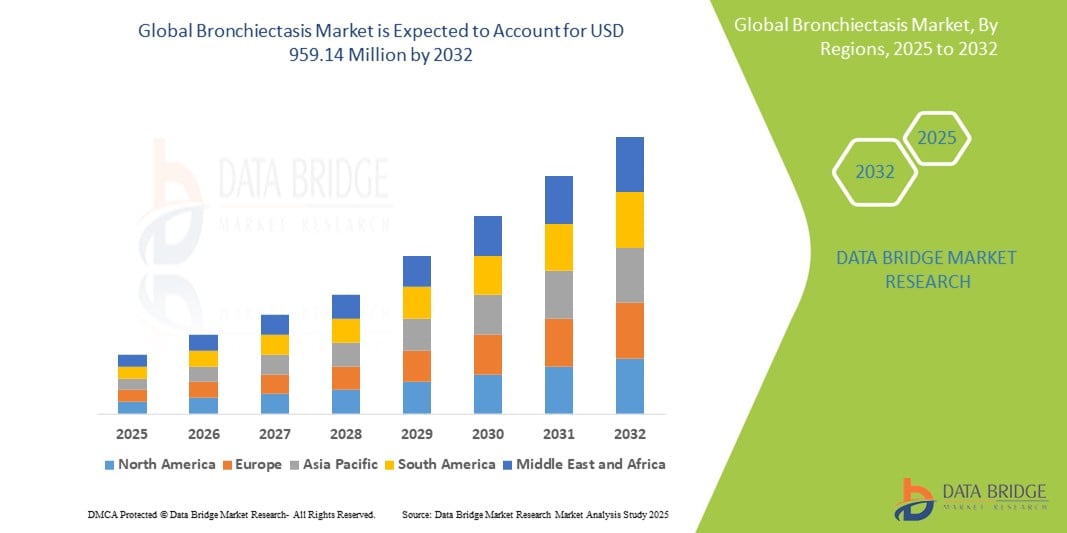
- The global bronchiectasis market size was valued at USD 597.25 Million in 2024 and is expected to reach USD 959.14 Million by 2032, at a CAGR of 6.10% during the forecast period
- The market growth is largely fueled by the rising prevalence of chronic respiratory diseases and the increasing awareness regarding early diagnosis and treatment of bronchiectasis, leading to greater demand for targeted therapies and diagnostic solutions
- Furthermore, advancements in imaging technologies, the introduction of novel antibiotics, and the growing availability of personalized treatment regimens are establishing bronchiectasis therapies as essential components in respiratory care. These converging factors are accelerating the uptake of bronchiectasis solutions, thereby significantly boosting the industry's growth
Bronchiectasis Market Analysis
- Bronchiectasis, a chronic and progressive lung condition characterized by irreversible bronchial dilation, is increasingly being recognized as a significant public health concern, with rising prevalence particularly among the elderly population and patients with chronic respiratory disorders such as COPD and cystic fibrosis. This is fueling demand for more effective diagnostic and treatment options globally
- The escalating demand for bronchiectasis treatment is primarily driven by improved awareness, availability of advanced imaging techniques such as high-resolution CT scans, and the development of novel therapies including inhaled antibiotics and mucolytics. In addition, rising research into the microbiome’s role in chronic lung infections is shaping new therapeutic approaches
- North America dominated the bronchiectasis market with the largest revenue share of 39.5% in 2024, attributed to early adoption of advanced healthcare infrastructure, robust reimbursement frameworks, and a high prevalence of associated comorbidities. The U.S. leads the region due to strong R&D investment and presence of key pharmaceutical and biotech players focusing on respiratory disorders
- Asia-Pacific is expected to be the fastest-growing region in the bronchiectasis market during the forecast period, with a projected CAGR of 8.1%, driven by increasing urbanization, expanding healthcare access, rising awareness of chronic respiratory conditions, and growing investments in healthcare infrastructure, especially in countries such as China and India
- The inhalation segment dominated the bronchiectasis market with a market share of 42.6% in 2024, due to their efficacy in managing chronic infections, targeted delivery to the lungs, and growing preference over systemic antibiotics for long-term use in recurrent exacerbation cases
Report Scope and Bronchiectasis Market Segmentation
|
Attributes |
Bronchiectasis Key Market Insights |
|
Segments Covered |
|
|
Countries Covered |
North America
Europe
Asia-Pacific
Middle East and Africa
South America
|
|
Key Market Players |
|
|
Market Opportunities |
|
|
Value Added Data Infosets |
In addition to the insights on market scenarios such as market value, growth rate, segmentation, geographical coverage, and major players, the market reports curated by the Data Bridge Market Research also include in-depth expert analysis, pricing analysis, brand share analysis, consumer survey, demography analysis, supply chain analysis, value chain analysis, raw material/consumables overview, vendor selection criteria, PESTLE Analysis, Porter Analysis, and regulatory framework. |
Bronchiectasis Market Trends
“Enhanced Diagnosis and Management in the Bronchiectasis Market”
- A significant and accelerating trend in the global bronchiectasis market is the deepening integration of artificial intelligence (AI) and digital health platforms to enhance diagnosis accuracy, predict exacerbations, and personalize treatment strategies. This technological fusion is significantly improving patient outcomes and clinical decision-making
- For instance, AI-driven imaging platforms are being employed to automatically detect and quantify bronchial dilation from high-resolution CT scans, reducing diagnostic variability and accelerating clinical workflows. Companies such as Aidoc and Zebra Medical Vision are developing algorithms that assist radiologists in identifying early signs of bronchiectasis
- AI integration in respiratory care devices enables features such as real-time symptom tracking, treatment adherence monitoring, and predictive analytics to anticipate flare-ups before they occur. For instance, connected nebulizers and smart inhalers now use AI algorithms to analyze usage patterns and alert patients or caregivers to changes indicating potential exacerbations
- The seamless integration of bronchiectasis management tools with digital health ecosystems and telemedicine platforms allows clinicians to monitor patients remotely, adjust therapies proactively, and offer continuous care through a single interface. This is especially transformative for patients in remote or underserved areas
- This trend towards more intelligent, connected, and proactive respiratory care systems is fundamentally reshaping expectations around chronic disease management. Consequently, companies such as Philips and ResMed are investing in AI-powered solutions for home-based pulmonary monitoring and integrated care platforms
- The demand for bronchiectasis solutions that incorporate AI, remote monitoring, and digital health capabilities is growing rapidly across both hospital and homecare settings, as healthcare systems increasingly prioritize efficiency, early intervention, and personalized medicine
Bronchiectasis Market Dynamics
Driver
“Growing Need Due to Rising Prevalence and Demand for Targeted Respiratory Care”
- The increasing prevalence of chronic respiratory conditions such as COPD, asthma, and cystic fibrosis, along with improved awareness and diagnosis of bronchiectasis, is a significant driver for the heightened demand for specialized bronchiectasis treatments
- For instance, in April 2024, Boehringer Ingelheim announced progress in the development of inhaled therapies aimed at reducing pulmonary inflammation and bacterial colonization in bronchiectasis patients. Such advancements by key industry players are expected to drive the bronchiectasis market growth during the forecast period
- As clinicians and healthcare systems seek more effective management strategies for patients with frequent exacerbations and chronic infections, targeted treatments such as inhaled antibiotics, mucolytics, and airway clearance devices offer tailored solutions to improve outcomes and reduce hospitalizations
- Furthermore, the growing integration of bronchiectasis treatment into chronic respiratory care frameworks and digital health platforms is enabling earlier diagnosis and ongoing patient monitoring, positioning it as a key component in comprehensive pulmonary care strategies
- The rising demand for homecare treatment options, non-invasive delivery systems, and personalized medicine is accelerating the adoption of bronchiectasis management solutions across both developed and emerging healthcare markets. The trend towards outpatient management and the availability of user-friendly nebulizers and airway clearance devices further support this growth
Restraint/Challenge
“Limited Awareness, Diagnostic Complexity, and High Treatment Costs”
- Limited awareness among primary care providers and the general public regarding bronchiectasis symptoms and its differentiation from other chronic respiratory conditions pose a significant challenge to timely diagnosis and treatment. The disease is often underdiagnosed or misdiagnosed, particularly in regions with limited access to high-resolution imaging technologies
- For instance, delayed access to CT scans or pulmonology specialists in rural and underserved areas often leads to late-stage diagnosis, resulting in suboptimal patient outcomes and delayed intervention
- Addressing this issue requires widespread awareness campaigns, improved clinical training, and standardized diagnostic guidelines to promote early detection. Moreover, the relatively high cost of advanced treatments such as inhaled antibiotics and airway clearance devices can be prohibitive for patients in lower-income regions or those without comprehensive insurance coverage
- While generic options and public health support are improving access, affordability remains a key barrier. The lack of specific approved therapies in some countries further limits access to optimized care
- Overcoming these challenges through public-private partnerships, reimbursement reforms, and increased clinical education efforts will be vital to unlocking the full growth potential of the global bronchiectasis market
Bronchiectasis Market Scope
The market is segmented on the basis of disease type, severity, type, drug type, route of administration, and end user.
• By Disease Type
On the basis of disease type, the bronchiectasis market is segmented into CF bronchiectasis and Non-CF bronchiectasis. The Non-CF bronchiectasis segment dominated the largest market revenue share of 78.3% in 2024, due to its higher prevalence and more frequent diagnosis in adults.
The CF bronchiectasis segment is expected to witness the fastest CAGR of 7.1% from 2025 to 2032, driven by advancements in cystic fibrosis management, early screening, and increasing adoption of CFTR modulators and specialized therapies.
• By Severity
On the basis of severity, the bronchiectasis market is segmented into mild to moderate and moderate-to-severe. The mild to moderate segment held the largest revenue share of 61.5% in 2024, supported by better awareness and earlier clinical intervention.
The moderate-to-severe segment is projected to grow at the fastest CAGR of 6.8% during 2025–2032, attributed to rising demand for aggressive pharmacological therapies, hospital-based care, and the growing burden of severe, recurrent exacerbations.
• By Type
On the basis of type, the bronchiectasis market is segmented into diagnosis and treatment. The treatment segment dominated the market with a 69.4% revenue share in 2024, reflecting the chronic and progressive nature of bronchiectasis that necessitates long-term therapy.
The diagnosis segment is forecasted to register the highest CAGR of 7.4% between 2025 and 2032, owing to increasing use of HRCT scans, pulmonary function testing, and biomarker-based diagnosis to enable earlier detection and monitoring.
• By Drug Type
On the basis of drug type, the bronchiectasis market is segmented into branded and generics. The generics segment led the market with a 66.9% share in 2024, favored for their affordability and wide availability in emerging and public healthcare markets.
The branded segment is expected to grow at the fastest CAGR of 7.2% from 2025 to 2032, driven by the launch of novel inhaled antibiotics, mucolytic agents, and targeted therapies backed by clinical trials.
• By Route of Administration
On the basis of route of administration, the market is segmented into oral, parenteral, and inhalation. The inhalation segment dominated with a 42.6% revenue share in 2024, owing to its high efficiency in delivering medications directly to the respiratory tract with fewer systemic side effects.
The oral segment is anticipated to grow at the fastest CAGR of 6.9% during the forecast period, fueled by the growing demand for convenient, at-home treatment options, especially for milder cases.
• By End User
On the basis of end user, the bronchiectasis market is segmented into hospitals, clinics, home healthcare, and others. The hospitals segment held the largest market share of 44.6% in 2024, supported by comprehensive respiratory services, emergency care, and diagnostic infrastructure.
The home healthcare segment is projected to register the fastest CAGR of 8.1% from 2025 to 2032, as patients increasingly adopt portable nebulizers and remote monitoring technologies for chronic disease management in a home setting.
Bronchiectasis Market Regional Analysis
- North America dominated the bronchiectasis market with the largest revenue share of 39.5% in 2024, driven by a high disease prevalence, strong healthcare infrastructure, and favorable reimbursement policies
- The region benefits from early diagnosis due to widespread use of advanced imaging techniques such as HRCT and the presence of specialized respiratory care centers
- In addition, increasing awareness among both healthcare providers and patients regarding chronic respiratory diseases contributes to greater treatment uptake. Pharmaceutical and biotech companies in the U.S. and Canada are also intensifying efforts in clinical trials and drug innovation, further supporting regional market growth
U.S. Bronchiectasis Market Insight
The U.S. bronchiectasis market captured the largest revenue share of 47.4% in 2024 within North America, primarily driven by a high prevalence of non-cystic fibrosis bronchiectasis and the presence of advanced healthcare infrastructure. Increasing awareness, early diagnosis, and the availability of novel treatment options such as inhaled antibiotics and pipeline drugs such as Brensocatib are fueling market growth. In addition, strong R&D funding and favorable reimbursement policies are further propelling the bronchiectasis treatment landscape in the country.
Europe Bronchiectasis Market Insight
The Europe bronchiectasis market is projected to grow at a CAGR of 5.6% during the forecast period. Growth is fueled by increasing awareness of chronic respiratory diseases, rising diagnostic rates, and the availability of improved treatment protocols. Several European countries are investing in clinical research and public health campaigns to better manage bronchiectasis, especially non-CF types. The market is also being bolstered by the adoption of advanced diagnostic imaging and an aging population across the region.
U.K. Bronchiectasis Market Insight
The U.K. bronchiectasis market is expected to grow at a steady CAGR of 5.9% during the forecast period, supported by government-led awareness campaigns and growing investments in respiratory disease research. The increasing burden of chronic respiratory conditions, particularly among the elderly, is pushing demand for long-term care and advanced treatments. Moreover, the U.K.’s strong clinical trial landscape and access to innovative drug therapies contribute to market expansion.
Germany Bronchiectasis Market Insight
The Germany bronchiectasis market is projected to grow at a CAGR of 6.1% during the forecast period, owing to a well-established healthcare system and heightened awareness of bronchiectasis. The country’s focus on technological innovation, including advanced pulmonary diagnostics and personalized medicine, is aiding the early detection and effective treatment of bronchiectasis. In addition, increasing adoption of inhaled antibiotics and non-pharmacological interventions are contributing to market growth.
Asia-Pacific Bronchiectasis Market Insight
The Asia-Pacific bronchiectasis market is anticipated to grow at the fastest CAGR of 8.1% from 2025 to 2032. This growth is driven by the rising prevalence of respiratory diseases, increasing healthcare expenditure, and improving access to diagnostic and therapeutic services in emerging economies such as China, India, and Japan. Government initiatives to boost awareness and healthcare infrastructure, along with growing participation in clinical trials, are expanding treatment access across the region.
Japan Bronchiectasis Market Insight
The Japan bronchiectasis market is gaining traction due to the country’s aging population, robust healthcare infrastructure, and a strong focus on early disease diagnosis. Japan’s market is characterized by high adoption of inhaled therapies, integration of digital respiratory monitoring tools, and ongoing research into rare pulmonary conditions. These factors are expected to drive a CAGR of around 6.3% over the forecast period.
China Bronchiectasis Market Insight
The China bronchiectasis market captured the largest revenue share in the Asia-Pacific bronchiectasis market in 2024, driven by rapid urbanization, a growing middle class, and significant increases in air pollution-related respiratory conditions. The Chinese market is expanding at a CAGR of 8.6%, supported by the rising availability of bronchiectasis-specific therapies and growing participation in global clinical research. The country’s push toward improving healthcare access in rural areas also plays a vital role in market development.
Bronchiectasis Market Share
The bronchiectasis industry is primarily led by well-established companies, including:
- Abbott (U.S.)
- HERSILL (Spain)
- Inogen, Inc. (U.S.)
- Boehringer Ingelheim International GmbH (Germany)
- Medline Industries, Inc. (U.S.)
- Ache Laboratories Farmaceuticos S.A. (Brazil)
- Johnson & Johnson Services, Inc. (U.S.)
- Trudell Medical International (Canada)
- GSK plc (U.S.)
- AstraZeneca (U.K.)
- Pfizer Inc. (U.S.)
- Merck & Co., Inc. (U.S.)
- Novartis AG (Switzerland)
- Teva Pharmaceutical Industries Ltd. (Israel)
- Sun Pharmaceutical Industries Ltd. (India)
- Bayer AG (Germany)
- Dr. Reddy’s Laboratories Ltd. (India)
- Sumitomo Pharma Co., Ltd. (U.S.)
- Viatris Inc. (U.S.)
- Covis Pharma (Switzerland)
- Zydus Group (U.S.)
- Cipla (India)
- Electromed, Inc. (U.S.)
Latest Developments in Global Bronchiectasis Market
- In May 2024, Insmed Incorporated announced positive results from the Phase III ASPEN trial evaluating Brensocatib, an oral DPP1 inhibitor, for the treatment of non-cystic fibrosis bronchiectasis. The trial demonstrated a statistically significant reduction in the annualized rate of pulmonary exacerbations. This advancement marks a major milestone, positioning Brensocatib as a potential first-in-class treatment for bronchiectasis
- In April 2024, Armata Pharmaceuticals advanced its investigational phage therapy candidate AP-PA02 into a Phase Ib/IIa clinical trial for patients with bronchiectasis caused by Pseudomonas aeruginosa. This bacteriophage-based treatment represents a novel approach to managing chronic infections in bronchiectasis patients who are resistant to conventional antibiotics
- In March 2024, researchers at the European Respiratory Society (ERS) reported progress on the EMBARC registry, a major pan-European initiative collecting longitudinal data on non-CF bronchiectasis patients. The real-world data from over 17,000 patients is helping shape treatment protocols and identify unmet clinical needs
- In February 2024, Zambon S.p.A. announced the expansion of its Colistimethate sodium inhalation solution (Promixin) availability in new European markets for managing chronic P. aeruginosa infections in bronchiectasis. This step enhances access to targeted inhaled antibiotic therapy for patients with limited treatment options
- In January 2024, Aradigm Corporation, in collaboration with regulatory authorities, reinitiated its strategy to bring Lipoquin and Pulmaquin—liposomal ciprofloxacin formulations—back into clinical development for bronchiectasis, following a previous regulatory setback. These long-acting inhaled antibiotics have potential to improve treatment adherence and reduce exacerbations

- Interactive Data Analysis Dashboard
- Company Analysis Dashboard for high growth potential opportunities
- Research Analyst Access for customization & queries
- Competitor Analysis with Interactive dashboard
- Latest News, Updates & Trend analysis
- Harness the Power of Benchmark Analysis for Comprehensive Competitor Tracking
Data collection and base year analysis are done using data collection modules with large sample sizes. The stage includes obtaining market information or related data through various sources and strategies. It includes examining and planning all the data acquired from the past in advance. It likewise envelops the examination of information inconsistencies seen across different information sources. The market data is analysed and estimated using market statistical and coherent models. Also, market share analysis and key trend analysis are the major success factors in the market report. To know more, please request an analyst call or drop down your inquiry.
The key research methodology used by DBMR research team is data triangulation which involves data mining, analysis of the impact of data variables on the market and primary (industry expert) validation. Data models include Vendor Positioning Grid, Market Time Line Analysis, Market Overview and Guide, Company Positioning Grid, Patent Analysis, Pricing Analysis, Company Market Share Analysis, Standards of Measurement, Global versus Regional and Vendor Share Analysis. To know more about the research methodology, drop in an inquiry to speak to our industry experts.
Data Bridge Market Research is a leader in advanced formative research. We take pride in servicing our existing and new customers with data and analysis that match and suits their goal. The report can be customized to include price trend analysis of target brands understanding the market for additional countries (ask for the list of countries), clinical trial results data, literature review, refurbished market and product base analysis. Market analysis of target competitors can be analyzed from technology-based analysis to market portfolio strategies. We can add as many competitors that you require data about in the format and data style you are looking for. Our team of analysts can also provide you data in crude raw excel files pivot tables (Fact book) or can assist you in creating presentations from the data sets available in the report.












