


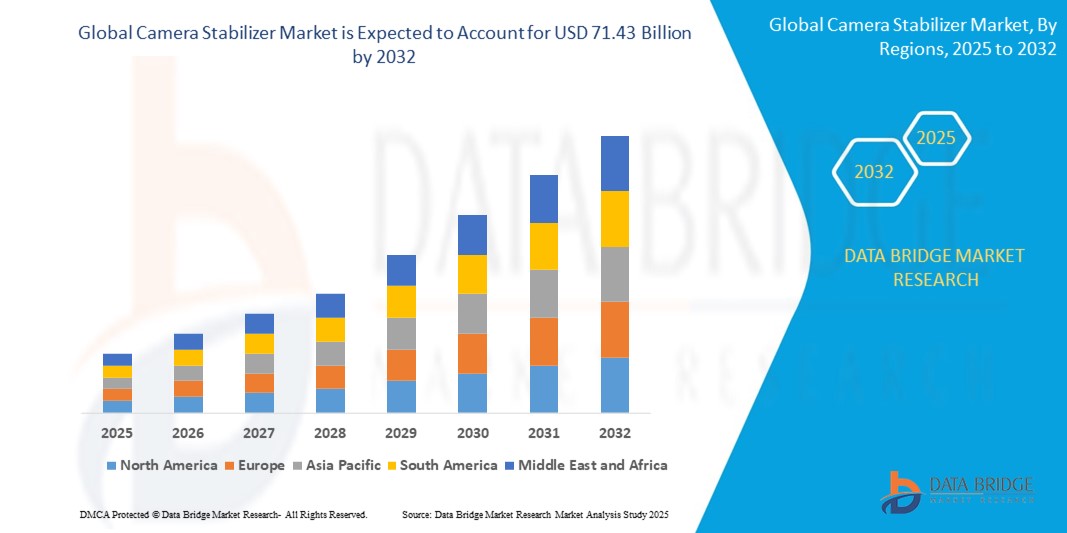
Camera Stabilizer Market Size
- The global camera stabilizer market size was valued at USD 13.2 billion in 2024 and is expected to reach USD 71.43 billion by 2032, at a CAGR of 23.50% during the forecast period
- The market growth is largely fueled by the increasing demand for high-quality video content across platforms such as YouTube, Instagram, and TikTok, driving widespread adoption of camera stabilizers among content creators, vloggers, and filmmakers
- Furthermore, advancements in stabilization technology, including AI integration and compact gimbal designs, are making these devices more user-friendly and accessible, thereby accelerating their uptake across both consumer and professional video production segments
Camera Stabilizer Market Analysis
- Camera stabilizers are mechanical or electronic devices designed to reduce shake and vibrations during video recording, ensuring smooth and stable footage across various shooting conditions. These tools are widely used with smartphones, DSLRs, cinema cameras, and action cameras, enhancing the visual quality of video content
- The escalating demand for camera stabilizers is primarily driven by the growth of digital content creation, the rise of social media influencers, and the expanding accessibility of affordable stabilizing solutions for both amateurs and professionals
- North America dominated the camera stabilizer market with a share of 40.5% in 2024, due to high demand for professional and consumer-grade video equipment, especially among content creators, filmmakers, and vloggers
- Asia-Pacific is expected to be the fastest growing region in the camera stabilizer market during the forecast period due to rising smartphone penetration, booming online content creation, and growing disposable incomes across countries such as China, India, and Japan
- Hand held segment dominated the market with a market share of 62.9% in 2024, due to its ease of use, portability, and compatibility with a wide range of devices including smartphones, DSLRs, and action cameras. These stabilizers are highly favored among independent content creators, vloggers, and hobbyist videographers due to their lightweight design and relatively lower cost. The surge in social media video content creation and the rise of travel vlogging have further propelled the demand for handheld stabilizers across both developed and emerging markets
Report Scope and Camera Stabilizer Market Segmentation
|
Attributes |
Camera Stabilizer Key Market Insights |
|
Segments Covered |
|
|
Countries Covered |
North America
Europe
Asia-Pacific
Middle East and Africa
South America
|
|
Key Market Players |
|
|
Market Opportunities |
|
|
Value Added Data Infosets |
In addition to the insights on market scenarios such as market value, growth rate, segmentation, geographical coverage, and major players, the market reports curated by the Data Bridge Market Research also include in-depth expert analysis, geographically represented company-wise production and capacity, network layouts of distributors and partners, detailed and updated price trend analysis and deficit analysis of supply chain and demand. |
Camera Stabilizer Market Trends
“Increasing Demand for High-Quality Video Content”
- The global camera stabilizer market is expanding steadily, fueled by the soaring demand for smooth, professional-grade video content across social media, streaming, filmmaking, advertising, live sports, and corporate arenas. Both professional creators and amateurs prioritize stabilization to achieve stable, cinematic shots that stand out in a crowded digital landscape
- For instance, in December 2024, ARRI introduced the ARTEMIS 2 Live—a modular, ergonomic camera stabilizer designed for live and broadcast productions—demonstrating leading brands’ commitment to advanced solutions for high-end video applications
- Social media influencers, vloggers, and mobile journalists increasingly use compact, portable stabilizers for smartphones and action cameras, expanding the user base far beyond traditional filmmakers
- Integration of AI tracking, 3-axis gimbal technology, wireless controls, and device compatibility (DSLRs, cinema cameras, smartphones) continues to elevate usability and content quality
- As streaming platforms and online video content production proliferate, demand for efficient, creative stabilizers remains a prominent market driver
- Asian markets, led by rapid content creation growth and digital adoption, now hold the largest regional share, with North America following as the largest revenue contributor
Camera Stabilizer Market Dynamics
Driver
“Advancements in Camera Technology”
- Constant innovations in camera and sensor technology—including higher resolutions, advanced autofocus, and enhanced low-light performance—push the need for even more effective stabilization solutions to maximize image quality in dynamic scenarios
- For instance, the introduction of AI-powered tracking and auto-calibration features in new stabilizer models from brands such as DJI and Zhiyun Tech enables creators to shoot complex, moving scenes effortlessly, keeping subjects in perfect focus without manual adjustment
- Modern stabilizers now support a wide array of devices, from lightweight mirrorless cameras to heavy, cinema-grade rigs, as well as smartphones, making them adaptable for use in various media, sports, and entertainment projects
- Continuous integration with software apps (such as remote control, programmable motion paths, and virtual production tools) further propel adoption among professionals demanding efficiency and creative control
- Investment in R&D for lighter, modular, and more ergonomic stabilizers—such as quick-release systems and battery-swappable handles—increases their appeal and usability across different content creation environments
Restraint/Challenge
“Rising Competition from In-Built Stabilization Systems”
- The rapid improvement of in-camera and in-lens stabilization technologies (such as IBIS and optical IS), particularly in the latest DSLRs, mirrorless, and even smartphones, is reducing reliance on external stabilizers for many users
- For instance, Sony’s flagship Alpha and iPhone Pro models now feature advanced multi-axis sensor shift and digital stabilization, minimizing shakes even in handheld shooting—thereby threatening the mass-market appeal of standalone stabilizers and shifting growth focus toward professional or niche segments
- Price-sensitive amateurs and content creators may opt for cameras with strong native stabilization over investing in a separate stabilizer, contributing to market challenges, especially for entry-level products
- This trend is forcing stabilizer manufacturers to differentiate through innovations such as AI-driven features, modular add-ons, and multi-device compatibility to remain relevant and essential in a technologically fast-evolving ecosystem
- The competitive landscape intensifies further as emerging brands enter the market with low-cost alternatives, challenging incumbents to continuously improve performance and value features
Camera Stabilizer Market Scope
The market is segmented on the basis of type, application, and distribution channel.
- By Type
On the basis of type, the camera stabilizer market is segmented into body mounted and hand held. The hand held segment dominated the largest market revenue share of 62.9% in 2024, driven by its ease of use, portability, and compatibility with a wide range of devices including smartphones, DSLRs, and action cameras. These stabilizers are highly favored among independent content creators, vloggers, and hobbyist videographers due to their lightweight design and relatively lower cost. The surge in social media video content creation and the rise of travel vlogging have further propelled the demand for handheld stabilizers across both developed and emerging markets.
The body mounted segment is projected to witness the fastest growth rate from 2025 to 2032, fueled by rising adoption in professional filmmaking and broadcasting industries. Body mounted stabilizers offer superior stability during high-motion shots and extended filming sessions, making them ideal for cinematic production, sports filming, and live event coverage. The growing investment in high-quality content creation and the demand for immersive video experiences are encouraging professional users to invest in body mounted systems that ensure smooth, shake-free footage even in dynamic shooting conditions.
- By Application
On the basis of application, the market is segmented into cinema camera, DSLR, action camera, and smartphones. The DSLR segment held the largest market revenue share in 2024, driven by the continued use of DSLR cameras among professional photographers and videographers. These cameras often require external stabilization due to their weight and lack of built-in video stabilization features. The compatibility of stabilizers with interchangeable lenses and large camera bodies further cements DSLR stabilizers as a staple in semi-professional and professional video production workflows.
The smartphone segment is anticipated to register the fastest CAGR from 2025 to 2032, supported by the rapid improvement in mobile camera quality and the explosive growth of mobile-first content platforms. As smartphones become the primary tool for short-form video creation, especially on platforms such as TikTok, Instagram, and YouTube Shorts, demand for compact and affordable smartphone stabilizers continues to rise. These stabilizers are also appealing for everyday users and influencers looking to enhance video smoothness without the need for heavy equipment.
- By Distribution Channel
On the basis of distribution channel, the market is segmented into offline and online. The offline segment accounted for the largest revenue share in 2024, attributed to the preference of professional users and enthusiasts to test equipment physically before purchase. Specialized camera stores and electronics outlets provide hands-on experience, expert consultation, and post-purchase support, all of which are critical factors for higher-end stabilizer investments.
The online segment is expected to witness the fastest growth from 2025 to 2032, owing to the expansion of e-commerce platforms, growing digital penetration, and availability of wide product ranges and competitive pricing. Online channels offer convenience, extensive customer reviews, and easy comparisons, making them particularly attractive for amateur users and small-scale content creators seeking affordable and accessible solutions.
Camera Stabilizer Market Regional Analysis
- North America dominated the camera stabilizer market with the largest revenue share of 40.5% in 2024, driven by high demand for professional and consumer-grade video equipment, especially among content creators, filmmakers, and vloggers
- The region’s strong presence of production houses, independent creators, and widespread social media usage fuels the demand for high-quality, stabilized video content
- The market is further supported by a mature e-commerce landscape, advanced retail infrastructure, and a technology-savvy population, making camera stabilizers widely accessible to a broad spectrum of users
U.S. Camera Stabilizer Market Insight
The U.S. camera stabilizer market captured the largest revenue share within North America in 2024, bolstered by the country’s leading role in content creation and digital media production. The rapid expansion of platforms such as YouTube, TikTok, and Instagram Reels has created significant demand for handheld and smartphone-compatible stabilizers. The U.S. market benefits from strong purchasing power, quick adoption of camera accessories, and the presence of key brands and manufacturers. Moreover, the rise in freelance video production and independent filmmaking is sustaining robust market growth.
Europe Camera Stabilizer Market Insight
The Europe camera stabilizer market is projected to grow at a solid CAGR over the forecast period, driven by increasing investments in film and television production and a growing number of social media influencers across the region. Consumer preference for professional-grade video content and demand for high-performance stabilizers among travel vloggers and event videographers are contributing to market expansion. Growth is also supported by a strong presence of creative agencies and educational institutions offering multimedia courses that rely on video equipment, including stabilizers.
U.K. Camera Stabilizer Market Insight
The U.K. camera stabilizer market is anticipated to expand at a notable CAGR, supported by a vibrant creative sector and a growing community of content creators. Rising demand for stabilized footage in advertising, documentaries, and short films, along with increasing smartphone usage for video shooting, is boosting the adoption of handheld stabilizers. The presence of prominent online retailers and local distributors enhances accessibility and availability of stabilizers to both amateur and professional users.
Germany Camera Stabilizer Market Insight
The Germany camera stabilizer market is set to grow steadily, driven by high-quality production standards and the adoption of advanced filming technologies. The country's strong broadcast and entertainment industry, along with a high penetration of DSLR and mirrorless cameras, is contributing to consistent stabilizer demand. In addition, the increasing use of camera stabilizers in academic institutions, journalism, and live streaming is broadening market reach.
Asia-Pacific Camera Stabilizer Market Insight
The Asia-Pacific camera stabilizer market is expected to grow at the fastest CAGR from 2025 to 2032, fueled by rising smartphone penetration, booming online content creation, and growing disposable incomes across countries such as China, India, and Japan. A surge in vlogging, live streaming, and short-form video content is generating massive demand for affordable, high-performance stabilizers. Government support for digital infrastructure and a strong manufacturing base in the region are making camera stabilizers more accessible to a wide consumer base.
Japan Camera Stabilizer Market Insight
The Japan camera stabilizer market is gaining traction due to a strong culture of consumer electronics, high video content standards, and a tech-savvy population. The widespread use of action cameras, mirrorless systems, and smartphones for both personal and professional use is driving the demand for stabilizers. Growth is also supported by rising interest in travel vlogging, social media content, and cinematic videography among hobbyists and professionals.
China Camera Stabilizer Market Insight
The China camera stabilizer market accounted for the largest revenue share in Asia Pacific in 2024, driven by robust domestic production, expanding e-commerce platforms, and high adoption of smartphone-based content creation. The rapid growth of influencers, short video apps, and livestreaming platforms is accelerating demand for stabilizers, particularly handheld and mobile-compatible types. The presence of leading stabilizer manufacturers and growing export activity further bolster China’s dominant position in the regional market.
Camera Stabilizer Market Share
The camera stabilizer industry is primarily led by well-established companies, including:
- Flyfilms (India)
- SHAPE WLB (Canada)
- Tilta Inc. (U.S.)
- Letus Corporation (U.S.)
- Gudsen Technology Co., Ltd. (China)
- Rhino Camera Gear (U.S.)
- Ningbo Eimage Studio Equipment Co., Ltd. (China)
- SZ DJI Technology Co., Ltd. (China)
- Glidecam Industries, Inc. (U.S.)
- Ikan Corporation (U.S.)
- FeiyuTech (China)
- Zhiyun-Tech (China)
- CAME-TV (China)
- Camvate (China)
- Libec (Japan)
- Manfrotto (Italy)
- Steadicam – Tiffen Company (U.S.)
Latest Developments in Global Camera Stabilizer Market
- In February 2024, DJI teased the launch of two new products scheduled for February 18 and 20, sparking widespread speculation among tech enthusiasts. The first teaser, tagged “Focus on every move,” hinted at a mobile content creation accessory, possibly targeting vloggers and influencers. The product appears to be a smartphone-mounted device, aligning with DJI’s history of mobile-focused gear such as the Osmo Mobile series. This move is seen as particularly relevant to India's rapidly growing short-video and content creator ecosystem
- In August 2023, Freefly and Moza signed a memorandum of understanding to collaborate on the research and development of next-generation camera stabilization systems. This partnership is expected to reshape the professional stabilizer market by combining Freefly’s high-end cinema system capabilities with Moza’s AI-driven stabilization algorithms. The alliance aims to accelerate innovation in intelligent, adaptive stabilization solutions, enhancing performance and usability across professional and prosumer segments
- In July 2023, ZHIYUN, a global leader in professional camera and smartphone stabilizers, announced the launch of its new flagship gimbal, the CRANE 4. This launch marks a significant step in strengthening ZHIYUN’s presence in the premium stabilizer segment, with the CRANE 4 offering enhanced ergonomics, payload capacity, and advanced shooting features. The product is expected to stimulate competitive dynamics in the market and set new performance benchmarks for creators demanding high-precision stabilization tools
- In June 2023, Sachtler, a prominent German manufacturer of professional camera support systems, acquired Vinten, an Australian firm known for its precision-engineered fluid head systems. This acquisition reinforces Sachtler’s footprint in the professional broadcasting and filmmaking space and holds the potential to expand its offerings in integrated camera stabilizer solutions. The synergy between the two brands is likely to result in higher-performance, full-spectrum support systems tailored to the evolving needs of production professionals
- In September 2023, Zhiyun-Tech and Tilta entered into a strategic partnership to jointly explore co-development opportunities in the camera stabilizer and filmmaking accessory segment. This collaboration aims to merge Zhiyun’s technical leadership in stabilization with Tilta’s innovative design in camera rigs and accessories. The partnership is set to drive the creation of modular, highly compatible solutions, enhancing the flexibility and efficiency of filmmaking workflows across both consumer and professional markets

- Interactive Data Analysis Dashboard
- Company Analysis Dashboard for high growth potential opportunities
- Research Analyst Access for customization & queries
- Competitor Analysis with Interactive dashboard
- Latest News, Updates & Trend analysis
- Harness the Power of Benchmark Analysis for Comprehensive Competitor Tracking
Global Camera Stabilizer Market, Supply Chain Analysis and Ecosystem Framework
To support market growth and help clients navigate the impact of geopolitical shifts, DBMR has integrated in-depth supply chain analysis into its Global Camera Stabilizer Market research reports. This addition empowers clients to respond effectively to global changes affecting their industries. The supply chain analysis section includes detailed insights such as Global Camera Stabilizer Market consumption and production by country, price trend analysis, the impact of tariffs and geopolitical developments, and import and export trends by country and HSN code. It also highlights major suppliers with data on production capacity and company profiles, as well as key importers and exporters. In addition to research, DBMR offers specialized supply chain consulting services backed by over a decade of experience, providing solutions like supplier discovery, supplier risk assessment, price trend analysis, impact evaluation of inflation and trade route changes, and comprehensive market trend analysis.
Data collection and base year analysis are done using data collection modules with large sample sizes. The stage includes obtaining market information or related data through various sources and strategies. It includes examining and planning all the data acquired from the past in advance. It likewise envelops the examination of information inconsistencies seen across different information sources. The market data is analysed and estimated using market statistical and coherent models. Also, market share analysis and key trend analysis are the major success factors in the market report. To know more, please request an analyst call or drop down your inquiry.
The key research methodology used by DBMR research team is data triangulation which involves data mining, analysis of the impact of data variables on the market and primary (industry expert) validation. Data models include Vendor Positioning Grid, Market Time Line Analysis, Market Overview and Guide, Company Positioning Grid, Patent Analysis, Pricing Analysis, Company Market Share Analysis, Standards of Measurement, Global versus Regional and Vendor Share Analysis. To know more about the research methodology, drop in an inquiry to speak to our industry experts.
Data Bridge Market Research is a leader in advanced formative research. We take pride in servicing our existing and new customers with data and analysis that match and suits their goal. The report can be customized to include price trend analysis of target brands understanding the market for additional countries (ask for the list of countries), clinical trial results data, literature review, refurbished market and product base analysis. Market analysis of target competitors can be analyzed from technology-based analysis to market portfolio strategies. We can add as many competitors that you require data about in the format and data style you are looking for. Our team of analysts can also provide you data in crude raw excel files pivot tables (Fact book) or can assist you in creating presentations from the data sets available in the report.













