


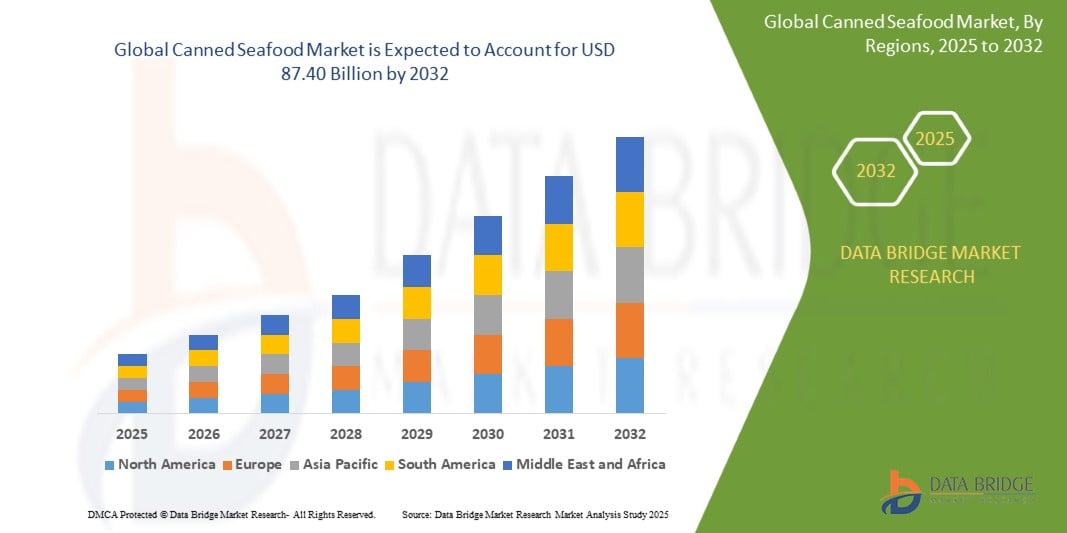
Canned Seafood Market Size
- The global canned seafood market was valued at USD 34.31 billion in 2024 and is expected to reach USD 87.40 billion by 2032
- During the forecast period of 2025 to 2032 the market is likely to grow at a CAGR of 12.40%, primarily driven by growing demand for convenient & ready-to-eat foods
- This growth is driven by factors such as changing lifestyles & busy schedules and on-the-go consumption
Canned Seafood Market Analysis
- Canned seafood refers to fish and shellfish that have been processed, sealed in airtight containers, and heat-treated to ensure long shelf life while preserving flavor, texture, and nutritional value. Common varieties include tuna, salmon, sardines, mackerel, and shellfish, offering a convenient and protein-rich food option suitable for various culinary applications
- The industry is witnessing steady expansion, driven by rising demand for ready-to-eat meals, growing health awareness, and increasing disposable incomes. As consumers prioritize convenience and nutrition, manufacturers are introducing sustainably sourced, flavored, and value-added canned seafood products to enhance market appeal and meet dietary preferences
- Innovations in packaging, product diversification, and sustainable fishing practices are reshaping the canned seafood industry by improving shelf life, reducing environmental impact, and enhancing consumer trust
- For instance, companies such as Bumble Bee Foods and Thai Union Group have incorporated BPA-free packaging, traceability technology, and responsibly sourced seafood certifications to strengthen their market presence and appeal to eco-conscious buyers
- The increasing demand for healthy, protein-rich, and ready-to-eat seafood options will continue to shape the industry, with manufacturers focusing on premium offerings, ethical sourcing, and smart packaging solutions to maintain a competitive edge
Report Scope and Canned Seafood Market Segmentation
|
Attributes |
Canned Seafood Key Market Insights |
|
Segments Covered |
|
|
Countries Covered |
North America
Europe
Asia-Pacific
Middle East and Africa
South America
|
|
Key Market Players |
|
|
Market Opportunities |
|
|
Value Added Data Infosets |
In addition to the insights on market scenarios such as market value, growth rate, segmentation, geographical coverage, and major players, the market reports curated by the Data Bridge Market Research also include in-depth expert analysis, pricing analysis, brand share analysis, consumer survey, demography analysis, supply chain analysis, value chain analysis, raw material/consumables overview, vendor selection criteria, PESTLE Analysis, Porter Analysis, and regulatory framework. |
Canned Seafood Market Trends
“Expanding Premium and Value-Added Canned Seafood Products”
- One prominent trend in the global canned seafood market is the expansion of premium and value-added products
- This trend is driven by the growing demand for gourmet, organic, and protein-rich seafood, encouraging manufacturers to introduce wild-caught, marinated, smoked, and ready-to-eat variations that cater to evolving dietary preferences
- For instance, Wild Planet Foods has launched sustainably caught, hand-cut canned tuna with no added fillers, appealing to health-conscious and environmentally aware consumers
- As consumers shift toward premium, restaurant-quality seafood at home, brands are enhancing their offerings with specialty flavors, spice-infused products, and high-protein formulations to differentiate in a competitive market
- This shift is expected to drive continuous product innovation, ensuring long-term market growth as companies focus on premiumization, clean-label ingredients, and unique taste experiences to attract discerning consumers
Canned Seafood Market Dynamics
Driver
“Rising Innovations in Fish Farming Techniques”
- The increasing emphasis on innovative fish farming techniques is a key driver of growth in the canned seafood market
- As sustainability concerns and the need for consistent seafood supply grow, advancements in aquaculture technology, responsible farming practices, and efficient breeding methods are reshaping the industry
- With consumers demanding high-quality and responsibly sourced seafood, companies are adopting techniques such as recirculating aquaculture systems (RAS), offshore fish farming, and selective breeding to improve seafood yield, reduce environmental impact, and ensure year-round availability
- As sustainable aquaculture becomes a priority, seafood brands are leveraging this trend by obtaining ASC (Aquaculture Stewardship Council) certifications, implementing blockchain-based traceability, and partnering with eco-friendly fisheries to build consumer trust and market credibility
- Manufacturers are also prioritizing nutritionally enriched farmed fish, incorporating omega-3-enhanced diets, and reducing antibiotic use to deliver healthier seafood options that align with consumer preferences for natural, chemical-free, and premium canned products
For instance,
- Nissui (Japan) has invested in closed-loop aquaculture systems to enhance fish quality while minimizing environmental disruption
- Thai Union Group has implemented smart farming technologies to optimize fish health and improve sustainability in seafood production
- With increasing reliance on innovative fish farming techniques and stricter environmental regulations, the canned seafood market will continue to expand, driving sustainability, efficiency, and premiumization in the industry worldwide
Opportunity
“Expanding into Emerging Markets”
- The growing middle class and increasing disposable income in emerging markets present a significant opportunity for the canned seafood market. As consumers in regions such as Asia-Pacific, Latin America, and the Middle East shift toward more convenient and nutritious food options, demand for canned seafood products is on the rise
- With rising urbanization and busy lifestyles in these regions, there is a greater need for convenient, ready-to-eat, and long-shelf-life seafood products. Canned seafood offers a practical solution for consumers seeking nutritious meals that are both affordable and easily accessible
- The demand for premium and value-added canned seafood is also increasing, as consumers in emerging markets become more health-conscious and open to trying new, diverse food options. Value-added products such as flavored, seasoned, or marinated canned seafood are gaining popularity as they offer added convenience and unique taste experiences
For instance,
- In Latin America, canned seafood brands have introduced products catering to local culinary preferences. Thai Union Group has launched value-added canned fish flavored with regional spices and seasonings, tailored specifically for markets in Brazil and Argentina
- Côte d'Ivoire and Nigeria are experiencing significant growth in the canned seafood market as seafood becomes a more accessible and affordable protein source due to the rising popularity of packaged and canned goods
- By capitalizing on these market trends, local preferences, and increased access to digital platforms, canned seafood companies can tap into the rapid growth occurring in emerging markets, ensuring a solid foundation for future expansion and increasing their presence in fast-growing regions
Restraint/Challenge
“Rising Usage of Preservatives in Some Canned Foods”
- The increasing use of preservatives in some canned foods presents a challenge for the canned seafood market. As consumers become more health-conscious, there is growing concern about the long-term health effects of preservatives and artificial additives in food products
- The demand for fresh, preservative-free foods is rising, especially among health-conscious individuals and those seeking products with shorter ingredient lists. Many seafood brands are being pressured to reformulate products to exclude artificial preservatives, relying on natural methods such as vacuum sealing, salt curing, or smoking to ensure product shelf life
- This shift can be costly and challenging for manufacturers who have historically relied on preservatives for extended shelf life and ease of distribution
For instance,
- In regions such as Asia-Pacific, where preservative use is still prevalent in many food products, there may be growing resistance from a younger, more health-conscious demographic
- By addressing the rise in the use of preservatives, the canned seafood market may face significant challenges as consumer preferences shift toward cleaner, preservative-free options. The growing demand for natural, organic, and preservative-free products, especially in developed markets, could lead to a decline in the appeal of canned seafood that still relies on traditional preservation methods
Canned Seafood Market Scope
The market is segmented on the basis of product, distribution channel, and type.
|
Segmentation |
Sub-Segmentation |
|
By Product |
|
|
By Distribution Channel |
|
|
By Type |
|
Canned Seafood Market Regional Analysis
“Asia-Pacific is the Dominant Region in the Canned Seafood Market”
- Asia-Pacific dominates the canned seafood market, driven by its large consumer base, rising disposable incomes, and increasing demand for convenient, shelf-stable food products. The region's robust seafood production and consumption, along with growing urbanization, play a key role in its market leadership
- Countries such as China, Japan, and India contribute significantly to this dominance, with China emerging as the largest consumer of canned seafood products. The demand for canned seafood is further boosted by the increasing popularity of ready-to-eat meals and changing dietary habits, which emphasize convenience without compromising nutrition
- A growing awareness of the health benefits of seafood and rising preference for protein-rich foods among the Asia-Pacific population are driving the demand for high-quality canned seafood
- The region is also home to several leading manufacturers, such as Thai Union Group and Maruha Nichiro Corporation, whose established market presence and wide distribution channels continue to solidify Asia-Pacific's dominance. The availability of a wide variety of canned seafood products, including fish, shellfish, and specialty items, contributes to the region’s strong market position
“South America is Projected to Register the Highest Growth Rate”
- The South America region is expected to witness the highest growth rate in the canned seafood market, driven by rising consumer demand for affordable, convenient, and nutritious food options. With improving economic conditions, an expanding middle class, and evolving food preferences, the region is becoming increasingly receptive to canned seafood as a reliable source of protein
- Countries such as Brazil, Argentina, and Chile are witnessing a surge in canned seafood consumption, as urbanization continues to drive demand for ready-to-eat and easy-to-store food products. The convenience factor, coupled with a growing population of working individuals and small households, is expected to propel the market further
- The South American market is benefiting from increasing seafood production, particularly from Chile, a leading exporter of canned fish. The region's seafood industry is expanding with innovations in production methods and the availability of new product varieties, such as sustainable and eco-friendly options
- The region is also benefiting from rising disposable incomes and changing consumer lifestyles, which make canned seafood more attractive for busy consumers seeking affordable, nutritious meal options. As the demand for seafood increases and local production grows, South America is set to experience the fastest market expansion in the forecast period
Canned Seafood Market Share
The market competitive landscape provides details by competitor. Details included are company overview, company financials, revenue generated, market potential, investment in research and development, new market initiatives, global presence, production sites and facilities, production capacities, company strengths and weaknesses, product launch, product width and breadth, application dominance. The above data points provided are only related to the companies' focus related to market.
The Major Market Leaders Operating in the Market Are:
- Bumble Bee Foods, LLC (U.S.)
- StarKist Co (U.S.)
- Nissui (Japan)
- Maruha Nichiro Corporation (Japan)
- Icicle Seafoods, Inc (U.S.)
- LDH (La Doria) Ltd (U.K.)
- Wild Planet Foods, Inc. (U.S.)
- Thai Union Group PCL (Thailand)
- American Tuna (U.S.)
- Universal Canning Inc. (Philippines)
- Trident Seafoods (U.S.)
Latest Developments in Global Canned Seafood Market
- In July 2023, Wild Planet Foods expanded its presence in the canned seafood market by introducing five new products at Whole Foods Market nationwide. Known for its sustainable sourcing, Wild Planet caters to health-conscious consumers seeking premium, eco-friendly seafood options, further driving demand for sustainable canned seafood
- In March 2023, Natural Grocers, America’s largest family-operated organic and natural grocery retailer, introduced five new varieties of canned seafood to its premium Natural Grocers Brand. This expansion highlights the increasing consumer demand for high-quality, sustainable, and natural seafood options. By offering these new products, Natural Grocers is catering to the growing trend of health-conscious shoppers seeking eco-friendly and premium canned seafood, further driving the market's shift toward quality and sustainability in the canned seafood sector

- Interactive Data Analysis Dashboard
- Company Analysis Dashboard for high growth potential opportunities
- Research Analyst Access for customization & queries
- Competitor Analysis with Interactive dashboard
- Latest News, Updates & Trend analysis
- Harness the Power of Benchmark Analysis for Comprehensive Competitor Tracking
Global Canned Seafood Market, Supply Chain Analysis and Ecosystem Framework
To support market growth and help clients navigate the impact of geopolitical shifts, DBMR has integrated in-depth supply chain analysis into its Global Canned Seafood Market research reports. This addition empowers clients to respond effectively to global changes affecting their industries. The supply chain analysis section includes detailed insights such as Global Canned Seafood Market consumption and production by country, price trend analysis, the impact of tariffs and geopolitical developments, and import and export trends by country and HSN code. It also highlights major suppliers with data on production capacity and company profiles, as well as key importers and exporters. In addition to research, DBMR offers specialized supply chain consulting services backed by over a decade of experience, providing solutions like supplier discovery, supplier risk assessment, price trend analysis, impact evaluation of inflation and trade route changes, and comprehensive market trend analysis.
Data collection and base year analysis are done using data collection modules with large sample sizes. The stage includes obtaining market information or related data through various sources and strategies. It includes examining and planning all the data acquired from the past in advance. It likewise envelops the examination of information inconsistencies seen across different information sources. The market data is analysed and estimated using market statistical and coherent models. Also, market share analysis and key trend analysis are the major success factors in the market report. To know more, please request an analyst call or drop down your inquiry.
The key research methodology used by DBMR research team is data triangulation which involves data mining, analysis of the impact of data variables on the market and primary (industry expert) validation. Data models include Vendor Positioning Grid, Market Time Line Analysis, Market Overview and Guide, Company Positioning Grid, Patent Analysis, Pricing Analysis, Company Market Share Analysis, Standards of Measurement, Global versus Regional and Vendor Share Analysis. To know more about the research methodology, drop in an inquiry to speak to our industry experts.
Data Bridge Market Research is a leader in advanced formative research. We take pride in servicing our existing and new customers with data and analysis that match and suits their goal. The report can be customized to include price trend analysis of target brands understanding the market for additional countries (ask for the list of countries), clinical trial results data, literature review, refurbished market and product base analysis. Market analysis of target competitors can be analyzed from technology-based analysis to market portfolio strategies. We can add as many competitors that you require data about in the format and data style you are looking for. Our team of analysts can also provide you data in crude raw excel files pivot tables (Fact book) or can assist you in creating presentations from the data sets available in the report.













