


Capnography Consumables Market Size
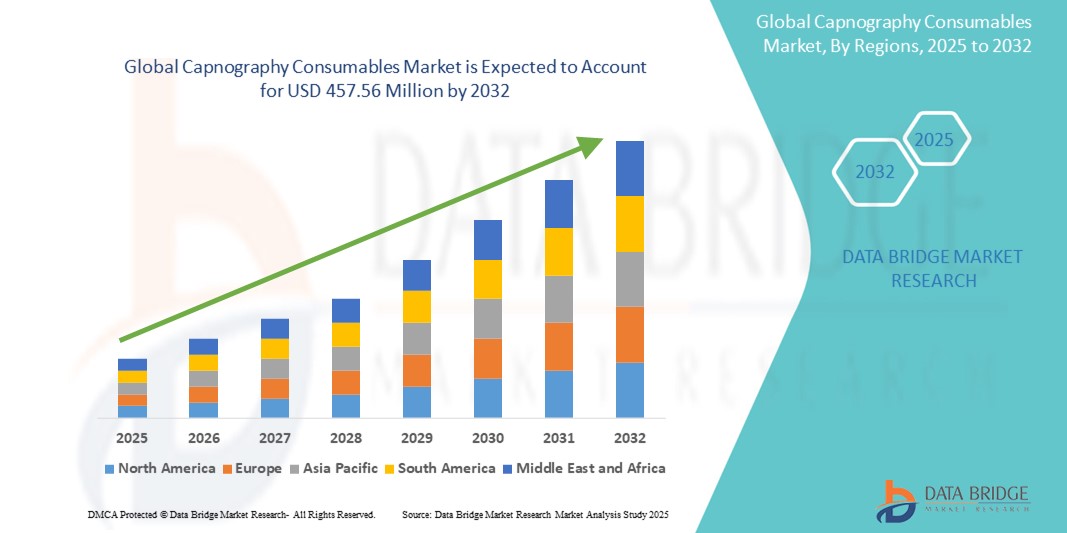
- The global capnography consumables market size was valued at USD 300.41 million in 2024 and is expected to reach USD 457.56 million by 2032, at a CAGR of 5.4% during the forecast period
- The market growth is largely driven by the increasing incidence of respiratory disorders and the expanding utilization of capnography monitoring in emergency care, surgical procedures, and critical care settings
- Furthermore, growing awareness regarding the importance of real-time CO₂ monitoring, along with the rise in outpatient surgeries and the use of portable capnography devices, is driving demand for reliable and disposable consumables. These combined factors are propelling the adoption of capnography consumables, significantly boosting the industry's growth
Capnography Consumables Market Analysis
- Capnography consumables, including cannulas, masks, adapters, and sensor accessories, are essential for enabling accurate and continuous end-tidal CO₂ monitoring across a wide range of clinical settings, supporting critical patient assessments in surgical, emergency, and home care environments
- The growing demand for capnography consumables is primarily fueled by the rising incidence of respiratory diseases, increased emphasis on perioperative monitoring, and expanding adoption of capnography in non-operating room anesthesia and procedural sedation
- North America dominated the capnography consumables market with the largest revenue share of 42.5% in 2024, attributed to advanced healthcare infrastructure, strong regulatory support, and growing integration of capnography systems in hospitals and trauma centers, particularly in the U.S., where capnography is increasingly mandated during sedation and ventilation
- Asia-Pacific is expected to be the fastest growing region in the capnography consumables market during the forecast period due to growing healthcare investments, increased awareness of patient safety protocols, and rising prevalence of chronic respiratory conditions
- The cannula segment dominated the capnography consumables market with a market share of 38.9% in 2024, owing to its frequent usage in non-intubated patients, ease of use, and compatibility with both low-flow oxygen systems and portable capnography monitors
Report Scope and Capnography Consumables Market Segmentation
|
Attributes |
Capnography Consumables Key Market Insights |
|
Segments Covered |
|
|
Countries Covered |
North America
Europe
Asia-Pacific
Middle East and Africa
South America
|
|
Key Market Players |
|
|
Market Opportunities |
|
|
Value Added Data Infosets |
In addition to the insights on market scenarios such as market value, growth rate, segmentation, geographical coverage, and major players, the market reports curated by the Data Bridge Market Research also include in-depth expert analysis, pricing analysis, brand share analysis, consumer survey, demography analysis, supply chain analysis, value chain analysis, raw material/consumables overview, vendor selection criteria, PESTLE Analysis, Porter Analysis, and regulatory framework. |
Capnography Consumables Market Trends
“Shift Toward Non-Invasive and Portable Monitoring Solutions”
- A key and accelerating trend in the global capnography consumables market is the growing preference for non-invasive and portable respiratory monitoring, driven by the increasing demand for patient comfort, faster diagnosis, and point-of-care applications across healthcare settings
- For instance, Microstream capnography technology by Medtronic enables low-flow and accurate CO₂ monitoring with specialized nasal cannulas and airway adapters designed for both intubated and non-intubated patients. Such consumables are tailored for compact, transportable monitors used in ambulances, emergency rooms, and homecare settings
- With the rising burden of respiratory diseases and emphasis on early detection and continuous monitoring, healthcare providers are increasingly relying on portable capnography devices supported by disposable and easy-to-use consumables. This ensures hygienic usage across multiple patients while reducing cross-contamination risks
- The demand for consumables such as nasal cannulas and sampling lines compatible with handheld and wearable capnography systems is expanding, especially in outpatient and prehospital care environments. These components are crucial in enabling flexible monitoring outside traditional ICU or OR setups
- This trend is reshaping how capnography is implemented—moving from primarily operating room use to becoming a standard of care across ambulatory, emergency, and homecare settings. Companies such as Philips and Masimo are innovating compact systems that integrate with cloud-based data platforms and offer consumables tailored for mobility and patient-friendly application
- The transition towards portable, patient-centric, and non-invasive solutions is fueling consistent demand for high-quality, disposable capnography consumables and expanding the market's reach into new care models and remote monitoring applications
Capnography Consumables Market Dynamics
Driver
“Increasing Clinical Adoption in Critical and Perioperative Care”
- The growing recognition of capnography as a vital monitoring tool in emergency, surgical, and procedural sedation environments is a major driver of demand for capnography consumables, such as sensor kits, cannulas, and adapters
- For instance, clinical guidelines from bodies such as the American Society of Anesthesiologists recommend the routine use of capnography during sedation and intubation, increasing the volume of procedures requiring single-use consumables
- Capnography’s ability to provide real-time feedback on ventilation effectiveness and early signs of respiratory depression has made it indispensable in trauma care, ICUs, and during conscious sedation. This has significantly boosted the consumption of capnography accessories tailored for different patient types and applications
- Moreover, the expansion of procedural sedation outside of the OR such as in gastroenterology suites and dental practices has driven additional demand for user-friendly and cost-effective consumables that can be safely used across outpatient and ambulatory care settings
- The continued rollout of capnography systems in pre-hospital and transport settings, combined with increased training and awareness among clinicians, is further accelerating the consumption of single-use capnography accessories, reinforcing the market’s growth trajectory
Restraint/Challenge
“Cost Sensitivity and Reimbursement Limitations in Developing Regions”
- The relatively high cost of capnography systems and associated consumables, along with inconsistent reimbursement frameworks, poses a restraint to wider market penetration, especially in price-sensitive or underfunded healthcare systems
- In lower-income countries, healthcare providers often prioritize basic vital sign monitoring, and the use of capnography is limited by budgetary constraints or lack of awareness. In addition, the recurring cost of disposable consumables such as sampling lines and specialized cannulas can deter long-term use where reimbursement is not well established
- Some healthcare facilities opt for reusing consumables, increasing infection risks and reducing the effectiveness of capnography monitoring, thereby undermining the technology’s clinical benefits.
- To overcome these challenges, manufacturers are working to develop more affordable, multi-functional consumables and offering bundled pricing models. However, broader adoption in resource-limited regions will depend on increased training, improved reimbursement policies, and public health initiatives that highlight the cost-benefit of capnography in improving patient outcomes
Capnography Consumables Market Scope
The market is segmented on the basis of product, component, application, end user, and distribution channel.
- By Product
On the basis of product, the capnography consumables market is segmented into capnography mask, sensor & sensor cable, adapter kit, cannula, and others. The cannula segment dominated the market with the largest market revenue share of 38.9% in 2024, owing to its frequent usage in both intubated and non-intubated patients, ease of application, and compatibility with portable and fixed capnography monitors. Hospitals and emergency care providers prefer cannulas for their non-invasive nature and effectiveness in continuous CO₂ monitoring. The segment also benefits from the growing need for disposable, hygienic consumables in critical care and home settings.
The adapter kit segment is anticipated to witness the fastest growth rate of 19.3% from 2025 to 2032, fueled by the increasing use of capnography in procedural sedation and critical care scenarios. Adapter kits enable seamless integration of capnography sensors with ventilators, oxygen masks, and other respiratory support systems, enhancing their appeal across trauma centers and surgical units. Their role in expanding device compatibility and reducing setup time contributes to their rising demand.
- By Component
On the basis of component, the capnography consumables market is segmented into OEM modules and others. The OEM modules segment held the largest market revenue share of 42.1% in 2024, driven by the increasing demand from original equipment manufacturers for embedded capnography capabilities in multi-parameter patient monitors and anesthesia machines. OEM integration supports the growing adoption of compact and unified monitoring systems across hospitals and ambulatory care centers, enhancing workflow efficiency and patient safety.
The others segment is expected to grow steadily during the forecast period, supported by rising demand for supplemental accessories and third-party components that improve system interoperability and upgrade older monitoring equipment in cost-effective ways.
- By Application
On the basis of application, the capnography consumables market is segmented into cardiac care, trauma and emergency care, respiratory monitoring, sleep monitoring, procedural sedation, and others. The respiratory monitoring segment dominated the market with the largest market revenue share of 30.8% in 2024, driven by the rising global burden of respiratory diseases such as COPD, asthma, and acute respiratory failure. Real-time CO₂ monitoring is increasingly used for treatment optimization and ventilator management, boosting the demand for consumables that ensure reliable sampling and measurement accuracy.
The procedural sedation segment is anticipated to witness the fastest growth rate of 20.2% from 2025 to 2032, owing to growing clinical awareness and regulatory mandates for continuous CO₂ monitoring during sedation outside the operating room. Disposable nasal cannulas and adapters play a key role in these applications due to their comfort and compatibility with low-flow oxygen delivery systems.
- By End User
On the basis of end user, the capnography consumables market is segmented into hospitals, specialty clinics, trauma centers, ambulatory care centers, homecare settings, and others. The hospitals segment dominated the market with the largest market revenue share of 45.7% in 2024, supported by the widespread use of capnography in operating rooms, ICUs, and emergency departments for intubated and non-intubated patients. Hospitals also benefit from centralized procurement systems and adherence to clinical guidelines that require consistent usage of disposable capnography accessories.
The homecare settings segment is expected to witness the fastest growth rate of 21.5% from 2025 to 2032, fueled by the increasing use of portable capnography monitors in chronic disease management, remote monitoring, and post-acute care. User-friendly consumables that are easy to apply and dispose of make capnography more accessible to caregivers and patients outside the hospital environment.
- By Distribution Channel
On the basis of distribution channel, the capnography consumables market is segmented into direct tender, retail sales, and online sales. The direct tender segment dominated the market with the largest market revenue share of 52.3% in 2024, as hospitals and government healthcare institutions often procure consumables through bulk contracts and long-term agreements with manufacturers and distributors. This ensures supply consistency, regulatory compliance, and cost-efficiency for large-scale users.
The online sales segment is anticipated to witness the fastest growth rate of 23.1% from 2025 to 2032, driven by growing digitization in the medical supply chain, increasing preference for e-commerce platforms by small clinics and homecare providers, and the ease of comparing products and prices across brands and suppliers.
Capnography Consumables Market Regional Analysis
- North America dominated the capnography consumables market with the largest revenue share of 42.5% in 2024, attributed to advanced healthcare infrastructure, strong regulatory support, and growing integration of capnography systems in hospitals and trauma centers
- Healthcare providers in the region prioritize continuous respiratory monitoring to enhance patient safety, particularly in surgical, trauma, and intensive care settings, fueling the demand for high-quality, disposable consumables such as cannulas, adapters, and sensor kits
- This dominance is further reinforced by favorable reimbursement policies, a high volume of procedural sedation cases, and adherence to regulatory guidelines that mandate CO₂ monitoring, solidifying capnography consumables as a critical component of modern patient care across hospitals, ambulatory centers, and homecare environments
U.S. Capnography Consumables Market Insight
The U.S. capnography consumables market captured the largest revenue share of 79% in 2024 within North America, fueled by the widespread integration of capnography in hospital protocols and increasing usage across surgical, trauma, and outpatient procedures. High awareness among clinicians regarding early respiratory event detection, along with strong adherence to guidelines recommending CO₂ monitoring during anesthesia and sedation, drives consistent demand for disposable cannulas, adapters, and sensor kits. The country's robust healthcare infrastructure and high procedure volumes further strengthen its leadership in this segment.
Europe Capnography Consumables Market Insight
The Europe capnography consumables market is projected to grow at a substantial CAGR during the forecast period, driven by increasing focus on patient safety, strong regulatory frameworks, and the standardization of capnography monitoring across intensive care and emergency settings. Rising prevalence of respiratory conditions and adoption of portable monitoring solutions are encouraging broader use of capnography consumables in both hospital and ambulatory environments. Growing healthcare investments and emphasis on quality care across Western Europe continue to support sustained market growth.
U.K. Capnography Consumables Market Insight
The U.K. capnography consumables market is anticipated to grow at a noteworthy CAGR during the forecast period, supported by national guidelines that emphasize the importance of CO₂ monitoring during sedation and respiratory therapy. The country’s established public healthcare infrastructure, combined with growing application of capnography in non-OR clinical settings such as dental and outpatient surgery, contributes to the increasing demand for disposable consumables such as nasal cannulas and sampling lines.
Germany Capnography Consumables Market Insight
The Germany capnography consumables market is expected to expand at a considerable CAGR, driven by rising clinical awareness of CO₂ monitoring's value in intensive care and emergency medicine. Germany’s strong healthcare system and focus on technological integration support the adoption of advanced capnography systems, creating consistent demand for high-performance, single-use consumables. Emphasis on patient safety and infection control further promotes the usage of disposable components.
Asia-Pacific Capnography Consumables Market Insight
The Asia-Pacific capnography consumables market is poised to grow at the fastest CAGR of 23.5% from 2025 to 2032, driven by increasing healthcare expenditure, rising respiratory disease burden, and expanding access to advanced monitoring technologies. Rapid urbanization and growth of private healthcare sectors in countries such as China, India, and Japan are accelerating the deployment of capnography in emergency, surgical, and homecare settings. The growing availability of cost-effective, disposable consumables is also broadening market penetration across public and rural health sectors.
Japan Capnography Consumables Market Insight
The Japan capnography consumables market is gaining traction due to the country's aging population, high surgical volumes, and strong inclination toward advanced medical technologies. Capnography is increasingly adopted in hospitals and ambulatory centers to ensure patient safety during anesthesia and critical care. Demand for compact, disposable consumables is rising, especially in perioperative monitoring and portable home-use devices. The country's emphasis on infection prevention supports the preference for single-use components.
India Capnography Consumables Market Insight
The India capnography consumables market accounted for the largest market revenue share in Asia Pacific in 2024, attributed to the country’s expanding hospital network, growing prevalence of respiratory illnesses, and rising awareness of real-time respiratory monitoring. Government-backed healthcare initiatives, increased adoption of capnography in emergency and surgical care, and availability of low-cost disposable consumables are driving robust market growth. Domestic manufacturing capacity and affordable product offerings further boost accessibility and adoption across both urban and semi-urban regions.
Capnography Consumables Market Share
The capnography consumables industry is primarily led by well-established companies, including:
- Medtronic (Ireland)
- Koninklijke Philips N.V. (Netherlands)
- Masimo Corporation (U.S.)
- Drägerwerk AG & Co. KGaA (Germany)
- GE HealthCare (U.S.)
- Nihon Kohden Corporation (Japan)
- ZOLL Medical Corporation (U.S.)
- Mindray Medical International Limited (China)
- Nonin Medical, Inc. (U.S.)
- BD (U.S.)
- Hamilton Medical AG (Switzerland)
- Infinium Medical Inc. (U.S.)
- Edan Instruments, Inc. (China)
- Criticare Technologies Inc. (U.S.)
- Schiller AG (Switzerland)
- Spacelabs Healthcare Inc. (U.S.)
- Promed Group Co., Ltd. (China)
- Surgimed Medical Devices Pvt. Ltd. (India)
- Trivitron Healthcare Pvt. Ltd. (India)
What are the Recent Developments in Global Capnography Consumables Market?
- In March 2024, Medtronic plc, a global leader in medical technology, introduced its next-generation capnography consumables designed to deliver enhanced patient comfort and optimized CO₂ monitoring during procedural sedation and intensive care. This innovation includes low-dead-space sampling lines and ergonomic cannulas aimed at improving clinical accuracy while reducing patient discomfort. The launch reinforces Medtronic’s commitment to advancing respiratory monitoring and improving patient outcomes across diverse care settings
- In February 2024, Philips Healthcare expanded its capnography consumables portfolio with the release of eco-friendly, single-use sampling lines compatible with its IntelliVue monitors. These products are designed with sustainable materials to minimize environmental impact while maintaining high-quality respiratory measurement. This development aligns with Philips’ strategic focus on green healthcare solutions and highlights growing market demand for environmentally responsible medical disposables
- In December 2023, Masimo Corporation announced a collaboration with a major U.S. hospital network to implement its full suite of capnography consumables and monitoring solutions across emergency departments and post-anesthesia care units (PACUs). The initiative aims to enhance early detection of respiratory compromise through widespread deployment of high-efficiency nasal and oral CO₂ cannulas. This move illustrates Masimo’s growing footprint in critical care and procedural settings
- In October 2023, Smiths Medical, now part of ICU Medical, introduced a redesigned capnography adapter line for pediatric and neonatal applications. The new consumables offer improved flexibility, smaller dead space, and compatibility with mainstream and sidestream capnography monitors. This product launch emphasizes the company’s focus on specialized respiratory solutions for vulnerable patient populations, meeting growing clinical demand in neonatal and pediatric intensive care units
- In August 2023, Drägerwerk AG & Co. KGaA unveiled its expanded line of disposable capnography accessories for use in anesthesia and emergency response. Designed for rapid deployment and reliable CO₂ monitoring in high-pressure environments, the new consumables support infection control protocols and enhance operational efficiency in acute care scenarios. This development underlines Dräger’s ongoing investment in critical care innovation and patient safety

- Interactive Data Analysis Dashboard
- Company Analysis Dashboard for high growth potential opportunities
- Research Analyst Access for customization & queries
- Competitor Analysis with Interactive dashboard
- Latest News, Updates & Trend analysis
- Harness the Power of Benchmark Analysis for Comprehensive Competitor Tracking
Data collection and base year analysis are done using data collection modules with large sample sizes. The stage includes obtaining market information or related data through various sources and strategies. It includes examining and planning all the data acquired from the past in advance. It likewise envelops the examination of information inconsistencies seen across different information sources. The market data is analysed and estimated using market statistical and coherent models. Also, market share analysis and key trend analysis are the major success factors in the market report. To know more, please request an analyst call or drop down your inquiry.
The key research methodology used by DBMR research team is data triangulation which involves data mining, analysis of the impact of data variables on the market and primary (industry expert) validation. Data models include Vendor Positioning Grid, Market Time Line Analysis, Market Overview and Guide, Company Positioning Grid, Patent Analysis, Pricing Analysis, Company Market Share Analysis, Standards of Measurement, Global versus Regional and Vendor Share Analysis. To know more about the research methodology, drop in an inquiry to speak to our industry experts.
Data Bridge Market Research is a leader in advanced formative research. We take pride in servicing our existing and new customers with data and analysis that match and suits their goal. The report can be customized to include price trend analysis of target brands understanding the market for additional countries (ask for the list of countries), clinical trial results data, literature review, refurbished market and product base analysis. Market analysis of target competitors can be analyzed from technology-based analysis to market portfolio strategies. We can add as many competitors that you require data about in the format and data style you are looking for. Our team of analysts can also provide you data in crude raw excel files pivot tables (Fact book) or can assist you in creating presentations from the data sets available in the report.












