


What is the Cardiac Imaging Software Market Size and Growth Rate?
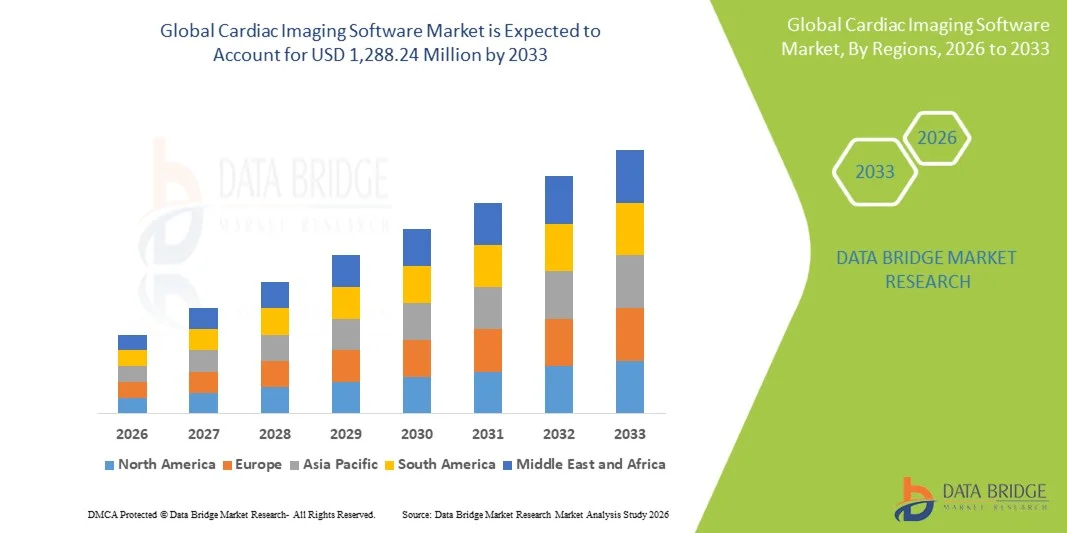
- As per Data Bridge Market Research analysis, the cardiac imaging software market was valued at USD 641.80 million in 2025 and is projected to reach USD 1,288.24 million by 2033, growing at a CAGR of 9.10% from 2026 to 2033.
- The market is experiencing consistent growth driven by rising demand for advanced cardiovascular diagnostic solutions, rapid advancements in artificial intelligence-powered image analysis, and expanding applications of cardiac imaging software across hospitals, diagnostic centers, and cardiovascular clinics.
- The increasing prevalence of cardiovascular diseases globally, combined with the growing need for early and accurate diagnosis, is compelling healthcare providers to adopt advanced cardiac imaging software. AI-enabled analysis, cloud-based deployment, and multimodality imaging platforms are enhancing diagnostic efficiency, supporting clinical decision-making, and enabling more integrated cardiovascular care workflows.
Market Size & Forecast
- Global Market Value (2025): USD 641.80 Million
- Expected Market Value (2033): USD 1,288.24 Million
- Forecast CAGR (2026–2033): 9.10%
- Leading Region in 2025: North America
- Fastest Growing Region: Asia Pacific
What are the Major Takeaways of the Cardiac Imaging Software Market?
- North America dominated the cardiac imaging software market with the largest revenue share of 42.17% in 2025, supported by advanced healthcare infrastructure, established cardiovascular information systems, and increasing adoption of AI-powered cardiac imaging solution
- Asia-Pacific is expected to be the fastest-growing region at a CAGR of 13.34% from 2026 to 2033, fueled by expanding healthcare infrastructure, rising cardiovascular disease prevalence, and growing adoption of cardiac imaging technologies across China, India, and Japan.
- The echocardiography segment led the market with a 32.18% share in 2025, driven by the widespread clinical use of echocardiography across hospitals, cardiovascular clinics, and outpatient care settings.
- Combined and multimodality imaging are the fastest-growing imaging modality type, projected to register a CAGR of 15.27%, reflecting the surge in demand for integrated analysis of cardiac information from multiple imaging modalities
- The on-premises segment dominated the deployment category with a 68.18% revenue share in 2025, led by the established installed base of cardiovascular information systems and cardiology PACS platforms.
- Coronary artery disease accounted for 33.35% of the market share in 2025, preferred by the extensive use of cardiac imaging software for coronary assessment and cardiovascular diagnosis.
- The structural heart disease segment is the fastest-growing application category, with a CAGR of 17.12%, driven by increasing adoption of advanced imaging for structural cardiovascular assessment and intervention planning.
Report Scope and Cardiac Imaging Software Market Segmentation
|
Attributes |
Cardiac Imaging Software Key Market Insights |
|
Segments Covered |
|
|
Countries Covered |
North America
Europe
Asia-Pacific
Middle East and Africa
South America
|
|
Key Market Players |
|
|
Market Opportunities |
|
|
Value Added Data Infosets |
In addition to the insights on market scenarios such as market value, growth rate, segmentation, geographical coverage, and major players, the market reports curated by the Data Bridge Market Research also include in-depth expert analysis, patient epidemiology, pipeline analysis, pricing analysis, and regulatory framework. |
What is the Key Trend in the Cardiac Imaging Software Market?
- Healthcare providers are increasingly adopting AI-enabled cardiac imaging software to automate measurements, improve image interpretation, and support faster cardiovascular diagnosis across echocardiography, CT, and MRI workflows.
- For instance, in August 2025, Philips launched Transcend Plus with FDA-cleared AI enhancements for cardiovascular ultrasound, including advanced two-dimensional and three-dimensional imaging capabilities designed to support faster and more reproducible cardiac assessments.
- Automated quantification tools enable clinicians to assess cardiac function, ventricular volumes, ejection fraction, and myocardial characteristics with improved speed and reproducibility.
- Cloud-based cardiac imaging platforms are increasingly enabling remote access, centralized workflows, multidisciplinary collaboration, and scalable management of cardiovascular images across healthcare networks.
- For instance, in November 2025, Philips received FDA 510(k) clearance for its cloud-hosted Cardiovascular Workspace, enabling Software-as-a-Service deployment and supporting secure remote access, automated analysis, documentation, and reporting.
- As healthcare organizations increasingly prioritize AI adoption, workflow automation, and connected cardiovascular care, demand for intelligent cardiac imaging software is expected to accelerate, reinforcing software as a core component of modern cardiac diagnosis.
What are the Key Drivers of the Cardiac Imaging Software Market?
- The rising prevalence of cardiovascular diseases and growing demand for earlier diagnosis are increasing adoption of cardiac imaging software capable of delivering quantitative analysis, automated measurements, and clinically actionable information across cardiovascular imaging workflows.
- For instance, in August 2024, GE HealthCare announced CE marks for Vscan Air SL with Caption AI, providing AI-driven software for rapid cardiac assessments at the point of care and supporting more timely cardiovascular evaluation.
- Hospitals, imaging centers, and cardiovascular clinics are integrating advanced software into imaging workflows to improve diagnostic efficiency, standardize measurements, reduce repetitive tasks, and support clinicians managing increasing cardiovascular imaging volumes.
- For instance, in September 2024, Siemens Healthineers highlighted AI-powered cardiology applications for its ACUSON Sequoia ultrasound system, including automated measurements and cardiac strain analysis designed to reduce routine examination time and streamline clinical workflows.
- With cardiovascular care increasingly relying on quantitative imaging, automated analysis, and AI-assisted decision support, cardiac imaging software will remain essential for improving diagnostic workflows and expanding the efficiency of cardiovascular imaging services.
Which Factors are Challenging the Growth of the Cardiac Imaging Software Market?
- Advanced cardiac imaging software requires substantial investment in licenses, infrastructure, integration, cybersecurity, maintenance, and staff training, particularly when healthcare organizations deploy complex enterprise imaging platforms across multiple facilities.
- For instance, in November 2025, Philips introduced cloud-hosted Cardiovascular Workspace with SaaS deployment, highlighting the need for scalable infrastructure, secure connectivity, and managed technology environments for modern cardiovascular imaging workflows.
- These implementation requirements can limit adoption among smaller hospitals, outpatient centers, and healthcare providers with constrained technology budgets or limited specialist information technology resources.
- For instance, in October 2024, The Lancet Digital Health highlighted that integrating AI into diverse institutional PACS and imaging devices remains a clinical hurdle in cardiac imaging, compounded by limited high-quality labeled data, data-sharing difficulties, and inconsistent validation standards.
- The financial and technical complexity of integrating cardiac imaging software with existing PACS, electronic health records, imaging modalities, and hospital information systems can slow deployment, particularly among organizations seeking interoperability and secure data exchange.
How is the Cardiac Imaging Software Market Segmented?
The cardiac imaging software market is segmented on the basis of imaging modality, deployment, application, and end user.
- By Imaging Modality
On the basis of imaging modality, the cardiac imaging software market is segmented into computed tomography (CT), magnetic resonance imaging (MRI), echocardiography, nuclear cardiology, X-ray and fluoroscopy, and combined and multimodality imaging. The echocardiography segment dominated the market with a 32.18% share in 2025, supported by the widespread clinical use of echocardiography across hospitals, cardiovascular clinics, and outpatient care settings. Echocardiography provides real-time visualization of cardiac structures and function without exposing patients to ionizing radiation. Cardiac imaging software is increasingly used to automate measurements such as ventricular function and strain analysis. AI-enabled echocardiography solutions are also improving image acquisition, quantification, workflow efficiency, and reporting. The broad availability of ultrasound systems across different healthcare settings supports continued demand for echocardiography software.
The combined and multimodality imaging segment is projected to register the fastest growth at a CAGR of 15.27% from 2026 to 2033, driven by increasing demand for integrated analysis of cardiac information from multiple imaging modalities. Multimodality platforms allow clinicians to combine CT, MRI, echocardiography, nuclear imaging, and other cardiovascular datasets within connected workflows. This capability is particularly valuable for complex cardiovascular conditions that require both anatomical and functional assessment. Structural heart disease, cardiomyopathy, congenital heart conditions, and advanced cardiovascular interventions can benefit from integrated imaging information. Software supporting image fusion, registration, visualization, and quantitative analysis is becoming increasingly important in specialized cardiovascular workflows. AI-assisted multimodality analysis is further improving the ability to interpret complex imaging datasets.
- By Deployment
On the basis of deployment, the cardiac imaging software market is segmented into on-premises, cloud-based and software as a service (SaaS), web-based, hybrid and edge deployment, and others. The on-premises segment dominated the market with a 68.18% share in 2025, supported by the established installed base of cardiovascular information systems and cardiology PACS platforms. Hospitals have historically preferred locally deployed software because it provides direct control over imaging data and IT infrastructure. On-premises systems can also be closely integrated with existing hospital information systems and imaging networks. Large healthcare organizations often maintain extensive cardiovascular imaging archives that are connected to local software environments.
The cloud-based and software as a service (SaaS) segment is projected to register the fastest growth at a CAGR of 19.21% from 2026 to 2033, driven by increasing demand for scalable and remotely accessible cardiac imaging platforms. Cloud-based systems reduce the need for extensive local server infrastructure and can simplify software maintenance and updates. Healthcare providers can access imaging applications across multiple facilities and support distributed cardiovascular care workflows. Cloud deployment also facilitates collaboration between cardiologists, radiologists, surgeons, and other specialists. Increasing use of AI-based cardiac image analysis is supporting demand for cloud environments capable of handling computationally intensive applications. SaaS models can In addition provide healthcare organizations with more flexible software procurement and deployment options.
- By Application
On the basis of application, the cardiac imaging software market is segmented into coronary artery disease, structural heart disease, heart failure, arrhythmia and electrophysiology, valvular heart disease, congenital heart disease, pulmonary hypertension, cardiomyopathy, image-guided treatment planning, and others. The coronary artery disease segment dominated the market with a 33.35% share in 2025, owing to the extensive use of cardiac imaging software for coronary assessment and cardiovascular diagnosis. Software solutions support visualization, quantitative analysis, plaque assessment, calcium scoring, and other forms of coronary evaluation. Cardiac CT and other imaging modalities are increasingly supported by advanced post-processing and analytical tools. AI-based technologies can assist with image interpretation and identification of clinically relevant abnormalities. The high clinical demand for assessing coronary artery disease supports substantial utilization of cardiac imaging software.
The structural heart disease segment is projected to register the fastest growth at a CAGR of 17.12% from 2026 to 2033, driven by increasing adoption of advanced imaging for structural cardiovascular assessment and intervention planning. Software solutions help clinicians analyze detailed cardiac anatomy and support patient-specific procedural preparation. Multimodality imaging is particularly relevant for evaluating complex structural abnormalities and determining appropriate intervention strategies. Three-dimensional visualization and quantitative measurements can improve the assessment of cardiac structures before procedures. Increasing use of minimally invasive structural heart interventions is creating additional demand for specialized imaging workflows. AI-assisted segmentation and automated measurements are further enhancing the efficiency of structural heart imaging analysis.
- By End User
On the basis of end user, the cardiac imaging software market is segmented into hospitals, diagnostic imaging centers, cardiovascular clinics, ambulatory surgical centers, research and pharmaceutical organizations, and others. The hospitals segment dominated the market with a 65.36% share in 2025, owing to the concentration of advanced cardiovascular infrastructure and high volumes of cardiac imaging procedures within hospital settings. Hospitals commonly operate multiple cardiac imaging modalities and therefore require software capable of managing diverse imaging workflows. Academic medical centers and large healthcare systems also use advanced visualization, AI-based analysis, and multimodality platforms for complex cardiovascular care. Hospital-based cardiovascular departments generate demand across diagnostic, treatment planning, procedural, and monitoring applications. Integration with cardiovascular information systems, PACS, and other clinical platforms further supports software adoption.
The ambulatory surgical centers segment is projected to register the fastest growth at a CAGR of 14.36% from 2026 to 2033, driven by the increasing shift toward outpatient and minimally invasive cardiovascular procedures. Ambulatory surgical centers require efficient imaging workflows that can support procedural preparation and clinical decision-making within shorter care pathways. Advanced cardiac imaging software can provide rapid visualization, quantitative analysis, and treatment-planning capabilities without requiring the infrastructure of a large hospital. Increasing adoption of minimally invasive cardiovascular interventions is creating additional demand for specialized imaging technologies in these settings. Cloud-based and interoperable software can also help ambulatory centers connect with external hospitals, specialists, and imaging networks. Automated analysis and AI-supported workflows can improve operational efficiency for facilities handling growing procedure volumes.
Which Region Holds the Largest Share of the Cardiac Imaging Software Market?
- North America dominated the cardiac imaging software market with the largest revenue share of 42.17% in 2025, supported by advanced healthcare infrastructure, established cardiovascular information systems, and increasing adoption of AI-powered cardiac imaging solution
- The region also benefits from established reimbursement pathways, high adoption of AI-enabled cardiac imaging solutions, extensive hospital and cardiovascular care networks, and the presence of major healthcare technology providers. Increasing use of CT, MRI, echocardiography, and advanced image-analysis software across cardiovascular diagnosis and treatment planning continues to strengthen North America’s leadership position in the global market.
U.S. Cardiac Imaging Software Market Insight
The U.S. cardiac imaging software market is witnessing strong growth due to advanced healthcare infrastructure, widespread adoption of cardiovascular information systems, and increasing investments in AI-enabled cardiac imaging technologies. The country’s mature hospital and cardiovascular care ecosystem, along with established reimbursement pathways for software-supported cardiac imaging, is driving demand across diagnostic and treatment-planning applications. In addition, growing adoption of CT, MRI, echocardiography, and advanced image-analysis platforms is accelerating software deployment across hospitals and specialized cardiovascular centers.
Asia-Pacific Cardiac Imaging Software Market Insight
The Asia-Pacific cardiac imaging software market is expected to witness rapid growth, driven by increasing cardiovascular disease prevalence, aging populations, healthcare digitization, and rising investments in AI-enabled medical technologies across countries such as China, India, and Japan. Growing adoption of advanced cardiac imaging modalities, expanding hospital infrastructure, and increasing demand for efficient diagnostic solutions are supporting regional market expansion. In addition, rising investments in healthcare AI, cloud-based imaging platforms, and cardiovascular diagnostic capabilities are accelerating software adoption across hospitals, diagnostic centers, and specialized cardiovascular facilities.
Japan Cardiac Imaging Software Market Insight
The Japan cardiac imaging software market is witnessing consistent growth due to the country’s technologically advanced healthcare system, aging population, and increasing adoption of sophisticated cardiovascular imaging technologies. Hospitals and cardiovascular specialists are increasingly utilizing advanced software for cardiac CT, MRI, and multimodality image analysis to support diagnosis and treatment planning. Moreover, increasing integration of AI-powered cardiac imaging solutions and collaborations focused on advanced cardiac CT analysis are further contributing to market growth.
China Cardiac Imaging Software Market Insight
The China cardiac imaging software market is growing rapidly, driven by increasing cardiovascular disease burden, expanding healthcare infrastructure, and rising investments in advanced medical imaging technologies. Growing adoption of AI-enabled cardiac imaging platforms and increasing modernization of hospital imaging systems are significantly boosting market demand. In addition, government support for healthcare technology development, increasing availability of advanced diagnostic equipment, and growing demand for efficient cardiovascular screening and diagnosis are positioning China as a key growth market for cardiac imaging software in Asia-Pacific.
U.K. Cardiac Imaging Software Market Insight
The U.K. cardiac imaging software market is experiencing steady growth, supported by continued healthcare digitization, established cardiovascular care networks, and increasing adoption of advanced imaging technologies. Hospitals and specialist cardiovascular centers are increasingly utilizing software for cardiac image analysis, workflow management, and treatment planning. Furthermore, integration of AI-assisted analysis, cloud-based imaging capabilities, and multimodality visualization technologies is improving diagnostic workflows and supporting greater adoption of cardiac imaging software across the U.K. healthcare system.
Germany Cardiac Imaging Software Market Insight
The Germany cardiac imaging software market is expanding steadily due to the country’s advanced healthcare infrastructure, strong medical technology ecosystem, and increasing investment in digital hospital systems. Hospitals, university medical centers, and cardiovascular specialists are increasingly utilizing advanced software for cardiac MRI, CT, multimodality imaging, and structured reporting. Continuous development of automated cardiac imaging workflows, AI-supported analysis, and digital health infrastructure, along with Germany’s strong focus on advanced cardiovascular diagnostics, is further driving market growth in the country.
Which are the Top Companies in Cardiac Imaging Software Market?
The cardiac imaging software industry is primarily led by well-established companies, including:
- GE HealthCare (U.S.)
- Siemens Healthineers AG (Germany)
- Koninklijke Philips N.V. (Netherlands)
- CANON MEDICAL SYSTEMS CORPORATION (Japan)
- FUJIFILM Holdings Corporation (Japan)
- Circle Cardiovascular Imaging Inc. (Canada)
- Medis Medical Imaging Systems B.V. (Netherlands)
- Pie Medical Imaging B.V. (Netherlands)
- NeoSoft LLC (U.S.)
- Tempus AI, Inc. (U.S.)
- Agfa-Gevaert N.V. (Belgium)
- Shimadzu Corporation (Japan)
- Esaote S.p.A. (Italy)
- Bracco S.p.A. (Italy)
- HeartFlow, Inc. (U.S.)
- TOMTEC Imaging Systems GmbH (Germany)
- Medviso AB (Sweden)
- Ventripoint Diagnostics Ltd. (Canada)
- Ultromics Limited (U.K.)
- Us2.ai Pte. Ltd. (Singapore)
What are Latest Developments in Cardiac Imaging Software Market?
- In September 2025, Tempus AI announced that it received U.S. FDA 510(k) clearance for an updated Tempus Pixel, an AI-powered cardiac imaging platform designed for cardiac MR image analysis. The updated platform added T1 and T2 inline mapping capabilities while supporting automated reporting, flow visualization, functional analysis, and tissue characterization. This development strengthens the use of AI-enabled software for advanced cardiac MRI interpretation and quantitative assessment.
- In April 2025, LARALAB announced that its AI-powered cardiac imaging platform received FDA 510(k) clearance for structural heart CT analysis. The platform provides automated analysis of CT data covering the mitral, tricuspid, and aortic valves as well as cardiac chambers, supporting clinical decision-making and procedural planning for transcatheter interventions. The development highlights the growing integration of automated AI analysis into structural heart imaging workflows.
- In April 2024, GE HealthCare launched Caption AI software on its Vscan Air SL wireless handheld ultrasound system to support rapid cardiac assessments. The AI-driven software provides real-time guidance for acquiring diagnostic-quality cardiac images and includes automated ejection fraction estimation. The launch expands access to AI-assisted cardiac imaging and supports faster assessment at the point of care.
- In January 2023, Pie Medical Imaging launched CAAS Qardia 2.0, an AI-enabled echocardiography software platform designed for cardiac image analysis. The software supports myocardial strain analysis, stress echocardiography, diastology, and valve analysis, while providing automated reporting and quality-control functionality. Its vendor-neutral architecture enables healthcare institutions to analyze echocardiography images from multiple equipment manufacturers.
- In June 2021, Circle Cardiovascular Imaging and DiA Imaging Analysis announced a multi-year partnership to provide comprehensive AI-based cardiovascular imaging solutions. The collaboration combined Circle CVI’s cardiac MR and CT imaging capabilities with DiA’s AI-based cardiac ultrasound solutions, expanding the companies’ multimodality cardiovascular imaging portfolio. The development supported broader integration of AI across cardiac MRI, CT, and ultrasound imaging workflows.

- Interactive Data Analysis Dashboard
- Company Analysis Dashboard for high growth potential opportunities
- Research Analyst Access for customization & queries
- Competitor Analysis with Interactive dashboard
- Latest News, Updates & Trend analysis
- Harness the Power of Benchmark Analysis for Comprehensive Competitor Tracking
Data collection and base year analysis are done using data collection modules with large sample sizes. The stage includes obtaining market information or related data through various sources and strategies. It includes examining and planning all the data acquired from the past in advance. It likewise envelops the examination of information inconsistencies seen across different information sources. The market data is analysed and estimated using market statistical and coherent models. Also, market share analysis and key trend analysis are the major success factors in the market report. To know more, please request an analyst call or drop down your inquiry.
The key research methodology used by DBMR research team is data triangulation which involves data mining, analysis of the impact of data variables on the market and primary (industry expert) validation. Data models include Vendor Positioning Grid, Market Time Line Analysis, Market Overview and Guide, Company Positioning Grid, Patent Analysis, Pricing Analysis, Company Market Share Analysis, Standards of Measurement, Global versus Regional and Vendor Share Analysis. To know more about the research methodology, drop in an inquiry to speak to our industry experts.
Data Bridge Market Research is a leader in advanced formative research. We take pride in servicing our existing and new customers with data and analysis that match and suits their goal. The report can be customized to include price trend analysis of target brands understanding the market for additional countries (ask for the list of countries), clinical trial results data, literature review, refurbished market and product base analysis. Market analysis of target competitors can be analyzed from technology-based analysis to market portfolio strategies. We can add as many competitors that you require data about in the format and data style you are looking for. Our team of analysts can also provide you data in crude raw excel files pivot tables (Fact book) or can assist you in creating presentations from the data sets available in the report.













