


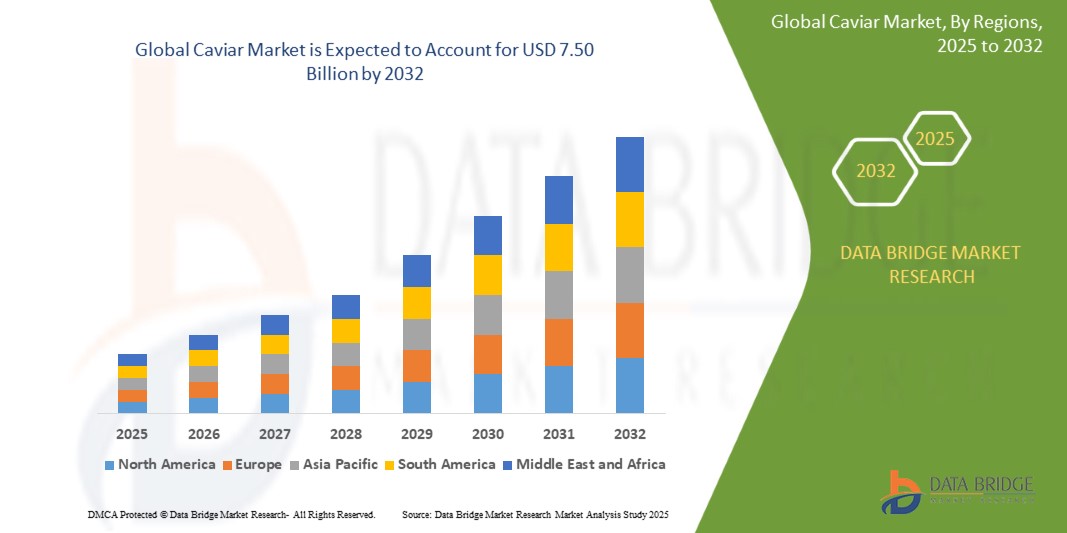
Caviar Market Size
- The global caviar market size was valued at USD 3.35 billion in 2024 and is expected to reach USD 7.50 billion by 2032, at a CAGR of 10.6% during the forecast period
- The market growth is largely fueled by rising consumer interest in gourmet and luxury food experiences, increasing disposable incomes, and the expansion of fine dining and premium retail channels globally, especially in urban centers and emerging economies
- Furthermore, innovations in sustainable aquaculture, the emergence of plant-based and cultivated caviar alternatives, and strategic brand partnerships across hospitality and aviation sectors are expanding product accessibility and consumer reach, thereby significantly boosting the industry's growth
Caviar Market Analysis
- Caviar is a high-end delicacy made from the salted eggs of sturgeon and other fish species, prized for its rich taste, texture, and association with luxury. Traditionally served in fine dining settings, it is now gaining popularity across premium retail, e-commerce, and even fusion cuisine segments
- The escalating demand for caviar is primarily driven by growing culinary experimentation, increased consumer awareness of product origin and sustainability, and the introduction of cost-effective and ethical alternatives such as farmed, plant-based, and lab-cultivated caviar
- Asia-Pacific dominated the caviar market with a share of 32.5% in 2024, due to increasing consumption of gourmet foods, rising disposable incomes, and expanding presence of luxury hotels and fine dining establishments across emerging economies
- North America is expected to be the fastest growing region in the caviar market with a share of during the forecast period due to increasing interest in premium, high-protein foods and rising consumer willingness to experiment with global cuisines
- Sevruga segment dominated the market with a market share of 31.7% in 2024, due to its relatively higher availability compared to other premium sturgeon varieties, combined with its distinct flavor profile and smaller, delicate grains that appeal to traditional caviar consumers. Its lower price point relative to Beluga and Osetra also makes it a preferred choice among restaurants and retailers seeking luxury offerings at more accessible rates, thereby driving widespread adoption across both on-trade and off-trade channels
Report Scope and Caviar Market Segmentation
|
Attributes |
Caviar Key Market Insights |
|
Segments Covered |
|
|
Countries Covered |
North America
Europe
Asia-Pacific
Middle East and Africa
South America
|
|
Key Market Players |
|
|
Market Opportunities |
|
|
Value Added Data Infosets |
In addition to the insights on market scenarios such as market value, growth rate, segmentation, geographical coverage, and major players, the market reports curated by the Data Bridge Market Research also include in-depth expert analysis, pricing analysis, brand share analysis, consumer survey, demography analysis, supply chain analysis, value chain analysis, raw material/consumables overview, vendor selection criteria, PESTLE Analysis, Porter Analysis, and regulatory framework. |
Caviar Market Trends
“Growing Demand for Sustainable Aquaculture Caviar”
- Sustainability is reshaping the caviar industry as consumers and regulators increasingly demand ethical sourcing and environmental stewardship. Modern caviar farming now leverages advanced aquaculture solutions such as recirculating aquaculture systems (RAS), non-lethal harvesting, and controlled breeding, all of which reduce environmental impact and address overfishing concerns
- For instance, Carelian Caviar, a Finnish producer, uses a state-of-the-art, land-based aquaculture system to sustainably farm Siberian sturgeon in closed-loop water systems, offering eco-friendly caviar with full traceability and minimal ecological footprint
- Product transparency and traceability through blockchain and third-party certifications are gaining momentum, enabling consumers to verify sourcing practices, animal welfare standards, and environmental safety
- Innovations such as AI-powered feeding systems, water-quality monitoring through IoT, and sustainable feed alternatives are making aquaculture more efficient and scalable
- Eco-labeling, carbon-neutral production, and circular farming models are not just regulatory compliance tools but also strong selling points in luxury markets
- The rise in demand from eco-conscious hospitality sectors, particularly in Europe and the Middle East, is encouraging more producers to invest in sustainable practices to appeal to high-end buyers looking for greener luxury choices
Caviar Market Dynamics
Driver
“Increasing Demand for Luxury Food Items”
- The global surge in luxury lifestyles, fine dining, and premium food gifting has elevated caviar to a sought-after delicacy among both traditional connoisseurs and emerging affluent demographics
- For instance, Petrossian, a French luxury caviar brand, has expanded its retail and fine dining presence across Europe and the U.S., feeding growing demand for caviar among consumers seeking premium culinary experiences and gourmet snack alternatives
- Caviar’s increasing popularity in hotel tasting menus, luxury airline lounges, and gourmet food retail has diversified its use case beyond traditional occasions into everyday indulgence experiences for high-net-worth individuals
- Cross-category innovation—such as caviar-infused skincare, gourmet spreads, or ready-to-eat products—is further elevating the product’s luxury positioning and expanding its market footprint
- Rising awareness of caviar’s nutritional profile, particularly its omega-3 content, protein, and antioxidants, is appealing to health-conscious luxury consumers seeking both indulgence and wellness
Restraint/Challenge
“Limited Production Capacity”
- Caviar production is inherently constrained due to biological limits, such as the long maturation period of sturgeon (often 7–10 years) and strict aquaculture conditions, resulting in low turnover and limited scalability
- For instance, Iran’s Caspian region, historically a major hub for wild caviar, has seen sharp declines in output following overfishing and international sanctions, highlighting the vulnerability of supply even in legacy-producing regions
- Compliance with CITES (Convention on International Trade in Endangered Species) regulations, which monitor and limit trade in sturgeon products, creates legal and logistical hurdles for producers and exporters
- High costs associated with sustainable farming, advanced water filtration systems, disease management, and skilled labor increase entry barriers for newcomers and limit expansion potential for small-scale farms
- Volatile environmental conditions, disease outbreaks, and feed price fluctuations can drastically affect supply schedules and quality consistency. The market remains highly sensitive to disruptions in global trade, making long-term supply planning and pricing consistency a challenge, especially for export-focused producers
Caviar Market Scope
The market is segmented on the basis of product, form, sales channel, and application.
• By Product
On the basis of product, the caviar market is segmented into Sevruga, Osetra, Salmon, Sushi, Beluga, Sterlet, and Others. The Sevruga segment dominated the largest market revenue share of 31.7% in 2024 due to its relatively higher availability compared to other premium sturgeon varieties, combined with its distinct flavor profile and smaller, delicate grains that appeal to traditional caviar consumers. Its lower price point relative to Beluga and Osetra also makes it a preferred choice among restaurants and retailers seeking luxury offerings at more accessible rates, thereby driving widespread adoption across both on-trade and off-trade channels.
The Salmon segment is anticipated to witness the fastest growth rate from 2025 to 2032, driven by its affordability, accessibility, and increasing popularity among health-conscious consumers. Salmon caviar, rich in omega-3 fatty acids, is gaining traction in both traditional and modern culinary dishes. Its wide use in sushi and fusion cuisines, along with a growing trend of sustainable and non-sturgeon-based caviar alternatives, is accelerating its market penetration globally.
• By Form
On the basis of form, the caviar market is segmented into Fresh, Dried, Preserved, and Frozen. The Preserved segment held the largest market revenue share in 2024, owing to its extended shelf life, ease of transport, and suitability for export. Preserved caviar retains essential flavor and texture while allowing suppliers to meet international demand without compromising quality, making it the preferred form for global distribution.
The Frozen segment is expected to witness the fastest CAGR from 2025 to 2032, supported by advancements in cold chain logistics and the increasing demand for high-quality caviar in emerging markets. Frozen caviar maintains freshness over longer periods and enables stockpiling, making it a practical choice for online retail, airliners, and cruise ships seeking consistent supply year-round.
• By Sales Channel
On the basis of sales channel, the caviar market is segmented into On-Trade and Off-Trade. The On-Trade segment accounted for the largest market revenue share in 2024, driven by the strong demand from luxury hotels, fine dining restaurants, and catering services that serve caviar as a premium delicacy. High per-serving margins and experiential dining trends make on-trade a lucrative channel for premium and rare caviar varieties.
The Off-Trade segment is projected to experience the fastest growth from 2025 to 2032, fueled by the rising influence of e-commerce, gourmet retail stores, and the growing culture of home fine dining. Consumers are increasingly purchasing caviar through online platforms for special occasions or gifting, supported by improved packaging technologies and promotional campaigns by luxury food brands.
• By Application
On the basis of application, the caviar market is segmented into Hotels and Restaurants, Airliners and Cruise Ships, Retail Stores, and Others. The Hotels and Restaurants segment dominated the market in 2024, owing to the high consumption volume in premium culinary experiences and event-based services. These establishments prioritize top-quality caviar for appetizers and gourmet dishes, ensuring steady demand from the foodservice sector.
The Retail Stores segment is anticipated to grow at the fastest rate from 2025 to 2032, as premium supermarkets and boutique food stores expand their luxury food offerings. Rising disposable incomes, consumer curiosity toward luxury food products, and the influence of culinary media are encouraging direct consumer purchases, particularly in urban centers and upscale neighborhoods.
Caviar Market Regional Analysis
- Asia-Pacific dominated the caviar market with the largest revenue share of 32.5% in 2024, driven by increasing consumption of gourmet foods, rising disposable incomes, and expanding presence of luxury hotels and fine dining establishments across emerging economies
- The region’s growing exposure to Western culinary trends, rapid urbanization, and strong aquaculture development—particularly in China and Japan—are fueling market expansion
- In addition, rising demand for locally farmed sturgeon caviar, government support for aquaculture, and the increasing popularity of caviar in modern fusion cuisines are strengthening the region’s leadership position
Japan Caviar Market Insight
The Japan caviar market is expanding steadily as luxury dining preferences rise among high-income consumers and tourism rebounds. Domestic aquaculture initiatives, particularly around sturgeon farming, are gaining traction due to government support and demand for locally produced gourmet foods. Japanese consumers value authenticity and quality, which is boosting demand for traceable, sustainably sourced caviar in fine-dining and omakase experiences.
China Caviar Market Insight
China held the largest share in Asia-Pacific’s caviar market in 2024, driven by its status as a major sturgeon farming hub and strong demand for luxury food products. High consumer spending on premium imported delicacies, especially during festivals and weddings, is propelling sales. Local producers are focusing on quality certifications and sustainable practices to gain competitiveness in domestic and export markets.
Europe Caviar Market Insight
The Europe caviar market is projected to grow steadily over the forecast period, supported by its rich heritage in caviar production and strong demand from gourmet restaurants and specialty food retailers. Regulatory frameworks supporting sustainable aquaculture and traceability are helping build consumer trust. Countries such as France and Italy continue to lead in both production and consumption of high-quality, farmed caviar.
U.K. Caviar Market Insight
The U.K. caviar market is growing steadily, driven by increasing gourmet food consumption and expanding availability of artisanal and ethically farmed caviar. Brexit-related trade changes have prompted a greater focus on domestic sourcing, with small-scale producers gaining attention for sustainability and quality. The rise of home fine dining and premium food hampers is contributing to retail segment growth.
Germany Caviar Market Insight
Germany is witnessing growing demand for sustainably farmed caviar, supported by a strong emphasis on food safety, clean labeling, and traceability. German consumers show a preference for domestic and European-origin products, with innovation in aquaculture and ethical production gaining prominence. High-end food retailers and fine dining establishments are key drivers of market growth.
North America Caviar Market Insight
North America is projected to grow at the fastest CAGR from 2025 to 2032, fueled by increasing interest in premium, high-protein foods and rising consumer willingness to experiment with global cuisines. Sustainable aquaculture initiatives and growing demand from restaurants, luxury hotels, and specialty retailers are propelling market expansion. Rising popularity of caviar among health-conscious and younger affluent demographics is also driving growth.
U.S. Caviar Market Insight
The U.S. caviar market held the largest share in North America in 2024, supported by its status as both a significant producer and consumer of farmed caviar. The growing number of domestic sturgeon farms, particularly in California and the Midwest, is reducing reliance on imports. Demand from Michelin-starred restaurants, gourmet retailers, and e-commerce platforms is fueling robust sales, while sustainability and origin transparency remain key purchase drivers
Caviar Market Share
The caviar industry is primarily led by well-established companies, including:
- Sasanian Caviar, Inc. (U.S.)
- Caviar Blanc (France)
- AmStur Caviar (U.S.)
- Labeyrie Fine Foods SAS (France)
- The Caviar Co. (U.S.)
- Agroittica Lombarda SpA (Italy)
- Caviar de France (France)
- Sterling Caviar (U.S.)
- Riofrío 1963 (Spain)
- Osage Catfisheries. (U.S.)
- Caviar Galilee Agrarian Cooperative Ltd (Russia)
- Caviar Creator Inc. (U.S.)
- THECAVIARHOUSE (Switzerland)
- California Caviar Company (U.S.)
- Hangzhou Qiandaohu Xunlong Sci-Tech Co., Ltd. (China)
- DELICATESSEN SNAILEX S.R.O. (Czech Republic)
- Black River Caviar (Uruguay)
- Amur Caviar Company Ltd. (China)
Latest Developments in Global Caviar Market
- In April 2025, Hey Caviar, a bold new gourmet brand, launched in the premium food space with responsibly sourced Kaluga sturgeon caviar priced up to 25% below traditional luxury labels. This strategic move aims to democratize luxury by offering high-quality caviar at accessible prices, appealing to modern consumers seeking indulgence with value. By positioning itself as an affordable yet premium option, Hey Caviar is expected to reshape competitive dynamics in the global caviar market
- In April 2025, Pizza Hut introduced a limited-time innovation called “Pizza Caviar,” featuring pepperoni-flavored, caviar-style pearls that combine luxury food aesthetics with mainstream comfort. This campaign reflects the brand’s strategy to tap into the growing culinary trend of caviar pairings in casual dining formats. By infusing fine-dining cues into quick-service offerings, Pizza Hut is broadening the visibility and cultural relevance of caviar-inspired products across a mass audience
- In January 2025, Umami Bioworks, a Singapore-based cellular agriculture pioneer, launched its cultivated caviar targeted at high-end restaurants and luxury retailers. This product marks a significant step in sustainable gourmet innovation, providing a cruelty-free and scalable alternative to traditional sturgeon caviar. Umami Bioworks' breakthrough underscores the role of biotech in shaping the future of luxury food consumption and sustainability
- In July 2024, Kaluga Queen Caviar partnered with Sino Jet, a prominent Asian aviation service provider, to elevate the in-flight experience by offering gourmet caviar to private jet clients. This partnership integrates luxury dining into aviation, reinforcing Kaluga Queen’s prestige positioning while expanding brand exposure among high-net-worth individuals. The collaboration highlights the increasing convergence of gastronomy and lifestyle luxury in emerging markets
- In June 2024, Ancrée, a French food innovation company, launched its plant-based caviar alternative made from chia seeds and seaweed. Positioned as the first of its kind in France, this launch addresses rising consumer demand for sustainable and vegan luxury foods. By redefining traditional luxury through clean, ocean-inspired ingredients, Ancrée is carving out a niche in the growing alternative caviar segment and challenging conventional notions of indulgence

- Interactive Data Analysis Dashboard
- Company Analysis Dashboard for high growth potential opportunities
- Research Analyst Access for customization & queries
- Competitor Analysis with Interactive dashboard
- Latest News, Updates & Trend analysis
- Harness the Power of Benchmark Analysis for Comprehensive Competitor Tracking
Global Caviar Market, Supply Chain Analysis and Ecosystem Framework
To support market growth and help clients navigate the impact of geopolitical shifts, DBMR has integrated in-depth supply chain analysis into its Global Caviar Market research reports. This addition empowers clients to respond effectively to global changes affecting their industries. The supply chain analysis section includes detailed insights such as Global Caviar Market consumption and production by country, price trend analysis, the impact of tariffs and geopolitical developments, and import and export trends by country and HSN code. It also highlights major suppliers with data on production capacity and company profiles, as well as key importers and exporters. In addition to research, DBMR offers specialized supply chain consulting services backed by over a decade of experience, providing solutions like supplier discovery, supplier risk assessment, price trend analysis, impact evaluation of inflation and trade route changes, and comprehensive market trend analysis.
Data collection and base year analysis are done using data collection modules with large sample sizes. The stage includes obtaining market information or related data through various sources and strategies. It includes examining and planning all the data acquired from the past in advance. It likewise envelops the examination of information inconsistencies seen across different information sources. The market data is analysed and estimated using market statistical and coherent models. Also, market share analysis and key trend analysis are the major success factors in the market report. To know more, please request an analyst call or drop down your inquiry.
The key research methodology used by DBMR research team is data triangulation which involves data mining, analysis of the impact of data variables on the market and primary (industry expert) validation. Data models include Vendor Positioning Grid, Market Time Line Analysis, Market Overview and Guide, Company Positioning Grid, Patent Analysis, Pricing Analysis, Company Market Share Analysis, Standards of Measurement, Global versus Regional and Vendor Share Analysis. To know more about the research methodology, drop in an inquiry to speak to our industry experts.
Data Bridge Market Research is a leader in advanced formative research. We take pride in servicing our existing and new customers with data and analysis that match and suits their goal. The report can be customized to include price trend analysis of target brands understanding the market for additional countries (ask for the list of countries), clinical trial results data, literature review, refurbished market and product base analysis. Market analysis of target competitors can be analyzed from technology-based analysis to market portfolio strategies. We can add as many competitors that you require data about in the format and data style you are looking for. Our team of analysts can also provide you data in crude raw excel files pivot tables (Fact book) or can assist you in creating presentations from the data sets available in the report.













