


What is the Central Venous Catheter Market Size and Growth Rate?
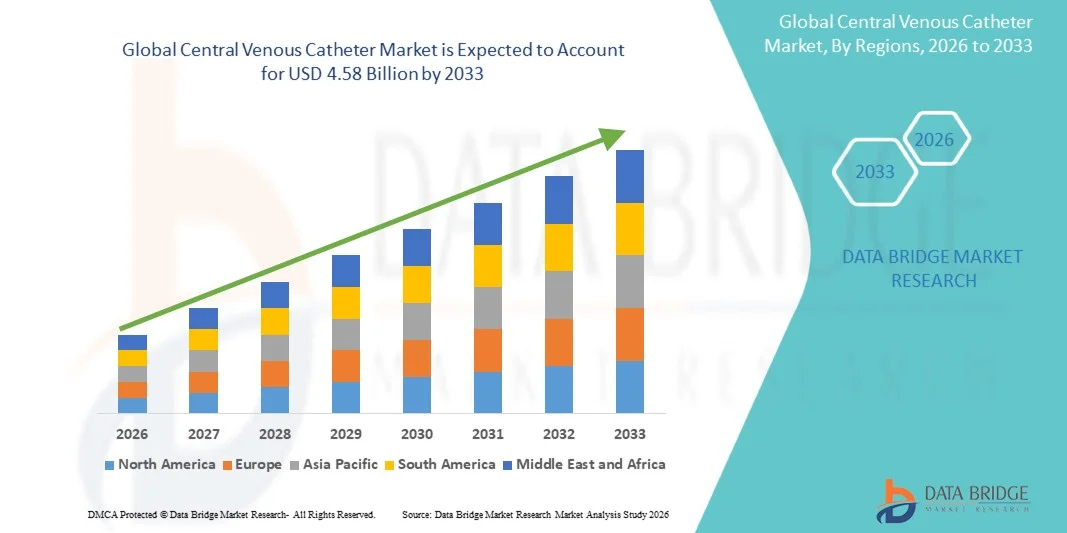
- As per Data Bridge Market Research analysis, the central venous catheter market was valued at USD 2.52 billion in 2025 and is projected to reach USD 4.58 billion by 2033, growing at a CAGR of 7.78% from 2026 to 2033.
- The market is experiencing consistent growth driven by rising demand across oncology, dialysis, and critical care, along with the increasing use of central venous access devices for patients requiring prolonged intravenous treatment. The growing adoption of implantable ports, tunneled catheters, and peripherally inserted central catheters (PICCs) is further supporting market expansion
- The growing prevalence of chronic kidney disease, increasing demand for hemodialysis treatment, and the rising use of central venous catheters in chemotherapy and long-term intravenous therapies are supporting market growth. Central venous catheters provide rapid and reliable vascular access for dialysis and critical-care patients, while implantable ports are widely used for chemotherapy and other prolonged treatments. At the same time, technological developments in catheter design and the availability of antimicrobial and specialized catheter products are helping address infection-related concerns.
Market Size & Forecast
- Global Market Value (2025): USD 2.52 Billion
- Expected Market Value (2033): USD 4.58 Billion
- Forecast CAGR (2026–2033): 7.78%
- Leading Region in 2025: North America
- Fastest Growing Region: Asia Pacific
What are the Major Takeaways of the Central Venous Catheter Market?
- North America dominated the central venous catheter market with the largest revenue share of 44.3% in 2025, supported by established healthcare infrastructure, high utilization of central venous access devices, and strong demand across oncology, dialysis, and critical care.
- Asia-Pacific is expected to be the fastest-growing region at a CAGR of 10.56% from 2026 to 2033, fueled by rising healthcare expenditure, increasing chronic disease prevalence, growing demand for dialysis and cancer care, and expanding healthcare infrastructure across the region.
- The PICC segment led the market with a 38.12% share in 2025, driven by its widespread use for long-term intravenous access and growing utilization across hospital and outpatient settings.
- implanted ports are the fastest-growing product type, projected to register a CAGR of 9.53%, reflecting the surge in demand for long-term venous access in oncology and other chronic-care applications.
- The double-lumen segment dominated the lumen category with a 42.45% revenue share in 2025, led by its ability to provide two independent access channels through a single catheter.
- Polyurethane accounted for 60.66% of the market share in 2025, preferred by its widespread use across mainstream central venous catheter formats.
- The fluid and nutrition segment is the fastest-growing application category, with a CAGR of 9.67%, driven by increasing demand for home parenteral nutrition, intensive-care nutritional support, and extended treatment outside traditional inpatient settings.
Report Scope and Central Venous Catheter Market Segmentation
|
Attributes |
Central Venous Catheter Key Market Insights |
|
Segments Covered |
|
|
Countries Covered |
North America
Europe
Asia-Pacific
Middle East and Africa
South America
|
|
Key Market Players |
|
|
Market Opportunities |
|
|
Value Added Data Infosets |
In addition to the insights on market scenarios such as market value, growth rate, segmentation, geographical coverage, and major players, the market reports curated by the Data Bridge Market Research also include in-depth expert analysis, patient epidemiology, pipeline analysis, pricing analysis, and regulatory framework. |
What is the Key Trend in the Central Venous Catheter Market?
- Antimicrobial and infection-prevention technologies are becoming an important trend in the central venous catheter market as manufacturers focus on reducing catheter-related bloodstream infections and improving catheter safety during prolonged vascular access.
- For instance, in October 2021, a multicenter prospective study evaluated a chlorhexidine-coated peripherally inserted central catheter (PICC) in 103 patients, reporting a CLABSI incidence of 0.82 per 1,000 catheter-days, supporting the development of antimicrobial-coated central venous access devices.
- The increasing emphasis on antimicrobial catheters, improved catheter materials, and infection-control technologies is supporting the development of products designed to reduce complications associated with central venous access.
- This trend is particularly relevant because central venous catheter use remains associated with catheter-related infections, deep vein thrombosis, and catheter malfunction, creating demand for safer catheter technologies.
- Ultrasound-guided catheter placement is also gaining importance as healthcare providers seek to reduce insertion-related complications and improve the accuracy of central venous access procedures.
- For instance, in March 2024, an article published in JAMA Internal Medicine analyzed 130 studies and found that ultrasound guidance reduced arterial puncture and pneumothorax rates, supporting the increasing use of ultrasound-assisted central venous catheter placement.
- As hospitals increasingly prioritize infection prevention, accurate catheter placement, and reduction of catheter-related complications, adoption of antimicrobial and technologically advanced central venous catheters is expected to increase, reinforcing safety-focused innovation as a major market trend.
What are the Key Drivers of the Central Venous Catheter Market?
- The rising prevalence of kidney diseases and the growing number of dialysis patients are significantly increasing demand for central venous catheters used for reliable vascular access during hemodialysis and other renal therapies.
- For instance, in March 2024, a study published in BMC Nephrology evaluated central venous catheter use among patients receiving hemodialysis, highlighting the continued role of CVCs as an important vascular-access option for patients with chronic kidney disease requiring renal replacement therapy.
- Increasing demand for antimicrobial catheters is also supporting market growth as healthcare providers seek to reduce catheter-related infections and improve outcomes among patients requiring prolonged central venous access.
- Oncology treatment represents another important demand area, as central venous catheters provide reliable access for chemotherapy, medication administration, fluid delivery, and other long-term intravenous therapies.
- The growing utilization of central venous catheters across hospitals and cancer treatment centers is further expanding the addressable patient population, particularly as complex treatments require dependable and prolonged vascular access.
- For instance, in November 2024, a multicenter study published in The Journal of Vascular Access evaluated non-cuffed central venous catheters for unplanned and urgent-start hemodialysis in patients with chronic kidney disease, demonstrating continued clinical demand for CVC-based vascular access in urgent dialysis settings.
- With increasing healthcare requirements for dialysis, cancer treatment, critical care, and long-term intravenous therapies, central venous catheters will remain an essential vascular-access technology, supporting sustained market expansion worldwide.
Which Factors are Challenging the Growth of the Central Venous Catheter Market?
- Catheter-related complications, including bloodstream infections, deep vein thrombosis, catheter malfunction, pneumothorax, and arterial puncture, remain significant challenges that can restrict broader utilization and increase the complexity of central venous catheter management.
- For instance, in March 2024, an article published in JAMA Internal Medicine analyzed 130 studies involving 214,325 central venous catheters and estimated 30.2 serious complications per 1,000 patients after three days of CVC exposure, including arterial cannulation, pneumothorax, infection, and deep-vein thrombosis.
- These complications can result in additional clinical interventions, longer hospitalization, increased healthcare costs, and the need for catheter replacement, creating pressure on healthcare providers to improve catheter safety and management practices.
- The risk becomes particularly important when catheters remain in place for prolonged periods, as infection and thrombosis risks accumulate with continued catheter use and require careful monitoring and maintenance.
- The clinical and economic burden associated with these complications continues to encourage hospitals to strengthen catheter-care protocols, adopt ultrasound-guided insertion, and consider antimicrobial catheter technologies where appropriate.
- For instance, in January 2024, an observational autopsy study published in Intensive Care Medicine found thrombi attached to the catheter or adjacent vessel wall in all 12 patients with short-term centrally inserted central catheters, highlighting catheter-related thrombosis as an important clinical challenge
- Consequently, reducing catheter-associated bloodstream infections, thrombosis, insertion-related complications, and malfunction remains a critical challenge for manufacturers and healthcare providers and continues to influence product development and market adoption.
How is the Central Venous Catheter Market Segmented?
The central venous catheter market is segmented on the basis of product type, lumen, material, application, and end user.
- By Product Type
On the basis of product type, the central venous catheter market is segmented into non-tunneled, tunneled CVCs, PICCs, and implanted ports. The PICC segment dominated the market with a 38.12% share in 2025, supported by its widespread use for long-term intravenous access and growing utilization across hospital and outpatient settings. PICCs provide reliable vascular access while avoiding the need for surgical implantation associated with ports. Their use is particularly important for patients requiring prolonged antibiotic therapy, chemotherapy, parenteral nutrition, and other intravenous treatments. The shift toward outpatient treatment and shorter hospital stays is further supporting PICC adoption. Their suitability for both inpatient and community-based care continues to strengthen their market position.
The implanted ports segment is projected to register the fastest growth, at a CAGR of 9.53% during forecast period, driven primarily by increasing demand for long-term venous access in oncology and other chronic-care applications. Implanted ports can remain in place for extended periods and are suitable for patients receiving repeated intravenous treatments. Their use is particularly relevant in chemotherapy because they provide dependable access while remaining beneath the skin when not in use. Increasing cancer treatment volumes and expansion of outpatient oncology care are supporting demand. The growing preference for durable vascular-access solutions is creating additional opportunities for implanted ports. These factors are expected to keep implanted ports among the fastest-growing product categories.
- By Lumen
On the basis of lumen, the market is segmented into single, double, triple, and multi-lumen catheters. The double-lumen segment dominated with a 42.45% share in 2025, supported by its ability to provide two independent access channels through a single catheter. Double-lumen devices are widely used when patients require simultaneous administration of different medications, fluids, blood products, or other therapies. Their versatility makes them particularly valuable in critical-care and complex treatment environments. Using separate lumens can reduce the need for multiple vascular-access devices in patients requiring several simultaneous infusions. Increasing demand from intensive-care and acute-care settings continues to support this segment. Their combination of functionality and relatively straightforward catheter design reinforces their leading market position.
The multi-lumen segment is projected to be the fastest-growing lumen category, registering a CAGR of 8.67% during forecast period. Multi-lumen catheters provide several independent channels for administering multiple therapies simultaneously. This capability is particularly valuable for critically ill patients who require several medications, fluids, nutrition, or blood products at the same time. Increasing complexity of critical-care treatment is supporting demand for higher-lumen configurations. Multi-lumen devices can also help healthcare professionals manage multiple infusion requirements through one central access point. Continued innovation in catheter geometry and channel functionality is improving their clinical utility. Consequently, growing requirements for complex intravenous therapy are expected to accelerate adoption of multi-lumen catheters.
- By Material
On the basis of material, the market is segmented into polyurethane, silicone, and others. The polyurethane segment dominated the market with a 60.66% share in 2025, reflecting its widespread use across mainstream central venous catheter formats. Polyurethane provides a combination of flexibility, mechanical strength, kink resistance, and pushability that supports catheter insertion and clinical use. Its material characteristics also support power-injectable applications in many catheter designs. Polyurethane is widely incorporated into PICCs and other central venous access products used across hospital settings. Its established clinical performance and broad product availability continue to support its leading position. The material's balance between durability, flexibility, and procedural performance makes it a preferred choice among manufacturers and healthcare providers.
The silicone segment is projected to register strong growth registering a CAGR of 7.35% during forecast period, supported by increasing demand for materials offering greater softness, flexibility, compliance, and biocompatibility, particularly in long-dwell and pediatric applications. Silicone continues to add value where patient comfort and vessel compatibility are important considerations. Its flexibility makes it suitable for applications requiring prolonged catheter residence and reduced mechanical irritation. The material is also relevant for specialized central venous access products where softer catheter characteristics are preferred. Increasing demand for long-term vascular access in oncology, pediatric care, and home-based treatment is creating additional opportunities for silicone-based products.
- By Application
On the basis of application, the market is segmented into drug administration, fluid/nutrition, blood transfusion, and diagnostics. The drug administration segment dominated the market with a 52.67% share in 2025, reflecting the extensive use of central venous catheters for delivering medications directly into the bloodstream. Central venous access is particularly important for patients requiring prolonged intravenous therapy, chemotherapy, and medications that require reliable vascular access. Hospitals use these devices extensively when peripheral access is inadequate or unsuitable. Increasing cancer treatment volumes and the growing prevalence of chronic conditions requiring intravenous therapy are supporting demand. The ability to administer multiple medications through different catheter lumens further increases their clinical utility. Drug administration therefore remains the largest application area for central venous catheter products.
The fluid and nutrition administration segment is projected to grow at the fastest rate, with a CAGR of 9.67%% during forecast period. Central venous catheters are used to administer fluids, electrolytes, nutrients, and parenteral nutrition when enteral or peripheral administration is unsuitable. Increasing numbers of critically ill and complex-care patients are creating greater demand for reliable central access for nutritional and fluid support. Parenteral nutrition is particularly important for patients who cannot receive adequate nutrition through the gastrointestinal tract. Central venous access also allows administration of solutions that require central circulation because of their concentration or composition. Growing utilization of nutritional support in hospitals and critical-care environments is strengthening this application. These factors are expected to make fluid and nutrition administration the fastest-growing application segment.
- By End User
On the basis of end user, the market is segmented into hospitals, ambulatory surgical centers (ASCs), clinics, and home healthcare. The hospitals segment dominated the market with a 70.34% share in 2025, reflecting the extensive use of central venous catheters across critical care, oncology, surgery, emergency medicine, and other hospital departments. Hospitals manage a large proportion of patients requiring temporary or long-term central venous access. Increasing critical-care admissions and complex surgical procedures continue to generate substantial catheter demand. Hospitals also have the trained personnel and infrastructure required for catheter placement, maintenance, and complication management. The growing use of central venous access for medication delivery, fluid management, nutrition, dialysis, and blood transfusion further supports utilization. Consequently, hospitals remain the primary end-user segment worldwide.
The ambulatory surgical centers segment is projected to be the fastest-growing end-user category, with a CAGR of 8.87%% during forecast period. Growth is supported by the increasing shift toward outpatient procedures and healthcare delivery outside traditional inpatient settings. ASCs increasingly perform procedures that require reliable vascular access while allowing patients to return home sooner. The expansion of minimally invasive and same-day procedures is contributing to greater demand for efficient vascular-access solutions. Increasing healthcare cost pressures are also encouraging the movement of appropriate procedures from hospitals to ambulatory settings. Improvements in catheter placement, management, and outpatient infusion pathways are further supporting adoption. The continued shift toward decentralized healthcare delivery is therefore expected to accelerate central venous catheter use in ASCs.
Which Region Holds the Largest Share of the Central Venous Catheter Market?
- North America dominated the central venous catheter market with the largest revenue share of 44.3% in 2025, supported by established healthcare infrastructure, high utilization of central venous access devices, and strong demand across oncology, dialysis, and critical care.
- The region also benefits from mature hospital systems, established contracting channels, and strong demand for workflow-improving technologies. The United States remains the major contributor, with continued demand from oncology infusion, hemodialysis, critical care, and long-duration nutrition support. Increasing adoption of antimicrobial products, power-injectable devices, and technologies designed to improve insertion and catheter management further supports North America's leadership in the market.
U.S. Central Venous Catheter Market Insight
The U.S. central venous catheter market is witnessing strong growth due to high utilization of central venous access devices across critical care, oncology, hemodialysis, and long-term intravenous treatment. The country’s advanced hospital infrastructure and established vascular-access practices are supporting demand for non-tunneled CVCs, PICCs, tunneled catheters, and implanted ports. Increasing emphasis on infection prevention is also encouraging the use of antimicrobial and technologically advanced catheter products. In addition, the growing need for reliable vascular access among patients receiving complex and prolonged therapies is sustaining market demand. An article published in JAMA Internal Medicine analyzed 130 studies and 214,325 CVCs, demonstrating the extensive clinical evidence base surrounding central venous catheter use and complications.
Asia-Pacific Central Venous Catheter Market Insight
The Asia-Pacific central venous catheter market is expected to witness rapid growth, driven by expanding healthcare infrastructure, increasing chronic disease burden, and rising demand for oncology, dialysis, and critical-care services. Growing hospital capacity and improving access to advanced medical procedures are supporting adoption of central venous access devices across the region. Increasing use of PICCs and other long-term vascular-access solutions is further contributing to market expansion. Rising awareness of catheter-associated infection prevention is also encouraging improvements in catheter placement and maintenance practices. In addition, the growing number of patients requiring prolonged intravenous therapies is creating further demand for reliable vascular access. A prospective observational study in a 600-bed Japanese acute-care hospital evaluated 1,650 CVCs used in 1,237 patients and identified 39 CLABSI cases, highlighting the substantial utilization of CVCs in advanced Asian hospital settings
Japan Central Venous Catheter Market Insight
The Japan central venous catheter market is witnessing consistent growth due to advanced acute-care infrastructure, increasing utilization of central venous access, and strong emphasis on catheter-related infection prevention. Hospitals and medical institutions are increasingly applying evidence-based catheter insertion and maintenance practices to improve patient safety. Growing demand from oncology, intensive care, and other complex treatment areas is supporting utilization of CVCs and PICCs. Japan’s mature healthcare system also provides an environment for adoption of improved catheter-management technologies and infection-control protocols. Clinical research conducted in Japanese hospitals continues to evaluate catheter types, insertion sites, and infection-prevention approaches. A multicenter randomized controlled study involving 16 Japanese intensive-care units evaluated 1,132 catheters and found lower catheter-tip colonization rates with chlorhexidine-based antiseptic solutions than with povidone-iodine.
China Central Venous Catheter Market Insight
The China central venous catheter market is growing rapidly, supported by expanding hospital infrastructure, increasing demand for critical-care services, and rising requirements for oncology and dialysis treatment. Growing healthcare capacity is increasing the number of patients receiving complex therapies that require reliable central venous access. The adoption of PICCs and other central venous access devices is also expanding as healthcare providers seek suitable solutions for prolonged intravenous treatment. Increasing attention to catheter-associated bloodstream infections is encouraging hospitals to strengthen catheter insertion and maintenance practices. Furthermore, the expansion of specialized treatment facilities is supporting demand for vascular-access devices across multiple clinical applications. In November 2023, a multicenter study published in BMC Infectious Diseases evaluated central-line-associated bloodstream infections across Chinese intensive care units and identified important differences in infection rates and risk factors, highlighting the growing emphasis on CVC management and infection prevention in China.
U.K. Central Venous Catheter Market Insight
The U.K. central venous catheter market is experiencing steady growth, supported by established hospital infrastructure, strong infection-control practices, and widespread use of central venous access in critical care and oncology. The country's healthcare system has a strong focus on evidence-based catheter management and prevention of catheter-related bloodstream infections. Increasing utilization of antimicrobial catheter technologies is supporting demand for advanced products that can help reduce infection risks. Central venous catheters are also important for patients requiring prolonged intravenous medication, nutrition, and other therapies. Research institutions and hospitals continue to evaluate catheter technologies and infection-prevention strategies. An article published in The Lancet Infectious Diseases evaluated antimicrobial CVCs and assessed their effectiveness in reducing microbial colonization and catheter-related bloodstream infections, supporting the U.K.'s strong focus on evidence-based catheter technologies
Germany Central Venous Catheter Market Insight
The Germany central venous catheter market is expanding steadily due to strong hospital infrastructure, extensive oncology and intensive-care services, and increasing emphasis on central-line infection prevention. German hospitals and specialist centers utilize CVCs extensively for patients requiring complex and prolonged therapies. The country also has established clinical guidelines addressing diagnosis, management, and prevention of central venous catheter-related infections. Increasing adoption of antimicrobial catheter technologies and evidence-based catheter-care protocols is supporting market development. Research activity in German hospitals is also contributing to improvements in catheter selection, insertion, and infection management. The German Society of Hematology and Medical Oncology published updated guidelines addressing diagnosis, management, and prevention of central venous catheter-related infections in hematology and oncology patients.
Which are the Top Companies in Central Venous Catheter Market?
The central venous catheter industry is primarily led by well-established companies, including:
- BD (U.S.)
- Medtronic (Ireland)
- Boston Scientific Corporation (U.S.)
- B. Braun SE (Germany)
- Terumo Corporation (Japan)
- Edwards Lifesciences Corporation (U.S.)
- Teleflex Incorporated (U.S.)
- Cook (U.S.)
- ICU Medical (U.S.)
- Lepu Medical Technology (Beijing) Co., Ltd. (China)
- Merit Medical Systems (U.S.)y
- Vygon (France)
- Argon Medical Devices (U.S.)
- Poly Medicure Limited (India)
- Vogt Medical Vertrieb GmbH (Germany)
- NIPRO CORPORATION (Japan)
- Romsons International (India)
- Newtech Medical Devices Pvt. Ltd. (India)
- DemeTECH Corporation (U.S.)
- SCW Medicath Ltd. (China)
What are Latest Developments in Central Venous Catheter Market?
- In August 2024, OBVIUS Robotics received U.S. FDA Breakthrough Device Designation for its CERTA Access System for central venous catheterization. The system combines robotics and imaging technologies to improve the accuracy, safety, and consistency of central venous catheter placement. The company stated that CVC procedures are performed more than 20 million times annually worldwide, highlighting the significant clinical need for improved vascular-access technologies.
- In April 2024, CorMedix commercially launched DefenCath in U.S. inpatient settings as a catheter-lock solution for adults with kidney failure receiving chronic hemodialysis through a central venous catheter. The product contains taurolidine and heparin and is designed to reduce catheter-related bloodstream infections. CorMedix subsequently began outpatient commercialization in July 2024 following the effectiveness of CMS reimbursement. This development expanded the use of antimicrobial catheter-lock technology for infection prevention in dialysis patients.
- In May 2023, Teleflex launched the new Arrow VPS Rhythm DLX Device and NaviCurve Stylet in the U.S., designed to enhance PICC insertion procedures and provide more efficient and predictable catheter placement. The VPS Rhythm DLX provides real-time catheter-tip location information using the patient’s cardiac electrical activity and can also integrate ultrasound with a catheter-to-vessel ratio tool. The launch highlights continued development of navigation and tip-location technologies for peripherally inserted central catheters.
- In April 2023, Bactiguard launched a clinical study comparing its Bactiguard Infection Prevention (BIP) Central Venous Catheter with a standard non-coated catheter. The randomized multicenter study in India was designed to evaluate outcomes including central-line-associated bloodstream infections and thrombosis, providing clinical evidence for Bactiguard’s infection-prevention coating technology.
- In June 2022, researchers reported an automated deep-learning approach for precision localization of peripherally inserted central catheter tips. The study developed a multi-stage network designed to improve PICC-line extraction and tip-position detection, addressing the clinical risk associated with catheter tip malposition. In internal validation, the approach improved root-mean-square error by more than 63%, while external validation showed a reduction of approximately 65%. The development highlights the growing application of artificial intelligence and image-analysis technologies to improve central venous catheter placement.

- Interactive Data Analysis Dashboard
- Company Analysis Dashboard for high growth potential opportunities
- Research Analyst Access for customization & queries
- Competitor Analysis with Interactive dashboard
- Latest News, Updates & Trend analysis
- Harness the Power of Benchmark Analysis for Comprehensive Competitor Tracking
Data collection and base year analysis are done using data collection modules with large sample sizes. The stage includes obtaining market information or related data through various sources and strategies. It includes examining and planning all the data acquired from the past in advance. It likewise envelops the examination of information inconsistencies seen across different information sources. The market data is analysed and estimated using market statistical and coherent models. Also, market share analysis and key trend analysis are the major success factors in the market report. To know more, please request an analyst call or drop down your inquiry.
The key research methodology used by DBMR research team is data triangulation which involves data mining, analysis of the impact of data variables on the market and primary (industry expert) validation. Data models include Vendor Positioning Grid, Market Time Line Analysis, Market Overview and Guide, Company Positioning Grid, Patent Analysis, Pricing Analysis, Company Market Share Analysis, Standards of Measurement, Global versus Regional and Vendor Share Analysis. To know more about the research methodology, drop in an inquiry to speak to our industry experts.
Data Bridge Market Research is a leader in advanced formative research. We take pride in servicing our existing and new customers with data and analysis that match and suits their goal. The report can be customized to include price trend analysis of target brands understanding the market for additional countries (ask for the list of countries), clinical trial results data, literature review, refurbished market and product base analysis. Market analysis of target competitors can be analyzed from technology-based analysis to market portfolio strategies. We can add as many competitors that you require data about in the format and data style you are looking for. Our team of analysts can also provide you data in crude raw excel files pivot tables (Fact book) or can assist you in creating presentations from the data sets available in the report.













