


What is the Ceramic Microspheres Market Size and Growth Rate?
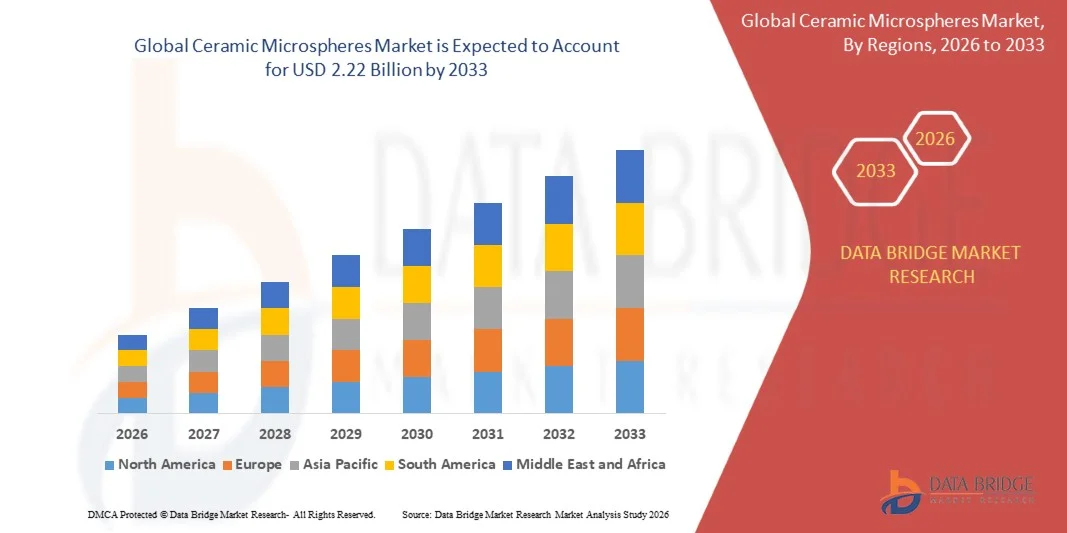
- As per Data Bridge Market Research analysis, the ceramic microspheres market was valued at USD 1.11 billion in 2025 and is projected to reach USD 2.22 billion by 2033, growing at a CAGR of 9.10% from 2026 to 2033.
- The market is experiencing consistent growth driven by increasing demand for lightweight and high-performance materials, expanding applications in paints and coatings, oil and gas, construction, automotive, and aerospace, and the growing use of ceramic microspheres as additives, fillers, and reinforcement materials.
- The increasing adoption of lightweight composites, thermal insulation materials, and advanced coatings, combined with the superior properties of ceramic microspheres such as low density, high compressive strength, thermal stability, and durability, is compelling manufacturers across industrial sectors to adopt these materials. Hollow and solid ceramic microspheres are increasingly being used to reduce material weight, improve insulation, enhance product performance, and support the development of advanced composite materials.
Market Size & Forecast
- Global Market Value (2025): USD 1.11 Billion
- Expected Market Value (2033): USD 2.22 Billion
- Forecast CAGR (2026–2033): 9.10%
- Leading Region in 2025: North America
- Fastest Growing Region: Asia Pacific
What are the Major Takeaways of the Ceramic Microspheres Market?
- North America dominated the ceramic microspheres market with the largest revenue share of 35.2% in 2025, supported by strong demand from paints and coatings, oil and gas, aerospace, and construction industries.
- Asia-Pacific is expected to be the fastest-growing region at a CAGR of 9.5% from 2026 to 2033, fueled by rapid industrialization, expanding construction and automotive sectors, and increasing adoption of lightweight and high-performance materials.
- The hollow segment led the market with a 58.8% share in 2025, driven by its lightweight characteristics, low density, and high strength-to-weight ratio.
- Solid are the fastest-growing type, projected to register a CAGR of 9%, reflecting the surge in demand for durable and high-performance ceramic materials.
- The additives segment dominated the product category with a 67% revenue share in 2025, led by the ability of ceramic microspheres to enhance the performance of paints, coatings, composites, and formulated materials
- Film ink production accounted for 33.2% of the market share in 2025, preferred by the use of ceramic microspheres to enhance ink formulated materials formulated materialsand improve the performance of printed films.
- The fiberglass production segment is the fastest-growing application category, with a CAGR of 10%, driven by the rising demand for lightweight and durable fiberglass-based materials.
Report Scope and Ceramic Microspheres Market Segmentation
|
Attributes |
Ceramic Microspheres Key Market Insights |
|
Segments Covered |
|
|
Countries Covered |
North America
Europe
Asia-Pacific
Middle East and Africa
South America
|
|
Key Market Players |
|
|
Market Opportunities |
|
|
Value Added Data Infosets |
In addition to the insights on market scenarios such as market value, growth rate, segmentation, geographical coverage, and major players, the market reports curated by the Data Bridge Market Research also include import export analysis, production capacity overview, production consumption analysis, price trend analysis, climate change scenario, supply chain analysis, value chain analysis, raw material/consumables overview, vendor selection criteria, PESTLE Analysis, Porter Analysis, and regulatory framework. |
What is the Key Trend in the Ceramic Microspheres Market?
- Manufacturers are increasingly developing advanced hollow ceramic microspheres for lightweight, thermal-insulation, and high-temperature applications, particularly across aerospace, defense, automotive, and industrial sectors where weight reduction and thermal protection are critical.
- For instance, in May 2024, researchers at Northwestern Polytechnical University and the National University of Defense Technology developed ZrC coatings modified with polymer-derived SiHfOC ceramic microspheres, demonstrating improved ablation resistance at ultrahigh temperatures for advanced aerospace thermal-protection applications.
- Ceramic microspheres are increasingly being engineered with controlled particle sizes, high strength, and low thermal conductivity to improve filler loading, durability, insulation, and performance in demanding applications.
- Paint and coating manufacturers are increasingly adopting ceramic microspheres to support higher-solids and lower-volatile-organic-compound formulations while maintaining viscosity, abrasion resistance, and surface durability.
- For instance, in May 2024, NASA-supported researchers demonstrated sprayable hollow-microsphere-based coatings with high solar reflectivity and infrared emissivity, highlighting their potential for thermal-radiation control and thermal management in spacecraft.
- As demand for lightweight, durable, thermally resistant, and lower-emission materials continues to expand, the development of application-specific ceramic microspheres is expected to accelerate, strengthening their adoption across advanced coatings, composites, aerospace, and energy applications
What are the Key Drivers of the Ceramic Microspheres Market?
- The increasing demand for lightweight and high-performance materials across construction, automotive, aerospace, and industrial applications is significantly increasing the use of ceramic microspheres as fillers and functional additives.
- For instance, in November 2025, researchers at the Federal University of Rio Grande do Norte developed low-density oil-well cement slurries containing ceramic microspheres, achieving densities of 1.32–1.50 g/cm³ and an optimized compressive strength of 9.35 MPa, demonstrating the growing use of ceramic microspheres to produce lightweight cement for petroleum wells.
- The growing emphasis on energy efficiency, thermal insulation, and durable coatings is encouraging manufacturers to replace conventional fillers with ceramic microspheres that provide enhanced performance while supporting lower material weight and improved processing characteristics.
- For instance, in September 2024, researchers at China University of Petroleum developed biodegradable polymer-ceramic composite microcapsules for natural gas hydrate drilling, achieving a 100% plugging rate and demonstrating how ceramic-based microscale materials can improve reservoir protection while supporting permeability recovery
- With industries increasingly prioritizing lightweight construction, advanced thermal protection, sustainable coatings, and high-performance composites, ceramic microspheres are expected to remain an important functional material for improving product performance and manufacturing efficiency.
Which Factors are Challenging the Growth of the Ceramic Microspheres Market?
- High production costs and manufacturing complexity remain major challenges because ceramic microspheres require specialized processing, precise particle-size control, and high-temperature manufacturing conditions.
- For instance, in March 2024, researchers developing Cr₂AlC ceramic microspheres reported that spray-drying parameters such as solid content and atomizer frequency directly affected microsphere quality, while achieving the required 30–70 μm particle size, sphericity, and flowability required careful process optimization, highlighting the manufacturing-control challenge.
- These production requirements can increase capital expenditure and operating costs, limiting adoption among smaller manufacturers and price-sensitive end-use industries, particularly in emerging economies.
- For instance, in April 2024, researchers reported that the global ceramic industry faces shortages and sudden price increases in critical raw materials, emphasizing the need for material substitution, recycling, and improved resource efficiency to reduce supply and cost risks
- The combination of energy-intensive processing, high-purity raw-material requirements, specialized quality control, and competition from lower-cost alternatives such as glass and polymeric microspheres continues to restrict broader market penetration, particularly where customers prioritize material cost over advanced performance characteristics
How is the Ceramic Microspheres Market Segmented?
The ceramic microspheres market is segmented on the basis of type, product, application, and end-use
- By Type
On the basis of type, the ceramic microspheres market is segmented into hollow and solid. The hollow segment dominated the market with 58.8% share in 2025, owing to its lightweight characteristics, low density, and high strength-to-weight ratio. Hollow ceramic microspheres are extensively used in coatings, composites, construction materials, automotive components, and aerospace applications. Their hollow structure enables manufacturers to reduce overall material weight while maintaining useful mechanical performance. They also provide thermal-insulation and buoyancy properties that make them suitable for specialized industrial applications. Increasing demand for lightweight and energy-efficient materials is further supporting their adoption.
The solid segment is projected to register the fastest growth at 9% CAGR from 2026 to 2035, driven by increasing demand for durable and high-performance ceramic materials. Solid microspheres offer greater structural integrity and mechanical strength for applications requiring enhanced resistance to pressure, abrasion, and elevated temperatures. They are increasingly utilized in coatings, composites, plastics, and other specialty industrial formulations. Their thermal stability also makes them suitable for demanding applications where conventional lightweight fillers may have performance limitations. Advances in ceramic processing are enabling manufacturers to develop microspheres with more controlled particle characteristics.
- By Product
On the basis of product, the ceramic microspheres market is segmented into additives and fillers. The additives segment dominated the market with 67% share in 2025, supported by the ability of ceramic microspheres to enhance the performance of paints, coatings, composites, and formulated materials. Ceramic microspheres used as additives can improve durability, thermal insulation, chemical resistance, and surface characteristics. Their incorporation can also help manufacturers optimize formulation performance while maintaining lightweight properties. Demand is supported by growing applications in construction, automotive, aerospace, and industrial coatings. Increasing requirements for functional and high-performance materials are further strengthening the use of ceramic microspheres as additives.
The fillers segment is expected to witness the fastest growth at 10% CAGR from 2026 to 2033, driven by increasing use of ceramic microspheres for lightweighting and material reinforcement. Ceramic microspheres can replace a portion of conventional materials while helping reduce density and improve dimensional stability. They are increasingly used in plastics, composites, coatings, rubber products, and construction materials. Their spherical geometry can also support improved processing and dispersion within formulated materials. Growing demand for lightweight automotive and aerospace components is creating additional opportunities for microsphere-based fillers. Expansion of construction and industrial composite applications is further supporting demand.
- By Application
On the basis of application, the ceramic microspheres market is segmented into film ink production, fiberglass production, mining explosives production, plastic products, and rubber products. The film ink production segment dominated the market with a share of 33.2% in 2025, supported by the use of ceramic microspheres to enhance ink formulations and improve the performance of printed films. Their spherical morphology can contribute to surface smoothness, durability, and improved formulation characteristics. Ceramic microspheres can also provide functional properties that support abrasion resistance and surface performance. Increasing demand for high-quality packaging, labeling, and industrial printing materials is supporting this application. The established use of microspheres in specialty ink formulations provides a stable demand base
The fiberglass production segment is expected to witness the fastest growth at 10% CAGR from 2026 to 2033, driven by rising demand for lightweight and durable fiberglass-based materials. Ceramic microspheres can function as lightweight fillers while contributing to thermal and mechanical performance in composite formulations. Growing construction activity is increasing demand for fiberglass materials used in panels, insulation, structures, and other building applications. Automotive manufacturers are also increasing the use of lightweight fiberglass composites to improve vehicle efficiency and reduce component weight. Aerospace applications provide additional opportunities because of the need for lightweight and high-performance composite materials.
- By End-Use
On the basis of end-use, the ceramic microspheres market is segmented into construction composites, medical technology, life science & biotechnology, paints & coatings, cosmetics & personal care, oil & gas, automotive, and aerospace. The aerospace segment dominated the market with 37% share in 2025, supported by demand for lightweight, thermally stable, and high-performance materials. Ceramic microspheres are valuable in aerospace composites and coatings because they can reduce material weight while providing thermal and mechanical benefits. Their resistance to elevated temperatures makes them suitable for demanding aerospace environments. They are also used in applications requiring thermal insulation and specialized composite performance. Increasing aircraft production and investment in advanced aerospace technologies are supporting market opportunities.
The automotive segment is projected to be among the fastest-growing end-use segments at 9% CAGR from 2026 to 2033, driven by increasing demand for lightweight materials and advanced composite systems. Ceramic microspheres can help reduce component weight while maintaining useful mechanical and thermal characteristics. Their use is particularly relevant to automotive manufacturers seeking improved fuel efficiency and greater electric-vehicle range. They are also incorporated into coatings, plastics, and composite materials used for vehicle components. Increasing vehicle electrification is strengthening the need for lightweight materials that can offset battery-related weight. Growing adoption of advanced manufacturing and material-optimization technologies is creating further opportunities.
Which Region Holds the Largest Share of the Ceramic Microspheres Market?
- North America dominated the ceramic microspheres market with the largest revenue share of 35.2% in 2025, supported by strong demand from paints and coatings, oil and gas, aerospace, and construction industries.
- The region also benefits from advanced manufacturing capabilities, established aerospace and automotive industries, and increasing adoption of lightweight and high-performance materials. Growing demand for ceramic microspheres in fiberglass, coatings, composites, and insulation applications continues to strengthen North America’s leadership position in the global market.
U.S. Ceramic Microspheres Market Insight
The U.S. ceramic microspheres market is witnessing strong growth due to rising demand for lightweight, high-performance materials across paints and coatings, construction, aerospace, automotive, and oil & gas applications. The country’s advanced manufacturing ecosystem, along with increasing adoption of ceramic microspheres as functional fillers and lightweight additives, is driving demand across industrial applications. In addition, growing emphasis on improving coating durability, reducing material weight, and enhancing thermal insulation is accelerating the adoption of ceramic microspheres in the U.S.
Asia-Pacific Ceramic Microspheres Market Insight
The Asia-Pacific ceramic microspheres market is expected to witness rapid growth, driven by increasing industrialization, expanding infrastructure development, and rising manufacturing activity across countries such as China, India, and Japan. Growing demand for lightweight materials, advanced coatings, composites, and insulation solutions is supporting regional market expansion. In addition, increasing investments in aerospace, automotive, construction, and energy applications are accelerating the adoption of ceramic microspheres across the region, with China representing a major regional market.
Japan Ceramic Microspheres Market Insight
The Japan ceramic microspheres market is witnessing consistent growth due to rising demand for advanced materials across automotive, aerospace, construction, coatings, and high-performance manufacturing applications. Japanese manufacturers are increasingly utilizing lightweight and durable microsphere-based materials to improve product performance, thermal insulation, and material efficiency. Moreover, the country’s strong technological capabilities, focus on advanced manufacturing, and growing adoption of high-performance composites are further contributing to market growth in Japan.
China Ceramic Microspheres Market Insight
The China ceramic microspheres market is growing rapidly, driven by expanding industrial manufacturing, infrastructure development, and increasing demand for lightweight and high-performance materials. Growing adoption of ceramic microspheres in paints and coatings, construction materials, automotive components, aerospace applications, and oil & gas is significantly boosting market demand. In addition, rising investments in advanced manufacturing, expanding aerospace and automotive industries, and continued technological development are positioning China as one of the fastest-growing markets for ceramic microspheres in Asia-Pacific.
U.K. Ceramic Microspheres Market Insight
The U.K. ceramic microspheres market is experiencing steady growth, supported by rising adoption of advanced materials in aerospace, automotive, construction, paints and coatings, and medical technology applications. Increasing demand for lightweight composites, durable coatings, and materials with improved thermal and mechanical properties is contributing to market expansion. Furthermore, the integration of advanced manufacturing technologies and continued development of high-performance materials are strengthening the U.K.’s position in the European ceramic microspheres industry.
Germany Ceramic Microspheres Market Insight
The Germany ceramic microspheres market is expanding steadily due to the country’s strong automotive manufacturing base, advanced industrial capabilities, and growing demand for high-performance materials. Automotive manufacturers, aerospace companies, construction suppliers, and coating producers are increasingly utilizing ceramic microspheres to reduce material weight, enhance durability, and improve thermal performance. Continuous advancements in material engineering, lightweight composites, and sustainable coating technologies, along with Germany’s strong focus on industrial innovation, are further driving market growth in the country.
Which are the Top Companies in Ceramic Microspheres Market?
The ceramic microspheres industry is primarily led by well-established companies, including:
- 3M (U.S.)
- Zeeospheres Ceramics, LLC (U.S.)
- Potters Industries LLC (U.S.)
- Sigmund Lindner GmbH (Germany)
- Polysciences, Inc. (U.S.)
- Momentive Performance Materials Inc. (U.S.)
- Akzo Nobel N.V. (Netherlands)
- Trelleborg AB (Sweden)
- Dennert Poraver GmbH (Germany)
- McDanel Advanced Ceramic Technologies LLC (U.S.)
- Mo-Sci Corporation (U.S.)
- Matsumoto Yushi-Seiyaku Co., Ltd. (Japan)
- Spherotech, Inc. (U.S.)
- Omya AG (Switzerland)
- The Cary Company (U.S.)
- Cospheric LLC (U.S.)
- Reade International Corp. (U.S.)
- Frontier Building Products, Inc. (U.S.)
- Denka Company Limited (Japan)
- Nanjing Jianzun Glass Microsphere Co., Ltd. (China)
What are Latest Developments in Ceramic Microspheres Market ?
- In August 2025, TRUNNANO, a brand of Luoyang Tongrun Nano Technology Co., Ltd., announced the launch of its Hollow Glass Powder for advanced industrial applications. The company highlighted lightweight properties, thermal insulation, and durability for applications including coatings, composites, and adhesives. TRUNNANO also identifies hollow ceramic microspheres among its broader high-performance nanomaterial product portfolio. This launch demonstrates continued commercial development of hollow microsphere-based materials for industrial applications.
- In May 2025, researchers published a study demonstrating the development of hollow ceramic/carbon microspheres using an ultrasonic spray method, designed for applications requiring thermal insulation, ablative resistance, and electromagnetic shielding. The approach provided a practical route for producing lightweight microspheres with multifunctional performance, highlighting their potential for advanced aerospace and high-temperature applications. The study also demonstrated that the microspheres could function effectively as fillers in composite materials, supporting the development of lightweight and thermally resistant systems.
- In April 2024, researchers at South China University of Technology developed monodispersed hollow ceramic microspheres using preceramic polymers and a pulse-controlled coaxial injection technique. The process enabled control over the size and shell morphology of the microspheres by adjusting the coaxial injection parameters. The resulting microspheres incorporated ZrO₂, SiO₂, ZrC, and SiC nanocrystals, providing enhanced functional properties. The researchers also demonstrated electromagnetic shielding performance, indicating potential applications in aerospace and electronic materials.
- In February 2023, researchers reported the synthesis of hollow silicon oxycarbide ceramic microspheres using a solvothermal process followed by high-temperature pyrolysis. The study investigated how synthesis conditions influenced the structural evolution and composition of the SiOC microspheres. The research showed that changes in synthesis temperature affected carbon content, Si–C bonding, and the formation of silica and silicon carbide nanocrystals. These findings support the controlled development of ceramic microspheres with tailored structures and high-temperature characteristics.
- In May 2022, researchers investigated hollow ceramic cenospheres as thermal insulation materials for high-temperature thermal energy storage systems using molten nitrate salts. The study evaluated the chemical compatibility of hollow ceramic cenospheres with molten salt environments and examined their suitability for thermal insulation. The research indicated that controlling impurities in cenospheres could improve chemical stability during operation. Their low-density structure and insulating properties make them attractive for reducing heat losses in thermal energy storage systems.

- Interactive Data Analysis Dashboard
- Company Analysis Dashboard for high growth potential opportunities
- Research Analyst Access for customization & queries
- Competitor Analysis with Interactive dashboard
- Latest News, Updates & Trend analysis
- Harness the Power of Benchmark Analysis for Comprehensive Competitor Tracking
Global Ceramic Microspheres Market, Supply Chain Analysis and Ecosystem Framework
To support market growth and help clients navigate the impact of geopolitical shifts, DBMR has integrated in-depth supply chain analysis into its Global Ceramic Microspheres Market research reports. This addition empowers clients to respond effectively to global changes affecting their industries. The supply chain analysis section includes detailed insights such as Global Ceramic Microspheres Market consumption and production by country, price trend analysis, the impact of tariffs and geopolitical developments, and import and export trends by country and HSN code. It also highlights major suppliers with data on production capacity and company profiles, as well as key importers and exporters. In addition to research, DBMR offers specialized supply chain consulting services backed by over a decade of experience, providing solutions like supplier discovery, supplier risk assessment, price trend analysis, impact evaluation of inflation and trade route changes, and comprehensive market trend analysis.
Data collection and base year analysis are done using data collection modules with large sample sizes. The stage includes obtaining market information or related data through various sources and strategies. It includes examining and planning all the data acquired from the past in advance. It likewise envelops the examination of information inconsistencies seen across different information sources. The market data is analysed and estimated using market statistical and coherent models. Also, market share analysis and key trend analysis are the major success factors in the market report. To know more, please request an analyst call or drop down your inquiry.
The key research methodology used by DBMR research team is data triangulation which involves data mining, analysis of the impact of data variables on the market and primary (industry expert) validation. Data models include Vendor Positioning Grid, Market Time Line Analysis, Market Overview and Guide, Company Positioning Grid, Patent Analysis, Pricing Analysis, Company Market Share Analysis, Standards of Measurement, Global versus Regional and Vendor Share Analysis. To know more about the research methodology, drop in an inquiry to speak to our industry experts.
Data Bridge Market Research is a leader in advanced formative research. We take pride in servicing our existing and new customers with data and analysis that match and suits their goal. The report can be customized to include price trend analysis of target brands understanding the market for additional countries (ask for the list of countries), clinical trial results data, literature review, refurbished market and product base analysis. Market analysis of target competitors can be analyzed from technology-based analysis to market portfolio strategies. We can add as many competitors that you require data about in the format and data style you are looking for. Our team of analysts can also provide you data in crude raw excel files pivot tables (Fact book) or can assist you in creating presentations from the data sets available in the report.













