


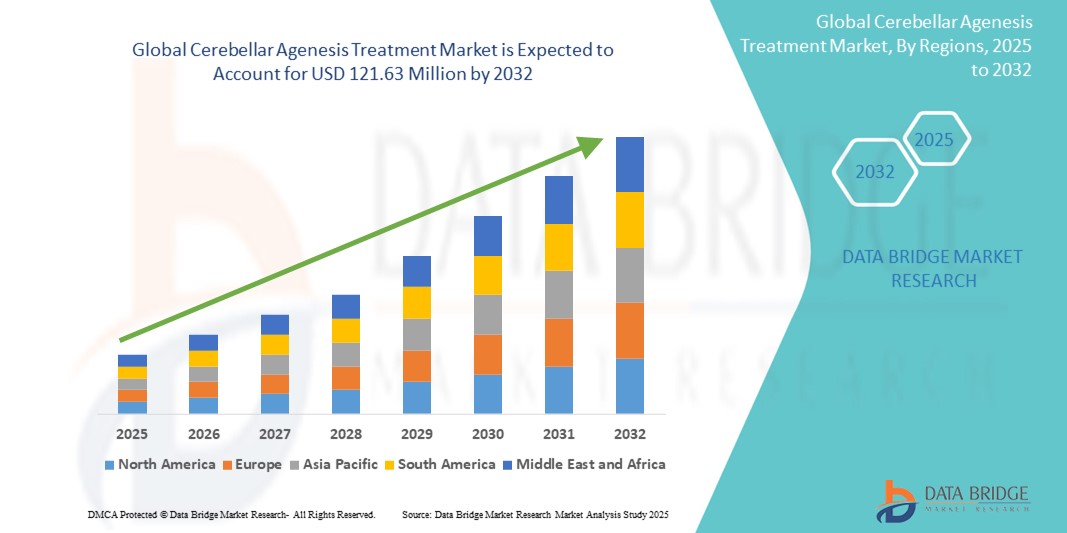
Cerebellar Agenesis Treatment Market Size
- The Global Cerebellar Agenesis Treatment Market size was valued at USD 90.25 billion in 2024 and is expected to reach USD 121.63 million by 2032, at a CAGR of 3.80% during the forecast period
- This growth is driven by factors such as increasing awareness of rare neurological disorders, improvements in neuroimaging technologies, and growing investment in orphan drug development
Cerebellar Agenesis Treatment Market Analysis
- Cerebellar agenesis is a rare congenital condition characterized by the complete or partial absence of the cerebellum, leading to motor, cognitive, and speech-related impairments. Treatment is supportive in nature and typically involves a combination of drug therapies and rehabilitative interventions including physical, occupational, and speech therapies.
- The demand for cerebellar agenesis treatment is significantly driven by increased recognition and diagnosis of rare neurodevelopmental conditions, expanding clinical research in pediatric neurology, and improvements in healthcare access and multidisciplinary care options.
- North America is expected to dominate the cerebellar agenesis treatment market with a market share of 38.7%, due to the availability of specialized neurology centers, strong research funding for rare diseases, and access to advanced diagnostic infrastructure.
- Asia-Pacific is expected to be the fastest growing region in the cerebellar agenesis treatment market during the forecast period, owing to rapid advancements in healthcare systems, increased awareness about neurological disorders, and rising availability of supportive care services in emerging economies
- The physical therapy segment is expected to lead within the therapy type category with a market share of 38.7%, as it remains a fundamental part of the multidisciplinary approach to managing cerebellar agenesis. Physical therapy plays a crucial role in improving balance, motor coordination, gait, and muscle strength, particularly in pediatric patients who are still undergoing neuromuscular development. Its non-invasive nature, long-term benefits, and ability to enhance functional independence make it a cornerstone of supportive care. The rising adoption of early-intervention strategies in neurology and the availability of specialized physiotherapy services contribute to the segment’s continued dominance
Report Scope and Cerebellar Agenesis Treatment Market Segmentation
|
Attributes |
Cerebellar Agenesis Treatment Key Market Insights |
|
Segments Covered |
|
|
Countries Covered |
North America
Europe
Asia-Pacific
Middle East and Africa
South America
|
|
Key Market Players |
|
|
Market Opportunities |
|
|
Value Added Data Infosets |
In addition to the insights on market scenarios such as market value, growth rate, segmentation, geographical coverage, and major players, the market reports curated by the Data Bridge Market Research also include import export analysis, production capacity overview, production consumption analysis, price trend analysis, climate change scenario, supply chain analysis, value chain analysis, raw material/consumables overview, vendor selection criteria, PESTLE Analysis, Porter Analysis, and regulatory framework. |
Cerebellar Agenesis Treatment Market Trends
“Growing Focus on Multidisciplinary Management”
- One prominent trend in the cerebellar agenesis treatment market is the increasing focus on multidisciplinary care, combining pharmacologic therapy with tailored rehabilitation programs
- As awareness of the condition grows among clinicians and caregivers, there is an emphasis on early diagnosis and a holistic management approach that integrates physical, occupational, and speech therapies
- For instance, leading neurological centers are adopting integrated care pathways involving pediatric neurologists, therapists, and genetic counselors to manage motor dysfunction, developmental delays, and cognitive impairments in cerebellar agenesis patients
- This trend is reshaping the therapeutic landscape by promoting personalized care plans, improving developmental outcomes, and supporting lifelong functional independence for affected individuals
- With advancements in neuroimaging and genetic testing, early and accurate diagnosis is becoming more achievable, further driving the trend toward proactive and coordinated treatment strategies
- As healthcare systems evolve and rare neurological disorders receive more research funding, cerebellar agenesis treatment is expected to benefit from an expanded range of innovative care models and digital rehabilitation tools
Cerebellar Agenesis Treatment Market Dynamics
Driver
“Advancements in Symptomatic Drug Therapies”
- Continuous advancements in pharmacological research are significantly driving the cerebellar agenesis treatment market, especially in managing associated symptoms such as seizures, spasticity, behavioral issues, and cognitive dysfunction
- Innovative drug classes such as N-Methyl-D-Aspartate (NMDA) receptor antagonists, serotonin (5-HT1a) agonists, and glutamatergic neurotransmission blockers are gaining clinical relevance in modulating neurological symptoms and enhancing quality of life
- These therapies are being tailored for neuroprotective effects, behavioral regulation, and seizure control, making them critical components in the treatment regimen
For instance,
- NMDA receptor antagonists are increasingly used to address excitotoxicity and improve cognitive outcomes in pediatric patients with cerebellar dysfunction
- As the demand for better neurological care rises, there is growing interest in developing drugs that are safer, more effective, and better tolerated in pediatric and adolescent populations
- The rising number of clinical trials and orphan drug designations for rare neurological conditions further support the expansion of drug-based treatment modalities for cerebellar agenesis
Opportunity
“Rising Investment in Rare Disease Research and Global Collaborations”
- The increasing global focus on rare and orphan neurological disorders is opening up major opportunities in the cerebellar agenesis treatment market
- Research institutions, biotech firms, and governments are investing in understanding the genetic basis and pathophysiology of the condition, enabling potential breakthroughs in gene therapy, targeted drugs, and neuro-regenerative approaches
- Strategic collaborations between academic institutions and pharmaceutical companies are accelerating biomarker discovery, clinical trials, and treatment development
For instance,
- Multinational partnerships under initiatives like the Rare Diseases Clinical Research Network (RDCRN) and EU’s Horizon programs are expanding access to new treatment pipelines for rare brain disorders like cerebellar agenesis
- This collaborative approach enhances diagnosis, expands therapeutic options, and fosters the development of disease-specific management strategies
- The global recognition of rare pediatric neurological conditions and improved funding are expected to drive sustained market growth through novel therapeutic innovations
Restraint/Challenge
“Limited Access to Specialized Care and Diagnostic Tools”
- A key challenge in the cerebellar agenesis treatment market is the limited availability of specialized neurological care and advanced diagnostic tools, particularly in low- and middle-income regions
- Accurate diagnosis of cerebellar agenesis requires access to high-resolution MRI, genetic testing, and pediatric neurologists, which are not readily available in under-resourced healthcare settings
- Additionally, long-term treatment involves regular sessions of physical, occupational, and speech therapy, which may not be affordable or accessible for many families
For instance,
- In rural or remote areas, patients often lack access to developmental specialists and therapeutic facilities, leading to delayed intervention and suboptimal outcomes
- The high cost of therapy, lack of reimbursement coverage for rare disease management, and shortage of trained professionals contribute to disparities in care delivery
- These challenges underscore the need for policy support, telemedicine solutions, and increased investment in pediatric neurodevelopmental care infrastructure
Cerebellar Agenesis Treatment Market Scope
The market is segmented on the basis of therapy type, drugs, route of administration, end users and distribution channel.
|
Segmentation |
Sub-Segmentation |
|
By Therapy Type |
|
|
By Drugs |
|
|
By Route of Administration |
|
|
By End- Users |
|
|
By Distribution Channel |
|
In 2025, the physical therapy segment is projected to dominate the market with the largest share in the therapy type segment
The physical therapy segment is expected to dominate the cerebellar agenesis treatment market with the largest share of 38.7% in 2025 due to its critical role in improving motor function, balance, and coordination in patients. Despite the increasing use of occupational and speech therapies, physical therapy remains the cornerstone of rehabilitation as it directly addresses the core motor deficits associated with cerebellar agenesis. Its widespread clinical adoption, ability to enhance patient mobility, and effectiveness in reducing disability support its leading position in the market
The N-Methyl-D-Aspartate (NMDA) receptor antagonist segment is expected to account for the largest share during the forecast period in the drugs segment
In 2025, the NMDA receptor antagonist segment is expected to dominate the market due to its neuroprotective properties and effectiveness in managing neurological symptoms such as seizures and cognitive impairments associated with cerebellar agenesis. These drugs play a vital role in stabilizing excitotoxicity and improving neuronal function. The growing adoption of NMDA receptor antagonists, supported by ongoing clinical research and favorable regulatory environments, is driving the growth of this segment. Their critical role in symptom management and quality-of-life improvement makes them the preferred pharmacological treatment choice
Cerebellar Agenesis Treatment Market Regional Analysis
“North America Holds the Largest Share in the Cerebellar Agenesis Treatment Market”
- North America dominates the cerebellar agenesis treatment market with a share of 38.2%, driven by advanced healthcare infrastructure, strong adoption of comprehensive rehabilitation therapies, and the presence of leading pharmaceutical and therapy providers
- The U.S. holds a significant share of 75.6% due to high investments in neurological disorder research, widespread availability of drug therapies such as NMDA receptor antagonists, and well-established rehabilitation programs tailored for cerebellar disorders
- The presence of key players such as Mylan N.V., GlaxoSmithKline plc, and Teva Pharmaceutical Industries Ltd., alongside ongoing clinical trials and research in neurodegenerative and congenital brain disorders, supports innovation and market growth. Additionally, substantial healthcare R&D investment accelerates the development of novel treatments and improved therapy protocols
- Increasing diagnosis rates, growing awareness about rare neurological disorders, and the focus on early intervention and multi-disciplinary care contribute to rising demand for effective treatment options, solidifying North America’s leading position in the market
“Asia-Pacific is Projected to Register the Highest CAGR in the Cerebellar Agenesis Treatment Market”
- The Asia-Pacific region is expected to witness the highest growth rate in the cerebellar agenesis treatment market, driven by expanding healthcare infrastructure, increasing awareness of rare neurological diseases, and rising patient volumes
- Countries such as China, India, and Japan are emerging as key markets due to improved diagnostic capabilities, growing government initiatives focused on neurological health, and expanding access to drug therapies and rehabilitation services
- Japan, with its advanced medical infrastructure and strong emphasis on neurological research, remains a critical market for cerebellar agenesis treatment, fostering adoption of innovative drug therapies and rehabilitation techniques
- The growing focus on healthcare system modernization and neurological disorder management in the APAC region is expected to drive demand for advanced treatment options, positioning it as the fastest-growing market for cerebellar agenesis therapies
Cerebellar Agenesis Treatment Market Share
The market competitive landscape provides details by competitor. Details included are company overview, company financials, revenue generated, market potential, investment in research and development, new market initiatives, global presence, production sites and facilities, production capacities, company strengths and weaknesses, product launch, product width and breadth, application dominance. The above data points provided are only related to the companies' focus related to market.
The Major Market Leaders Operating in the Market Are:
- Mylan N.V. (U.S.)
- GlaxoSmithKline plc (UK)
- Amneal Pharmaceuticals LLC (U.S.)
- Glenmark Pharmaceuticals Ltd. (India)
- Zydus Cadila (India)
- ALLERGAN (U.S.)
- Teva Pharmaceutical Industries Ltd. (Israel)
- Takeda Pharmaceutical Company Limited (Japan)
- ANI Pharmaceuticals, Inc. (U.S.)
- Lupin Pharmaceuticals, Inc. (India)
- Mirum Pharmaceuticals (U.S.)
- Sun Pharmaceutical Industries Ltd. (India)
- Epic Pharma, LLC (U.S.)
- WOCKHARDT (India)
- Novartis AG (Switzerland)
- Aurobindo Pharma (India)
- Albireo Pharma, Inc. (U.S.)
- Alembic Pharmaceuticals Limited (India)
- Lannett (U.S.)
- Adamas Pharmaceuticals, Inc. (U.S.)

- Interactive Data Analysis Dashboard
- Company Analysis Dashboard for high growth potential opportunities
- Research Analyst Access for customization & queries
- Competitor Analysis with Interactive dashboard
- Latest News, Updates & Trend analysis
- Harness the Power of Benchmark Analysis for Comprehensive Competitor Tracking
Data collection and base year analysis are done using data collection modules with large sample sizes. The stage includes obtaining market information or related data through various sources and strategies. It includes examining and planning all the data acquired from the past in advance. It likewise envelops the examination of information inconsistencies seen across different information sources. The market data is analysed and estimated using market statistical and coherent models. Also, market share analysis and key trend analysis are the major success factors in the market report. To know more, please request an analyst call or drop down your inquiry.
The key research methodology used by DBMR research team is data triangulation which involves data mining, analysis of the impact of data variables on the market and primary (industry expert) validation. Data models include Vendor Positioning Grid, Market Time Line Analysis, Market Overview and Guide, Company Positioning Grid, Patent Analysis, Pricing Analysis, Company Market Share Analysis, Standards of Measurement, Global versus Regional and Vendor Share Analysis. To know more about the research methodology, drop in an inquiry to speak to our industry experts.
Data Bridge Market Research is a leader in advanced formative research. We take pride in servicing our existing and new customers with data and analysis that match and suits their goal. The report can be customized to include price trend analysis of target brands understanding the market for additional countries (ask for the list of countries), clinical trial results data, literature review, refurbished market and product base analysis. Market analysis of target competitors can be analyzed from technology-based analysis to market portfolio strategies. We can add as many competitors that you require data about in the format and data style you are looking for. Our team of analysts can also provide you data in crude raw excel files pivot tables (Fact book) or can assist you in creating presentations from the data sets available in the report.













