


What is the Circular Chemicals Market Size and Growth Rate?
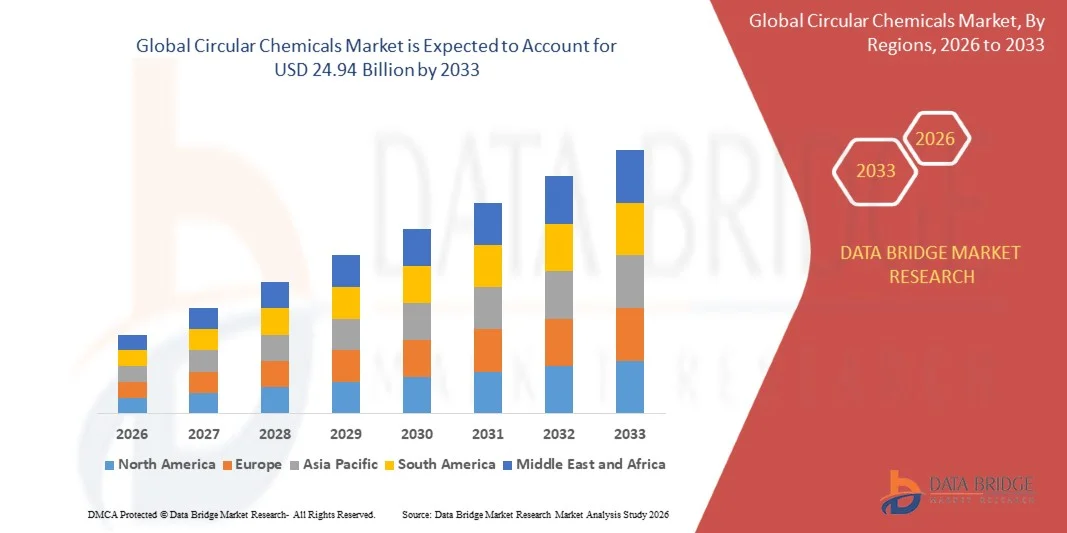
As per Data Bridge Market Research Analysis the global Circular chemicals market was valued at USD 9.65 Billion in 2025 and is projected to reach USD 24.94 Billion by 2033, growing at a CAGR of 12.60% from 2026 to 2033. Circular chemicals refer to chemical products derived from recycled, bio-based, or recovered feedstocks through processes that prioritize material reuse, waste reduction, and resource efficiency. These products—including circular polymers, solvents, bio-chemicals, and CO₂-based chemicals—are designed to keep materials in circulation and minimize reliance on virgin fossil-based feedstocks.
The market's growth is propelled by several interrelated factors: tightening regulatory frameworks on plastic waste and recycling, rising raw material costs encouraging reuse of chemical inputs, growing consumer demand for sustainable packaging, and industry-wide pressure to reduce landfill dependency. Corporate sustainability commitments and circular supply contracts are further strengthening market expansion. The European Chemicals Industry Action Plan and the upcoming Circular Economy Act are creating lead markets for renewable and circular solutions, while Asia-Pacific manufacturers are scaling circular chemical production alongside industrial growth.
Market Size & Forecast
- Global Market Value (2025): USD 9.65 Billion
- Expected Market Value (2033): USD 24.94 Billion
- Forecast CAGR (2026–2033): 12.60%
- Leading Region in 2025: Europe
- Fastest Growing Region: Asia-Pacific
Key Market Trends & Insights
- Europe emerged as the most significant regional market, with a 38% revenue share in 2024. The region generated USD 61.7 billion in revenue from the circular economy chemicals market in 2024, supported by stringent regulatory enforcement, advanced recycling infrastructure, and ambitious corporate sustainability mandates.Asia-Pacific is expected to witness the fastest growth during the forecast period, fueled by rapid industrialization, increasing waste volumes, and rising environmental concerns in countries such as China and India.
- The circular polymers & plastics segment accounted for the largest share in 2025, driven by immense global consumption of plastics across packaging, automotive, and construction industries.
- Chemical recycling is expanding rapidly as a processing technology for mixed and contaminated waste streams, overcoming limitations of traditional mechanical recycling.
- Mechanical recycling remains dominant due to cost-efficiency and established infrastructure, accounting for a significant share of circular chemical production.
- Growing corporate net-zero commitments and ESG reporting requirements are accelerating adoption of circular chemical solutions across global supply chains.
- Advanced chemical recycling technologies such as pyrolysis and depolymerization are improving commercial feasibility and expanding the range of recyclable materials.
- Regulatory developments including the EU Packaging and Packaging Waste Regulation (PPWR) and extended producer responsibility programs are creating structural demand for circular chemicals.
- Digital platforms for tracking material flows and provenance are enabling greater transparency and circularity certification across supply chains.
Report Scope and Circular Chemicals Market Segmentation
|
Attributes |
Circular Chemicals Key Market Insights |
|
Segments Covered |
|
|
Countries Covered |
North America
Europe
Asia-Pacific
Middle East and Africa
South America
|
|
Key Market Players |
|
|
Market Opportunities |
|
|
Value Added Data Infosets |
In addition to the insights on market scenarios such as market value, growth rate, segmentation, geographical coverage, and major players, the market reports curated by the Data Bridge Market Research also include import export analysis, production capacity overview, production consumption analysis, price trend analysis, climate change scenario, supply chain analysis, value chain analysis, raw material/consumables overview, vendor selection criteria, PESTLE Analysis, Porter Analysis, and regulatory framework. |
What is the Key Trend in the Circular Chemicals Market?
Trend: Regulatory-Driven Market Acceleration
Government policies and regulatory frameworks are playing an increasingly decisive role in shaping the circular chemicals market. The European Union's Packaging and Packaging Waste Regulation (PPWR) aims to expand targets for recycled content in packaging. The upcoming Circular Economy Act and green procurement initiatives are creating lead markets for renewable and circular solutions. Extended producer responsibility programs are shifting the cost burden of waste management to producers, creating financial incentives for circular chemical adoption. The European Chemicals Agency's redesigned Classification and Labelling Inventory and the European Chemicals Industry Action Plan are accelerating the transition toward safer and more sustainable chemical substitutes. These regulatory developments are creating structural demand for circular chemicals across end-use industries
Circular Chemicals Market Dynamics
Key Market Driver: Stringent Environmental Regulations and Waste Reduction Mandates
A primary driver of the circular chemicals market is the increasing regulatory pressure to reduce waste and promote recycling. The European Union's Packaging and Packaging Waste Regulation (PPWR) and extended producer responsibility programs are creating structural demand for circular chemicals. The UK's household waste recycling rate reached 44.6% in 2023, up from 44.1% in 2022, reflecting growing regulatory effectiveness. The European Chemicals Industry Action Plan is creating lead markets for renewable and circular solutions through the upcoming Circular Economy Act and green procurement initiatives. These regulatory drivers are compelling chemical manufacturers to invest in circular production capacity and develop circular product portfolios.
Key Restraint/Challenge: High Capital Investment and Process Complexity
A significant challenge facing the circular chemicals market is the high capital investment required for chemical recycling and circular production facilities. Process complexity, feedstock variability, and limited large-scale infrastructure pose barriers to market expansion. Cost competitiveness with virgin chemicals remains a challenge in several applications. Technology maturity differs across recycling and CCU pathways, increasing operational risk. Regulatory certification complexity and lack of uniform circular standards also limit faster market penetration. Technical complexity in recycling mixed and contaminated plastics, high energy consumption of some chemical recycling methods, and the need for infrastructure investments in waste collection and processing further constrain market growth.
Key Market Opportunity: Expansion of Recycled Feedstock Supply Chains
The expansion of recycled feedstock supply chains for virgin material replacement presents a significant growth opportunity for the circular chemicals market. Development of new polymer formulations optimized for recyclability and new markets for post-consumer recycled chemicals are creating substantial demand. Policy incentives for circular economy investments and the growth of B2B recycling service providers are accelerating market development. Innovation in circular business models offering leasing and take-back programs and enhanced brand differentiation through circular certifications are further supporting market growth. As recycling infrastructure expands and collection and sorting capabilities improve, the availability of high-quality recycled feedstocks is expected to increase, driving further adoption of circular chemicals.
How is the Circular Chemicals Market Segmented?
The circular chemicals market is segmented based on product type, process, and end-use industry.
- By Product Type
On the basis of product type, the Circular Chemicals Market is segmented into circular polymers & plastics, circular solvents, recovered metals & inorganic chemicals, bio-chemicals, CO₂-based chemicals, and recovered specialty chemicals. The circular polymers & plastics segment accounted for the largest share in 2025, driven by high demand from packaging, automotive, and consumer goods industries. Circular solvents are gaining adoption in pharmaceuticals, coatings, and electronics manufacturing. Recovered metals & inorganic chemicals support battery, electronics, and industrial applications. Bio-chemicals are witnessing strong growth driven by renewable feedstock utilization, while CO₂-based chemicals are emerging as a key decarbonization route. Recovered specialty chemicals support high-value performance and electronic material applications. The diversification of product offerings is enabling a broader range of circular chemical applications across end-use industries.
- By Process
On the basis of process, the Circular Chemicals Market is segmented into mechanical recycling, chemical recycling, biological/enzymatic processing, CO₂ capture & utilization (CCU), biorefining, and solvent recovery & purification. Mechanical recycling dominates due to cost-efficiency and established infrastructure. Chemical Recycling is expanding rapidly for mixed and contaminated waste streams. Biological and enzymatic processing supports low-energy and bio-based pathways. CCU is gaining strong momentum under carbon neutrality strategies. Biorefining enables multi-product recovery from biomass, while solvent recovery and purification support closed-loop industrial solvent systems.
- By End-Use Industry
On the basis of end-use industry, the Circular Chemicals Market is segmented into packaging, automotive, construction, electronics, consumer goods, pharmaceuticals, and agriculture. Packaging represents the largest end-use segment, driven by regulatory mandates for recycled content and consumer demand for sustainable packaging. The automotive segment is increasingly adopting circular polymers and solvents to meet sustainability targets and lightweighting requirements. Construction is emerging as a significant end-user through circular building materials and recycled content specifications. Electronics and consumer goods industries are adopting circular chemicals to meet ESG commitments and regulatory requirements. The Pharmaceuticals and Agriculture segments are growing through bio-based and renewable chemical adoption.
Which Region Holds the Largest Share of the Circular Chemicals Market ?
Europe Circular Chemicals Market Insight
Europe led the Circular Chemicals Market with a significant revenue share in 2025, supported by stringent regulatory enforcement, advanced recycling infrastructure, and ambitious corporate sustainability mandates. The region generated substantial market revenue, reflecting its strong presence in the global circular chemicals sector. The European Union's Packaging and Packaging Waste Regulation, the upcoming Circular Economy Act, and the European Chemicals Industry Action Plan are creating lead markets for renewable and circular solutions. Comprehensive initiatives aimed at increasing recycling rates and improving product circularity continue to support the region's leadership as it pushes toward more sustainable chemical production and waste reduction. Key players such as BASF SE, Covestro AG, Evonik Industries AG, and Borealis AG are headquartered in Europe, strengthening the region's market position.
Asia-Pacific Circular Chemicals Market Insight
Asia-Pacific is expected to witness the fastest growth during the forecast period, fueled by rapid industrialization, increasing waste volumes, and rising environmental concerns in countries such as China and India. The region's dominance in chemical manufacturing is attributed to rapid industrialization, rising population, and increasing environmental concerns. China accounts for 43% of global chemical sales, up from 34% a decade ago, driving substantial demand for circular chemicals across all product types. The APAC chemicals sector in 2025 is defined by robust growth in emerging markets and increasing pressure from sustainability requirements. India is emerging as a key growth market, fueled by increasing industrial activity and rising awareness of circular economy practices. The region's expanding industrial base, coupled with rising environmental awareness and regulatory pressure, is expected to maintain Asia-Pacific's growth momentum throughout the forecast period.
North America Circular Chemicals Market Insight
North America represents a significant market for circular chemicals, supported by strong policy incentives, a mature industrial base, and growing corporate net-zero commitments. The United States is at the forefront of circular chemical development, driven by growing chemical recycling investments and industrial circular adoption. Key companies such as Dow Inc., Eastman Chemical Company, and LyondellBasell Industries N.V. are headquartered in the U.S., strengthening the region's market position. The region's strong venture capital funding for clean technology startups and favorable regulatory environment for circular innovation are further accelerating market growth. Canada is also investing in circular chemical infrastructure through federal and provincial initiatives, contributing to the region's overall market expansion. The North American market benefits from abundant natural resources and ongoing investments in advanced manufacturing technologies and sustainable practices.
Latin America Circular Chemicals Market Insight
Latin America represents an emerging market for circular chemicals, with growing demand influenced by increasing investments in renewable energy, government incentives for clean fuel adoption, and the region's abundant bioenergy resources. Countries such as Brazil and Argentina are witnessing significant investments in circular chemical projects, supported by policies promoting sustainable development and reducing emissions. Brazil's established bioenergy sector provides a foundation for integrating circular chemical production with bio-based pathways. The region's expanding industrial base and growing awareness of circular economy practices are creating opportunities for circular chemicals. However, market growth is currently constrained by limited regulatory frameworks, higher technology costs compared to developed regions, and fragmented policy support. The development of regional supply chains and partnerships with global circular chemical technology providers is expected to accelerate market growth.
Middle East & Africa Circular Chemicals Market Insight
The Middle East and Africa region represents a nascent market for circular chemicals, with demand primarily concentrated in the GCC countries. Governments across the region are increasing investments in circular economy initiatives and sustainable chemical production to reduce carbon emissions and diversify their economies away from fossil fuel dependence. Saudi Arabia is expanding its circular chemical infrastructure as part of its Vision 2030 initiative, with significant investments in recycling and waste-to-chemical projects. The UAE is investing in sustainable chemical production and circular economy solutions, positioning itself as a regional hub for circular innovation. South Africa is gradually adopting circular chemical practices to support the growing demand for cleaner industrial processes. Increasing investments from global technology providers and the availability of low-cost renewable energy in the region are improving the commercial viability of circular chemical projects.
Circular Chemicals Market Share
The Circular Chemicals industry is primarily led by well-established companies, including:
- BASF SE (Germany)
- Dow Inc. (U.S.)
- LyondellBasell Industries N.V. (Netherlands)
- SABIC (Saudi Arabia)
- Evonik Industries AG (Germany)
- Covestro AG (Germany)
- Eastman Chemical Company (U.S.)
- Neste Oyj (Finland)
- Veolia Environnement S.A. (France)
- TotalEnergies SE (France)
- Mitsubishi Chemical Group Corporation (Japan)
- INEOS Group Limited (UK)
- Braskem S.A. (Brazil)
- Borealis AG (Austria)
- Solvay S.A. (Belgium)
- Carbios S.A. (France)
- GreenMantra Technologies (Canada)
- Agilyx Corporation (U.S.)
- Loop Industries Inc. (Canada)
- Reliance Industries Limited (India)
What are Latest Developments in Circular Chemicals Market?
- In June 2026, Encina Development Group, an ISCC PLUS certified producer of circular chemicals, announced the execution of a strategic Collaboration Agreement with BASF supporting the development of Encina's planned United States Gulf Coast circular chemicals manufacturing facility. The agreement provides BASF with rights to participate alongside Encina in future project development opportunities, including potential equity participation. BASF intends to utilize these circular feedstocks within its broad Ccycled® product portfolio, supporting customers across packaging, textiles, automotive, and consumer applications.
- In September 2025, Loop Industries, Inc. announced an offtake agreement with Taro Plast S.p.A. to supply Loop™ DMT (Dimethyl Terephthalate) made from 100% recycled content. The DMT will be supplied from Loop's planned Infinite Loop™ India facility, scheduled to come online in early 2028 through a joint venture with Ester Industries. Taro Plast will use the recycled DMT for automotive and specialty polymer applications.
- In July 2025, Veolia Environnement S.A. completed the acquisition of Chameleon Industries Inc., a Texas-based producer of specialty chemicals serving the semiconductor and microelectronics sectors. The acquisition expands Veolia's circular economy capabilities in North America by recovering and repurposing semiconductor manufacturing byproducts, reducing waste, and providing sustainable chemical solutions for advanced industries.
- In March 2025, BASF announced the startup of the world's first commercial-scale plant dedicated to producing loopamid® recycled polyamide 6 at its Caojing site in Shanghai, China, with an annual capacity of 500 metric tons. Loopamid is a recycled polyamide 6 derived entirely from textile waste, designed to meet the increasing demand within the textile sector for more sustainable polyamide 6 fibers.
- In March 2025, BASF Corporation and Braven Environmental signed a long-term supply agreement for Braven PyChem®, an advanced recycled feedstock derived from mixed plastic waste. The pyrolysis oil will partially replace fossil resources at the BASF TotalEnergies Petrochemical facility in Port Arthur, Texas. Braven will supply BASF from a multi-unit facility it will build in Texarkana, Texas.
- In February 2025, Maire, Eni, and Iren announced the authorization initiation for a circular methanol and hydrogen plant at Eni's Sannazzaro refinery in Italy. The project will convert 200,000 tons of non-recyclable waste into syngas, and subsequently into 110,000 tons of circular methanol and 1,500 tons of circular hydrogen. The project also recovers 33,000 tons of inert granulate for the cement industry.

- Interactive Data Analysis Dashboard
- Company Analysis Dashboard for high growth potential opportunities
- Research Analyst Access for customization & queries
- Competitor Analysis with Interactive dashboard
- Latest News, Updates & Trend analysis
- Harness the Power of Benchmark Analysis for Comprehensive Competitor Tracking
Global Circular Chemicals Market, Supply Chain Analysis and Ecosystem Framework
To support market growth and help clients navigate the impact of geopolitical shifts, DBMR has integrated in-depth supply chain analysis into its Global Circular Chemicals Market research reports. This addition empowers clients to respond effectively to global changes affecting their industries. The supply chain analysis section includes detailed insights such as Global Circular Chemicals Market consumption and production by country, price trend analysis, the impact of tariffs and geopolitical developments, and import and export trends by country and HSN code. It also highlights major suppliers with data on production capacity and company profiles, as well as key importers and exporters. In addition to research, DBMR offers specialized supply chain consulting services backed by over a decade of experience, providing solutions like supplier discovery, supplier risk assessment, price trend analysis, impact evaluation of inflation and trade route changes, and comprehensive market trend analysis.
Data collection and base year analysis are done using data collection modules with large sample sizes. The stage includes obtaining market information or related data through various sources and strategies. It includes examining and planning all the data acquired from the past in advance. It likewise envelops the examination of information inconsistencies seen across different information sources. The market data is analysed and estimated using market statistical and coherent models. Also, market share analysis and key trend analysis are the major success factors in the market report. To know more, please request an analyst call or drop down your inquiry.
The key research methodology used by DBMR research team is data triangulation which involves data mining, analysis of the impact of data variables on the market and primary (industry expert) validation. Data models include Vendor Positioning Grid, Market Time Line Analysis, Market Overview and Guide, Company Positioning Grid, Patent Analysis, Pricing Analysis, Company Market Share Analysis, Standards of Measurement, Global versus Regional and Vendor Share Analysis. To know more about the research methodology, drop in an inquiry to speak to our industry experts.
Data Bridge Market Research is a leader in advanced formative research. We take pride in servicing our existing and new customers with data and analysis that match and suits their goal. The report can be customized to include price trend analysis of target brands understanding the market for additional countries (ask for the list of countries), clinical trial results data, literature review, refurbished market and product base analysis. Market analysis of target competitors can be analyzed from technology-based analysis to market portfolio strategies. We can add as many competitors that you require data about in the format and data style you are looking for. Our team of analysts can also provide you data in crude raw excel files pivot tables (Fact book) or can assist you in creating presentations from the data sets available in the report.













