


What is the Coconut Derived Emollients Market Size and Growth Rate?
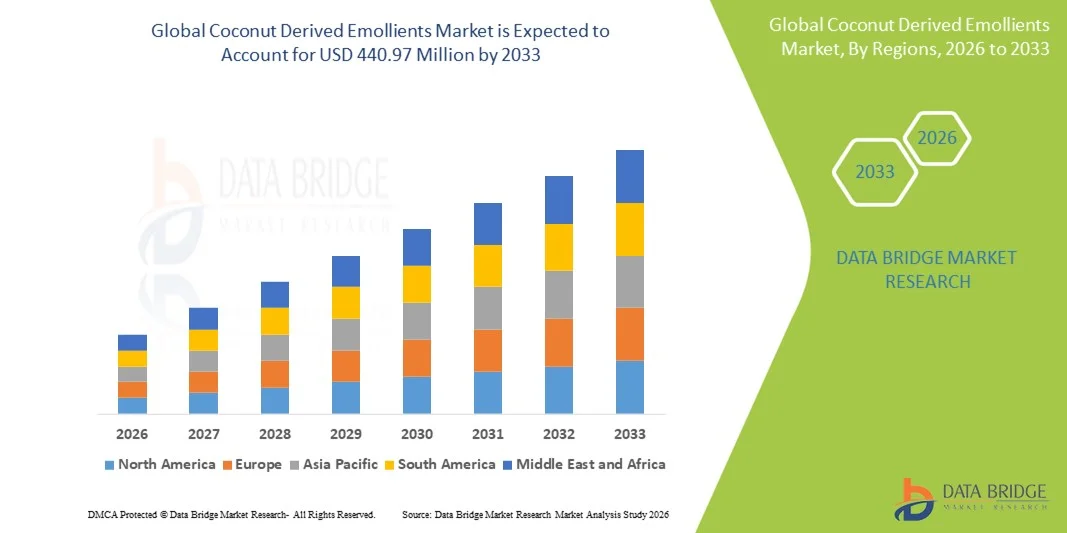
- As per Data Bridge Market Research Analysis the global coconut derived emollients market size was valued at USD 329.75 million in 2025 and is expected to reach USD 440.97 million by 2033, at a CAGR of 3.70% during the forecast period
- The market growth is primarily driven by the increasing consumer preference for natural, sustainable, and skin-friendly ingredients in personal care, cosmetics, and pharmaceutical products, alongside technological advancements in extraction and formulation processes
- In addition, rising awareness regarding the benefits of coconut-based emollients, such as moisturizing, soothing, and hypoallergenic properties, is encouraging adoption across skincare, haircare, and cosmetic products. These converging trends are accelerating the demand for coconut-derived emollients, thereby significantly propelling the industry's growth
Market Size & Forecast
- Global Market Value (2025): USD 329.75 million
- Expected Market Value (2033): USD 440.97 million
- Forecast CAGR (2026–2033): 3.70%
What are the Major Takeaways of Coconut Derived Emollients Market?
- Coconut derived emollients, offering natural moisturizing and skin-conditioning properties, are increasingly vital ingredients in personal care, cosmetics, and pharmaceutical formulations due to their biocompatibility, gentle profile, and versatility across multiple product types
- The escalating demand for coconut-derived emollients is primarily fueled by the growing consumer preference for clean-label, sustainable, and plant-based ingredients, along with rising awareness about skin health and natural product benefits
- North America dominated the coconut derived emollients market with the largest revenue share of 38.9% in 2025, characterized by high consumer awareness, strong presence of key cosmetic and personal care manufacturers, and a robust demand for natural and organic skincare products, particularly in the U.S., where innovation in multifunctional emollient formulations is driving market growth
- Asia-Pacific is expected to be the fastest-growing region in the coconut derived emollients market during the forecast period due to increasing urbanization, rising disposable incomes, and growing adoption of natural personal care products in countries such as India, China, and Japan
- Natural oil segment dominated the coconut derived emollients market with a market share of 44.7% in 2025, driven by its widespread use across hair care, skin care, and toiletries applications, owing to superior moisturizing properties, compatibility with sensitive skin, and consumer preference for naturally sourced ingredients
Report Scope and Coconut Derived Emollients Market Segmentation
|
Attributes |
Coconut Derived Emollients Key Market Insights |
|
Segments Covered |
|
|
Countries Covered |
North America
Europe
Asia-Pacific
Middle East and Africa
South America
|
|
Key Market Players |
|
|
Market Opportunities |
|
|
Value Added Data Infosets |
|
What is the Key Trend in the Coconut Derived Emollients Market?
Rising Demand for Multifunctional Natural Emollients
- A significant and accelerating trend in the global coconut derived emollients market is the increasing formulation of multifunctional products that combine moisturizing, hair-nourishing, and soothing benefits, enhancing overall consumer appeal
- For instance, coconut oil-based hair serums now incorporate vitamins and antioxidants to simultaneously strengthen hair and provide scalp nourishment, attracting health-conscious consumers
- Formulations leveraging coconut-derived esters and oils are gaining popularity in skincare for their lightweight texture, quick absorption, and non-greasy finish, catering to diverse consumer preferences
- The integration of coconut emollients in organic and vegan-certified products supports clean-label positioning, allowing brands to differentiate in a competitive personal care market
- This trend towards multifunctional, natural, and sustainable formulations is reshaping product development strategies, with companies such as Aroma Magic developing coconut-based creams and lotions targeting multiple skin concerns
- The rising consumer preference for natural and ethically sourced ingredients is driving widespread adoption of coconut-derived emollients across hair care, skin care, and toiletries segments globally
- Growing innovations in product formats, such as coconut oil-based balms, lip care sticks, and hair masks, are expanding the application scope and attracting niche consumer segments
- Increasing collaborations between cosmetic manufacturers and coconut oil suppliers are enabling premium, high-quality product launches with traceable and sustainable sourcing, boosting consumer confidence
Coconut Derived Emollients Market Dynamics
Driver
Increasing Consumer Preference for Natural and Sustainable Ingredients
- The growing awareness and preference for plant-based, skin-friendly, and eco-conscious ingredients is a significant driver of demand for coconut-derived emollients in personal care and cosmetic products
- For instance, companies such as The Body Shop and Kama Ayurveda are expanding product lines incorporating coconut oils and derivatives to cater to eco-conscious consumers seeking clean-label skincare solutions
- Coconut-derived emollients offer natural moisturizing, soothing, and hair-conditioning benefits, providing a safer and gentler alternative to synthetic ingredients, enhancing consumer trust and adoption
- Rising demand for multifunctional personal care products that combine natural ingredients with performance benefits is further propelling market growth across hair care, skin care, and toiletries segments
- The expanding retail and e-commerce presence of natural and organic personal care products enables easier access to coconut-based formulations, accelerating global adoption
- Increasing disposable incomes and growing preference for premium natural and sustainable products in regions such as North America and Europe are expected to sustain the market growth trajectory
- The rising trend of DIY and home-based personal care routines is encouraging consumers to use coconut-derived oils and emollients directly, increasing market consumption
- Strategic product launches targeting specific consumer concerns, such as sensitive skin and hair repair, are expanding the market scope and driving demand for specialized coconut-based emollients
Restraint/Challenge
Supply Chain Volatility and Regulatory Compliance Hurdle
- Variability in raw material availability due to fluctuating coconut production and climate-dependent yields poses a significant challenge to consistent supply and pricing stability
- For instance, tropical regions experiencing adverse weather conditions can reduce coconut oil output, affecting global production of coconut-derived emollients and increasing raw material costs
- Compliance with stringent cosmetic and pharmaceutical regulations across different countries requires rigorous testing and certification, which can delay product launches and increase costs
- Market penetration can be constrained by the comparatively higher price point of naturally derived emollients versus synthetic alternatives, limiting adoption in price-sensitive regions
- Addressing these challenges through sustainable sourcing practices, diversified supplier networks, and adherence to regulatory standards is crucial for maintaining market credibility and growth
- Companies such as Biorigin and AAK emphasize sustainable sourcing and certification of coconut oils to ensure product quality, traceability, and regulatory compliance, mitigating these market challenges
- Limited consumer awareness in emerging markets regarding the benefits of natural emollients can restrict demand growth, requiring targeted educational campaigns
- Transportation and storage challenges of coconut oils, which are prone to rancidity if not handled properly, add operational complexities for manufacturers and distributors
How is the Coconut Derived Emollients Market Segmented?
The market is segmented on the basis of type, application, end-users, and distribution channel.
- By Type
On the basis of type, the coconut derived emollients market is segmented into natural oil and synthetic oil. The natural oil segment dominated the market with the largest revenue share of 44.7% in 2025, driven by rising consumer preference for clean-label, plant-based, and sustainably sourced personal care ingredients. Natural coconut oils such as coconut oil, fractionated coconut oil, and virgin coconut oil are widely used for their moisturizing, anti-inflammatory, and skin-barrier-enhancing properties. The segment benefits significantly from strong demand in skin care and hair care, where natural formulations are a priority for premium and mass-market brands. Manufacturers also prefer natural coconut oils due to regulatory advantages associated with fewer chemical processing steps. In addition, the clean beauty movement and expanding product launches featuring coconut-based natural emollients further reinforce the segment’s dominance.
The synthetic oil segment is anticipated to witness the fastest growth rate from 2026 to 2033, driven by increasing demand for highly stable, lightweight, and texture-enhancing emollients in cosmetic formulations. Synthetic coconut-derived emollients offer enhanced formulation consistency, odor neutrality, and improved oxidative stability, making them suitable for high-performance personal care products. Their ability to mimic natural oils while providing superior spreadability and non-greasy sensory profiles contributes to accelerated adoption among formulators. This segment is also gaining traction in premium skincare and color cosmetics where controlled emollience, rapid absorption, and compatibility with active ingredients are essential. Thus, rising innovation and a shift toward performance-driven formulations are expected to fuel strong segment growth.
- By Application
On the basis of application, the coconut derived emollients market is segmented into hair care, skin care, toiletries, oral care, and others. The skin care segment dominated the market with the largest revenue share in 2025, supported by the widespread use of coconut-derived emollients in moisturizers, lotions, creams, serums, and ointments. The high demand is attributed to coconut-based emollients’ excellent hydration, smoothening, and anti-irritant properties, making them ideal for sensitive and dry-skin formulations. Skin care brands increasingly incorporate coconut oils and esters due to their natural origin and compatibility with both organic and dermatology-grade products. The trend toward natural emollients in anti-aging, brightening, and barrier-repair product lines further strengthens the segment. Expansion in both premium and budget-friendly skincare categories continues to contribute to strong market dominance.
The hair care segment is anticipated to witness the fastest growth rate from 2026 to 2033, driven by increasing consumer focus on scalp health, hair nourishment, and reducing chemical-based ingredient exposure. Coconut-derived emollients are widely appreciated for strengthening hair strands, improving shine, and reducing protein loss, making them essential in shampoos, conditioners, serums, and hair masks. Clean and natural hair care trends especially sulfate-free and silicone-free formulations significantly boost demand for coconut esters as natural conditioning agents. Rapid expansion of hair oiling rituals in Western markets and growing product penetration in emerging Asian economies also contribute to strong forecasted growth. In addition, innovations in lightweight, non-greasy coconut emollient derivatives further elevate usage in styling and treatment products.
- By End-Users
On the basis of end-users, the coconut derived emollients market is segmented into clinic, hospital, and others. The hospital segment dominated the market in 2025, driven by increasing use of coconut-derived emollients in dermatology treatments, wound-care formulations, and therapeutic skincare products recommended by clinicians. Hospitals prefer emollient-based products that support skin healing, reduce inflammation, and help manage conditions such as eczema and dermatitis, where coconut oils are frequently included for their mildness and restorative benefits. Expanding use in medicated ointments, pediatric skincare, and post-treatment moisturizing regimens further strengthens the segment. The preference for formulations with minimal irritants and natural components also contributes to the dominance of coconut-derived emollients in hospital-distributed therapeutic products.
The clinic segment is anticipated to witness the fastest growth rate from 2026 to 2033, supported by rising adoption of coconut-based emollient products in dermatology, trichology, and aesthetic clinics. Clinics increasingly recommend natural emollients for routine skincare regimens following cosmetic procedures such as chemical peels, laser treatments, and microdermabrasion. Growing awareness of coconut-derived ingredients’ soothing and barrier-repair capabilities encourages dermatologists to include such products in patient care plans. In addition, expanding outpatient dermatology services and greater availability of clinic-exclusive skin and hair care formulations drive segment growth. The trend toward personalized skincare solutions using natural and effective emollients further strengthens demand across clinical environments.
- By Distribution Channel
On the basis of distribution channel, the coconut derived emollients market is segmented into hospital pharmacy, retail pharmacy, and online pharmacy. The retail pharmacy segment dominated the market with the largest revenue share in 2025 due to strong availability of over-the-counter skincare, hair care, and topical treatment products containing coconut-derived emollients. Consumers rely heavily on retail channels for quick access to dermatology-approved and natural personal care items, boosting consistent product movement. Retail pharmacies also benefit from established supply chains and wide assortments of natural emollient-based formulations across mass-market and premium brands. In-store dermatologist recommendations and dedicated skincare sections further support sales. The trust and accessibility associated with retail pharmacies keep this channel dominant in distributing coconut-based emollient products.
The online pharmacy segment is anticipated to witness the fastest growth rate from 2026 to 2033, driven by rising e-commerce penetration, digital-first beauty brands, and consumer preference for convenient doorstep delivery. Online platforms provide access to a wider variety of coconut-derived emollient products, including specialty, organic, and international brands unavailable in local stores. Growing adoption of subscription-based skincare and haircare offerings is strengthening this channel further. Online reviews, influencer-driven product awareness, and targeted marketing significantly accelerate consumer conversion. Moreover, expanding teledermatology services encourage the purchase of recommended emollient-based products through online pharmacies, driving rapid channel growth.
Which Region Holds the Largest Share of the Coconut Derived Emollients Market?
- North America dominated the coconut derived emollients market with the largest revenue share of 38.9% in 2025, characterized by high consumer awareness, strong presence of key cosmetic and personal care manufacturers, and a robust demand for natural and organic skincare products
- Consumers in the region highly value clean-label, plant-based formulations and are increasingly shifting toward sustainable ingredients, positioning coconut-derived emollients as a preferred option for beauty and dermatological products
- This widespread adoption is further supported by high disposable incomes, a mature cosmetics and dermatology market, and rising awareness of ingredient transparency, establishing coconut-derived emollients as an essential component in both consumer and professional formulations
U.S. Coconut Derived Emollients Market Insight
The U.S. coconut derived emollients market captured the largest revenue share within North America in 2025, fueled by the rising demand for natural, plant-based ingredients in skincare, haircare, and cosmetic formulations. Manufacturers and consumers are increasingly prioritizing clean-label, sustainable, and dermatologically safe ingredients, positioning coconut-derived emollients as a preferred choice. The growing popularity of premium beauty brands, dermatology-driven formulations, and organic personal care products is further accelerating market expansion. Moreover, strong innovation in functional cosmetic ingredients and widespread retail availability support the continued growth of coconut-derived emollients across both mass and specialty beauty markets.
Europe Coconut Derived Emollients Market Insight
The Europe coconut derived emollients market is projected to expand at a substantial CAGR throughout the forecast period, primarily driven by stringent regulations promoting the use of safe, sustainable, and environmentally friendly cosmetic ingredients. The region’s rising focus on natural and organic personal care products, combined with a high consumer preference for skin-soothing and moisturizing formulations, supports the adoption of coconut-derived emollients. European consumers are particularly drawn to ethically sourced, vegan, and eco-certified ingredients. In addition, increasing product innovation in skincare, haircare, and premium cosmetic segments is contributing to steady market growth across the region.
U.K. Coconut Derived Emollients Market Insight
The U.K. coconut derived emollients market is anticipated to grow at a noteworthy CAGR during the forecast period, driven by the rising demand for natural beauty products and the strong shift toward botanical and plant-based ingredients. Concerns regarding synthetic chemicals and skin sensitivity issues are encouraging consumers to opt for safer, coconut-derived emollients in skincare and personal hygiene applications. The U.K.’s advanced retail infrastructure, strong online beauty marketplace, and rapid consumer adoption of clean beauty trends continue to stimulate market expansion. In addition, growing interest in cruelty-free and vegan formulations further fuels demand.
Germany Coconut Derived Emollients Market Insight
The Germany coconut derived emollients market is expected to expand at a considerable CAGR during the forecast period, fueled by the country’s strong emphasis on product safety, dermatological efficacy, and sustainable ingredient sourcing. German consumers show high interest in natural personal care solutions, driving demand for coconut-derived moisturizing agents used in lotions, creams, and haircare products. The market also benefits from Germany’s robust cosmetics manufacturing base and its focus on innovation and environmentally conscious formulations. The increasing integration of coconut-based emollients into high-performance skincare products continues to support consistent growth.
Asia-Pacific Coconut Derived Emollients Market Insight
The Asia-Pacific coconut derived emollients market is poised to grow at the fastest CAGR during the forecast period, driven by rising disposable incomes, rapid expansion of the beauty and personal care sector, and increasing consumer awareness of natural ingredients. Countries such as China, Japan, and India are witnessing strong demand for plant-based and sustainably sourced cosmetic components. Government support for industrial expansion and local production also contributes to market growth. Furthermore, as APAC remains a major coconut-producing region, the availability of raw materials enhances affordability and accelerates adoption across both mass and premium cosmetic categories.
Japan Coconut Derived Emollients Market Insight
The Japan coconut derived emollients market is gaining momentum due to the country’s strong focus on high-quality beauty products, advanced skincare routines, and consumer preference for gentle, natural ingredients. Japanese consumers value mild, hydrating, and multifunctional emollients that support sensitive-skin formulations, making coconut-derived ingredients increasingly popular. Growth is further driven by innovation in premium cosmetic and haircare segments, with brands integrating coconut-based emollients into functional and anti-aging products. In addition, the country’s aging population increases demand for soothing, low-irritation ingredients, supporting steady market expansion.
India Coconut Derived Emollients Market Insight
The India coconut derived emollients market accounted for one of the largest market revenue shares in Asia Pacific in 2025, attributed to the country’s abundant coconut supply, rising beauty consciousness, and expanding personal care industry. India is experiencing strong growth in both natural and Ayurvedic beauty segments, where coconut-derived oils and emollients are widely preferred. The rise of domestic cosmetic brands, increased urbanization, and higher purchasing power further drive market adoption. Growing demand for affordable yet effective skincare and haircare products, supported by online retail growth, continues to propel the coconut-derived emollient market in India.
Which are the Top Companies in Coconut Derived Emollients Market?
The Coconut Derived Emollients industry is primarily led by well-established companies, including:
- AAK AB (Sweden)
- Croda International Plc (U.K.)
- BASF SE (Germany)
- Oleon NV (Belgium)
- Emery Oleochemicals (U.S.)
- IOI Oleochemical (Malaysia)
- KLK OLEO (Malaysia)
- Wilmar International Ltd (Singapore)
- Cargill, Incorporated (U.S.)
- Stepan Company (U.S.)
- Evonik Industries AG (Germany)
- Corbion (Netherlands)
- Kao Corporation (Japan)
- Galaxy Surfactants Ltd (India)
- Biorigin (Brazil)
- Godrej Industries Limited (India)
- PTT Global Chemical Public Company Limited (Thailand)
- Vantage Specialty Chemicals (U.S.)
- Procter & Gamble Company (U.S.)
- Unilever (U.K.)
What are the Recent Developments in Global Coconut Derived Emollients Market?
- In September 2025, As part of a broader industry push toward green chemistry and natural emollients, stakeholders noted increasing use of coconut-oil–derived esters (such as Cocoyl Caprylocaprate) for moisturizing and stabilizing in personal care products, highlighting development of coconut-derived emollients beyond traditional oils
- In June 2025, A supplier of coconut-oil derivatives published a descriptive update on coconut oil derivatives’ suitability for skin benefits (hydration, anti-aging, mild emollience, non-greasy finish), suggesting ingredient-level development and increasing commercial availability of cosmetic-grade coconut-derived oils for global personal-care brands
- In May 2025, At its Suppliers’ Day event, Croda unveiled new sustainable ingredient technologies and high-performance formulations including new coconut-oil based or derived inputs for skin/hair care indicating active development and scaling of coconut-derivative emollient ingredients in personal care product pipelines
- In April 2024, Croda Beauty showcased several new ingredient launches at the global cosmetic-industry event in-cosmetics Global, including novel sustainable and natural oil/derivative ingredients designed for skin and hair care formulations signaling ongoing development of coconut-oil derivatives for cosmetic use
- In January 2024, Nari'yal announced the launch of a new coconut-based skincare line, featuring products such as “Body Brightening Oil Serum” and “Cream of Coco Body Lotion,” leveraging coconut-derived emollients for natural, gentle skincare

- Interactive Data Analysis Dashboard
- Company Analysis Dashboard for high growth potential opportunities
- Research Analyst Access for customization & queries
- Competitor Analysis with Interactive dashboard
- Latest News, Updates & Trend analysis
- Harness the Power of Benchmark Analysis for Comprehensive Competitor Tracking
Data collection and base year analysis are done using data collection modules with large sample sizes. The stage includes obtaining market information or related data through various sources and strategies. It includes examining and planning all the data acquired from the past in advance. It likewise envelops the examination of information inconsistencies seen across different information sources. The market data is analysed and estimated using market statistical and coherent models. Also, market share analysis and key trend analysis are the major success factors in the market report. To know more, please request an analyst call or drop down your inquiry.
The key research methodology used by DBMR research team is data triangulation which involves data mining, analysis of the impact of data variables on the market and primary (industry expert) validation. Data models include Vendor Positioning Grid, Market Time Line Analysis, Market Overview and Guide, Company Positioning Grid, Patent Analysis, Pricing Analysis, Company Market Share Analysis, Standards of Measurement, Global versus Regional and Vendor Share Analysis. To know more about the research methodology, drop in an inquiry to speak to our industry experts.
Data Bridge Market Research is a leader in advanced formative research. We take pride in servicing our existing and new customers with data and analysis that match and suits their goal. The report can be customized to include price trend analysis of target brands understanding the market for additional countries (ask for the list of countries), clinical trial results data, literature review, refurbished market and product base analysis. Market analysis of target competitors can be analyzed from technology-based analysis to market portfolio strategies. We can add as many competitors that you require data about in the format and data style you are looking for. Our team of analysts can also provide you data in crude raw excel files pivot tables (Fact book) or can assist you in creating presentations from the data sets available in the report.












