


What is the Natural Antioxidants Market Size and Growth Rate?
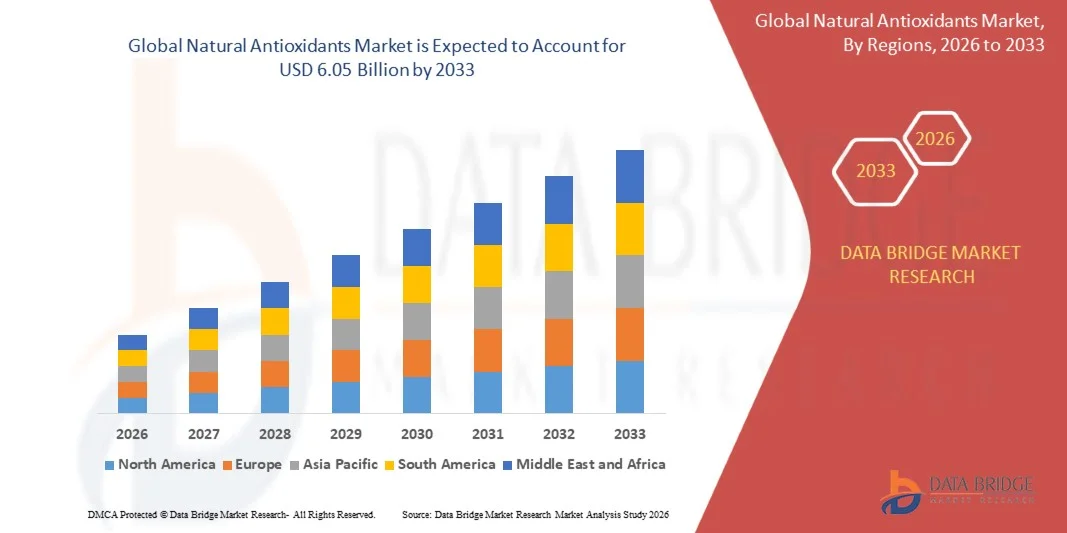
- As per Data Bridge Market Research analysis, the natural antioxidants market was valued at USD 3.54 billion in 2025 and is projected to reach USD 6.05 billion by 2033, growing at a CAGR of 6.95% from 2026 to 2033.
- The market is experiencing consistent growth driven by rising consumer demand for clean-label and naturally sourced ingredients, increasing awareness of the health benefits of antioxidants, and expanding applications across food and beverages, dietary supplements, pharmaceuticals, and cosmetics.
- The growing prevalence of lifestyle-related health concerns, combined with increasing demand for functional and fortified products, is compelling food manufacturers, nutraceutical companies, pharmaceutical firms, and cosmetic producers to adopt natural antioxidant ingredients. Plant-based antioxidants such as vitamin E, vitamin C, polyphenols, carotenoids, and botanical extracts are gaining traction as consumers increasingly prefer natural alternatives to synthetic additives, supporting product innovation across multiple industries.
Market Size & Forecast
- Global Market Value (2025): USD 3.54 Billion
- Expected Market Value (2033): USD 6.05 Billion
- Forecast CAGR (2026–2033): 6.95%
- Leading Region in 2025: North America
- Fastest Growing Region: Asia Pacific
What are the Major Takeaways of the Natural Antioxidants Market?
- North America dominated the natural antioxidants market with the largest revenue share of 36.0% in 2025, supported by strong consumer demand for clean-label products, established nutraceutical industries, and increasing adoption of natural ingredients across food and beverages.
- Asia-Pacific is expected to be the fastest-growing region at a CAGR of 8.0% from 2026 to 2033, fueled by rising health awareness, expanding functional food and dietary supplement industries, and growing demand for naturally sourced ingredients in China, India, and Japan.
- The vitamin E segment led the market with a 34% share in 2025, driven by its established use as a natural antioxidant in food, dietary supplements, personal care products, and animal nutrition.
- Rosemary extract are the fastest-growing type, projected to register a CAGR of 6%, reflecting the surge in demand for natural and clean-label alternatives to synthetic antioxidants
- The fruits and vegetables segment dominated the source category with a 45% revenue share in 2025, led by the broad availability of antioxidant-rich plant materials containing vitamins, carotenoids, polyphenols, and other bioactive compounds.
- Liquid accounted for 60% of the market share in 2025, preferred by its ease of incorporation into beverages, sauces, oils, emulsions, and other liquid formulations
- The personal care segment is the fastest-growing application category, with a CAGR of 5%, driven by increasing demand for natural and plant-derived cosmetic formulations.
Report Scope and Natural Antioxidants Market Segmentation
|
Attributes |
Natural Antioxidants Key Market Insights |
|
Segments Covered |
|
|
Countries Covered |
North America
Europe
Asia-Pacific
Middle East and Africa
South America
|
|
Key Market Players |
|
|
Market Opportunities |
|
|
Value Added Data Infosets |
In addition to the insights on market scenarios such as market value, growth rate, segmentation, geographical coverage, and major players, the market reports curated by the Data Bridge Market Research also include import export analysis, production capacity overview, production consumption analysis, price trend analysis, climate change scenario, supply chain analysis, value chain analysis, raw material/consumables overview, vendor selection criteria, PESTLE Analysis, Porter Analysis, and regulatory framework. |
What is the Key Trend in the Natural Antioxidants Market?
- Food and beverage manufacturers are increasingly adopting natural antioxidants to improve product stability, extend shelf life, and meet growing consumer demand for clean-label ingredients while reducing reliance on synthetic preservatives globally.
- For instance, in October 2024, Syensqo launched Riza, a 100% plant-based range of rosemary-derived antioxidants and flavors, designed for applications including meat, bakery, oils, beverages, and pet food; Syensqo stated that rosemary extract represents more than one-third of natural preservatives used in food.
- Natural antioxidants help reduce oxidative deterioration and support product quality during storage, while maintaining sensory quality.
- Food, nutraceutical, pharmaceutical, and cosmetic manufacturers are increasingly incorporating plant-derived antioxidants into formulations to satisfy demand for naturally sourced ingredients naturally.
- For instance, in September 2025, researchers from the National Institute of Food Technology Entrepreneurship and Management, Sonipat, published research showing that rosemary extract improved the oxidative stability of omega-3-rich margarine, demonstrating its potential as a natural alternative to synthetic antioxidants.
- As manufacturers increasingly prioritize clean-label formulation, natural preservation, and functional health positioning, demand for plant-derived antioxidant ingredients is expected to accelerate, reinforcing their role across food, nutraceutical, pharmaceutical, and cosmetic applications across global food and health product markets.
What are the Key Drivers of the Natural Antioxidants Market?
- The growing consumer demand for clean-label and naturally sourced ingredients is significantly increasing demand for natural antioxidants capable of supporting food quality, shelf life, and functional product positioning across diverse applications across multiple end-use sectors.
- For instance, in April 2025, Layn Natural Ingredients expanded its plant-based antioxidant solutions, including rosemary, green tea, pomegranate, and acerola extracts, to help food manufacturers extend shelf life naturally while meeting growing demand for products without synthetic additives
- Food, nutraceutical, pharmaceutical, and cosmetic companies are integrating natural antioxidants into product formulations to support oxidative stability, enhance positioning, and meet consumer preferences for plant-derived ingredients.
- For instance, in July 2025, Novella Innovative Technology and Metaphor Foods introduced next-generation plant-based antioxidants and antimicrobials, designed to provide natural food preservation, extend shelf life, and support cleaner ingredient labels in meat and poultry applications.
- As industries increasingly prioritize clean-label products, natural preservation, and functional benefits, natural antioxidants will remain ingredients for improving product stability and supporting innovation across food, pharmaceutical, nutraceutical, and cosmetic formulations.
What Factors are Challenging the Growth of the Natural Antioxidants Market?
- Natural antioxidants can require optimization as their effectiveness may vary with source, extraction method, concentration, storage conditions, and interactions within food matrices.
- For instance, in February 2025, Food Ingredients First reported that natural preservation suppliers face challenges related to price sensitivity, regulatory hurdles, and the complexity of complying with different food-safety requirements across markets, which can increase the difficulty and cost of adopting natural antioxidant solutions.
- These technical limitations can restrict performance, particularly when standardized efficacy and prolonged product stability are required.
- For instance, in May 2024, Symrise highlighted increasing supply risks for natural raw materials due to climate change, geopolitical conditions, declining agricultural yields, rising production costs, and price volatility, creating uncertainty in the availability and cost of plant-derived ingredients used in natural antioxidant formulations.
- The variability, stability, cost, sensory effects, and regulatory requirements associated with natural antioxidant ingredients continue to challenge manufacturers seeking consistent performance. These barriers can increase formulation complexity and production costs, limiting broader adoption across price-sensitive applications despite rising demand and can complicate scale-up, quality control, and supply consistency for manufacture
How is the Natural Antioxidants Market Segmented?
The natural antioxidants market is segmented on the basis of type, source, form, and application.
- By Type
On the basis of type, the natural antioxidants market is segmented into vitamin E, vitamin C, polyphenols, carotenoids, rosemary extract, and others. The vitamin E segment dominated the market with 34% share in 2025, owing to its established use as a natural antioxidant in food, dietary supplements, personal care products, and animal nutrition. Natural tocopherols are widely used to protect oils and fat-containing products from oxidative deterioration. Their established commercial availability and compatibility with different formulations support broad adoption. Vitamin E is also recognized for its nutritional and antioxidant properties, strengthening its demand across consumer and industrial applications. Increasing preference for naturally sourced ingredients further supports the use of vitamin E-based antioxidant systems.
The rosemary extract segment is projected to register the fastest growth at 6% CAGR from 2026 to 2033, driven by increasing demand for natural and clean-label alternatives to synthetic antioxidants. Rosemary contains antioxidant compounds that help control oxidation in food formulations. Its use is expanding across meat, bakery, oils, fats, snacks, and other food products. Manufacturers are increasingly incorporating rosemary extracts into formulations to support natural preservation claims. Improvements in extraction and standardization technologies are helping provide more consistent antioxidant performance. Growing consumer preference for recognizable plant-derived ingredients is further supporting adoption. The increasing use of rosemary extract as a natural preservation solution is expected to strengthen its growth trajectory.
- By Source
On the basis of source, the natural antioxidants market is segmented into fruits and vegetables, herbs and spices, and microalgae and seaweed. The fruits and vegetables segment dominated the market with 45% share in 2025, supported by the broad availability of antioxidant-rich plant materials containing vitamins, carotenoids, polyphenols, and other bioactive compounds. Extracts from fruits and vegetables are widely incorporated into food, beverage, nutraceutical, and personal care formulations. Their natural origin aligns with increasing consumer preference for plant-derived ingredients. Improvements in extraction technologies are enabling more efficient recovery of antioxidant compounds from plant materials. The use of processing by-products as sources of valuable antioxidant compounds is also supporting sustainable ingredient development.
The herbs and spices segment is projected to register the fastest growth at 6% CAGR from 2026 to 2033, driven by growing demand for concentrated botanical antioxidant ingredients. Herbs and spices such as rosemary, oregano, turmeric, and related botanicals contain polyphenols and other compounds with strong antioxidant properties. Their extracts are increasingly used in natural food preservation and clean-label formulations. Adoption is also expanding across nutraceutical, cosmetic, and personal care applications. Advances in extraction and standardization are improving the consistency and functionality of botanical extracts. Increasing consumer preference for recognizable plant-based ingredients is further supporting demand.
- By Form
On the basis of form, the natural antioxidants market is segmented into dry and liquid. The liquid segment dominated the market with 60% share in 2025, owing to its ease of incorporation into beverages, sauces, oils, emulsions, and other liquid formulations. Liquid antioxidants can be blended directly into formulations, allowing convenient processing and relatively precise dosing. Their ability to disperse efficiently in suitable formulations supports widespread industrial use. The format is particularly useful for food and beverage applications requiring uniform antioxidant distribution. Liquid extracts are also increasingly used in personal care formulations such as creams, lotions, and other emulsified products.
The dry segment is projected to register the fastest growth at a CAGR of 7.5% from 2026 to 2033, supported by advantages related to shelf stability, storage, transportation, and handling. Dry antioxidant ingredients are suitable for powders, premixes, supplements, dry foods, and animal-feed formulations. They can be incorporated into formulations without adding significant moisture. Improved drying and stabilization technologies are helping preserve antioxidant activity during processing and storage. The format also provides convenient handling for manufacturers using automated ingredient-blending systems. Growing demand for convenient and stable ingredient formats is supporting broader adoption.
- By Application
On the basis of application, the natural antioxidants market is segmented into food and beverages, personal care, animal feed, and others. The food and beverages segment dominated the market with 50% share in 2025, supported by extensive use of natural antioxidants to control oxidation and maintain product quality. Antioxidants are incorporated into oils, fats, processed foods, meat products, bakery products, beverages, and other formulations. The shift toward clean-label preservation is encouraging manufacturers to use naturally derived antioxidant ingredients. Increasing consumer interest in minimally processed and naturally formulated foods is further supporting adoption. Natural antioxidants can help maintain sensory characteristics and extend product stability.
The personal care segment is projected to register the fastest growth at 5% CAGR from 2026 to 2033, driven by increasing demand for natural and plant-derived cosmetic formulations. Natural antioxidants such as vitamin C, vitamin E, polyphenols, carotenoids, and botanical extracts are increasingly incorporated into skincare and haircare products. These ingredients can help protect formulations from oxidation while supporting antioxidant-focused product positioning. Growing demand for clean-label and naturally formulated cosmetics is encouraging manufacturers to increase their use of botanical ingredients. Innovation in concentrated plant extracts is also expanding the range of personal care formulations that can incorporate natural antioxidants. Increasing consumer interest in beauty and wellness products is supporting demand for antioxidant-rich formulations.
Which Region Holds the Largest Share of the Natural Antioxidants Market?
- North America dominated the natural antioxidants market with the largest revenue share of 36.0% in 2025, supported by strong consumer demand for clean-label products, established nutraceutical industries, and increasing adoption of natural ingredients across food and beverages.
- The region also benefits from growing demand for natural additives, functional foods, dietary supplements, and antioxidant-rich formulations, alongside strong regulatory support and continued innovation in plant-derived ingredients. Increasing consumer preference for naturally sourced products and the expanding use of natural antioxidants across food, beverages, personal care, and animal feed applications continue to strengthen North America's position in the global market.
U.S. Natural Antioxidants Market Insight
The U.S. natural antioxidants market is witnessing strong growth due to rising consumer demand for clean-label, plant-based, and naturally derived ingredients across food, beverages, nutraceuticals, and personal care products. The country’s mature food processing and dietary supplement industries, along with increasing demand for functional foods and natural preservation solutions, are driving adoption across multiple applications. In addition, growing awareness of the health benefits associated with antioxidant-rich ingredients is accelerating demand for natural antioxidant formulations among manufacturers and consumers.
Asia-Pacific Natural Antioxidants Market Insight
The Asia-Pacific natural antioxidants market is expected to witness rapid growth, driven by expanding food and beverage processing, increasing health awareness, and rising demand for natural and plant-based ingredients across countries such as China, India, and Japan. Growing consumption of functional foods, dietary supplements, and naturally formulated personal care products is supporting regional market expansion. In addition, the availability of botanical raw materials and increasing investments in natural ingredient extraction and processing are accelerating adoption across food, nutraceutical, and personal care industries.
Japan Natural Antioxidants Market Insight
The Japan natural antioxidants market is witnessing consistent growth due to rising consumer interest in health-oriented foods, functional beverages, and naturally derived ingredients. Food manufacturers, nutraceutical companies, and personal care producers are increasingly adopting natural antioxidants to support product stability and clean-label formulations. Moreover, increasing demand for functional ingredients and the country’s focus on high-quality food and wellness products are further contributing to market growth.
China Natural Antioxidants Market Insight
The China natural antioxidants market is growing rapidly, driven by expanding food and beverage manufacturing, increasing consumer health awareness, and rising demand for naturally derived ingredients. Growing adoption of plant-based antioxidants across functional foods, dietary supplements, and personal care products is significantly boosting market demand. In addition, the availability of botanical resources, development of natural ingredient processing capabilities, and increasing preference for clean-label products are supporting China's position as an important market for natural antioxidants.
U.K. Natural Antioxidants Market Insight
The U.K. natural antioxidants market is experiencing steady growth, supported by rising consumer preference for clean-label, organic, and naturally sourced food and personal care ingredients. Increasing demand for functional foods, nutritional supplements, and natural preservation solutions is contributing to market growth. Furthermore, growing adoption of botanical extracts and antioxidant-rich ingredients in food, beverages, cosmetics, and wellness products is strengthening the country's natural antioxidants industry.
Germany Natural Antioxidants Market Insight
The Germany natural antioxidants market is expanding steadily due to strong demand for natural and clean-label ingredients across food, beverages, nutraceuticals, and personal care applications. Food manufacturers and ingredient producers are increasingly utilizing plant-derived antioxidants to support product stability and meet consumer preferences for naturally formulated products. Continuous innovation in botanical extracts, growing demand for functional ingredients, and strong emphasis on sustainable and naturally sourced products are further driving market growth in Germany.
Which are the Top Companies in Natural Antioxidants Market?
The natural antioxidants industry is primarily led by well-established companies, including:
- Kemin Industries, Inc. (U.S.)
- Kalsec Inc. (U.S.)
- Symrise AG (Germany)
- Givaudan SA (Switzerland)
- Kerry Group plc (Ireland)
- Koninklijke DSM N.V. (Netherlands)
- ADM (U.S.)
- International Flavors & Fragrances Inc. (U.S.)
- BASF SE (Germany)
- Corbion N.V. (Netherlands)
- AAK AB (Sweden)
- Novonesis A/S (Denmark)
- Camlin Fine Sciences Ltd. (India)
- Vidya Herbs Pvt. Ltd. (India)
- Sabinsa Corporation (U.S.)
- Indena S.p.A. (Italy)
- Lycored Ltd. (Israel)
- Naturex S.A. (France)
- BTSA Biotecnologías Aplicadas S.L. (Spain)
- Nexira (France)
What are Latest Developments in Natural Antioxidants Market?
- In July 2025, Novella Innovative Technology and Metaphor Foods announced a strategic partnership to commercialize cell-based natural preservatives, leveraging Novella’s AuraCell plant-cell technology to develop natural antioxidant and antimicrobial compounds for clean-label food preservation. The collaboration initially focuses on meat and poultry applications, with potential expansion into seafood, dairy, bakery, alternative proteins, and pet food.
- In May 2024, Kemin Industries received European Commission authorization for rosemary extract as a functional additive in dog and cat food, providing the pet food industry with a natural antioxidant alternative to traditionally used tocopherols. The approval expanded the availability of rosemary-based antioxidant solutions for pet food formulations in the European market.
- In April 2023, CJ Food & Nutrition Tech launched its ActiveNrich functional nutrition brand, with a natural antioxidant solution based on fermentation-derived glutathione introduced as its first product. The solution was developed for use as a raw material in health foods and supplements, with the company targeting global nutrition markets.
- In March 2022, Florida Food Products launched VegStable, a plant-based antioxidant solution, derived from green tea, rosemary, acerola, and rice bran extracts. The clean-label ingredient was developed as an alternative to chemical antioxidants such as BHA and BHT and was designed to help maintain freshness, prevent rancidity, and extend the shelf life of meat and poultry products.
- In November 2021, Givaudan Active Beauty launched [N.A.S.] Rosemary 01, a natural and organic rosemary-based antioxidant ingredient developed through green fractionation. The ingredient was positioned as an alternative to synthetic antioxidants such as BHT and BHA and was designed to protect botanical oils and stabilize colors in cosmetic formulations.

- Interactive Data Analysis Dashboard
- Company Analysis Dashboard for high growth potential opportunities
- Research Analyst Access for customization & queries
- Competitor Analysis with Interactive dashboard
- Latest News, Updates & Trend analysis
- Harness the Power of Benchmark Analysis for Comprehensive Competitor Tracking
Global Natural Antioxidants Market, Supply Chain Analysis and Ecosystem Framework
To support market growth and help clients navigate the impact of geopolitical shifts, DBMR has integrated in-depth supply chain analysis into its Global Natural Antioxidants Market research reports. This addition empowers clients to respond effectively to global changes affecting their industries. The supply chain analysis section includes detailed insights such as Global Natural Antioxidants Market consumption and production by country, price trend analysis, the impact of tariffs and geopolitical developments, and import and export trends by country and HSN code. It also highlights major suppliers with data on production capacity and company profiles, as well as key importers and exporters. In addition to research, DBMR offers specialized supply chain consulting services backed by over a decade of experience, providing solutions like supplier discovery, supplier risk assessment, price trend analysis, impact evaluation of inflation and trade route changes, and comprehensive market trend analysis.
Data collection and base year analysis are done using data collection modules with large sample sizes. The stage includes obtaining market information or related data through various sources and strategies. It includes examining and planning all the data acquired from the past in advance. It likewise envelops the examination of information inconsistencies seen across different information sources. The market data is analysed and estimated using market statistical and coherent models. Also, market share analysis and key trend analysis are the major success factors in the market report. To know more, please request an analyst call or drop down your inquiry.
The key research methodology used by DBMR research team is data triangulation which involves data mining, analysis of the impact of data variables on the market and primary (industry expert) validation. Data models include Vendor Positioning Grid, Market Time Line Analysis, Market Overview and Guide, Company Positioning Grid, Patent Analysis, Pricing Analysis, Company Market Share Analysis, Standards of Measurement, Global versus Regional and Vendor Share Analysis. To know more about the research methodology, drop in an inquiry to speak to our industry experts.
Data Bridge Market Research is a leader in advanced formative research. We take pride in servicing our existing and new customers with data and analysis that match and suits their goal. The report can be customized to include price trend analysis of target brands understanding the market for additional countries (ask for the list of countries), clinical trial results data, literature review, refurbished market and product base analysis. Market analysis of target competitors can be analyzed from technology-based analysis to market portfolio strategies. We can add as many competitors that you require data about in the format and data style you are looking for. Our team of analysts can also provide you data in crude raw excel files pivot tables (Fact book) or can assist you in creating presentations from the data sets available in the report.













