


What is the Color Cosmetics Market Size and Growth Rate?
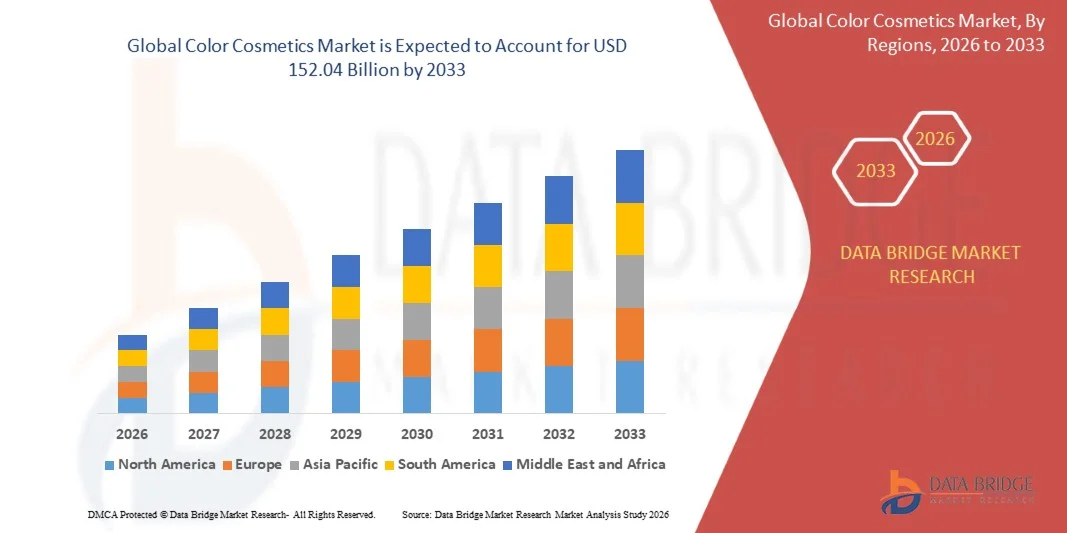
- As per Data Bridge Market Research analysis, the color cosmetics market was valued at USD 100.59 billion in 2025 and is projected to reach USD 152.04 billion by 2033, growing at a CAGR of 5.30% from 2026 to 2033.
- The market is experiencing consistent growth driven by rising demand for innovative and high-quality beauty products, rapid advancements in cosmetic formulations and product technologies, and expanding applications across facial makeup, eye makeup, lip makeup, and nail products.
- The increasing consumer focus on personal appearance and beauty, combined with growing demand for clean-label, long-lasting, and multifunctional cosmetics, is compelling beauty brands and manufacturers to introduce advanced color cosmetic products. Liquid, powder, and cream-based formulations are gaining adoption across many markets, offering consumers convenient, versatile, and personalized makeup solutions.
Market Size & Forecast
- Global Market Value (2025): USD 100.59 Billion
- Expected Market Value (2033): USD 152.04 Billion
- Forecast CAGR (2026–2033): 5.30%
- Leading Region in 2025: North America
- Fastest Growing Region: Asia Pacific
What are the Major Takeaways of the Color Cosmetics Market?
- North America dominated the color cosmetics market with the largest revenue share of 38.0% in 2025, supported by high consumer spending on beauty products, strong brand presence, product innovation, and established retail and e-commerce infrastructure.
- Asia-Pacific is expected to be the fastest-growing region at a CAGR of 7.5% from 2026 to 2033, fueled by rising disposable incomes, increasing beauty awareness, urbanization, and growing adoption of cosmetics across China and India.
- The face color cosmetics segment led the market with a 38.2% share in 2025, driven by strong demand for foundations, concealers, powders, blushes, and bronzers
- Lip color cosmetics are the fastest-growing product type, projected to register a CAGR of 6.2%, reflecting the surge in demand for lipsticks, glosses, tints, and balms.
- The chemical segment dominated the type category with a 67.0% revenue share in 2025, led by broad availability, established formulations, and strong consumer familiarity.
- Mass product accounted for 55.1% of the market share in 2025, preferred by affordability, broad accessibility, and extensive availability across retail channels.
- The lip products segment is the fastest-growing application category, with a CAGR of 8.9%, driven by increasing demand for lipsticks, glosses, tints, liners, and multifunctional lip products
Report Scope and Color Cosmetics Market Segmentation
|
Attributes |
Color Cosmetics Key Market Insights |
|
Segments Covered |
|
|
Countries Covered |
North America
Europe
Asia-Pacific
Middle East and Africa
South America
|
|
Key Market Players |
|
|
Market Opportunities |
|
|
Value Added Data Infosets |
In addition to the insights on market scenarios such as market value, growth rate, segmentation, geographical coverage, and major players, the market reports curated by the Data Bridge Market Research also include import export analysis, production capacity overview, production consumption analysis, price trend analysis, climate change scenario, supply chain analysis, value chain analysis, raw material/consumables overview, vendor selection criteria, PESTLE Analysis, Porter Analysis, and regulatory framework |
What is the Key Trend in the Color Cosmetics Market?
- Color cosmetics brands are increasingly integrating AI, augmented reality, and personalized digital beauty technologies to improve shade selection, virtual product testing, and consumer engagement while reducing uncertainty in online makeup purchases.
- For instance, in March 2025, Google expanded its AI-powered Shopping experience to allow U.S. shoppers to virtually try multiple makeup products and complete beauty looks using AI and augmented-reality technology, supporting more personalized digital cosmetics discovery.
- AI-enabled beauty platforms are increasingly combining virtual try-on capabilities with personalized recommendations, helping consumers evaluate complexion, lip, and eye products digitally before purchasing.
- Beauty companies are also expanding inclusive and technology-enabled makeup development to address diverse skin tones, visible skin differences, and localized consumer preferences across emerging markets.
- For instance, in September 2025, The Estée Lauder Companies and Nykaa announced 13 finalists for BEAUTY&YOU India 2025, including Mimiq, a complexion-focused makeup concept developing inclusive, high-performance products for consumers with visible skin differences.
- As beauty brands continue combining AI, digital commerce, personalization, and inclusive product development, the adoption of technology-driven color cosmetics experiences is expected to accelerate, reinforcing digital engagement as a core component of modern beauty purchasing.
What are the Key Drivers of the Color Cosmetics Market?
- The rapid expansion of digital beauty commerce and social-media-driven product discovery has significantly increased demand for accessible makeup products, personalized recommendations, and convenient online purchasing experiences.
- For instance, in December 2025, Bobbi Brown Cosmetics launched in the U.S. Amazon Premium Beauty Store, expanding online access to complexion, lip, and skincare-enhanced makeup products through a major digital retail platform.
- Beauty brands, retailers, and technology platforms are integrating digital tools, omnichannel distribution, and data-driven consumer engagement to shorten product-discovery cycles and expand access to color cosmetics across wider consumer groups.
- For instance, in July 2025, The Estée Lauder Companies launched the fourth edition of BEAUTY&YOU India with Nykaa and Startup India, providing financial support and industry expertise to entrepreneurs developing new beauty and makeup concepts for the Indian market.
- With consumers increasingly discovering and purchasing makeup through digital platforms while brands invest in personalized and omnichannel experiences, digitalization will remain an important driver of color cosmetics market expansion.
What Factors are Challenging the Growth of the Color Cosmetics Market?
- Color cosmetics manufacturers face increasing regulatory compliance requirements involving product safety, ingredient restrictions, color additives, facility registration, product listing, and safety documentation across major markets.
- For instance, in March 2025, the U.S. Food and Drug Administration (FDA) published registration data under the Modernization of Cosmetics Regulation Act (MoCRA), confirming that cosmetic manufacturers and processors must register facilities every two years, while responsible persons must list each marketed cosmetic product and update the information annually
- These requirements can increase compliance costs and administrative workloads, particularly for smaller brands and manufacturers that must manage formulation, labeling, registration, ingredient, and product-safety requirements across different jurisdictions.
- For instance, in August 2025, the European Commission clarified that Trimethylbenzoyl Diphenylphosphine Oxide (TPO) was prohibited in cosmetic products from September 1, 2025, with businesses also prohibited from continuing to supply existing TPO-containing products, creating additional formulation and compliance requirements for cosmetic manufacturers.
- The increasing complexity of regulatory requirements and restrictions on cosmetic ingredients and color additives continues to raise compliance burdens, particularly for companies introducing new formulations and expanding color cosmetics across international markets.
How is the Color Cosmetics Market Segmented?
The color cosmetics market is segmented on the basis of product type, type, target market, application, and distribution channel.
- By Product Type
On the basis of product type, the color cosmetics market is segmented into face color cosmetics, lip color cosmetics, eye color cosmetics, and nail color cosmetics. The face color cosmetics segment dominated the market with a 38.2% share in 2025, owing to strong demand for foundations, concealers, powders, blushes, and bronzers. Facial makeup forms an important part of everyday beauty routines and benefits from frequent product usage and repeat purchases. Consumers increasingly prefer lightweight complexion products that provide natural finishes and long-lasting coverage. Growing demand for inclusive shade ranges is encouraging brands to expand their facial makeup portfolios. Skincare-infused makeup products are also strengthening demand by combining complexion enhancement with additional beauty benefits. The broad product range and frequent usage of facial cosmetics continue to support the segment's leading position.
The lip color cosmetics segment is projected to register the fastest growth at a CAGR of 6.2% from 2026 to 2033, driven by strong demand for lipsticks, glosses, tints, and balms. Lip products remain popular because of their ease of application and ability to quickly enhance overall appearance. Consumers are increasingly seeking long-wear, transfer-resistant, hydrating, and comfortable formulations. Innovations in textures and finishes are further expanding consumer choices across matte, glossy, sheer, and hybrid formats. Lip products are also benefiting from social-media-driven beauty trends and frequent product launches. The combination of everyday usage, product innovation, and frequent repurchases is expected to support strong segment growth.
- By Type
On the basis of type, the color cosmetics market is segmented into chemical and natural and organic products. The chemical color cosmetics segment dominated the market with a 67.0% share in 2025, supported by broad availability, established formulations, and strong consumer familiarity. Conventional formulations provide manufacturers with flexibility in developing pigmentation, texture, stability, and long-wear performance. These products are widely available across face, eye, lip, and nail categories. Established manufacturing technologies and extensive distribution networks further support their adoption. Consumers continue to rely on conventional cosmetics because of their consistent performance and broad shade availability. Their established presence across mass and premium product ranges continues to support segment dominance.
The natural and organic color cosmetics segment is projected to register the fastest growth at a CAGR of 5.7% from 2026 to 2033, driven by increasing consumer preference for clean-label formulations and plant-based ingredients. Consumers are paying greater attention to cosmetic ingredients and product transparency. Demand for formulations perceived as gentler and more environmentally responsible is encouraging brands to expand natural product portfolios. Manufacturers are improving pigmentation, texture, wear performance, and shade availability in natural formulations. Skincare benefits are also being incorporated into natural color cosmetics to increase product functionality. Growing awareness of ingredient sourcing and sustainability is expected to continue supporting segment growth.
- By Target Market
On the basis of target market, the color cosmetics market is segmented into prestige product and mass product. The mass product segment dominated the market with a 55.1% share in 2025, supported by affordability, broad accessibility, and extensive availability across retail channels. Mass products attract a wide consumer base because of their accessible price points and diverse product offerings. They are widely distributed through supermarkets, specialty retailers, convenience stores, and e-commerce platforms. Affordable cosmetics also encourage consumers to experiment with different shades, textures, and product formats. Brands are increasingly introducing innovative and trend-driven products at accessible price levels. The combination of affordability, convenience, and broad consumer reach continues to support the segment's leading position.
The prestige product segment is projected to register the fastest growth at a CAGR of 6.7% from 2026 to 2033, driven by premiumization and increasing consumer interest in high-performance beauty products. Prestige brands are investing in advanced formulations, sophisticated packaging, and differentiated product experiences. Consumers are increasingly seeking products that combine makeup performance with skincare-oriented benefits. Celebrity influence, social media, and digital beauty content are increasing exposure to premium cosmetic brands. Luxury and prestige retailers are also expanding their omnichannel presence to improve consumer accessibility. Continued innovation and demand for differentiated beauty experiences are expected to support the segment's growth.
- By Application
On the basis of application, the color cosmetics market is segmented into nail products, lip products, eye make-up, facial make-up, hair color products, special effects products, and others. The facial make-up segment dominated the market with 38.2% share in 2025, supported by strong demand for foundations, concealers, powders, blushes, and bronzers. Facial makeup products are frequently incorporated into everyday beauty routines. Consumers increasingly prefer lightweight, natural-looking, and multifunctional complexion products. Shade inclusivity and undertone accuracy are encouraging broader adoption among diverse consumer groups. Hybrid products combining makeup with skincare benefits are also strengthening demand. The extensive range and frequent use of facial makeup products continue to support its leading position.
The lip products segment is projected to register the fastest growth at a CAGR of 8.9% from 2026 to 2033, driven by increasing demand for lipsticks, glosses, tints, liners, and multifunctional lip products. Consumers are increasingly interested in innovative textures, finishes, and long-lasting formulations. Lip products are also benefiting from the popularity of trend-driven beauty content and social-media influence. Hydrating and skincare-infused lip products are expanding the category beyond traditional color applications. The relatively convenient application and accessible price points encourage frequent purchases and experimentation. Continued innovation in lip formulations and shades is expected to support strong segment growth.
- By Distribution Channel
On the basis of distribution channel, the color cosmetics market is segmented into hypermarket/supermarket, convenience stores, speciality store, direct selling, and e-commerce. The hypermarket/supermarket segment dominated the market with a 34.5% share in 2025, supported by broad product availability, established retail networks, and convenient one-stop shopping. These outlets provide consumers with access to multiple brands and cosmetic categories in one location. Consumers can physically examine shades, textures, packaging, and product ranges before purchasing. Promotional campaigns and in-store beauty displays further encourage product discovery and purchases. Extensive geographic coverage makes these channels accessible to a broad consumer base. Their combination of convenience, assortment, and physical product access continues to support segment dominance.
The e-commerce segment is projected to register the fastest growth at a CAGR of 7.0% from 2026 to 2033, driven by increasing smartphone penetration, digital beauty discovery, and consumer preference for convenient online purchasing. Online platforms provide access to extensive product assortments and broader shade ranges. Customer reviews, beauty tutorials, personalized recommendations, and virtual try-on technologies are improving the digital purchasing experience. Social commerce is also encouraging consumers to discover new cosmetic products through digital content and influencers. Brands are increasingly using direct-to-consumer websites and online marketplaces to launch and promote products. Continued expansion of digital beauty retail is expected to support strong growth in e-commerce distribution.
Which Region Holds the Largest Share of the Color Cosmetics Market?
- North America dominated the color cosmetics market with the largest revenue share of 38.0% in 2025, supported by high consumer spending on beauty products, strong brand presence, product innovation, and established retail and e-commerce infrastructure.
- The region also benefits from strong adoption of innovative formulations, inclusive shade ranges, influencer-led beauty marketing, and growing demand for clean and personalized cosmetics. Established beauty ecosystems in the U.S. and Canada, combined with expanding omnichannel distribution and frequent product launches, continue to strengthen North America's position in the global color cosmetics market.
U.S. Color Cosmetics Market Insight
The U.S. color cosmetics market is witnessing strong growth due to rising consumer spending on beauty products, increasing demand for premium and innovative formulations, and expanding adoption of digital beauty technologies. The country’s mature beauty industry, along with strong presence of leading cosmetic brands and extensive retail networks, is driving demand across facial, lip, eye, and nail cosmetics. In addition, growing consumer interest in clean-label, multifunctional, personalized, and skincare-infused makeup products is accelerating product innovation and market expansion.
Asia-Pacific Color Cosmetics Market Insight
The Asia-Pacific color cosmetics market is expected to witness rapid growth, driven by rising disposable incomes, expanding urban populations, and increasing beauty consciousness across countries such as China, India, Japan, and South Korea. Growing adoption of premium and natural cosmetics, expanding e-commerce penetration, and increasing influence of social media beauty trends are supporting regional market expansion. In addition, the growing presence of international beauty brands and development of localized cosmetic products are accelerating color cosmetics adoption across emerging markets.
Japan Color Cosmetics Market Insight
The Japan color cosmetics market is witnessing consistent growth due to rising demand for innovative beauty formulations, premium cosmetics, and products combining makeup with skincare benefits. Consumers are increasingly adopting lightweight, natural-looking, and multifunctional cosmetics, while established beauty companies continue investing in advanced formulations and product development. Moreover, growing e-commerce adoption, aging consumer preferences, and increasing demand for high-quality and technologically advanced beauty products are further contributing to market growth.
China Color Cosmetics Market Insight
The China color cosmetics market is growing rapidly, driven by rising disposable incomes, expanding urbanization, and increasing consumer interest in beauty and personal appearance. Growing adoption of premium, natural, and multifunctional cosmetics across younger consumers is significantly boosting market demand. In addition, the rapid expansion of e-commerce, social commerce, domestic beauty brands, and digital beauty marketing is increasing product accessibility and consumer engagement, positioning China as a major growth market for color cosmetics globally.
U.K. Color Cosmetics Market Insight
The U.K. color cosmetics market is experiencing steady growth, supported by rising demand for premium, natural, vegan, and sustainable beauty products. Increasing consumer interest in innovative formulations, inclusive shade ranges, and multifunctional cosmetics is contributing to market expansion across facial, lip, eye, and nail categories. Furthermore, the integration of e-commerce, social media marketing, and personalized beauty technologies is improving product discovery and purchasing convenience, strengthening the U.K.'s position as an important market for color cosmetics.
Germany Color Cosmetics Market Insight
The Germany color cosmetics market is expanding steadily due to increasing consumer preference for high-quality, sustainable, and ingredient-conscious beauty products. Cosmetic manufacturers and retailers are increasingly focusing on natural formulations, environmentally responsible packaging, and innovative skincare-infused makeup products. Continuous expansion of e-commerce and specialty beauty retail, along with growing demand for premium and clean beauty products, is further supporting market growth in Germany.
Which are the Top Companies in Color Cosmetics Market?
The color cosmetics industry is primarily led by well-established companies, including:
- L'Oréal Groupe (France)
- The Estée Lauder Companies Inc. (U.S.)
- Coty Inc. (U.S.)
- Shiseido Company, Limited (Japan)
- Revlon Consumer Products LLC (U.S.)
- Kao Corporation (Japan)
- AMOREPACIFIC Corporation (South Korea)
- e.l.f. Beauty, Inc. (U.S.)
- Puig Brands, S.A. (Spain)
- LVMH Moët Hennessy Louis Vuitton (France)
- Unilever PLC (U.K.)
- KIKO S.p.A. (Italy)
- cosnova GmbH (Germany)
- Kryolan GmbH (Germany)
- Milani Cosmetics (U.S.)
- Mary Kay Inc. (U.S.)
- Huda Beauty (U.S.)
- Mehron, Inc. (U.S.)
- ColourPop Cosmetics, LLC (U.S.)
- CHANEL (France)
What are Latest Developments in Color Cosmetics Market?
- In May 2025, The Estée Lauder Companies reported the launch of several makeup innovations during fiscal 2025, including the M·A·C Nudes Collection featuring new and reintroduced nude shades across lip and eye categories, and Estée Lauder Double Wear Stay-in-Place 24-Hour Concealer, expanding its complexion makeup portfolio with a multi-use formulation.
- In December 2024, Revlon launched PhotoReady Prime Plus Perfecting + Smoothing Primer as its first EWG VERIFIED cosmetic product for mass retail, meeting the Environmental Working Group’s ingredient and transparency standards and expanding the company’s clean-beauty offering in the mass cosmetics segment.
- In January 2023, The Estée Lauder Companies launched its Voice-Enabled Makeup Assistant in the U.K., an AI-powered application designed to help visually impaired users apply lipstick, eyeshadow, and foundation by providing voice instructions and feedback on makeup application.
- In January 2023, L’Oréal unveiled HAPTA and L’Oréal Brow Magic at CES 2023, introducing a computerized makeup applicator designed to assist people with limited hand and arm mobility and a smart eyebrow makeup applicator capable of creating customized brow looks.
- In May 2022, The Estée Lauder Companies highlighted the launch of M·A·CStack mascara and LustreGlass Sheer-Shine Lipstick, while Estée Lauder introduced Double Wear Sheer Long-Wear Makeup, as makeup sales recovered with increased usage occasions in Western markets

- Interactive Data Analysis Dashboard
- Company Analysis Dashboard for high growth potential opportunities
- Research Analyst Access for customization & queries
- Competitor Analysis with Interactive dashboard
- Latest News, Updates & Trend analysis
- Harness the Power of Benchmark Analysis for Comprehensive Competitor Tracking
Global Color Cosmetics Market, Supply Chain Analysis and Ecosystem Framework
To support market growth and help clients navigate the impact of geopolitical shifts, DBMR has integrated in-depth supply chain analysis into its Global Color Cosmetics Market research reports. This addition empowers clients to respond effectively to global changes affecting their industries. The supply chain analysis section includes detailed insights such as Global Color Cosmetics Market consumption and production by country, price trend analysis, the impact of tariffs and geopolitical developments, and import and export trends by country and HSN code. It also highlights major suppliers with data on production capacity and company profiles, as well as key importers and exporters. In addition to research, DBMR offers specialized supply chain consulting services backed by over a decade of experience, providing solutions like supplier discovery, supplier risk assessment, price trend analysis, impact evaluation of inflation and trade route changes, and comprehensive market trend analysis.
Data collection and base year analysis are done using data collection modules with large sample sizes. The stage includes obtaining market information or related data through various sources and strategies. It includes examining and planning all the data acquired from the past in advance. It likewise envelops the examination of information inconsistencies seen across different information sources. The market data is analysed and estimated using market statistical and coherent models. Also, market share analysis and key trend analysis are the major success factors in the market report. To know more, please request an analyst call or drop down your inquiry.
The key research methodology used by DBMR research team is data triangulation which involves data mining, analysis of the impact of data variables on the market and primary (industry expert) validation. Data models include Vendor Positioning Grid, Market Time Line Analysis, Market Overview and Guide, Company Positioning Grid, Patent Analysis, Pricing Analysis, Company Market Share Analysis, Standards of Measurement, Global versus Regional and Vendor Share Analysis. To know more about the research methodology, drop in an inquiry to speak to our industry experts.
Data Bridge Market Research is a leader in advanced formative research. We take pride in servicing our existing and new customers with data and analysis that match and suits their goal. The report can be customized to include price trend analysis of target brands understanding the market for additional countries (ask for the list of countries), clinical trial results data, literature review, refurbished market and product base analysis. Market analysis of target competitors can be analyzed from technology-based analysis to market portfolio strategies. We can add as many competitors that you require data about in the format and data style you are looking for. Our team of analysts can also provide you data in crude raw excel files pivot tables (Fact book) or can assist you in creating presentations from the data sets available in the report.













