What is the Commercial Balsamic Vinegar Market Size and Growth Rate?
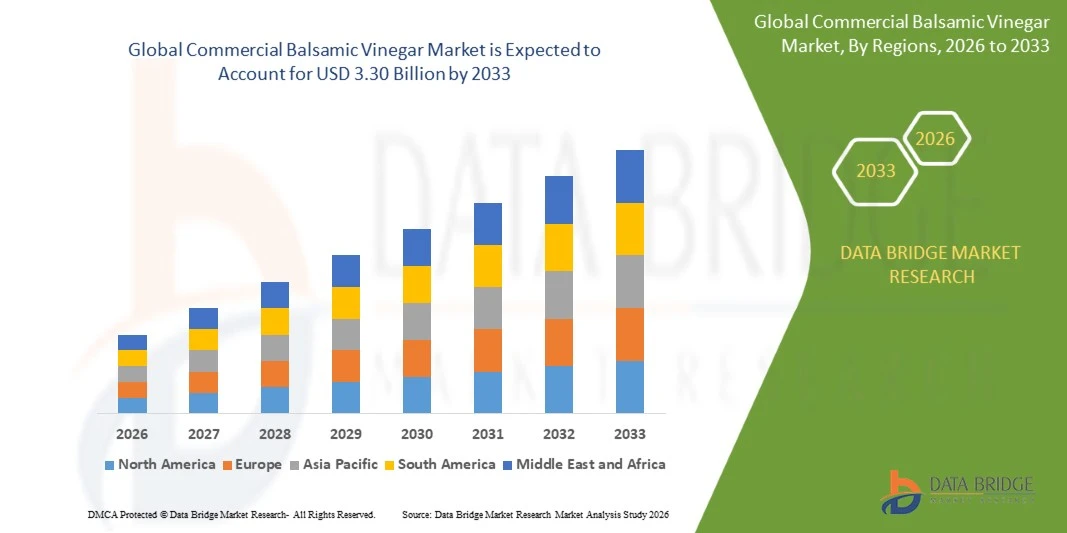
- As per Data Bridge Market Research analysis, the commercial balsamic vinegar market was valued at USD 2.61 billion in 2025 and is projected to reach USD 3.30 billion by 2033, growing at a CAGR of 3.00% from 2026 to 2033.
- The market is experiencing consistent growth driven by rising demand for premium and gourmet food ingredients, increasing popularity of Mediterranean cuisine, and expanding applications across foodservice, retail, and food processing industries.
- Growing consumer preference for natural condiments and clean-label ingredients, combined with the expansion of restaurants, hotels, and catering services, is encouraging commercial buyers to adopt balsamic vinegar in salad dressings, marinades, sauces, and glazes. Increasing demand for authentic Italian flavors, premium culinary products, and convenient food ingredients is further supporting market expansion.
Market Size & Forecast
- Global Market Value (2025): USD 2.61 Billion
- Expected Market Value (2033): USD 3.30 Billion
- Forecast CAGR (2026–2033): 3.00%
- Leading Region in 2025: North America
- Fastest Growing Region: Asia Pacific
What are the Major Takeaways of the Commercial Balsamic Vinegar Market?
- North America dominated the commercial balsamic vinegar market with the largest revenue share of 38.0% in 2025, supported by rising demand for premium food ingredients, expanding foodservice operations, and growing consumption of gourmet condiments.
- Asia-Pacific is expected to be the fastest-growing region at a CAGR of 4.2% from 2026 to 2033, fueled by rising disposable incomes, increasing exposure to international cuisines, and growing demand for specialty food products across China, India, and Japan.
- The dark balsamic vinegars segment led the market with a 62% share in 2025, driven by its widespread use in restaurants, food processing, and gourmet culinary applications.
- White balsamic vinegars are the fastest-growing product type, projected to register a CAGR of 4.0%, reflecting the surge in demand for lighter-colored condiments and versatile culinary ingredients.
- The commercial grade balsamic vinegar segment dominated the grade type category with a 48% revenue share in 2025, led by affordability, broad availability, and extensive use in foodservice and packaged food production.
- Conventional accounted for 78% of the market share in 2025, preferred by established manufacturing infrastructure, competitive pricing, and broad distribution.
- The marinades segment is the fastest-growing application category, with a CAGR of 4.3%, driven by increasing use of flavor-enhancing ingredients in meat, poultry, seafood, and vegetable preparations
Report Scope and Commercial Balsamic Vinegar Market Segmentation
|
Attributes |
Commercial Balsamic Vinegar Key Market Insights |
|
Segments Covered |
|
|
Countries Covered |
North America
Europe
Asia-Pacific
Middle East and Africa
South America
|
|
Key Market Players |
|
|
Market Opportunities |
|
|
Value Added Data Infosets |
In addition to the insights on market scenarios such as market value, growth rate, segmentation, geographical coverage, and major players, the market reports curated by the Data Bridge Market Research also include in-depth expert analysis, pricing analysis, brand share analysis, consumer survey, demography analysis, supply chain analysis, value chain analysis, raw material/consumables overview, vendor selection criteria, PESTLE Analysis, Porter Analysis, and regulatory framework. |
What is the Key Trend in the Commercial Balsamic Vinegar Market?
- Commercial balsamic vinegar manufacturers are increasingly focusing on premium product offerings, authentic Italian origin, and diversified formulations to meet the evolving requirements of restaurants, catering businesses, and gourmet food retailers.
- For instance, in September 2024, FoodNavigator reported that Italian vinegar producer Ponti introduced Chili Pepper Balsamic Glaze and explored cross-cultural flavors, including soy glaze with Balsamic Vinegar of Modena, reflecting the trend toward innovative flavors and diversified culinary applications.
- Product diversification enables suppliers to serve different culinary applications, including salad dressings, marinades, sauces, glazes, and premium food preparations.
- Foodservice suppliers are expanding product ranges to accommodate professional kitchens seeking consistent flavor, convenient formats, and dependable bulk availability.
- For instance, in June 2024, Giusti announced new balsamic-based products, including a truffle condiment and Organic 2 Gold Medals Balsamic Vinegar of Modena, alongside fruit-based sweet-and-sour condiments designed for salads, marinades, sauces, and other culinary uses, highlighting premiumization, organic offerings, and product diversification
- As demand for premium ingredients and authentic Italian flavors continues to expand, manufacturers are expected to emphasize product differentiation, international distribution, and specialized commercial packaging to strengthen market competitiveness.
What are the Key Drivers of the Commercial Balsamic Vinegar Market?
- The growing international demand for Italian specialty foods and premium condiments is significantly increasing commercial balsamic vinegar consumption across foodservice, retail, and food processing industries.
- For instance, in May 2026, the Consortium for the Protection of Balsamic Vinegar of Modena reported annual production of approximately 93–95 million liters, with more than 93% of production exported to over 130 countries. This demonstrates how international demand for Italian specialty foods and premium condiments supports commercial balsamic vinegar production and distribution.
- Restaurants, catering companies, and packaged food manufacturers are incorporating balsamic vinegar into dressings, marinades, sauces, and ready-to-eat meals to enhance flavor and diversify product offerings.
- For instance, in February 2024, Acetaia Giusti showcased its premium balsamic vinegar products at Gulfood 2024, emphasizing expansion into Middle Eastern hotel, restaurant, and catering (HoReCa) channels. This demonstrates how international food exhibitions and foodservice partnerships help manufacturers reach commercial buyers and expand export demand.
- As international food trade and demand for versatile culinary ingredients continue to expand, commercial manufacturers are expected to benefit from broader distribution networks, increased foodservice use, and wider applications in processed foods.
What Factors are Challenging the Growth of the Commercial Balsamic Vinegar Market?
- Commercial balsamic vinegar producers face challenges from fluctuating grape and wine vinegar input costs, strict authenticity requirements, and the need to maintain consistent product quality across large-scale production.
- For instance, in February 2024, a study published in Foods examined methods for detecting the dilution of high-density Balsamic Vinegar of Modena. The research highlighted the risk of adulteration through the addition of external water and the limitations of existing authenticity-testing methods, increasing the need for specialized quality-control procedures and raising compliance costs for producers.
- These challenges can increase procurement, quality-control, packaging, and compliance expenses, particularly for manufacturers supplying price-sensitive foodservice customers and large food processing companies.
- In addition, food safety and allergen-control issues involving prepared foods containing balsamic vinaigrette can create product recalls, reputational damage, and additional costs for commercial suppliers.
- For instance, in November 2024, the European Committee for Standardization published EN 16466-1:2024, a standard specifying isotopic analysis for verifying vinegar authenticity and identifying adulteration involving synthetic acetic acid or acids from non-permitted sources. Such testing and verification requirements can increase quality-assurance expenses for commercial vinegar manufacturers and exporters.
- Rising input costs, authenticity requirements, and food safety obligations continue to challenge commercial suppliers, making effective sourcing, quality assurance, and regulatory compliance essential for maintaining profitability and customer confidence.
How is the Commercial Balsamic Vinegar Market Segmented?
The commercial balsamic vinegar market is segmented on the basis of product type, grade, category, ageing, applications, and distribution channel.
- By Product Type
On the basis of product type, the commercial balsamic vinegar market is segmented into dark balsamic vinegars and white balsamic vinegars. The dark balsamic vinegars segment dominated the market with an estimated 62% share in 2025, owing to its widespread use in restaurants, food processing, and gourmet culinary applications. Its rich color, concentrated flavor, and balanced sweetness and acidity make it suitable for sauces, glazes, marinades, and dressings. Commercial kitchens value its versatility across traditional and contemporary recipes. Strong consumer recognition and established distribution networks further support demand. Increasing use in packaged foods and premium condiments continues to reinforce its market position.
The white balsamic vinegars segment is projected to register the fastest growth at an estimated CAGR of 4.0% from 2026 to 2033, driven by increasing demand for lighter-colored condiments and versatile culinary ingredients. Its mild flavor and lighter appearance make it suitable for seafood, poultry, vegetables, and fruit-based dishes. Restaurants use it to preserve the visual appeal of light-colored preparations. Growing interest in contemporary cuisine is encouraging its adoption in specialty dressings and sauces. Manufacturers are expanding product portfolios to meet evolving culinary preferences. Increasing use in premium foodservice applications is expected to support further growth.
- By Grade
On the basis of grade, the commercial balsamic vinegar market is segmented into traditional grade balsamic vinegar, commercial grade balsamic vinegar, and condiment grade balsamic vinegar. The commercial grade balsamic vinegar segment dominated the market with an estimated 48% share in 2025, supported by affordability, broad availability, and extensive use in foodservice and packaged food production. Restaurants, hotels, and catering businesses rely on this grade for regular, high-volume ingredient requirements. Its consistent flavor and cost-effectiveness support standardized recipes. Availability through wholesale suppliers simplifies procurement. It is widely used in dressings, marinades, sauces, and prepared foods. These characteristics strengthen its position among commercial buyers.
The traditional grade balsamic vinegar segment is projected to register the fastest growth at an estimated CAGR of 4.2% from 2026 to 2033, driven by rising demand for authentic, premium, and artisanal products. Traditional balsamic vinegar is produced through established methods involving concentrated grape must and extended wooden-barrel ageing. Its distinctive flavor profile appeals to gourmet restaurants and specialty food retailers. Protected geographical indications help communicate origin and authenticity. Premium culinary applications support higher-value positioning. Interest in traditional food craftsmanship is encouraging product differentiation. However, higher prices and longer production cycles may limit adoption in cost-sensitive commercial applications.
- By Category
On the basis of category, the commercial balsamic vinegar market is segmented into organic and conventional. The conventional segment dominated the market with an estimated 78% share in 2025, supported by established manufacturing infrastructure, competitive pricing, and broad distribution. Conventional products meet the requirements of restaurants, caterers, and food manufacturers purchasing vinegar in substantial volumes. Their availability through wholesalers and foodservice distributors facilitates procurement. Standardized production supports consistent flavor and quality. Conventional balsamic vinegar is widely used in dressings, sauces, marinades, and prepared meals. Its affordability and established supply chains continue to underpin demand.
The organic segment is projected to register the fastest growth at an estimated CAGR of 4.5% from 2026 to 2033, driven by increasing interest in certified organic ingredients and premium food products. Organic balsamic vinegar appeals to specialty restaurants, organic retailers, and premium food brands. Certified production practices can help differentiate products in competitive condiment markets. Growing interest in sustainable agriculture supports demand for organic ingredients. Manufacturers are expanding specialty product ranges to address changing purchasing preferences. Premium positioning may support higher selling prices. However, certification and production costs can restrict adoption among price-sensitive commercial buyers.
- By Ageing
On the basis of ageing, the commercial balsamic vinegar market is segmented into aged, semi-aged, and matured products. The matured segment is estimated to account for the largest share of 40% in 2025, supported by demand for concentrated flavor profiles and premium culinary characteristics. Maturation can improve the balance of sweetness, acidity, and aromatic complexity. These products are suitable for reductions, gourmet sauces, dressings, and finishing applications. Upscale restaurants and specialty food retailers value distinctive sensory qualities. Wooden-barrel ageing can contribute additional aromatic characteristics. Premium positioning supports their use in differentiated culinary offerings, although longer production cycles may increase costs.
The aged segment is projected to register the fastest growth at an estimated CAGR of 4.1% from 2026 to 2033, driven by increasing interest in premium condiments and products with deeper flavor characteristics. Ageing can develop a smoother taste and greater aromatic complexity. Commercial kitchens use aged balsamic vinegar in cheese pairings, roasted vegetables, meat preparations, and salad dressings. Gourmet dining trends encourage chefs to explore differentiated ingredients. Specialty food retailers can use ageing characteristics to distinguish premium products. Manufacturers can benefit from growing interest in artisanal food production. Adoption will depend on balancing perceived quality benefits against price and availability.
- By Applications
On the basis of applications, the commercial balsamic vinegar market is segmented into salad dressings, desserts, boiled vegetables, cheese, soups, marinades, fruits, lemonade, meat products, and others. The salad dressings segment is estimated to dominate the market with a 32% share in 2025, driven by widespread use in vinaigrettes, prepared salads, and commercial dressing formulations. Restaurants, hotels, and catering businesses use balsamic vinegar to create distinctive sweet-and-sour flavors. Packaged food manufacturers incorporate it into ready-to-use dressings and salad products. Its compatibility with olive oil, herbs, and mustard supports recipe versatility. Commercial buyers value its ability to enhance flavor without complex preparation. Established culinary applications continue to support consistent demand.
The marinades segment is projected to register the fastest growth at an estimated CAGR of 4.3% from 2026 to 2033, supported by increasing use of flavor-enhancing ingredients in meat, poultry, seafood, and vegetable preparations. Balsamic vinegar contributes acidity, sweetness, and aromatic complexity to marinades. Restaurants use it to diversify menus and develop signature dishes. Food manufacturers can incorporate it into ready-to-cook products and prepared meals. Demand for globally inspired flavors encourages experimentation with sweet-and-sour formulations. Its compatibility with herbs, spices, and oils supports product innovation. Wider use in commercial food preparation is expected to support segment expansion.
- By Distribution Channel
On the basis of distribution channel, the commercial balsamic vinegar market is segmented into store-based retailing and non-store retailing. The store-based retailing segment is estimated to dominate the market with a 65% share in 2025, supported by established supermarkets, hypermarkets, specialty food stores, and wholesale outlets. These channels enable buyers to compare brands, grades, and packaging formats. Wholesale outlets support regular procurement by restaurants and catering businesses. Physical availability facilitates product inspection and repeat purchasing. Established retail networks provide broad geographic coverage. Familiar purchasing arrangements continue to support adoption among commercial buyers and smaller foodservice operators.
The non-store retailing segment is projected to register the fastest growth at an estimated CAGR of 5.0% from 2026 to 2033, driven by increasing adoption of online procurement platforms and business-to-business marketplaces. Digital ordering enables commercial buyers to compare product specifications and supplier prices efficiently. Bulk purchasing and recurring orders can simplify inventory management. Online channels also improve access to imported, organic, artisanal, and specialty vinegar varieties. Manufacturers can reach geographically dispersed customers without relying exclusively on physical outlets. Improved digital purchasing convenience supports broader supplier access. Shipping costs, packaging requirements, and supplier reliability will remain important considerations.
Which Region Holds the Largest Share of the Commercial Balsamic Vinegar Market?
- North America dominated the commercial balsamic vinegar market with the largest revenue share of 38.0% in 2025, supported by rising demand for premium food ingredients, expanding foodservice operations, and growing consumption of gourmet condiments.
- The region also benefits from established supermarket and specialty food distribution networks, rising interest in Mediterranean cuisine, and increasing use of balsamic vinegar in salad dressings, marinades, sauces, and packaged foods. Growing demand for authentic Italian products, organic condiments, and premium culinary ingredients continues to support regional consumption across household and commercial applications
U.S. Commercial Balsamic Vinegar Market Insight
The U.S. commercial balsamic vinegar market is witnessing steady growth due to rising demand for premium condiments, gourmet food products, and versatile ingredients across foodservice and retail channels. The country’s established restaurant industry, expanding specialty food market, and increasing use of balsamic vinegar in salad dressings, marinades, sauces, and prepared meals are supporting market demand. In addition, growing consumer interest in Mediterranean cuisine, clean-label products, and distinctive flavor profiles is encouraging manufacturers to expand their commercial balsamic vinegar offerings.
Asia-Pacific Commercial Balsamic Vinegar Market Insight
The Asia-Pacific commercial balsamic vinegar market is expected to witness rapid growth, driven by urbanization, changing food preferences, and the expansion of foodservice and packaged-food industries across countries such as China, Japan, and India. Growing interest in international cuisines, premium sauces, and convenient meal solutions is supporting the adoption of balsamic vinegar in restaurants, hotels, and food-processing applications. In addition, expanding modern retail networks and e-commerce channels are improving product accessibility and supporting regional market growth.
Japan Commercial Balsamic Vinegar Market Insight
The Japan commercial balsamic vinegar market is witnessing consistent growth due to rising interest in international cuisines, premium condiments, and innovative food products. Restaurants, hotels, and food manufacturers are increasingly using balsamic vinegar in salad dressings, marinades, sauces, and fusion dishes to meet evolving consumer preferences. Moreover, the expansion of specialty food retailing, growing availability of imported products, and increasing adoption of Western culinary influences are further supporting market growth in Japan.
China Commercial Balsamic Vinegar Market Insight
The China commercial balsamic vinegar market is growing rapidly, driven by rising disposable incomes, urbanization, and increasing demand for imported premium food products. Growing adoption of Western-style dining, expanding restaurant and hospitality sectors, and rising interest in gourmet sauces are supporting balsamic vinegar consumption across commercial and retail applications. In addition, the expansion of e-commerce platforms and modern grocery channels is improving product accessibility, positioning China as a key growth market for commercial balsamic vinegar.
U.K. Commercial Balsamic Vinegar Market Insight
The U.K. commercial balsamic vinegar market is experiencing steady growth, supported by demand for premium condiments and the widespread use of international ingredients in foodservice and home cooking. Restaurants, cafés, and food manufacturers are incorporating balsamic vinegar into dressings, marinades, sauces, and prepared meals to deliver distinctive flavors. Furthermore, growing interest in Mediterranean cuisine, expanding specialty food retail, and increasing availability through online grocery channels are contributing to market growth in the U.K.
Germany Commercial Balsamic Vinegar Market Insight
The Germany commercial balsamic vinegar market is expanding steadily due to demand for high-quality condiments, diverse culinary products, and convenient food ingredients. Foodservice operators, retailers, and food manufacturers are using balsamic vinegar in salad dressings, sauces, marinades, and prepared foods to meet changing consumer tastes. In addition, the country’s established grocery distribution network, interest in Mediterranean cuisine, and availability of imported and specialty vinegar products are supporting continued market development in Germany.
Which are the Top Companies in Commercial Balsamic Vinegar Market?
The commercial balsamic vinegar industry is primarily led by well-established companies, including:
- Acetum S.p.A. Benefit company (Italy)
- De Nigris (Italy)
- ORTALLI S.R.L. a s.u. (Italy)
- Monari Federzoni SpA (Italy)
- Acetaia Giusti S.r.l. (Italy)
- Acetaia Malpighi (Italy)
- Mengazzoli (Italy)
- Acetaia Due Vittorie (Italy)
- Acetificio Carandini Emilio SPA (Italy)
- Acetaia Leonardi (Italy)
- Ponti S.p.A. (Italy)
- Mazzetti l’Originale (Italy)
- Fini (Italy)
- Antica Modena (Italy)
- Balsamico Village Srl (Italy)
- Acetaia Marchi (Italy)
- Acetaia Cavedoni (Italy)
- Acetaia Reale (Italy)
- Acetaia Valeri di Giacobazzi Valerio (Italy)
- Azienda Agricola Sereni Pier Luigi (Italy)
What are Latest Developments in Commercial Balsamic Vinegar Market?
- In November 2025, Carandini expanded the U.S. availability of its gourmet glazes, announcing that its full range of products was available to American consumers. The range includes glaze made with Balsamic Vinegar of Modena, offering a versatile sweet-and-savory condiment for everyday cooking. The expansion strengthened Carandini’s commercial presence in the U.S. and reflected the growing product diversification of balsamic vinegar beyond traditional bottled vinegar.
- In June 2024, Giusti announced three new condiment additions for presentation at the Summer Fancy Food Show 2024: a range of sweet-and-sour fruit condiments, a gourmet condiment combining balsamic vinegar and truffle, and an organic two-gold-medal Balsamic Vinegar of Modena. The new offerings expanded the brand’s portfolio across fruit-infused, truffle-flavored, and organic products, targeting applications ranging from salads and marinades to sauces and specialty dishes.
- In September 2023, Acetaia Giusti opened its first international boutique in Seoul, South Korea, at Lotte Department Store. The new location offered consumers access to the company’s balsamic vinegar collection and gourmet condiments while introducing them to the heritage and production traditions associated with Modena. The expansion represented a step in Giusti’s international commercial development and strengthened its direct engagement with consumers in the Asian market
- In August 2022, Carandini launched its Organic Silver Leaf Balsamic Vinegar of Modena PGI nationwide in the U.S. The product combined organic grape must and organic wine vinegar and was developed for versatile use in salads, vegetables, meat, fish, and vinaigrettes. The launch expanded the availability of certified organic balsamic vinegar through national retailers, highlighting product innovation and growing differentiation within the commercial condiment category.
- In August 2021, the Consortium of Balsamic Vinegar of Modena announced the first Original Balsamic Weeks in the U.S., with events planned in New York and San Francisco. The initiative involved restaurant partners serving balsamic vinegar in different culinary applications and educating diners about the product’s history, characteristics, and authenticity. The campaign aimed to increase consumer awareness and strengthen the positioning of authentic Balsamic Vinegar of Modena in the U.S. foodservice and specialty
- Interactive Data Analysis Dashboard
- Company Analysis Dashboard for high growth potential opportunities
- Research Analyst Access for customization & queries
- Competitor Analysis with Interactive dashboard
- Latest News, Updates & Trend analysis
- Harness the Power of Benchmark Analysis for Comprehensive Competitor Tracking
Global Commercial Balsamic Vinegar Market, Supply Chain Analysis and Ecosystem Framework
To support market growth and help clients navigate the impact of geopolitical shifts, DBMR has integrated in-depth supply chain analysis into its Global Commercial Balsamic Vinegar Market research reports. This addition empowers clients to respond effectively to global changes affecting their industries. The supply chain analysis section includes detailed insights such as Global Commercial Balsamic Vinegar Market consumption and production by country, price trend analysis, the impact of tariffs and geopolitical developments, and import and export trends by country and HSN code. It also highlights major suppliers with data on production capacity and company profiles, as well as key importers and exporters. In addition to research, DBMR offers specialized supply chain consulting services backed by over a decade of experience, providing solutions like supplier discovery, supplier risk assessment, price trend analysis, impact evaluation of inflation and trade route changes, and comprehensive market trend analysis.
Data collection and base year analysis are done using data collection modules with large sample sizes. The stage includes obtaining market information or related data through various sources and strategies. It includes examining and planning all the data acquired from the past in advance. It likewise envelops the examination of information inconsistencies seen across different information sources. The market data is analysed and estimated using market statistical and coherent models. Also, market share analysis and key trend analysis are the major success factors in the market report. To know more, please request an analyst call or drop down your inquiry.
The key research methodology used by DBMR research team is data triangulation which involves data mining, analysis of the impact of data variables on the market and primary (industry expert) validation. Data models include Vendor Positioning Grid, Market Time Line Analysis, Market Overview and Guide, Company Positioning Grid, Patent Analysis, Pricing Analysis, Company Market Share Analysis, Standards of Measurement, Global versus Regional and Vendor Share Analysis. To know more about the research methodology, drop in an inquiry to speak to our industry experts.
Data Bridge Market Research is a leader in advanced formative research. We take pride in servicing our existing and new customers with data and analysis that match and suits their goal. The report can be customized to include price trend analysis of target brands understanding the market for additional countries (ask for the list of countries), clinical trial results data, literature review, refurbished market and product base analysis. Market analysis of target competitors can be analyzed from technology-based analysis to market portfolio strategies. We can add as many competitors that you require data about in the format and data style you are looking for. Our team of analysts can also provide you data in crude raw excel files pivot tables (Fact book) or can assist you in creating presentations from the data sets available in the report.