


What is the Computer-Aided Dispatch (CAD) Market Size and Growth Rate?
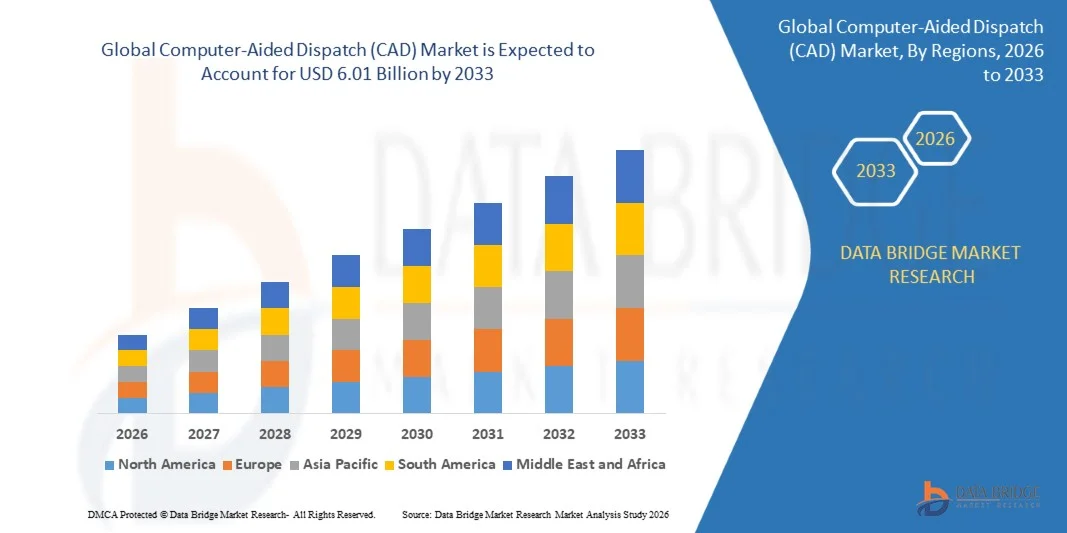
- As per Data Bridge Market Research analysis, the computer-aided dispatch (CAD) market was valued at USD 2.50 billion in 2025 and is projected to reach USD 6.01 billion by 2033, growing at a CAGR of 11.60% from 2026 to 2033.
- The market is experiencing consistent growth driven by rising demand for real-time emergency response and incident management, modernization of public safety communication infrastructure, and increasing adoption of cloud-based CAD solutions across public safety, government, transportation, utilities, and healthcare sectors.
- The increasing need for faster emergency response and coordinated resource allocation, combined with growing investments in GIS, AI-enabled analytics, and digital public safety infrastructure, is compelling emergency services, law enforcement agencies, transportation organizations, and government bodies to adopt advanced CAD platforms. Cloud-based and integrated CAD systems are increasingly replacing fragmented dispatch processes by providing real-time information sharing, automated resource allocation, and scalable emergency response capabilities.
Market Size & Forecast
- Global Market Value (2025): USD 2.50 Billion
- Expected Market Value (2033): USD 6.01 Billion
- Forecast CAGR (2026–2033): 11.60%
- Leading Region in 2025: North America
- Fastest Growing Region: Asia Pacific
What are the Major Takeaways of the Computer-Aided Dispatch (CAD) Market?
- North America dominated the computer-aided dispatch (CAD) market with the largest revenue share of 41.4% in 2025, supported by advanced public safety infrastructure, strong government investments, and widespread adoption of next-generation emergency communication technologies
- Asia-Pacific is expected to be the fastest-growing region at a CAGR of 13.3% from 2026 to 2033, fueled by rapid urbanization, smart-city investments, and modernization of emergency response systems across China, India, Japan, and South Korea.
- The software segment led the market with a 64.2% share in 2025, driven by widespread adoption of CAD platforms across law enforcement, fire and rescue, EMS, and other emergency-response organizations.
- Services are the fastest-growing component type, projected to register a CAGR of 14.1%, reflecting the surge in demand for implementation, system integration, customization, training, maintenance, and technical support.
- The on-premises segment dominated the deployment category with a 55% revenue share in 2025, led by continued preference among large public safety organizations for direct control over sensitive emergency-response data and mission-critical infrastructure.
- Law enforcement accounted for 34.2% of the market share in 2025, preferred by extensive CAD deployment across police departments and law enforcement agencies.
- The emergency medical services (EMS) segment is the fastest-growing application category, with a CAGR of 14.8%, driven by increasing demand for rapid ambulance dispatch, emergency call prioritization, and coordinated healthcare response.
Report Scope and Computer-Aided Dispatch (CAD) Market Segmentation
|
Attributes |
Computer-Aided Dispatch (CAD) Key Market Insights |
|
Segments Covered |
|
|
Countries Covered |
North America
Europe
Asia-Pacific
Middle East and Africa
South America
|
|
Key Market Players |
|
|
Market Opportunities |
|
|
Value Added Data Infosets |
In addition to the market insights such as market value, growth rate, market segments, geographical coverage, market players, and market scenario, the market report curated by the Data Bridge Market Research team includes in-depth expert analysis, import/export analysis, pricing analysis, production consumption analysis, and pestle analysis. |
What is the Key Trend in the Computer-Aided Dispatch (CAD) Market?
- Public safety agencies are increasingly adopting cloud-native and AI-enabled CAD platforms to unify emergency calls, responder information, GIS data, and incident workflows, improving situational awareness and enabling faster, more coordinated dispatch operations.
- For instance, in April 2025, Sunnyvale, California selected Hexagon’s HxGN OnCall Dispatch and mobile field applications to modernize emergency dispatching, improve response times, and provide scalable capabilities for future population growth.
- Real-time integration of caller information, responder locations, incident data, and communications enables dispatchers to make faster decisions while improving coordination between police, fire, and emergency medical teams.
- Public safety agencies are also increasingly integrating CAD with Next Generation 911 (NG911), cloud infrastructure, GIS, and mobile responder technologies to support data-rich emergency communications and seamless information exchange across jurisdictions.
- For instance, in May 2024, CentralSquare launched cloud-based Pro CAD and its Vertex NG911 Call Handling solution, providing dispatchers with cloud-based tools to manage NG911 communications and coordinate emergency resources.
- As emergency communications centers continue to modernize legacy infrastructure and demand real-time, interoperable information, the adoption of cloud-based, AI-enabled, and integrated CAD platforms is expected to accelerate, reinforcing CAD as a core component of next-generation public safety operations.
What are the Key Drivers of the Computer-Aided Dispatch (CAD) Market?
- The rapid modernization of Next Generation 911 (NG911) infrastructure and emergency communications networks has significantly increased demand for CAD platforms capable of processing richer data, integrating multiple communication channels, and sharing incident information with responders in real time.
- For instance, in February 2025, the U.S. National 911 Program highlighted AI-based non-emergency call diversion in Arlington County, demonstrating how machine learning can reduce telecommunicator workloads and improve emergency communications efficiency.
- Public safety agencies, municipalities, and emergency communications centers are integrating CAD with GIS, mobile data, IoT, automated location information, and records-management systems to improve resource allocation, reduce dispatch delays, and strengthen situational awareness.
- For instance, in September 2024, the City of Oakland modernized its police, fire, and EMS dispatch operations with Motorola Solutions’ PremierOne CAD, enabling dispatchers to assign resources and manage incidents as they evolved in real time.
- With emergency agencies increasingly prioritizing faster response, data-driven decision-making, and interoperable communications, CAD systems will remain indispensable for modernizing public safety operations and improving coordination between dispatch centers and field responders.
Which Factors are Challenging the Growth of the Computer-Aided Dispatch (CAD) Market?
- Advanced CAD platforms require significant investment in software modernization, system integration, cybersecurity, infrastructure, training, and ongoing maintenance, creating financial and operational challenges for smaller municipalities and public safety agencies.
- For instance, in July 2024, the City of Worcester received a USD 3.2 million State 911 grant specifically to purchase and implement a new CAD and records-management system, highlighting the substantial funding required for CAD modernization.
- These costs can restrict adoption among agencies operating with limited technology budgets, particularly when legacy CAD, records-management, radio, GIS, and emergency communication systems must be upgraded or integrated simultaneously.
- Interoperability between disparate CAD platforms remains another major challenge because different vendors use varying data structures, workflows, and standards, complicating information sharing across jurisdictions and limiting seamless coordination during multi-agency emergencies.
- Cybersecurity and data privacy risks are also challenging CAD adoption because these platforms process sensitive caller information, responder locations, incident records, and other mission-critical data that require strong protection against unauthorized access and cyberattacks.
- For instance, in March 2025, the U.S. Cybersecurity and Infrastructure Security Agency (CISA) highlighted the increasing cybersecurity risks facing emergency communications systems and recommended stronger identity management, network segmentation, and resilience measures for public safety organizations
- Legacy-system integration and workforce training requirements can further slow CAD deployment because agencies must migrate historical data, integrate existing dispatch and communications infrastructure, and train telecommunicators without disrupting continuous emergency operations.
How is the Computer-Aided Dispatch (CAD) Market Segmented?
The computer-aided dispatch (CAD) market is segmented on the basis of component, deployment, application, and industry vertical.
- By Component
On the basis of component, the computer-aided dispatch market is segmented into software, services, and hardware. The software segment dominated the market with 64.2% share in 2025, owing to the widespread adoption of CAD platforms across law enforcement, fire and rescue, EMS, and other emergency-response organizations. CAD software provides core capabilities such as incident creation, call prioritization, resource allocation, GIS mapping, and real-time information sharing. Increasing integration with mobile responder applications and communication systems is strengthening demand for advanced CAD software. Public safety organizations are also modernizing legacy dispatch infrastructure, creating additional demand for integrated software platforms. Growing adoption of cloud-based CAD and AI-enabled decision-support capabilities is further expanding software functionality.
The services segment is projected to register the fastest growth at a CAGR of 14.1% during forecast period, driven by increasing demand for implementation, system integration, customization, training, maintenance, and technical support. CAD deployments frequently require integration with existing 911, radio, GIS, records-management, and mobile systems. Service providers therefore play an important role in ensuring interoperability and minimizing operational disruption during system migration. The transition from legacy infrastructure to cloud-based environments is further increasing demand for implementation and managed services. Public safety agencies also require continuous maintenance, upgrades, cybersecurity support, and system optimization after deployment. Increasing investments in CAD modernization are creating additional opportunities for professional service providers.
- By Deployment
On the basis of deployment, the computer-aided dispatch market is segmented into on-premises, cloud-based, and hybrid. The on-premises segment dominated the market with 55% share in 2025, supported by continued preference among large public safety organizations for direct control over sensitive emergency-response data and mission-critical infrastructure. Many established agencies have already invested substantially in local servers, data centers, and legacy CAD environments. On-premises systems can provide organizations with greater control over data storage, security policies, system configuration, and network performance. They remain particularly relevant for agencies with stringent security and operational requirements. Existing infrastructure investments and lengthy procurement cycles can also delay migration to cloud platforms.
The cloud-based segment is projected to register the fastest growth at a CAGR of 15.6% during forecast period, driven by increasing demand for scalable, flexible, and remotely accessible dispatch infrastructure. Cloud CAD reduces the need for agencies to maintain extensive local server infrastructure while enabling centralized system management and faster software updates. Smaller public safety organizations can benefit from subscription-based models that reduce infrastructure requirements and simplify deployment. Cloud platforms also support disaster recovery, remote access, and real-time information sharing across geographically distributed teams. Integration with AI, GIS, mobile applications, and analytics is further encouraging the shift toward cloud-native CAD architectures.
- By Application
On the basis of application, the computer-aided dispatch market is segmented into law enforcement, fire and rescue, emergency medical services (EMS), transportation, utilities, government and defense, and others. The law enforcement segment dominated the market with 34.2% share in 2025, supported by extensive CAD deployment across police departments and law enforcement agencies. CAD systems enable dispatchers to receive emergency calls, prioritize incidents, identify appropriate units, and monitor field resources in real time. Integration with records-management systems, mobile data terminals, GIS, and officer-location technologies is further increasing CAD functionality. Rising urban populations and increasingly complex public safety requirements are creating greater demand for coordinated police response. Law enforcement organizations are also adopting analytics and real-time information capabilities to improve operational awareness.
The emergency medical services (EMS) segment is projected to register the fastest growth at a CAGR of 14.8% during forecast period, driven by increasing demand for rapid ambulance dispatch, emergency call prioritization, and coordinated healthcare response. CAD platforms help EMS organizations identify available ambulances, determine responder locations, prioritize incidents, and coordinate with hospitals. Integration with GPS, mobile applications, hospital systems, and real-time location technologies is improving emergency medical operations. Increasing emergency call volumes are also encouraging healthcare and EMS organizations to optimize ambulance utilization. Cloud-based CAD platforms can facilitate information sharing between dispatch centers, ambulance crews, and receiving healthcare facilities. As emergency healthcare providers increasingly focus on response efficiency and connected operations,
- By Industry Vertical
On the basis of industry vertical, the computer-aided dispatch market is segmented into public safety, government and defense, transportation, power and utilities, healthcare, and others. The public safety segment dominated the market with 38.7% share in 2025, supported by extensive CAD deployment among law enforcement agencies, fire departments, EMS organizations, and public safety answering points. Public safety organizations use CAD to manage emergency calls, prioritize incidents, dispatch appropriate resources, and maintain real-time situational awareness. Increasing modernization of emergency communication infrastructure and Next Generation 911 systems is strengthening demand. Integration with GIS, mobile responder applications, communication networks, and analytics is further expanding CAD capabilities. The need for faster, more coordinated emergency response continues to support adoption across public safety organizations.
The healthcare segment is projected to register the fastest growth at a CAGR of 15.92% during forecast period, driven by increasing demand for efficient emergency medical dispatch, ambulance coordination, and connected healthcare response systems. Healthcare organizations are increasingly using CAD to manage emergency calls, allocate ambulances, coordinate field personnel, and improve communication with hospitals. Integration with real-time location technologies enables dispatch centers to identify nearby available emergency resources more efficiently. Growing emergency healthcare requirements are also encouraging hospitals and healthcare networks to modernize dispatch infrastructure. Cloud-based and interoperable platforms are making it easier to connect ambulance services with healthcare facilities and emergency agencies. Increasing focus on rapid response and coordinated patient-care pathways is expected to support strong CAD adoption within healthcare.
Which Region Holds the Largest Share of the Computer-Aided Dispatch (CAD) Market?
- North America dominated the computer-aided dispatch (CAD) market with the largest revenue share of 41.4% in 2025, supported by advanced public safety infrastructure, strong government investments, and widespread adoption of next-generation emergency communication technologies
- The region also benefits from extensive deployment of Next Generation 911 (NG911) infrastructure, increasing adoption of cloud-based dispatch platforms, and the presence of established CAD technology providers. Growing demand for real-time incident management, GIS integration, and interoperable emergency communications continues to strengthen North America’s leadership position in the global market.
U.S. Computer-Aided Dispatch (CAD) Market Insight
The U.S. computer-aided dispatch (CAD) market is witnessing strong growth due to rising investments in public safety modernization, Next Generation 911 infrastructure, and advanced emergency communication technologies. The country’s mature law enforcement, fire, and emergency medical services ecosystem, along with increasing adoption of cloud-based, AI-enabled, and GIS-integrated CAD systems, is driving demand across public safety agencies and government organizations. In addition, growing emphasis on faster emergency response, interoperability, and real-time incident management is accelerating CAD adoption across emergency communications centers.
Asia-Pacific Computer-Aided Dispatch (CAD) Market Insight
The Asia-Pacific computer-aided dispatch (CAD) market is expected to witness rapid growth, driven by increasing urbanization, expanding smart-city infrastructure, and rising investments in emergency response systems across countries such as China, India, Japan, and South Korea. Growing awareness regarding public safety, rising adoption of cloud-based dispatch technologies, and increasing demand for scalable emergency communication solutions are supporting regional market expansion. In addition, the growing development of digital government infrastructure and modernization of police, fire, and emergency medical services is accelerating CAD adoption across the region.
Japan Computer-Aided Dispatch (CAD) Market Insight
The Japan computer-aided dispatch (CAD) market is witnessing consistent growth due to rising investments in advanced emergency communication technologies, disaster-response infrastructure, and public safety modernization. Police, fire departments, emergency medical services, and government organizations are increasingly adopting integrated CAD platforms for incident management, resource allocation, and real-time coordination. Moreover, increasing integration of GIS, cloud computing, and AI-enabled analytics, along with Japan’s focus on efficient disaster and emergency response, is further contributing to market growth.
China Computer-Aided Dispatch (CAD) Market Insight
The China computer-aided dispatch (CAD) market is growing rapidly, driven by increasing urbanization, expanding smart-city infrastructure, and rising government focus on public safety and emergency response modernization. Growing adoption of cloud-based, AI-enabled, and GIS-integrated CAD platforms across law enforcement, fire, emergency medical, and transportation sectors is significantly boosting market demand. In addition, rising investments in digital government infrastructure, increasing emergency-response requirements, and rapid development of intelligent public safety technologies are positioning China as one of the fastest-growing markets for computer-aided dispatch solutions globally.
U.K. Computer-Aided Dispatch (CAD) Market Insight
The U.K. computer-aided dispatch (CAD) market is experiencing steady growth, supported by rising adoption of digital emergency communication technologies across police, fire, ambulance, and other public safety organizations. Increasing investments in modern dispatch infrastructure and growing demand for integrated, interoperable, and real-time emergency response solutions are contributing to market growth. Furthermore, integration of cloud computing, GIS, AI, and advanced data analytics technologies is improving dispatch efficiency and situational awareness, positioning the U.K. as a key market for next-generation public safety systems.
Germany Computer-Aided Dispatch (CAD) Market Insight
The Germany computer-aided dispatch (CAD) market is expanding steadily due to the country’s strong public safety infrastructure, advanced digital capabilities, and increasing adoption of next-generation emergency communication technologies. Police, fire departments, emergency medical organizations, and government agencies are increasingly utilizing CAD platforms for incident management, resource allocation, and coordinated emergency response. Continuous advancements in cloud-based systems, AI integration, GIS technologies, and interoperable communications, along with strong government focus on public safety modernization and digitalization, are further driving market growth in Germany.
Which are the Top Companies in Computer-Aided Dispatch (CAD) Market?
The computer-aided dispatch (CAD) industry is primarily led by well-established companies, including:
- Motorola Solutions, Inc. (U.S.)
- CentralSquare Technologies, LLC. (U.S.)
- Tyler Technologies, Inc. (U.S.)
- Hexagon AB (Sweden)
- Mark43, Inc. (U.S.)
- Carbyne Ltd. (U.S.)
- Versaterm Inc. (Canada)
- NICE Ltd. (Israel)
- Zetron, Inc. (U.S.)
- ZOLL Medical Corporation (U.S.)
- ESO Solutions, Inc. (U.S.)
- Priority Dispatch Corp. (U.S.)
- Caliber Public Safety (U.S.)
- GINA Software (Czech Republic)
- SmartCOP, Inc. (U.S.)
- Axon Enterprise, Inc. (U.S.)
- RapidSOS, Inc. (U.S.)
- Prepared, Inc. (U.S.)
- 10-8 Systems, LLC (U.S.)
- CODY Systems (U.S.)
What are Latest Developments in Computer-Aided Dispatch (CAD) Market?
- In April 2025, Hexagon announced that public safety agencies in Erie County, New York, selected its cloud-based HxGN OnCall Dispatch, analytics, and records-management systems to modernize emergency response across more than 100 agencies. The deployment will bring 20 emergency communications centers onto one CAD platform, supporting law enforcement, fire, and EMS operations across the county.
- In May 2024, CentralSquare launched its Pro Computer Aided Dispatch (CAD) solution in the cloud along with CentralSquare Vertex NG911 Call Handling, introducing cloud-based capabilities for emergency communications centers. The new platform includes features such as real-time call transcription, multilingual text translation, automatic call distribution, and improved resource prioritization to support faster emergency response.
- In September 2024, Motorola Solutions announced the launch of its new PremierOne CAD system for the City of Oakland, strengthening dispatch operations for police, fire, and EMS. The system provides a modern platform for rapid assignment of resources and improved coordination between dispatchers and emergency responders
- In March 2023, Motorola Solutions announced that Peel Regional Police had integrated its PremierOne CAD system to strengthen officer safety and emergency-response coordination for the Peel region. The CAD platform enables real-time communication between dispatchers and field personnel and improves collaboration among public safety agencies.
- In August 2021, Accenture announced the launch of the new FireCAD system for the Fire Department of New York City (FDNY), supporting the dispatch and response of firefighters to fires and other public-safety incidents across New York City. The system became a core technology platform supporting FDNY’s emergency operations and response activities.

- Interactive Data Analysis Dashboard
- Company Analysis Dashboard for high growth potential opportunities
- Research Analyst Access for customization & queries
- Competitor Analysis with Interactive dashboard
- Latest News, Updates & Trend analysis
- Harness the Power of Benchmark Analysis for Comprehensive Competitor Tracking
Data collection and base year analysis are done using data collection modules with large sample sizes. The stage includes obtaining market information or related data through various sources and strategies. It includes examining and planning all the data acquired from the past in advance. It likewise envelops the examination of information inconsistencies seen across different information sources. The market data is analysed and estimated using market statistical and coherent models. Also, market share analysis and key trend analysis are the major success factors in the market report. To know more, please request an analyst call or drop down your inquiry.
The key research methodology used by DBMR research team is data triangulation which involves data mining, analysis of the impact of data variables on the market and primary (industry expert) validation. Data models include Vendor Positioning Grid, Market Time Line Analysis, Market Overview and Guide, Company Positioning Grid, Patent Analysis, Pricing Analysis, Company Market Share Analysis, Standards of Measurement, Global versus Regional and Vendor Share Analysis. To know more about the research methodology, drop in an inquiry to speak to our industry experts.
Data Bridge Market Research is a leader in advanced formative research. We take pride in servicing our existing and new customers with data and analysis that match and suits their goal. The report can be customized to include price trend analysis of target brands understanding the market for additional countries (ask for the list of countries), clinical trial results data, literature review, refurbished market and product base analysis. Market analysis of target competitors can be analyzed from technology-based analysis to market portfolio strategies. We can add as many competitors that you require data about in the format and data style you are looking for. Our team of analysts can also provide you data in crude raw excel files pivot tables (Fact book) or can assist you in creating presentations from the data sets available in the report.













