


Emergency Medical Services (EMS) Market Size
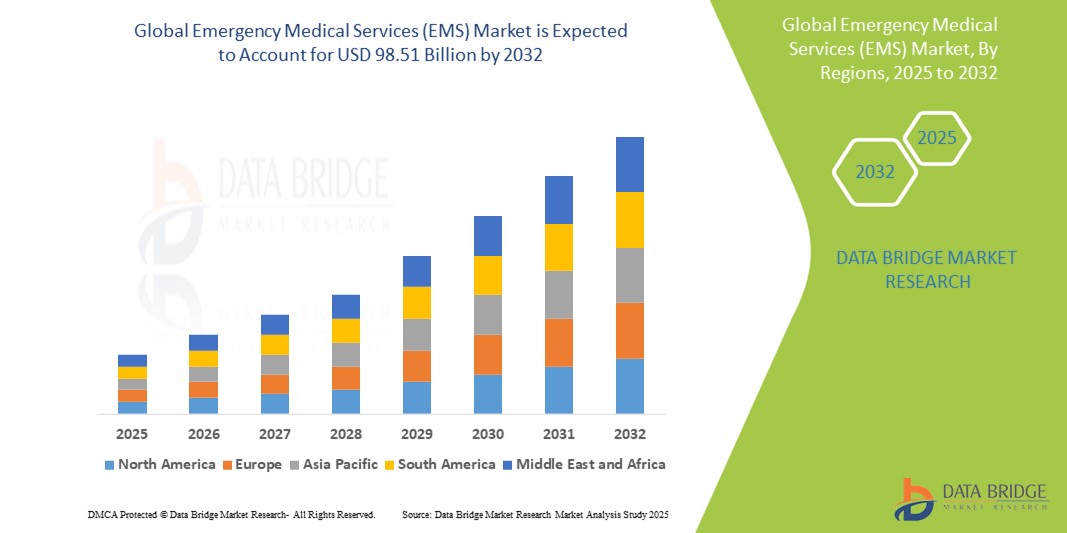
- The global emergency medical services (EMS) market size was valued at USD 50.54 billion in 2024 and is expected to reach USD 98.51 billion by 2032, at a CAGR of 8.70% during the forecast period
- The market growth is largely fuelled by the increasing prevalence of chronic diseases, a globally aging population, and a rising incidence of accidents and trauma, leading to heightened demand for immediate medical assistance
- Furthermore, rising consumer demand for advanced medical technologies, including telemedicine integration, improved diagnostic tools, and portable medical equipment, is establishing EMS solutions as a critical component of modern healthcare. These converging factors are accelerating the uptake of emergency medical services (EMS) solutions, thereby significantly boosting the industry's growth
Emergency Medical Services (EMS) Market Analysis
- Emergency Medical Services (EMS), also known as ambulatory services, involve the acute care of patients and provide urgent medical care and transportation in emergencies. The primary focus of EMS is on attending to patients with injuries and emergency illnesses, such as chronic diseases, stroke, cardiac arrest, and accidents, offering vital immediate medical attention and transportation to healthcare facilities
- The escalating demand for EMS is primarily fuelled by the increasing prevalence of chronic diseases, a globally aging population, and a rising incidence of accidents and trauma. Furthermore, technological advancements in pre-hospital care, including telemedicine integration, improved diagnostic tools, and portable medical equipment, are establishing EMS solutions as a critical component of modern healthcare. These converging factors are accelerating the uptake of EMS solutions, thereby significantly boosting the industry's growth
- North America dominated the emergency medical services (EMS) market with a largest revenue share of 56.17% in 2024. This dominance is characterized by advanced healthcare infrastructure, high disposable incomes, and a strong presence of key industry players
- Asia-Pacific is expected to be the fastest-growing region in the emergency medical services (EMS) market during the forecast period with a CAGR of 7.2%. This growth is attributed to increasing urbanization, rising disposable incomes, a large and growing population, increasing awareness of emergency medical care, and significant government initiatives and investments in improving healthcare infrastructure across the region
- Life support & emergency resuscitation equipment dominated the emergency medical services (EMS) market in 2024, accounting for 32.5% of the total market share. This dominance is driven by the critical need for immediate life-saving interventions in various emergency scenarios, requiring sophisticated equipment and highly trained personnel
Report Scope and Emergency Medical Services (EMS) Market Segmentation
|
Attributes |
Emergency Medical Services (EMS) Key Market Insights |
|
Segments Covered |
|
|
Countries Covered |
North America
Europe
Asia-Pacific
Middle East and Africa
South America
|
|
Key Market Players |
|
|
Market Opportunities |
|
|
Value Added Data Infosets |
In addition to the insights on market scenarios such as market value, growth rate, segmentation, geographical coverage, and major players, the market reports curated by the Data Bridge Market Research also include in-depth expert analysis, pricing analysis, brand share analysis, consumer survey, demography analysis, supply chain analysis, value chain analysis, raw material/consumables overview, vendor selection criteria, PESTLE Analysis, Porter Analysis, and regulatory framework. |
Emergency Medical Services (EMS) Market Trends
“Technological Advancements and Seamless Integration”
- A significant and accelerating trend in the global emergency medical services (EMS) market is the deepening integration of advanced technologies, including artificial intelligence (AI) and seamless connectivity with broader healthcare ecosystems. This fusion of technologies is significantly enhancing the efficiency, speed, and accuracy of EMS responses and patient care
- For instance, advanced dispatch systems leveraging AI can optimize ambulance routing based on real-time traffic and incident data, ensuring faster arrival times. Similarly, portable diagnostic devices and remote patient monitoring systems can seamlessly transmit vital patient data to hospitals while en route, allowing for pre-arrival preparation and more informed decision-making
- AI integration in EMS enables features such as predictive analytics for identifying potential emergency hotspots, optimizing resource allocation, and assisting paramedics with on-scene diagnoses. For instance, some advanced EMS platforms utilize AI to analyze patient symptoms and medical history to suggest appropriate protocols or predict potential complications. Furthermore, seamless communication capabilities offer EMS personnel the ease of real-time consultation with specialists, allowing them to provide higher-quality care in the field
- The seamless integration of EMS systems with hospital networks, electronic health records (EHRs), and other healthcare platforms facilitates centralized control and a holistic view of patient information. Through a single interface, EMS providers can access patient history, manage interventions, and seamlessly transfer care details to receiving facilities, creating a unified and streamlined healthcare experience
- This trend towards more intelligent, intuitive, and interconnected emergency medical systems is fundamentally reshaping expectations for pre-hospital care. Consequently, companies are developing AI-enabled EMS solutions with features such as automated incident reporting, real-time vital sign monitoring, and enhanced communication capabilities with hospital systems
- The demand for EMS solutions that offer seamless technological integration and advanced data analytics is growing rapidly across both urban and rural settings, as healthcare providers increasingly prioritize efficiency, accuracy, and comprehensive patient care
Emergency Medical Services (EMS) Market Dynamics
Driver
“Growing Need Due to Rising Health Concerns and Technological Integration”
- The increasing prevalence of chronic diseases, a globally aging population, and a rising incidence of accidents and trauma, coupled with the accelerating integration of advanced medical technologies, are significant drivers for the heightened demand for emergency medical services (EMS)
- For instance, the continuous advancements in pre-hospital care technologies, such as portable diagnostic devices, telemedicine platforms, and smart monitoring solutions, are enhancing the capabilities and reach of EMS. Such innovations by key companies are expected to drive the EMS industry growth in the forecast period
- As healthcare providers and patients become more aware of the critical need for rapid and effective medical intervention in emergencies, EMS offers advanced capabilities such as real-time vital sign monitoring, immediate resuscitation, and efficient transportation to healthcare facilities, providing a compelling alternative to delayed hospital visits for acute conditions.
- Furthermore, the growing popularity of integrated healthcare systems and the desire for seamless patient care pathways are making EMS an integral component of these systems, offering smooth transitions of patient data and care coordination with hospitals and other medical facilities
- The convenience of immediate medical attention at the scene, rapid transport to appropriate medical centers, and the ability to initiate life-saving treatments on-site are key factors propelling the adoption of EMS in both urban and rural sectors. The increasing awareness about the "golden hour" in emergency medicine and the growing investment in public health infrastructure further contribute to market growth
Restraint/Challenge
“Concerns Regarding Data Security and High Operational Costs”
- Concerns surrounding the data security vulnerabilities of connected medical devices and patient information, including those used in EMS, pose a significant challenge to broader market penetration. As EMS relies on electronic patient records, communication systems, and integrated technologies, it is susceptible to cyber threats and data breaches, raising anxieties among patients and healthcare providers about the confidentiality and integrity of sensitive medical data
- For instance, high-profile reports of cybersecurity incidents in healthcare IT systems have made some healthcare organizations hesitant to fully adopt advanced digital EMS solutions
- Addressing these data security concerns through robust encryption, secure authentication protocols, and regular software updates is crucial for building trust. Companies emphasize their adherence to stringent data protection regulations and security certifications in their marketing to reassure potential users.
- In addition, the relatively high operational costs of some advanced EMS systems, including specialized equipment, highly trained personnel, and continuous maintenance, can be a barrier to expansion for healthcare providers, particularly in developing regions or for budget-constrained public health departments. While basic ambulance services are essential, premium features such as advanced life support vehicles or integrated telemedicine capabilities often come with a higher price tag
- While efforts are being made to optimize costs and improve efficiency, the perceived financial burden of establishing and maintaining comprehensive EMS infrastructure can still hinder widespread adoption, especially for those who do not have immediate access to significant funding or public support
Emergency Medical Services (EMS) Market Scope
The market is segmented on the basis of type, applications, and end user.
- By Type
On the basis of type, the emergency medical services (EMS) market is segmented into patient monitoring systems, life support and emergency resuscitation equipment, patient handling equipment, personal protection equipment, wound care consumables, infection control supplies, and other. The life support and emergency resuscitation equipment segment dominated the largest market revenue share of 32.5% in 2024. This dominance is driven by the critical and immediate need for devices that sustain vital functions during medical emergencies, such as defibrillators, ventilators, and resuscitation bags. These foundational tools are indispensable for pre-hospital care, making them the most frequently acquired and utilized EMS equipment. The market also sees strong demand for these types due to continuous technological advancements enhancing portability and effectiveness.
The patient monitoring systems segment is expected to witness the fastest growth rate from 2025 to 2032. This growth is fueled by the increasing adoption of advanced diagnostic and monitoring technologies in pre-hospital settings, including portable ECGs, pulse oximeters, and capnography devices. Patient monitoring systems offer crucial real-time data to paramedics, enabling more informed decision-making and better patient outcomes before reaching a hospital. The integration of these systems with telemedicine capabilities further contributes to their growing popularity.
- By Applications
On the basis of applications, the emergency medical services (EMS) market is segmented into trauma injuries, oncology, cardiac care, respiratory care, and other. The cardiac care segment held the largest market revenue share in 2025. This is driven by the high global incidence of cardiovascular diseases and cardiac emergencies, such as heart attacks and cardiac arrest, which require immediate and specialized EMS intervention. Cardiac care encompasses a wide range of EMS services, including defibrillation, CPR, and timely transportation to cardiac care centers.
The trauma injuries segment is anticipated to witness the fastest CAGR from 2025 to 2032. This growth is driven by the rising incidence of accidents, disasters, and violence, which often result in severe trauma requiring immediate and specialized pre-hospital care. EMS plays a crucial role in stabilizing trauma patients, managing bleeding, and ensuring rapid transport, making advanced trauma care equipment and protocols highly sought after.
- By End User
On the basis of end user, the emergency medical services (EMS) market is segmented into ambulatory surgical centers, hospitals, and other. The hospitals segment held the largest market revenue share in 2025. This is driven by the fundamental role hospitals play as the primary receiving facilities for EMS patients, requiring close integration and advanced equipment compatibility. Hospitals also often operate their own EMS departments or are deeply involved in regional EMS networks, making them major purchasers and users of EMS equipment and services.
The ambulatory surgical centers segment is expected to witness the fastest CAGR from 2025 to 2032. This growth is fueled by the increasing shift of minor surgical procedures and outpatient care to ASCs, which also need robust emergency preparedness and response capabilities for unexpected complications. As ASCs become more prevalent, their demand for readily available and efficient EMS support, either in-house or through partnerships, is rapidly increasing.
Emergency Medical Services (EMS) Market Regional Analysis
- North America dominated the emergency medical services (EMS) market with a significant revenue share of 56.17% in 2024. This dominance is driven by a well-established healthcare infrastructure, high prevalence of chronic diseases and accidents, and a technologically advanced population
- Consumers and healthcare providers in the region highly value the efficiency, advanced medical capabilities, and seamless integration offered by modern EMS, including real-time patient monitoring and rapid response services
- This widespread adoption is further supported by high healthcare expenditures, a strong focus on emergency preparedness, and the growing preference for immediate and specialized medical intervention, establishing comprehensive EMS as a critical component of the regional healthcare system for both acute care and ongoing patient management
U.S. Emergency Medical Services (EMS) Market Insight
The U.S. emergency medical services (EMS) market captured the largest revenue share of 61.15% in 2024. This is fueled by the increasing incidence of emergency medical situations, largely attributed to an aging population and rising prevalence of chronic diseases. Consumers are increasingly prioritizing immediate and comprehensive medical care. The growing demand for advanced life support (ALS) ambulances, combined with robust demand for telemedicine integration and real-time patient data transfer, further propels the EMS industry. Moreover, the increasing government investments in healthcare infrastructure and technological advancements in medical equipment are significantly contributing to the market's expansion.
Europe Emergency Medical Services (EMS) Market Insight
The Europe emergency medical services (EMS) market is projected to expand at a substantial CAGR from 2025 to 2032. This growth is primarily driven by an expanding healthcare infrastructure, increasing healthcare expenditure, and a surge in medical emergency incidents. The rising prevalence of chronic diseases, an aging population, and a growing number of accidents and trauma cases are fostering the demand for EMS products and services. European healthcare systems are also drawn to the efficiency and improved patient outcomes that advanced EMS solutions offer. The region is experiencing significant growth across pre-hospital care, hospital-based EMS, and integration with smart city infrastructure, with EMS being crucial for rapid response and patient stabilization.
U.K. Emergency Medical Services (EMS) Market Insight
The U.K. emergency medical services (EMS) market is anticipated to grow at a noteworthy CAGR from 2025 to 2032. This growth is driven by the escalating demand for rapid emergency response and a desire for heightened patient outcomes. In addition, concerns regarding chronic illnesses and an aging population are encouraging both public and private healthcare providers to invest in advanced pre-hospital care solutions. The UK’s embrace of technological advancements in ambulance services and telemedicine, alongside its robust healthcare infrastructure, is expected to continue to stimulate market growth.
Germany Emergency Medical Services (EMS) Market Insight
The Germany emergency medical services (EMS) market is expected to expand at a considerable CAGR during the forecast period. This growth is fueled by increasing awareness of the importance of rapid medical intervention and the demand for technologically advanced healthcare solutions. Germany’s well-developed healthcare infrastructure, combined with its emphasis on innovation and robust government funding, promotes the adoption of advanced EMS equipment, particularly in response to an aging population and rising chronic disease prevalence. The integration of telemedicine and digital health solutions is also becoming increasingly prevalent, with a strong preference for efficient, high-quality care aligning with local healthcare expectations.
Asia-Pacific Emergency Medical Services (EMS) Market Insight
The Asia-Pacific emergency medical services (EMS) market is poised to grow at a fastest CAGR of 7.2% from 2025 to 2032. This growth is driven by increasing urbanization, rising disposable incomes, and technological advancements in countries such as China, Japan, and India. The region's growing inclination towards improving healthcare infrastructure, supported by government initiatives promoting public health, is driving the adoption of comprehensive EMS solutions. Furthermore, as APAC emerges as a manufacturing hub for medical components and systems, the affordability and accessibility of EMS equipment are expanding to a wider consumer base.
Japan Emergency Medical Services (EMS) Market Insight
The Japan emergency medical services (EMS) market is gaining momentum due to the country’s high-tech culture, rapid urbanization, and demand for efficient healthcare services. The Japanese market places a significant emphasis on patient care, and the adoption of advanced EMS is driven by the increasing need for rapid response to medical emergencies, particularly for an aging population. The integration of EMS with other healthcare IoT devices, such as remote patient monitoring systems and smart hospital networks, is fueling growth. Moreover, Japan's aging population is likely to spur demand for more accessible, efficient, and technologically advanced emergency medical solutions in both urban and rural sectors.
China Emergency Medical Services (EMS) Market Insight
The China emergency medical services (EMS) market accounted for the largest market revenue share in Asia Pacific in 2024. This is attributed to the country's expanding middle class, rapid urbanization, and high rates of healthcare adoption and investment. China stands as one of the largest markets for healthcare infrastructure development, and EMS is becoming increasingly vital in both urban and expanding rural areas. The push towards modernizing healthcare systems and the availability of increasingly sophisticated EMS equipment, alongside strong domestic manufacturers and government support for emergency care, are key factors propelling the market in China.
Emergency Medical Services (EMS) Market Share
The emergency medical services (EMS) industry is primarily led by well-established companies, including:
- Boston Scientific Corporation (U.S.)
- Terumo Corporation (Japan)
- STERIS (U.K.)
- ConvaTec Inc. (U.K.)
- Baxter (U.S.)
- Merit Medical Systems (U.S.)
- Danaher Corporation (U.S.)
- Johnson & Johnson Services, Inc. (U.S.)
- Asahi Kasei Corporation (Japan)
- 3M (U.S.)
- BD (U.S.)
- Koninklijke Philips N.V. (Netherlands)
- GENERAL ELECTRIC COMPANY (U.S.)
- Smith + Nephew (U.S.)
- Medtronic (Ireland)
- Stryker (U.S.)
- B. Braun SE (Germany)
- Cardinal Health (U.S.)
Latest Developments in Global Emergency Medical Services (EMS) Market
- In April 2023, Zoll Medical Corporation, a leader in medical devices and software solutions, continued to expand its presence and product offerings in regions such as South Africa, focusing on strengthening emergency cardiac and resuscitation care through its advanced EMS technologies. This initiative underscores the company's dedication to delivering innovative, reliable life-saving solutions tailored to the unique emergency medical needs of local markets. By leveraging its global expertise and cutting-edge product offerings, Zoll is not only addressing regional challenges but also reinforcing its position in the rapidly growing global Emergency Medical Services (EMS) market
- In March 2023, Stryker Corporation, a prominent medical technology company, continued to introduce advanced patient handling and transport solutions, specifically engineered for challenging pre-hospital and emergency department environments. Innovative stretchers and transport systems are designed to enhance patient safety and optimize workflow for EMS personnel, offering a reliable and effective solution for emergency situations. This advancement highlights Stryker's commitment to developing cutting-edge safety technologies that safeguard vulnerable patients and facilitate efficient emergency care, ensuring greater protection and peace of mind for institutions and their communities
- In March 2023, Koninklijke Philips N.V. successfully continued to expand its digital health and connected care solutions, aimed at enhancing urban safety and emergency response through its advanced EMS and security technologies. This initiative harnesses state-of-the-art solutions to create a more resilient and responsive city environment, underscoring Philips' dedication to utilizing its expertise in innovative health systems. The project highlights the increasing significance of smart technology in urban safety and emergency preparedness, contributing to the development of safer, smarter communities
- In February 2023, Medtronic plc, a leading global healthcare technology company, continued to forge strategic partnerships with healthcare providers and EMS organizations to integrate advanced monitoring and diagnostic solutions into pre-hospital care. This collaboration is designed to enhance the accuracy of vital sign assessment and streamline patient data transfer for EMS professionals, facilitating more efficient and informed emergency medical interventions. The initiative underscores Medtronic's commitment to driving innovation and improving operational effectiveness within the emergency medical sector
- In January 2023, General Electric Company, through its GE HealthCare segment, continued to unveil portable and connected patient monitoring devices at major medical expos. These innovative pre-hospital monitoring solutions, equipped with advanced data connectivity, enable EMS providers to capture and transmit critical patient data remotely to hospitals. This highlights the company’s commitment to integrating advanced technology into emergency medical systems, offering EMS personnel enhanced diagnostic capabilities and improved patient care while ensuring robust data security

- Interactive Data Analysis Dashboard
- Company Analysis Dashboard for high growth potential opportunities
- Research Analyst Access for customization & queries
- Competitor Analysis with Interactive dashboard
- Latest News, Updates & Trend analysis
- Harness the Power of Benchmark Analysis for Comprehensive Competitor Tracking
Data collection and base year analysis are done using data collection modules with large sample sizes. The stage includes obtaining market information or related data through various sources and strategies. It includes examining and planning all the data acquired from the past in advance. It likewise envelops the examination of information inconsistencies seen across different information sources. The market data is analysed and estimated using market statistical and coherent models. Also, market share analysis and key trend analysis are the major success factors in the market report. To know more, please request an analyst call or drop down your inquiry.
The key research methodology used by DBMR research team is data triangulation which involves data mining, analysis of the impact of data variables on the market and primary (industry expert) validation. Data models include Vendor Positioning Grid, Market Time Line Analysis, Market Overview and Guide, Company Positioning Grid, Patent Analysis, Pricing Analysis, Company Market Share Analysis, Standards of Measurement, Global versus Regional and Vendor Share Analysis. To know more about the research methodology, drop in an inquiry to speak to our industry experts.
Data Bridge Market Research is a leader in advanced formative research. We take pride in servicing our existing and new customers with data and analysis that match and suits their goal. The report can be customized to include price trend analysis of target brands understanding the market for additional countries (ask for the list of countries), clinical trial results data, literature review, refurbished market and product base analysis. Market analysis of target competitors can be analyzed from technology-based analysis to market portfolio strategies. We can add as many competitors that you require data about in the format and data style you are looking for. Our team of analysts can also provide you data in crude raw excel files pivot tables (Fact book) or can assist you in creating presentations from the data sets available in the report.













